# 1 position
Meridian Community College - Dental Assisting/Assistant.
certificate or diploma

Audited and Verified:
Our Editorial and Data Verification Process
Research.com uses government datasets, official education statistics and primary institutional information to support its career and degree guides. Our review process checks factual accuracy, occupational definitions, source dates and the requirements associated with the credentials discussed.
How This Article Was Fact-Checked
Our editorial team verifies salary estimates, employment projections, education requirements and program information against original data providers and official organizations. Salary figures are checked against the relevant occupational definitions and reporting periods. Information about licensure, accreditation and required in-person training is reviewed separately.
Fact-checked and verified on:

Co-Founder and Chief Data Scientist

Reviewed by Karolina Broda
Fact-Checker and Data Verification
The cheapest dental assistant program is not necessarily the least expensive path into a dental office. Fees, travel to clinical sites, and training for specific duties can change the calculation. The Research.com team of data scientists created the Most Affordable Dental Assistant Trade Schools in Mississippi for 2027 ranking to help students identify programs worth considering. The U.S. Bureau of Labor Statistics projects 7.4% national growth in dental assistant employment from 2025 to 2035. This guide helps you compare costs, practical training, credentials, and Mississippi work requirements before enrolling.
Expect instruction in chairside assistance, instrument processing, infection control, patient communication, and dental-office workflow, followed by supervised practice. A program may award a certificate or diploma; an associate-degree pathway, where offered, usually includes more general coursework. The credential's name alone does not tell you how much patient-facing practice you will receive.
Mississippi students can compare community-college training with private career-school options and ask local dental offices about supervised entry-level hiring. Meridian Community College, Hinds Community College, Pearl River Community College, Blue Cliff College-Gulfport, and Delta Technical College-Mississippi are providers to investigate, not interchangeable guarantees of a currently available dental assisting program. Verify each campus's current offering, credential, schedule, and clinical arrangements directly.
For someone who learns best through structured labs and wants documented preparation, a campus-based program may justify its cost. Someone with an offer from an office willing to train them should compare that route's pay, supervision, and access to permitted duties before committing to school.
General dental practices are the main place to investigate; specialty practices, including orthodontic and oral-surgery offices, may also hire assistants with suitable training. Duties differ by office and by what Mississippi permits an assistant to do. For example, sterilization and chairside support are not the same as authorization to perform a regulated radiographic or expanded function (U.S. Bureau of Labor Statistics; Mississippi State Board of Dental Examiners).
Location affects the decision. A student outside a larger employment center should check both the distance to clinical placements and the number of dental offices within a realistic commute. A low-cost program can become expensive if its required practice site or prospective jobs require substantial travel.
Use a Mississippi-specific wage estimate and actual local job postings to plan your budget. The U.S. Bureau of Labor Statistics reports a May 2025 national median annual wage of $48,070 for dental assistants, but that figure describes workers at different experience levels across the country. It is neither a Mississippi wage nor a likely first-job offer.
For a useful comparison, check the latest Mississippi occupational wage release from the Mississippi Department of Employment Security, then compare posted pay for offices you could commute to. Ask whether an offer includes paid training, benefits, and a predictable schedule. Those details can outweigh a small difference in hourly pay, particularly when evaluating whether training debt is manageable.
Dental assisting certificates and diplomas are commonly designed as shorter occupational pathways than associate-degree programs, but there is no single statewide program length or universal clock-hour figure to apply to every provider. Compare each school's published calendar, weekly attendance, lab hours, and required clinical hours - not just its advertised completion date. Clinical placement availability can affect when you actually finish.
An accelerated schedule may get you to job applications sooner but leave less room for paid work. Part-time study may lower that immediate income loss while extending travel and other expenses. If an office offers supervised training, ask how long it expects before you can perform routine duties and whether training time is paid. Readers comparing short credentials can also use high paying 6 month certificate programs online as a broader comparison, but should not assume an online certificate replaces dental clinical practice.
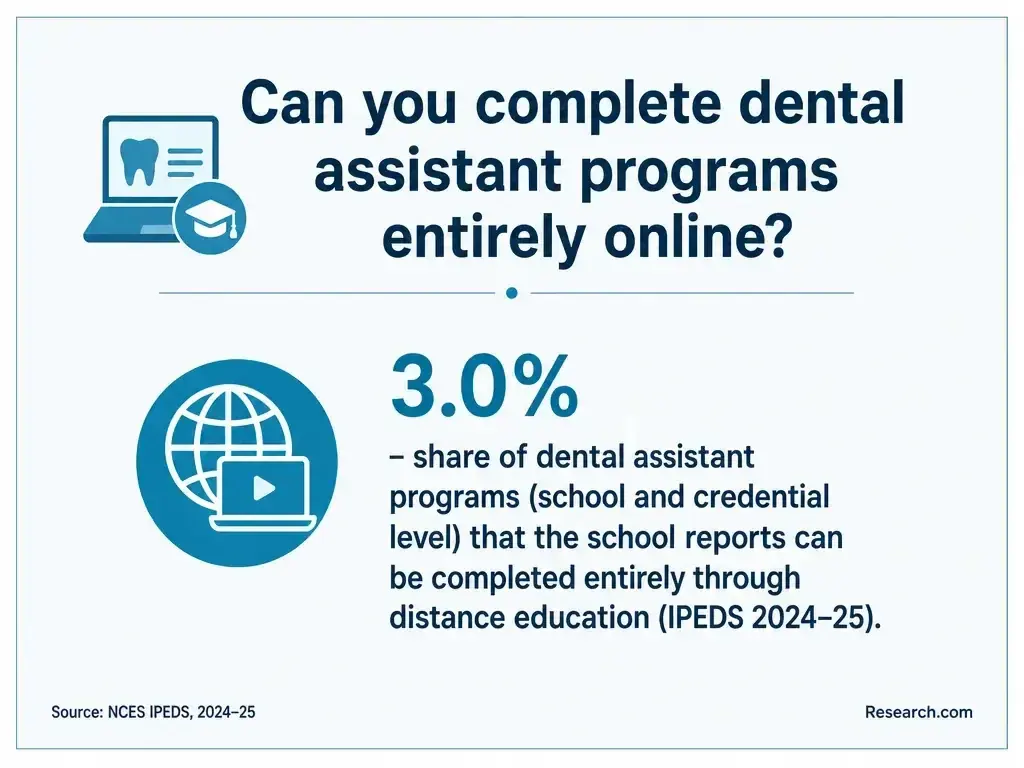
Online instruction can cover terminology, anatomy, infection-control principles, and office procedures. It cannot, by itself, demonstrate safe instrument handling, chairside technique, or patient interaction. A hybrid program is worth considering only if its in-person labs and supervised clinical work are accessible from where you live.
Ask who arranges clinical placements, where they occur, how performance is assessed, and what happens if a placement falls through. For rural students, those answers matter more than the convenience of online lectures. Do not assume an entirely online course satisfies a certifying organization's eligibility rules or Mississippi requirements for particular duties; verify both before enrolling (Dental Assisting National Board; Mississippi State Board of Dental Examiners).
There is no single reliable statewide price that covers every community-college program, private career-school program, and employer-trained route. Published tuition may exclude costs that differ substantially by provider and clinical placement. A defensible comparison uses current, itemized quotes for the same enrollment period rather than an unsupported "average."
Build a job-ready budget from each provider's figures. The categories below help expose costs that an advertised tuition price may miss:
Ask whether the specific program qualifies for federal student aid; institutional eligibility does not mean every short program qualifies (Federal Student Aid). Also ask about Mississippi workforce-training assistance through local workforce offices. For a return-on-investment comparison, consider debt, your chance of completing, current earnings, plausible post-training pay, and how long you expect to work in the field - not tuition alone. Lists of quick degrees with high pay may offer a broader comparison, but speed does not establish that dental assisting training is affordable for your circumstances.
The school credential may be a certificate, diploma, or, at a program that offers it, an associate degree. A school-issued credential documents completion of its curriculum; it is different from a professional certification. The Dental Assisting National Board's Certified Dental Assistant credential has separate eligibility and examination requirements, so ask a program which certification route its curriculum supports (Dental Assisting National Board).
Also distinguish institutional accreditation, CODA programmatic accreditation, and Mississippi authorization to perform particular duties. One does not automatically confer the others. If certification matters to an employer you hope to join, confirm the program's current CODA status, if any, and the applicable DANB eligibility pathway before paying a deposit (Commission on Dental Accreditation; Dental Assisting National Board).
Requirements vary by provider. Ask about the school's academic entry standard, application deadlines, and any health, immunization, background-check, or CPR requirements tied to clinical placement. Check whether these steps must be completed before admission or only before patient-facing work; the timing can affect your start date and total cost.
An employer-trained route has a different gatekeeper: the hiring office decides whom to train and what duties a new assistant initially performs, subject to Mississippi rules. Before accepting either route, request written confirmation of the clinical or workplace training you will receive and who supervises it. Do not mistake admission to a program for eligibility to perform every dental assisting function (Mississippi State Board of Dental Examiners).
A useful curriculum connects classroom knowledge to repeated, observed practice: preparing treatment areas, passing instruments, sterilizing equipment, recording information accurately, and communicating with patients and the dental team. Programs may teach radiography principles, but students should confirm the practical training and Mississippi conditions associated with actually performing radiographic duties (U.S. Bureau of Labor Statistics; Mississippi State Board of Dental Examiners).
Ask to see the course sequence and how many hours take place in a lab, clinic, or dental office. If two programs award similarly named certificates, favor evidence of supervised competence and a dependable placement process over a longer list of course titles. Digital records and imaging workflow may be part of office practice, making hands-on familiarity with the equipment used in placements especially valuable.
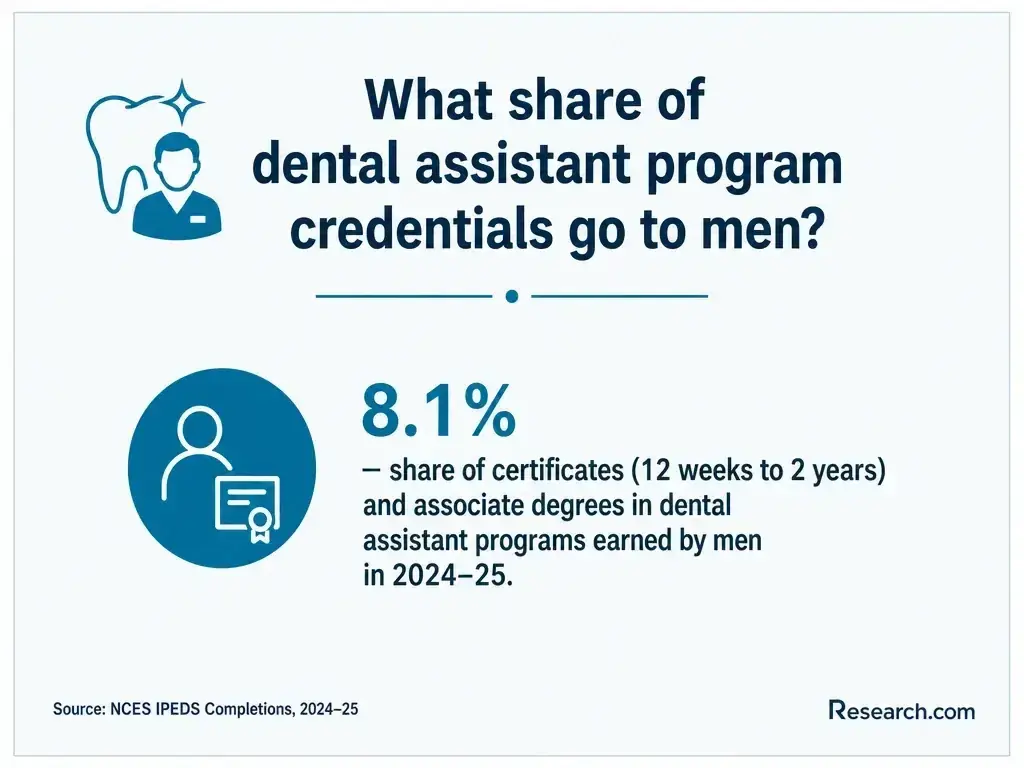
Do not treat "dental assistant" as permission to perform every dental procedure. Mississippi's rules distinguish ordinary assisting from functions with additional conditions; the Mississippi State Board of Dental Examiners is the authority to consult for the duties you want to perform. National certification from the Dental Assisting National Board is a separate credential, not a substitute for applicable state requirements (Mississippi State Board of Dental Examiners; Dental Assisting National Board).
Before choosing a school, name the duties your target employers expect - particularly radiography or expanded functions - and ask the board and the program what education, documentation, examinations, or supervision apply. Get the answer for your intended role rather than assuming that graduation, institutional accreditation, or an online course grants automatic authorization.
Start with the job you want, then compare programs on eligibility, supervised practice, and net cost. An affordable ranking narrows the search, but it does not measure every factor that determines whether you can finish training and work in your preferred office. Use the following checks when contacting schools:
A common mistake is choosing the lowest advertised tuition while overlooking clinical travel or missing certification alignment. Another is assuming a higher-priced provider has better outcomes without evidence. If you are comparing education options beyond this occupation, resources on cheapest online bachelor programs address a different investment; they should not be used to judge whether a dental assisting program provides the practical training you need.
A first role may emphasize chairside support, sterilization, and front-office coordination. With experience and any applicable additional qualifications, an assistant may seek responsibility in a specialty practice, office coordination, or training new staff. Those are possible paths, not automatic promotions; duties and pay depend on the employer and Mississippi rules (U.S. Bureau of Labor Statistics; Mississippi State Board of Dental Examiners).
If your goal is primarily patient care, prioritize clinical practice and the requirements for intended functions. If you prefer scheduling and insurance workflow, ask how much of the program addresses office operations. Further study for a different dental occupation should be evaluated as a separate pathway with separate entry requirements - not assumed to follow automatically from an assisting certificate. Likewise, lists of easy masters programs concern a different level of education and do not describe advancement within dental assisting.
The U.S. Bureau of Labor Statistics projects 7.4% growth nationally from 2025 to 2035 for dental assistants. That indicates continuing demand across the occupation, but it is not a Mississippi forecast or a promise of a local opening after graduation. For a decision tied to where you will live, check current Mississippi Department of Employment Security projections and dental-office postings within commuting distance.
Pay attention to the duties in those postings. An office seeking an assistant who can take radiographs may not view every entry-level course as equivalent. If openings near home are limited, the cost of commuting or relocating belongs in your investment calculation. Comparisons with a most affordable master's degree online serve a different career decision; local dental employers' requirements are the more relevant test here.
Education is a consequential investment, so Research.com evaluates affordable programs against other programs in the same occupation and location rather than against unrelated schools. Its most-affordable ranking considers tuition, cost of attendance, median student debt, and federal loan default rates. An entropy-based method gives more weight to cost and debt indicators that distinguish programs more clearly. Only programs reporting completions to IPEDS are eligible; a missing provider is not necessarily unapproved or poor quality.
The Research.com team uses the following sources to check education, cost, recognition, and training information relevant to its rankings:
Not every source listed applies equally to dental assisting; NCCER, for example, concerns construction training. Accreditation and other quality indicators are not part of the most-affordable score. The ranking is a cost-focused starting point, not a finding that every listed program provides the same clinical experience or eligibility for particular duties. See Research.com's methodology for more detail on how the ranking is created.
# 1 position
# 2 position
# 3 position
# 4 position

# 5 position
# 6 position
# 7 position

# 8 position
# 9 position
Compare itemized community-college and career-school quotes with any paid, supervised training offered by a dental office. The cheapest route depends on aid, travel, lost earnings, and whether it prepares you for your intended duties.
Online coursework can teach theory, but it cannot replace in-person clinical skills practice. Confirm how practical training is provided and whether the route meets any applicable certification or Mississippi duty requirements.
No. CODA accredits qualifying dental education programs; institutional accreditation applies to the school. Check each claim separately, along with certification eligibility and state rules.
No. The Dental Assisting National Board sets separate eligibility and examination requirements for its Certified Dental Assistant credential. Ask how the specific program fits an eligibility pathway.
It may be if structured labs, clinical placement, or a certification pathway provide value the office cannot offer. Compare the school's full cost and time commitment with the office's pay, supervision, and opportunities to learn permitted duties.