# 1 position
Arizona College-Mesa - Dental Assisting/Assistant.
certificate or diploma

Audited and Verified:
Our Editorial and Data Verification Process
Research.com uses government datasets, official education statistics and primary institutional information to support its career and degree guides. Our review process checks factual accuracy, occupational definitions, source dates and the requirements associated with the credentials discussed.
How This Article Was Fact-Checked
Our editorial team verifies salary estimates, employment projections, education requirements and program information against original data providers and official organizations. Salary figures are checked against the relevant occupational definitions and reporting periods. Information about licensure, accreditation and required in-person training is reviewed separately.
Fact-checked and verified on:

Co-Founder and Chief Data Scientist

Reviewed by Karolina Broda
Fact-Checker and Data Verification
Choosing dental assistant training in Mesa means comparing more than how quickly you can finish: hands-on practice, Arizona's rules for specific duties, and total cost all affect whether a program gets you job-ready. The U.S. Bureau of Labor Statistics projects 7.4% national employment growth for dental assistants from 2025 to 2035. This guide helps prospective students and career changers compare pathways, credentials, costs, and career prospects. It also features a Best Dental Assistant Trade Schools in Mesa for 2027 ranking created by the Research.com team of data scientists to help students identify programs worth considering.
A dental assistant training program prepares students to support dentists during patient care, maintain a safe treatment area, and manage clinical records. In Mesa, the central choice is between structured school training and entering a practice willing to teach basic duties on the job. School may be worth the investment if you need supervised practice before applying, a documented credential, or preparation for certification. Employer training may fit better if you can secure a position and want to avoid upfront tuition.
Programs differ in what they actually provide. The comparison below separates the credential from the practical experience; similarly named certificates should not be assumed to offer equivalent clinical preparation.
| Pathway | Typical credential or outcome | Best fit and trade-off |
| Career-school certificate or diploma | School-awarded certificate or diploma; practical experience varies by program | Suited to students seeking structured, occupation-focused training; compare clinical hours and total charges carefully. |
| Community-college certificate | College-awarded occupational certificate | Worth comparing for students who want a public-college option; scheduling, admission, and clinical placement may differ. |
| Employer-sponsored training | Work experience; a school credential is not automatic | Potentially reduces upfront cost and permits earning while learning, but instruction and access to particular duties depend on the employer and Arizona rules. |
| Registered apprenticeship, if available | Work-based training and the credential specified by its registered standards | Combines paid work and instruction; verify local availability, entry conditions, and whether its training matches dental assisting duties. |
Dental assisting is not the same occupation as dental hygiene. Training as an assistant does not itself qualify someone to practice as a hygienist or perform every procedure offered in a dental office (U.S. Bureau of Labor Statistics; Arizona State Board of Dental Examiners).
Most dental assistants work in dentists' offices, where tasks can include preparing patients, passing instruments, sterilizing equipment, and updating records. Orthodontic, pediatric, and other specialty practices may emphasize different procedures and patient interactions (U.S. Bureau of Labor Statistics). For a Mesa student, a clinical placement or employer connection in the Phoenix-Mesa area can matter more than a school's general claim of "career support": ask which duties you will practice and where students complete their experience.
Some practices hire beginners for front-office and basic clinical responsibilities and teach their workflows on the job. That route can be practical if a suitable opening is available, but it is not a substitute for meeting Arizona's separate requirements before performing regulated duties (Arizona State Board of Dental Examiners).
The national median annual wage for dental assistants was $48,070 in May 2025: half of employed assistants earned more and half earned less (U.S. Bureau of Labor Statistics). It is not a Mesa starting salary or a prediction of what a certificate holder will earn. Experience, specialty, duties, schedule, and employer affect an offer.
When estimating the value of Mesa training, request current pay ranges from practices where you could realistically commute and compare them with your present earnings. For local wage research, use the Phoenix-Mesa-Chandler metropolitan occupation data rather than treating a national figure as city-specific; check the data's reference year and remember that a metro estimate covers more than Mesa (U.S. Bureau of Labor Statistics). Students comparing short certificate programs that pay well should compare likely entry pay and training costs for the specific occupations, not national medians in isolation.
Dental assistant certificates and diplomas commonly take months rather than years, but a short advertised calendar is not a reliable measure of readiness. Schedules differ in classroom instruction, lab practice, externships, and part-time availability; an employer-trained assistant instead learns while working. There is no single clock-hour requirement for all basic dental assistant training in Arizona. Requirements for particular regulated functions are a separate question (Arizona State Board of Dental Examiners).
Ask each provider for its published total clock or contact hours, the portion spent practicing on mannequins versus patients, any required externship hours, and who arranges the site. An accelerated schedule makes sense if you can attend consistently and complete the practical component without sacrificing paid work you need; part-time study may have a lower opportunity cost even when it takes longer.
Online coursework can cover topics such as terminology, anatomy, infection-control principles, and office procedures. It cannot replace supervised practice in instrument transfer, sterilization, patient positioning, or other chairside tasks. A hybrid program may combine remote lessons with scheduled Mesa-area labs and an externship; an on-campus program typically brings students to labs more regularly. Neither format alone establishes eligibility to perform a regulated Arizona duty (Arizona State Board of Dental Examiners).
Ask where in-person sessions occur, whether externship placements are arranged near you, and what happens if a placement is delayed. This distinction matters especially for adults returning to study: a search for best online degrees for seniors addresses a different educational goal than hands-on dental assistant training. Likewise, an entirely online dental course should not be treated as equivalent to supervised clinical preparation.
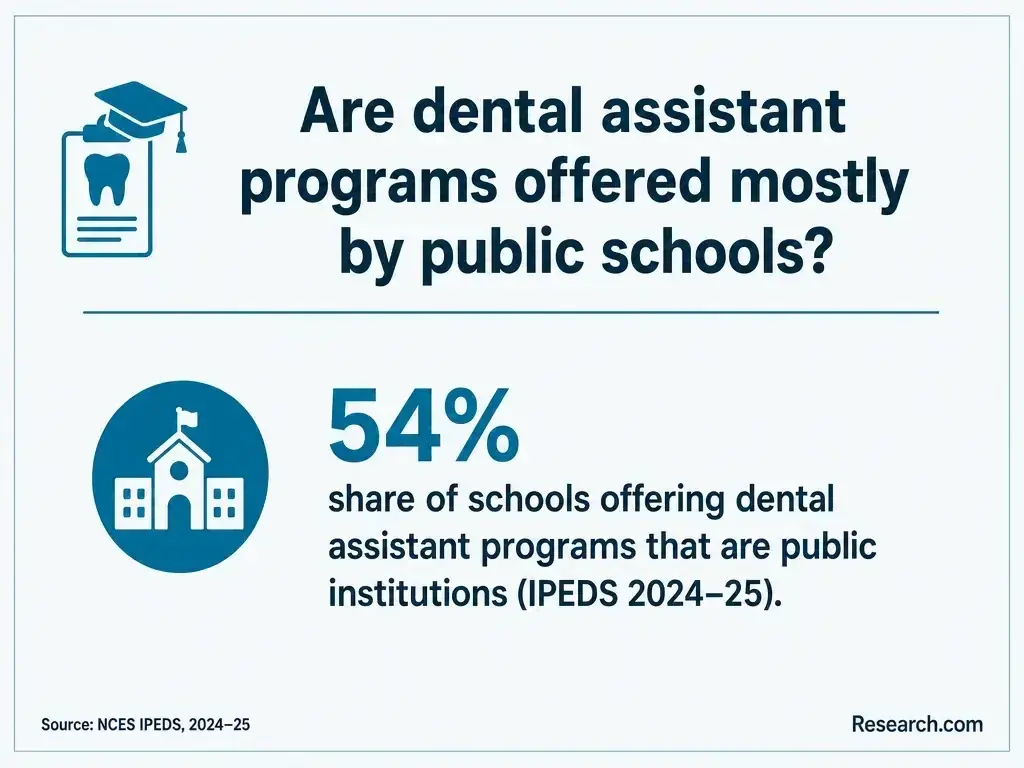
There is no defensible single "average Mesa cost" without comparable, current prices for the same credential and included services. A quoted tuition figure may exclude registration and lab fees, textbooks, scrubs, protective equipment, immunizations or health screening required by a placement site, transportation, and optional certification exams. Request an itemized, current cost of attendance from each program and mark which charges are mandatory.
The more useful comparison is total cost to become job-ready, including lost earnings while attending classes or an unpaid externship, minus grants, scholarships, eligible aid, or wages earned in employer training. Federal aid depends on the school and program's eligibility, not simply whether a school calls itself accredited (Federal Student Aid). If you are also weighing a longer college pathway, how much does it cost to get an associates degree is a separate cost question; do not use that price as a proxy for a dental assistant certificate.
To judge return on investment, consider your current pay, likely post-training offers, completion probability, borrowing and interest, time out of work, and how long you expect to work in the role. A cheaper program with little supervised practice can be poor value; a higher-priced one is not automatically better.
A trade-school graduate generally earns the certificate or diploma named by the specific program. That school credential is distinct from a professional certification issued after meeting an organization's eligibility rules and passing its examinations. For example, the Dental Assisting National Board (DANB) administers Certified Dental Assistant certification, with eligibility pathways and exam requirements that applicants must check directly with DANB. A school certificate does not automatically confer DANB certification.
CODA programmatic accreditation, an institution's accreditation, Arizona school authorization, and professional certification answer different questions. CODA recognition can matter for certain certification eligibility pathways; institutional accreditation concerns the school; state authorization concerns permission to operate; and none alone grants permission to perform every dental assisting function in Arizona (CODA; DANB; Arizona State Board of Dental Examiners). Ask a program to identify its exact credential and show, in writing, which certification or state duty-specific requirements its curriculum supports.
Admission rules vary by provider. Schools may ask for proof of prior schooling, an application, immunization or health documentation for clinical placement, and the ability to attend scheduled labs or externships. A dental practice hiring an entry-level assistant may set different employment requirements. Confirm these directly rather than assuming every Mesa program has the same age, testing, or background-check policy.
Before enrolling, ask when all requirements must be met - not just what is needed to start class. A student who can enter a program but cannot attend its clinical site or meet a planned certification pathway may face delays and additional costs. If you have previous relevant training, ask whether the provider awards documented prior-learning or transfer credit without waiving required practical competencies.
Useful dental assistant training connects classroom knowledge to safe, repeated clinical practice. Core subjects can include dental terminology and anatomy, infection prevention, instrument preparation and transfer, patient communication, records, scheduling, and the boundaries of an assistant's role. Radiography instruction is especially important to evaluate against Arizona's requirements for the duties you intend to perform (U.S. Bureau of Labor Statistics; Arizona State Board of Dental Examiners).
Look beyond a topic list. Ask whether students demonstrate sterilization and chairside skills in a supervised lab, whether an externship involves patient-facing work, and how competency is assessed. Current dental offices also rely on digital records and imaging workflows; familiarity is useful, but operating equipment or performing a task remains subject to applicable supervision and state rules.
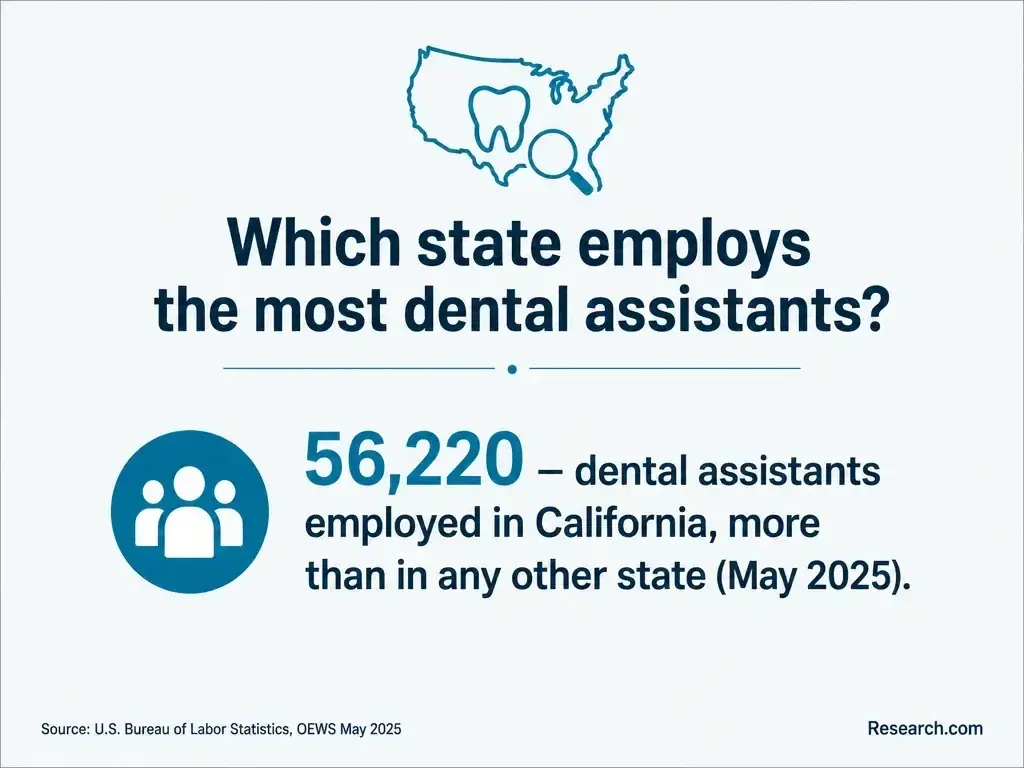
No general dental assistant occupational license is required to begin basic assisting in Arizona. That does not mean every assistant may perform every task. Arizona sets separate requirements for certain functions, including dental radiography and other expanded duties; the applicable authorization, training, examination, and supervision depend on the function (Arizona State Board of Dental Examiners). National certification is also distinct from state permission to perform a particular duty (DANB; Arizona State Board of Dental Examiners).
Before choosing a program, identify the duties in the jobs you want, then verify the current requirements with the Arizona State Board of Dental Examiners. Ask the school to specify which of those requirements its training satisfies and which exams or applications remain your responsibility. Avoid a claim that graduation alone makes you "fully licensed" as a dental assistant.
The best program is the one that provides the practical training and eligibility needed for your intended role at a cost you can sustain. A ranking can narrow the search, but it cannot tell you whether an individual externship schedule fits your work hours or whether a particular curriculum prepares you for your target duties. If you are considering Arizona College-Mesa, Pima Medical Institute-Mesa, Carrington College-Mesa, or UEI College-Mesa, verify current program offerings and terms directly rather than assuming every campus offers the same credential.
Use these checks when speaking with admissions staff and, where possible, recent graduates:
A common mistake is choosing the fastest or lowest-tuition offer without checking patient-care practice and regulatory fit. Another is comparing unlike goals: searches for quick high paying degrees do not establish the earnings or entry requirements of dental assisting. Select the route that matches the job, not the marketing label.
Training can lead to entry-level chairside assisting, followed by deeper experience in general dentistry or a specialty practice. Some assistants move toward practice coordination, patient scheduling, or office management; others pursue additional certification or Arizona-required qualifications for specific clinical duties. Those later steps are not automatic outcomes of an entry certificate (U.S. Bureau of Labor Statistics; DANB; Arizona State Board of Dental Examiners).
If your goal is primarily remote administrative work, dental assisting may be a poor fit because its core patient-care tasks are in person. Someone exploring bachelor's degree online cheap is considering a different kind of pathway, not a substitute credential for chairside practice. If your goal is to enter a dental office quickly, compare a hands-on program with employers willing to train beginners before paying for a credential.
The U.S. Bureau of Labor Statistics projects dental assistant employment to grow 7.4% nationally from 2025 to 2035. This supports considering the occupation, but it is not a Mesa hiring forecast or a guarantee of a job after graduation. Openings can depend on turnover as well as growth, and a student's prospects depend on practical skills, available schedules, and the duties local employers need.
For a local reality check, review current Phoenix-Mesa-area postings before enrolling: note which employers train beginners, ask for radiography-related qualifications, or require experience. Recheck those requirements near graduation. A program is a stronger investment when its supervised practice matches the jobs you could realistically take and its total cost makes sense against likely entry-level offers.
Investing in training is a consequential decision, so the Research.com team built the ranking to compare dental assistant programs with other programs in the same occupation and location - not with unrelated schools. Only programs reporting completions to the Integrated Postsecondary Education Data System (IPEDS) are eligible. That makes the comparison more consistent, but it also means an unlisted employer-training route or provider is not necessarily unapproved or low quality.
For the best-programs ranking, Research.com evaluates student outcomes; earnings and return on investment; costs and debt; and quality and recognition. Measures include completion and full- and part-time retention, median earnings one year after completion, earnings relative to annual attendance cost, tuition, attendance cost, median debt including debt held by students who withdrew, federal loan default rate, relevant accreditation or industry recognition, and student support. Relevant programmatic accreditation or industry recognition accounts for 20% of the score, institutional accreditation for 10%, and student support for 10%. Outcomes, earnings, and costs share the remaining 60%, weighted by an entropy-based method that gives more weight to indicators that vary more across programs.
Most-affordable-program rankings use only tuition, attendance cost, median student debt, and federal loan default rate, with entropy-based weights; accreditation and other quality measures are not part of that affordability score. To check coverage, outcomes, recognition, and occupational relevance, the team used these sources:
These checks help readers compare reported results without mistaking a ranking for a guarantee of employment or Arizona authorization to perform specific duties. For more detail on how the rankings are created, see Research.com's methodology.
# 1 position
# 2 position
# 3 position
# 4 position

Yes. An employer may train someone for basic assisting duties. Check Arizona's separate requirements before performing regulated functions, and compare the employer's training with a school's supervised practice (Arizona State Board of Dental Examiners).
No. A certificate or diploma is awarded by a training provider; DANB certification has its own eligibility and examination requirements (DANB).
Theory may be offered online, but chairside and infection-control skills need supervised practical training. Verify where labs and any externship take place.
Ask which Arizona requirement its radiography instruction addresses and what exam, application, or other step remains after completion. Confirm the answer with the Arizona State Board of Dental Examiners.
Not necessarily. Compare mandatory charges, practical hours, placement arrangements, completion outcomes, aid, and lost earnings - not tuition alone.
No. This ranking includes programs with completions reported to IPEDS; employer training and other routes may not appear. Their absence is not a quality judgment.


