# 1 position
Northwest Career College - Dental Assisting/Assistant.
certificate or diploma

Audited and Verified:
Our Editorial and Data Verification Process
Research.com uses government datasets, official education statistics and primary institutional information to support its career and degree guides. Our review process checks factual accuracy, occupational definitions, source dates and the requirements associated with the credentials discussed.
How This Article Was Fact-Checked
Our editorial team verifies salary estimates, employment projections, education requirements and program information against original data providers and official organizations. Salary figures are checked against the relevant occupational definitions and reporting periods. Information about licensure, accreditation and required in-person training is reviewed separately.
Fact-checked and verified on:

Co-Founder and Chief Data Scientist

Reviewed by Karolina Broda
Fact-Checker and Data Verification
Choosing dental assistant training in Las Vegas means weighing more than speed: you need chairside practice, an affordable route into work, and a credential employers recognize. The U.S. Bureau of Labor Statistics projects 7.4% national employment growth for dental assistants from 2025 to 2035, making the choice timely without guaranteeing a local job. The Research.com team of data scientists created the Best Dental Assistant Trade Schools in Las Vegas for 2027 ranking to help you identify programs worth considering. This guide explains how to compare their training, costs, credentials, and career fit.
Expect instruction in infection prevention, dental instruments, patient preparation, chairside assistance, and office procedures, followed by opportunities to practice those tasks. The practical component matters: watching a demonstration is not the same as positioning equipment, maintaining a clean field, or communicating with a patient under supervision.
Las Vegas-area choices may include a public-college program, a private career-school program, or hiring into a dental office that trains new assistants on the job. For example, compare current offerings at the College of Southern Nevada with those at Northwest Career College, Pima Medical Institute-Las Vegas, Carrington College-Las Vegas, and United Education Institute-Las Vegas; do not assume every campus offers the same credential or schedule. An employer-trained route may reduce upfront school costs but provide less structured instruction or fewer portable records of completed skills. Ask offices whether they hire beginners and how they document training.
A school program is most useful when you want structured practice before applying for chairside roles. If you already have an office willing to train you, compare its supervision and pay with the time and expense of enrolling. If your real goal is a different occupation, consider other quick schooling for good paying jobs before committing to dental-assisting training.
Dental offices are the principal workplace for dental assistants nationally (U.S. Bureau of Labor Statistics). In the Las Vegas area, that can mean general dentistry or practices focused on orthodontics, oral surgery, pediatric care, or other specialties. Duties differ: one office may emphasize chairside assistance, while another combines it with scheduling, records, and patient communication.
Ask a prospective program where its recent students completed practical training and what tasks they performed. A placement in an office that lets students observe but rarely assist may be less useful for a chairside job search than supervised, documented practice. Neither a placement nor graduation guarantees employment.
The U.S. Bureau of Labor Statistics reports a May 2025 national median annual wage of $48,070 for dental assistants. That is the midpoint among employed workers nationwide, not a Las Vegas wage and not what a newly trained assistant should expect to earn. Experience, duties, hours, and employer can change an individual offer.
For a local decision, compare current Las Vegas-area job postings and actual offers using the same hours and benefits assumptions. Then set the likely change from your present earnings against the program's full cost, any debt, and time away from paid work. A short program can still be a poor investment if its price is high relative to the job you can realistically obtain. If earnings are your primary reason for changing occupations, compare good majors that pay well as a separate career decision rather than treating the dental-assistant median as a guaranteed outcome.
There is no single Nevada-wide program length or universal clock-hour requirement for every route into dental assisting. A school's calendar may cover classroom instruction, lab sessions, and an externship; an office that hires beginners may train them while they work. Part-time schedules can extend the calendar time even when the instructional content is similar.
Ask each provider for its current total clock or credit hours, the hours devoted to hands-on labs, any required externship hours, and the earliest realistic completion date for your schedule. Confirm whether externship hours are arranged by the school or left to you. Compare time to job-readiness - not just the advertised number of weeks - especially if commuting across the Las Vegas Valley or reducing work hours would add costs.
Online delivery can suit subjects such as terminology, records, and introductory concepts. It cannot by itself demonstrate safe chairside technique, instrument handling, or patient interaction. A hybrid program may be workable if its local labs and supervised practice fit your schedule; an entirely remote course should not be assumed to provide the preparation an employer or certifying body expects.
Before enrolling from Las Vegas, find out exactly where practical sessions occur, who supervises them, and whether travel or externship arrangements are your responsibility. On-campus training may make access to equipment simpler, while hybrid study may reduce routine trips but still require travel at fixed times. Neither format is automatically better: compare the actual skills you will practice and document.
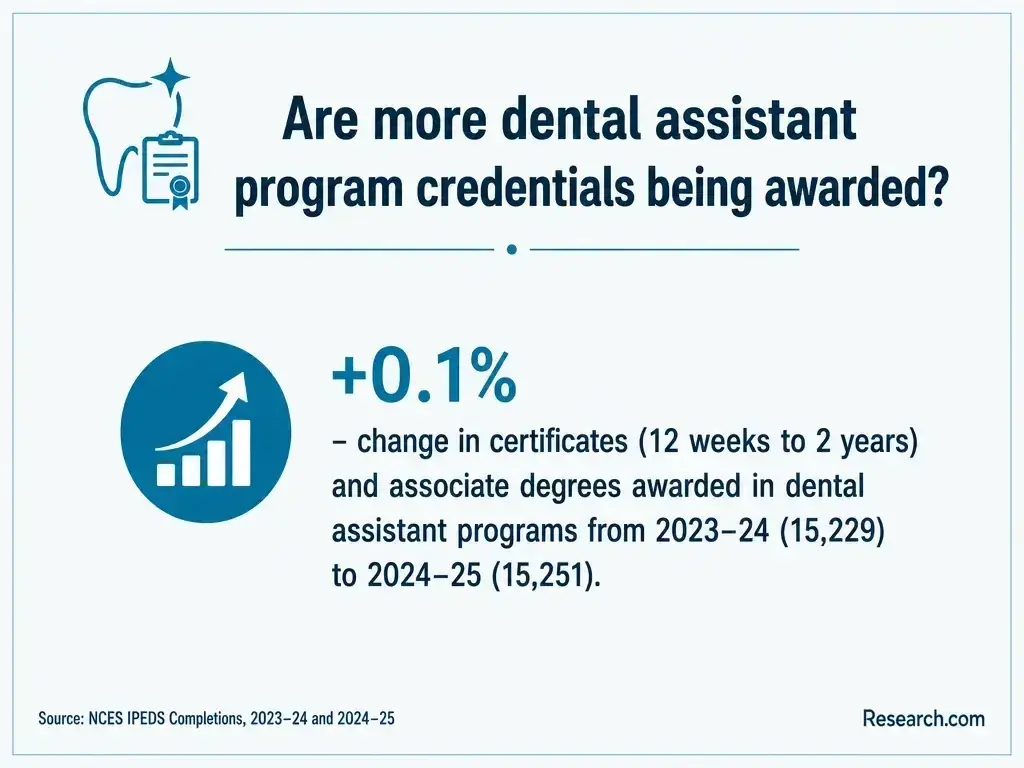
There is no reliable single average that represents every Las Vegas school program and employer-training route. Published tuition can also omit costs needed to become job-ready. Request an itemized, current quote from each provider rather than using an advertised price as your comparison.
These cost categories help you compare offers on the same basis:
Federal aid depends on both student and program eligibility; do not assume every short course qualifies (Federal Student Aid). Compare the net cost with realistic local pay, your probability of finishing, and how long you expect to work in the role. If you are also considering a national accredited college, remember that institutional accreditation alone does not establish the price or suitability of a dental-assisting program.
A provider may award a certificate or diploma; a college may offer a longer academic credential. The exact award depends on the program, and similarly named credentials need not include the same lab work or supervised experience. Employer training may instead produce documented work experience without a school credential.
A completion credential is different from professional certification. The Dental Assisting National Board administers certifications with their own eligibility requirements; completing any particular Las Vegas program does not automatically confer one (Dental Assisting National Board). Likewise, institutional accreditation concerns the school, while Commission on Dental Accreditation status concerns a qualifying dental program. Check the specific program and the certification route you intend to use, rather than treating these forms of recognition as interchangeable (Commission on Dental Accreditation; Dental Assisting National Board).
Requirements vary by provider and by the activities involved in practical training. Schools may ask for proof of prior schooling, an application, and documents needed for placement in a dental setting. An employer hiring an entry-level assistant sets its own hiring criteria. Ask for the written requirements before paying an application or enrollment fee; do not assume that admission also secures an externship.
If you have prior healthcare training or dental-office experience, ask whether the school grants credit or advanced standing and what evidence it requires. Also ask whether any waived coursework would affect practical-training records or your intended certification pathway. For workers changing careers later in life, scheduling and prior experience may matter more than an advertised accelerated finish; best degrees for older adults online addresses a different education route and should not be mistaken for chairside training.
Training typically connects dental anatomy and terminology with infection control, instrument preparation, chairside procedures, patient communication, and administrative workflow (U.S. Bureau of Labor Statistics). Ask to see how students practice each skill and how instructors assess it. Current dental offices also use digital records and imaging workflows, so familiarity with the equipment and software used during training can affect how quickly a new hire adapts.
Radiography and other specific duties deserve a separate check: instruction in a topic does not establish permission to perform every task in a Nevada office. Match the curriculum and any supervised practice to the duties in the jobs you want, then verify the applicable Nevada rules before relying on a school's marketing description (Nevada State Board of Dental Examiners).
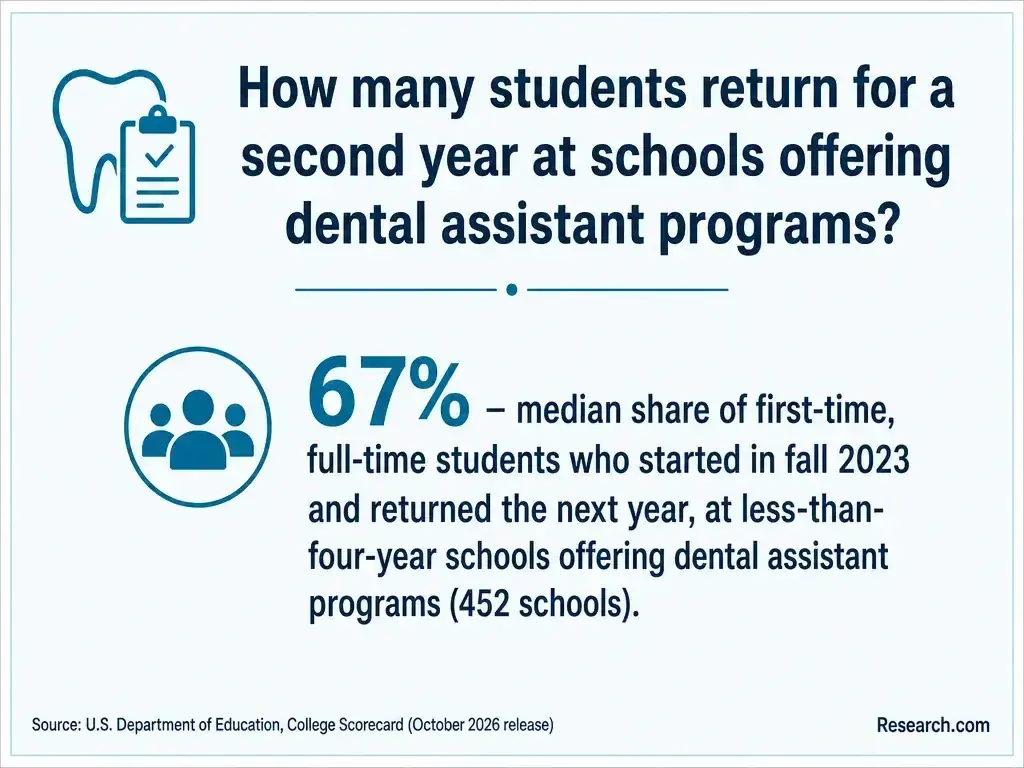
Nevada does not issue a general occupational license simply to work as a dental assistant, but state rules govern which duties an assistant may perform and under what conditions (Nevada State Board of Dental Examiners). That distinction matters when a job involves particular expanded duties: being hired as an assistant does not authorize every procedure.
National certification is a separate credential, not a substitute for Nevada's rules. Before choosing a program, check the Nevada State Board of Dental Examiners' current duty requirements and the Dental Assisting National Board's eligibility rules for any certification you want. Ask the school to identify - in writing - which requirements its instruction satisfies and which would still require an exam, additional training, or experience. A school's state authorization, institutional accreditation, and programmatic accreditation answer different questions; none alone grants occupational permission (Nevada State Board of Dental Examiners; Dental Assisting National Board).
Start with the job you want, then test each program against its requirements. The best-value choice is the one that provides usable practical training and a suitable credential at a cost and pace you can manage - not necessarily the shortest course or highest-ranked school. Compare a public-college option, career-school options, and any credible employer-training offer using the same questions.
Get written answers before you enroll:
Red flags include an unexplained "online-only" practical component, a price that excludes required items, or a claim that accreditation guarantees certification or a job. Rankings are a useful shortlist, not a substitute for verifying the current campus offering. If chairside work is not your goal, explore a different route - including a fast track bachelor's degree online - rather than buying training for the wrong occupation.
The direct entry path is a dental-assistant role, with experience potentially opening opportunities in specialty practices or office coordination. Assistants can build expertise in patient flow, imaging-related workflows where permitted, or front-office systems. An employer may value additional certification, but it should be considered alongside experience and the actual duties of the position (U.S. Bureau of Labor Statistics; Dental Assisting National Board).
Do not confuse progression within dental assisting with automatic entry to another regulated dental occupation. If you hope to change roles later, ask a provider what credit, if any, your training could receive elsewhere; get the answer from the receiving program rather than assuming a certificate transfers.
The U.S. Bureau of Labor Statistics projects 7.4% growth in dental-assistant employment nationwide from 2025 to 2035. This indicates national demand for the occupation, not the number of Las Vegas openings or the likelihood that one graduate will be hired.
For a local read, review recent Las Vegas-area postings for entry-level experience requirements, preferred credentials, schedules, and duties. Compare those patterns with each program's practical training and any documented employer relationships. If the openings you want routinely request skills a course does not teach, a faster graduation date may not improve your prospects.
Education is a significant investment, so the Research.com team built the ranking to help readers compare dental assistant programs with other options in the same occupation and location. The team evaluates reported outcomes, costs, and recognition using multiple sources. Only programs with completions reported to IPEDS are eligible; an unlisted training provider may still be a legitimate option.
For best-program rankings, student outcomes include completion and full-time and part-time retention. Earnings and return-on-investment measures include median earnings one year after completion and earnings relative to annual attendance cost. Costs and debt include tuition, attendance cost, median debt - including for students who withdrew - and federal loan default rates. Quality measures include relevant programmatic accreditation or industry recognition, institutional accreditation, and student support.
Relevant programmatic accreditation or industry recognition receives 20% of the score, institutional accreditation 10%, and student support 10%. The remaining 60% covers outcomes, earnings, and costs, with weights assigned through an entropy-based method that gives more weight to indicators that vary more across programs. Most-affordable-program rankings instead score only tuition, attendance cost, median debt, and federal loan default rate using that method; accreditation and other quality measures do not enter that score.
The ranking draws on the following sources. Some support broad data checks or comparisons across trades rather than dental-assisting accreditation specifically:
Use the ranking to narrow your options, then confirm current program details directly: a score cannot establish that a particular schedule, clinical placement, price, or certification pathway meets your needs. Research.com explains its broader approach on its methodology page.
# 1 position
# 2 position
# 3 position
# 4 position

# 5 position
# 6 position

Potentially. Some dental offices hire beginners and train them at work. Compare the supervision, documented skills, pay while learning, and Nevada duty rules with what a school program provides (Nevada State Board of Dental Examiners).
No. A school certificate documents program completion. National certification has separate eligibility and examination requirements set by the certifying organization (Dental Assisting National Board).
Online study can cover some academic subjects, but chairside skills require in-person practice. Check where a program provides labs and supervised experience before enrolling.
Not necessarily. Compare the full job-ready cost, practical training, completion prospects, and likely earnings - not tuition alone. Employer-paid training may be worth considering if it offers adequate supervision.
No. Nevada rules govern permitted duties, and a school credential does not override them. Verify requirements for the specific tasks you want to perform with the Nevada State Board of Dental Examiners.