# 1 position

Audited and Verified:
Our Editorial and Data Verification Process
Research.com uses government datasets, official education statistics and primary institutional information to support its career and degree guides. Our review process checks factual accuracy, occupational definitions, source dates and the requirements associated with the credentials discussed.
How This Article Was Fact-Checked
Our editorial team verifies salary estimates, employment projections, education requirements and program information against original data providers and official organizations. Salary figures are checked against the relevant occupational definitions and reporting periods. Information about licensure, accreditation and required in-person training is reviewed separately.
Fact-checked and verified on:

Co-Founder and Chief Data Scientist

Reviewed by Karolina Broda
Fact-Checker and Data Verification
Choosing dental assistant training in Pasadena means looking beyond program length: the right option must teach hands-on skills and support the California duties you want to perform. The U.S. Bureau of Labor Statistics projects 7.4% national employment growth for dental assistants from 2025 to 2035, making training quality worth examining. The Research.com team of data scientists created the Best Dental Assistant Trade Schools in Pasadena for 2027 ranking to help students identify programs worth considering. This guide explains costs, credentials, state rules, and career prospects so you can make an informed choice.
Expect a combination of classroom instruction, practice with dental equipment, and preparation for patient-facing work. Dental assistants commonly prepare treatment rooms, sterilize instruments, assist chairside, document care, and help with scheduling or billing; the procedures they may perform depend on state rules and training (U.S. Bureau of Labor Statistics; Dental Board of California).
A Pasadena-area certificate program may be a good fit if you want structured practice and a defined schedule. Pasadena City College is a public-college option to investigate; compare its current dental-assisting curriculum and clinical arrangements with any other training route before applying. A dental office may also train an entry-level assistant on the job. That route can reduce upfront school costs, but you should ask who teaches infection control, how practice is supervised, and who pays for courses required before particular duties. Do not assume an employer training position is a registered apprenticeship.
General dental practices are the most direct entry point. Depending on training and employer needs, assistants may also work in orthodontic, pediatric, oral-surgery, or other specialty practices, as well as larger dental clinics. Employers differ in how they divide chairside, sterilization, radiography, and front-office work (U.S. Bureau of Labor Statistics).
Pasadena students need not limit a job search to city boundaries: commuting across the Los Angeles area may expand opportunities, but it also changes transportation costs and shift feasibility. If you want a specialty office, ask prospective programs whether their clinical placements expose students to that setting. A placement opportunity is useful evidence of experience, not a job guarantee.
The national median annual wage for dental assistants was $48,070 in May 2025 (U.S. Bureau of Labor Statistics, Occupational Outlook Handbook). Half of employed dental assistants nationally earned more and half earned less. This is a benchmark for considering training costs, not a Pasadena wage or a prediction of what a new graduate will earn.
For a local offer, compare hourly pay, expected hours, benefits, commute expense, and whether the employer pays for required courses or exams. Ask schools for recent, occupation-specific graduate outcomes, including the number of graduates represented and when earnings were measured. A reported wage without those details is weak evidence for estimating your return.
Dental assistant training can range from short entry-level coursework and employer-led instruction to a longer, structured certificate program. The useful comparison is not the advertised calendar length alone: ask for total instructional hours, supervised clinical hours, weekly attendance, and the date you could realistically begin work. A part-time schedule may protect current earnings but extend the time until completion.
California training requirements depend on the duty or credential sought, so there is no single clock-hour requirement for every entry-level dental assistant route. Request a written curriculum map showing which courses address the California duties you intend to perform and whether any prior learning receives credit. A search for what is the easiest bachelor degree addresses a different educational decision; for dental assisting, supervised skills and state eligibility matter more than the quickest credential name.
Terminology, dental records, and some safety instruction can be studied remotely. Instrument handling, infection-control technique, chairside assistance, and other practical competencies require in-person practice and assessment. A hybrid schedule can reduce trips for lectures, but it cannot remove the need to reach a lab or clinical site. Online coursework alone does not establish California authorization to perform restricted duties (Dental Board of California).
When comparing programs marketed among the most popular trade schools online, check where practical sessions occur and who arranges them. For a Pasadena commuter, a nearby, scheduled lab may be more usable than a flexible online course with an unresolved placement requirement.
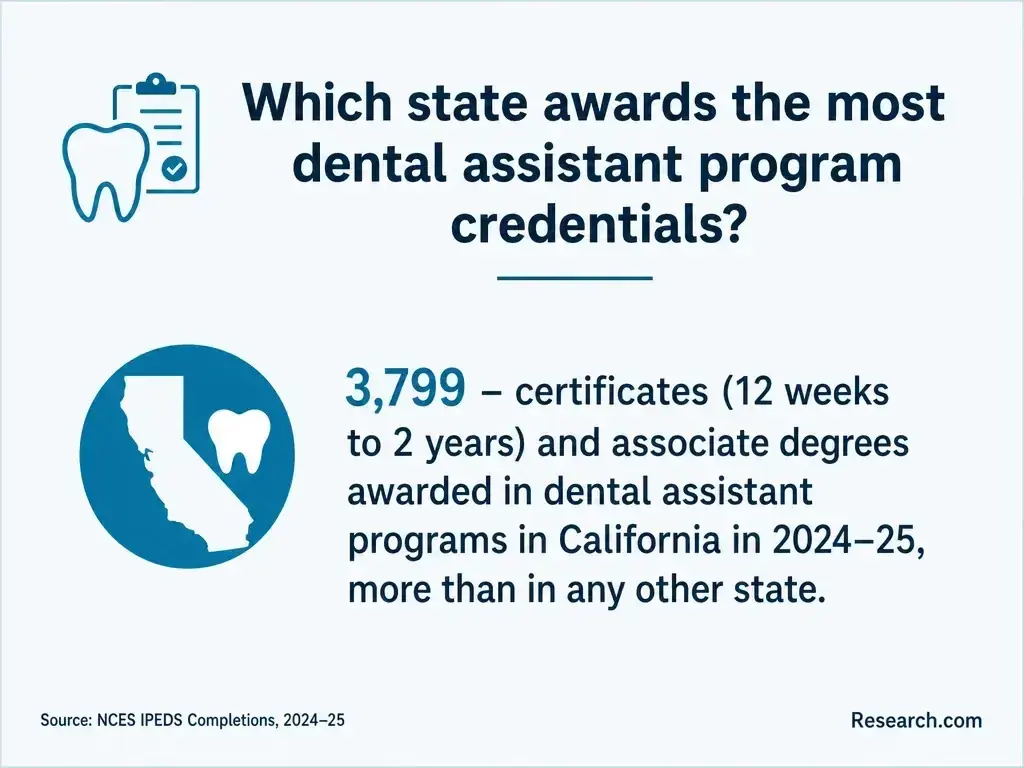
There is no reliable single Pasadena average that covers public programs, private career training, and employer-led routes on the same basis. Obtain a current, itemized quote instead. California community colleges generally charge eligible California residents a state-set enrollment fee of $46 per unit, but that figure is not the complete price of a dental-assisting program; residency, campus charges, supplies, and other expenses matter (California Community Colleges Chancellor's Office).
Use the same cost categories for every option so a low advertised tuition does not conceal a higher job-entry cost:
Ask about eligible federal or state aid, grants, and employer-paid training before borrowing; eligibility depends on the student and program (Federal Student Aid; California Community Colleges Chancellor's Office). Research on cheapest phd programs in usa uses a different cost and career framework. For dental assisting, compare the amount you must spend or borrow with your likely completion date and realistic entry-level earnings - not tuition alone.
Depending on the provider and pathway, you may earn a certificate, diploma, or associate degree, or complete employer training without an academic credential. The credential printed by a school is distinct from California's Registered Dental Assistant (RDA) status and from voluntary national certification. Ask for the exact award name and a written explanation of what it enables you to pursue next (Dental Board of California; Dental Assisting National Board).
A longer program makes sense when its supervised training and curriculum support your intended responsibilities and the additional time and expense are manageable. A shorter route may suit someone seeking an entry-level office role, especially with an employer willing to provide documented training. Neither a longer credential nor a similarly named certificate should be assumed to confer the same practical experience or state eligibility.
Requirements vary by provider. Ask whether admission calls for a high school diploma or equivalent, prerequisite coursework, an application deadline, or a separate selection process for the clinical portion. A clinical site may also impose health, safety, or background requirements; confirm these before paying a deposit. Pasadena City College and any other provider should be asked for current written requirements rather than relying on a general admissions page.
If you are already employed in a dental office, ask whether documented work experience changes placement or course requirements. Credit for prior learning is a school policy; it does not, by itself, waive Dental Board of California requirements for a restricted duty or RDA application.
A useful curriculum develops infection prevention, instrument processing, dental anatomy and terminology, chairside workflow, patient communication, and accurate records. It should also identify which radiography or other expanded-duty topics involve separate California requirements. Practicing a task in class is not the same as being authorized to perform it at work (Dental Board of California; U.S. Bureau of Labor Statistics).
Ask to see the lab schedule and how students are evaluated with real equipment. Also check whether supervised clinical experience is guaranteed, arranged by the school, or left to students to find. That distinction can determine whether an apparently convenient program is practical for someone balancing work and a Pasadena-area commute.
Not for every entry-level dental assistant role. California permits dental assistants to perform specified duties under required supervision, while radiography and certain other procedures have separate training requirements. RDA is a state registration with its own eligibility and examination rules. Check the Dental Board of California's current duty lists and application instructions against the work you want to do; completing a school program does not automatically grant registration or authority for every procedure (Dental Board of California).
Keep the distinctions clear: school authorization concerns whether a provider may operate; institutional accreditation concerns the institution; CODA accreditation concerns a dental program; state approval and rules affect California eligibility; and Dental Assisting National Board certification is a separate professional credential. None substitutes automatically for another. Before enrolling, ask the program to document its current CODA status, any relevant California board approval, and precisely how graduates meet each requirement they claim to support (Commission on Dental Accreditation; Dental Board of California; Dental Assisting National Board).
Start with your target job: entry-level chairside assisting, a role involving a particular regulated duty, or an eventual RDA application. Then compare programs on evidence of hands-on competence, eligibility, affordability, and a schedule you can finish. A ranking is a shortlist tool, not proof that a program meets your individual goal.
Use these questions when speaking with an admissions representative and, where possible, a clinical coordinator:
Verify answers with the Dental Board of California and the relevant accreditor, not just a recruiter. The mistake to avoid is treating an attractive price, fast finish, or online label as evidence of clinical readiness. Lists of top ranked online universities serve a different comparison; for this occupation, local practical access and California eligibility deserve priority.
A common progression begins with supervised chairside and sterilization work, followed by greater responsibility as an assistant gains experience and completes training for permitted duties. Some assistants move into specialty practices or take on scheduling and practice-coordination responsibilities. RDA is a distinct California credential to plan for, not an automatic promotion after a set time at work (Dental Board of California; U.S. Bureau of Labor Statistics).
Choose training for the role you actually want. If an entry-level office will provide structured paid instruction, a costly program may offer limited additional value; if you need a defined clinical placement and a pathway toward RDA eligibility, structured school training may be worth more. Articles about college degrees with best job outlook examine different career investments and should not replace a comparison of dental-assisting duties, costs, and credentials.
U.S. dental assistant employment is projected to grow 7.4% from 2025 to 2035 (U.S. Bureau of Labor Statistics, Employment Projections). That national projection suggests continuing opportunities, but it does not measure openings in Pasadena or guarantee placement for a graduate.
For a local decision, compare current openings within a commute you would accept and note their requested experience, schedule, and California-specific duties. That exercise helps test whether a program's clinical training matches the jobs you could realistically take. It also matters for return on investment: weigh total cost and debt against completion probability, time out of work, your current earnings, plausible post-training pay, and how long you expect to work in the role.
Investing in training is a consequential decision. Research.com created this ranking to help readers compare dental assistant programs with other options in the same occupation and location, rather than with unrelated schools. The team evaluates reported outcomes, costs, and relevant quality indicators; only programs with completions reported to IPEDS are eligible. That limit means an employer training route or other provider absent from the ranking is not necessarily unavailable or low quality.
For best-program rankings, student outcomes, earnings, and costs account for 60% of the score, with weights distributed through an entropy-based method that gives more weight to indicators that differ across programs. Occupation-relevant programmatic accreditation or industry recognition accounts for 20%, institutional accreditation for 10%, and student support services for 10%. Measures include completion and full- and part-time retention; earnings one year after completion relative to annual attendance cost; tuition, attendance cost, debt - including debt held by students who withdrew - and federal loan default rates. Most-affordable rankings instead score only cost and debt measures, using entropy-based weights; accreditation and other quality indicators are not part of that score.
The team uses the following sources to check education data and relevant recognition. Some sources cover other trades or broader health education; their inclusion does not make them a dental-assisting accreditor or California licensing authority.
The ranking can narrow a shortlist, but it cannot establish your eligibility to perform a particular California dental procedure. Verify current program details and Dental Board of California requirements before enrolling. More detail on the ranking process is available in Research.com's methodology.
# 1 position
# 2 position
Yes, an employer may train someone for an entry-level California dental assistant role. Ask how training is supervised and which additional courses are needed before performing specific duties (Dental Board of California).
No. RDA is a separate California registration. Check the Dental Board of California's current eligibility and examination requirements for your training route.
Online coursework can cover some theory, but chairside and other practical skills require in-person training. Confirm where labs or clinical experience occur and whether the program supports your intended California duties.
No. Compare its current program with other eligible training routes, including employer instruction. Judge each by practical experience, total cost, schedule, and the credential or eligibility it supports.
Request an itemized total cost, curriculum and clinical-hour details, current approval or accreditation information, and a written explanation of the California duties or RDA pathway the program supports.