# 1 position
Pima Medical Institute-San Marcos - Dental Assisting/Assistant.
certificate or diploma

Audited and Verified:
Our Editorial and Data Verification Process
Research.com uses government datasets, official education statistics and primary institutional information to support its career and degree guides. Our review process checks factual accuracy, occupational definitions, source dates and the requirements associated with the credentials discussed.
How This Article Was Fact-Checked
Our editorial team verifies salary estimates, employment projections, education requirements and program information against original data providers and official organizations. Salary figures are checked against the relevant occupational definitions and reporting periods. Information about licensure, accreditation and required in-person training is reviewed separately.
Fact-checked and verified on:

Co-Founder and Chief Data Scientist

Reviewed by Karolina Broda
Fact-Checker and Data Verification
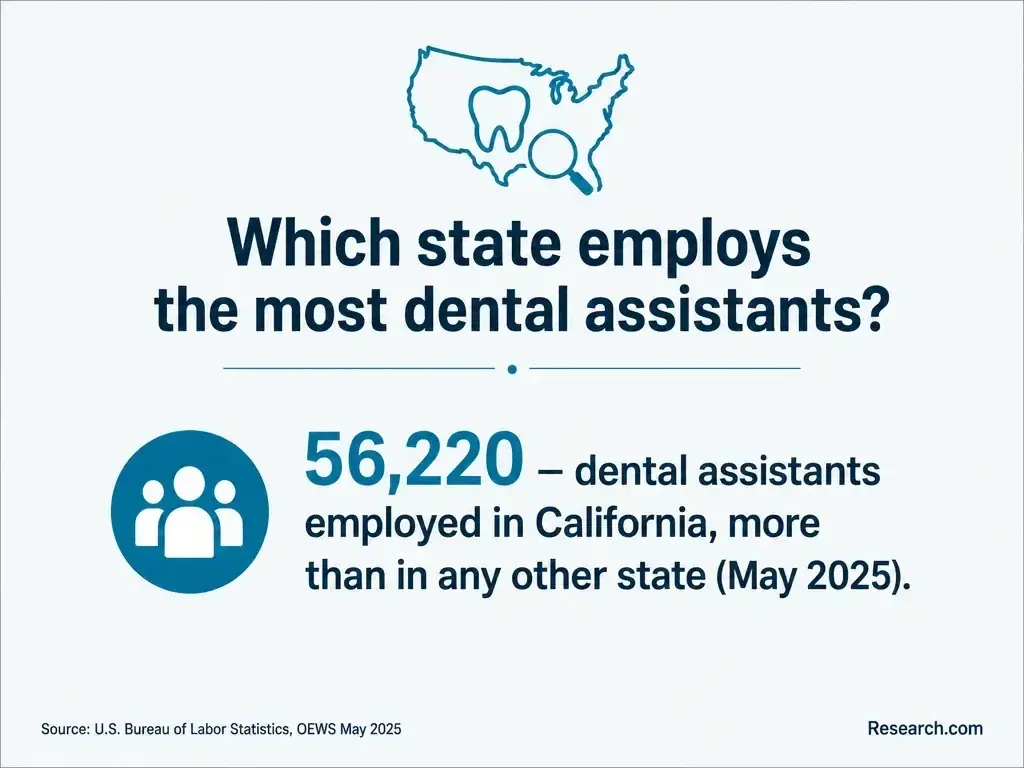
Choosing dental assistant training in San Marcos means comparing more than tuition: California's rules, hands-on practice, and time away from work can change which program is worth the investment. The U.S. Bureau of Labor Statistics projects 7.4% national job growth for dental assistants from 2025 to 2035, but that is not a local hiring guarantee. This guide helps prospective students compare pathways, costs, credentials, and career prospects. It accompanies the Best Dental Assistant Trade Schools in San Marcos for 2027 ranking, created by the Research.com team of data scientists to help students identify programs worth considering.
Expect instruction in chairside procedures, infection prevention, patient communication, dental materials, recordkeeping, and supervised practical skills. The decisive difference between options is how students practice those skills and which California duties or credentials the training supports. A classroom certificate is not interchangeable with a program that arranges substantial lab and clinical experience.
These pathways serve different starting points. Confirm the current offering, schedule, and credential directly with Pima Medical Institute-San Marcos or Palomar College rather than assuming every campus runs the same program each term.
| Pathway | What to compare | Best fit |
| Career-school certificate or diploma | Included lab and externship experience, total charges, and California credential alignment | Students seeking a structured route into chairside work |
| Community-college program | Course sequence, available clinical places, fees, and any applicable associate-degree option | Students who can accommodate the published course and clinical schedule |
| Employer-sponsored entry-level training | Paid training, supervision, permitted duties, and access to required courses | Applicants with a willing dental employer who prefer to earn while learning |
Unlike trades with a standard paid registered-apprenticeship route, dental assisting can begin through supervised dental-office employment under California rules. Do not assume an office placement is a registered apprenticeship - or that it covers every course needed for expanded duties. For a broader look at online school for trade skills, apply the same test: identify what must still happen in person.
Dental offices are the main destination; possibilities include general, pediatric, orthodontic, oral-surgery, and other specialty practices (U.S. Bureau of Labor Statistics). San Marcos students should search across North County and the wider San Diego area rather than treating city limits as the job market. That expands the range of practices to compare, but an externship commute can add a substantial cost before paid work begins.
Ask a program where recent students completed clinical placements and whether it arranges them. A placement site is useful experience, not a promise of employment. Confirm that any tasks advertised in a job posting are within your current California-authorized scope.
The national median annual wage for dental assistants was $48,070 in May 2025 (U.S. Bureau of Labor Statistics). This is the midpoint for employed workers nationwide, including experienced assistants - not a San Marcos wage estimate or a likely first offer.
For a local decision, compare current North County postings by required credential, duties, hours, and benefits, and ask prospective employers for a pay range. Evaluate a training quote against a conservative entry-level offer and the earnings you would give up while studying. A higher advertised wage for expanded duties is relevant only if the program and subsequent steps make you eligible to perform them.
Length depends on the provider's calendar, course load, and required lab and clinical sequence; there is no single clock-hour total that makes every California dental assistant program equivalent. Ask for the current catalog's scheduled weeks, contact hours, in-person lab hours, externship hours, and expected time to completion. An accelerated schedule may reduce time before applying for work while making it harder to keep a job or arrange transportation.
Working adults comparing fastest degree college options for working adults should not use a college-degree timetable as a shortcut for evaluating dental assisting. Compare the actual clinical calendar and missed-work costs instead. Direct-entry office training may allow earlier earnings, but the employer must provide appropriate supervision and time to complete any training needed for the duties you want.
Online instruction can cover terminology, records, and some theory; it cannot replace physical practice in instrument transfer, infection-control procedures, radiography techniques, and patient care. A hybrid option is useful when it reduces travel for theory without leaving students to find their own lab or clinical site. An on-campus schedule generally makes supervised practice easier to inspect before enrollment, but it may require more frequent travel.
Request a written breakdown of remote coursework, campus labs, clinical hours, and who secures the placement. For an "online" offer, verify California course approval and radiography-training implications with the Dental Board of California. Compare claims about top affordable online courses & degree programs against this occupation's hands-on requirements; a low online price is not good value if essential practical training is missing.

There is no reliable single San Marcos average that captures career-school charges, community-college enrollment, and paid office training on the same basis. Request an itemized, current written quote from each option. A lower tuition figure can lose its advantage if required courses, an externship commute, or time away from work cost more.
Compare these parts of the cost to become job-ready, not tuition in isolation:
Federal aid depends on the student, institution, and program; confirm eligibility with the school and Federal Student Aid rather than assuming every short course qualifies. Compare borrowing and likely completion as well as price. Resources on most affordable phd programs concern a different investment and cannot establish whether a dental assistant program is affordable.
The award depends on the specific offering: it may be a school certificate or diploma, or a community-college credential. That award records completed training; it is not itself California Registered Dental Assistant (RDA) licensure, a radiography authorization, or Dental Assisting National Board (DANB) certification.
Keep the distinctions separate. Institutional accreditation concerns the school; Commission on Dental Accreditation (CODA) accreditation concerns a particular dental-assisting program; California approval concerns specified courses or routes under state rules; DANB issues professional certifications; and the Dental Board of California governs state credentials and permitted duties. Ask the school to identify its exact program status and explain which additional courses, experience, or examinations your intended role requires.
School admission requirements vary. Obtain the current catalog for prerequisites, application deadlines, placement requirements, and any documentation needed before clinical participation, such as immunization records or a background check. Ask whether clinical eligibility is decided after enrollment and what happens to your fees if you cannot be placed.
An employer-trained applicant faces a different gate: finding an office willing to hire, supervise, and train a new assistant. Neither school admission nor an employer's offer confirms eligibility for California's RDA examination or expanded duties. Before enrolling, match the program's documented route to the Dental Board of California's current requirements.
Students learn how to prepare treatment rooms, support dentists during procedures, manage instruments and materials, communicate with patients, and maintain records (U.S. Bureau of Labor Statistics). Infection prevention deserves particular scrutiny: knowing the terminology is different from consistently performing procedures under supervision in a busy clinic.
Review the course outline for actual practice with equipment, feedback from instructors, and clinical evaluations. Radiography and other expanded functions have California-specific rules, so ask which instruction is board-approved and which duties require further credentials. Digital records and imaging may appear in training, but software exposure cannot replace competency in safe, authorized patient care.
Not every California dental assistant position requires an RDA license. California allows entry-level dental assisting under its rules for supervision and permitted duties, while the RDA title and certain expanded duties require meeting separate Dental Board of California requirements. State rules also govern specified courses and radiography-related duties. Check the board's current requirements for the tasks you want before accepting a school's claim that its certificate "qualifies" you.
DANB certification is a separate professional credential, not a substitute for California authorization. Likewise, CODA accreditation can matter to a training pathway but does not automatically confer a state license. Ask an employer which duties its vacancy actually includes; that determines whether direct-entry training is sufficient or a more structured pathway is the better investment.
Choose the option that can document the skills, clinical experience, and regulatory route for your target job at a manageable total cost. A ranking helps form a shortlist; it cannot replace checking a current catalog or speaking with a California regulator. When comparing Pima Medical Institute-San Marcos and Palomar College, use the same questions even if their awards or calendars differ.
Before paying a deposit, work through these checks:
Red flags include a promised license upon graduation, an "entirely online" claim without practical training, or a tuition quote that omits clinical costs. Advice about the easiest master degree to complete does not answer these trade-training questions; focus on documented dental-assisting outcomes instead.
A common starting point is supervised general-practice chairside work, followed by experience in a specialty office or pursuit of California credentials that permit additional duties. Experienced assistants may also take on scheduling, treatment coordination, training, or office-management responsibilities. Those jobs have different requirements and pay practices; a dental assistant certificate alone does not guarantee advancement.
If your goal is broader duties, ask employers which credential they recognize and check the Dental Board of California's current RDA pathway before choosing training. If your immediate goal is to enter a practice and earn income, supervised employer training may be more suitable than paying for a longer program - provided the role offers meaningful instruction and a realistic way to complete any required courses.
U.S. dental assistant employment is projected to grow 7.4% from 2025 to 2035 (U.S. Bureau of Labor Statistics). This national projection supports considering the occupation, but it does not measure vacancies in San Marcos or predict an individual graduate's prospects.
Use the wider North County and San Diego job market to test demand: examine current postings for experience requirements, schedules, authorized duties, and whether employers will train beginners. Compare those requirements with a program's clinical experience. A strong national outlook is less useful to you than a workable path to the jobs you can actually reach and qualify for.
Education is a significant investment. Research.com created the ranking to help readers compare dental assistant programs against relevant local alternatives, using reported outcomes, costs, and quality indicators rather than a school's name alone. Only programs with completions reported to IPEDS are eligible; an unlisted employer-training route or other provider should not be assumed to be unapproved or poor quality.
Best-program scores assess student outcomes, earnings and return on investment, costs and debt, and quality and recognition. Programmatic accreditation or relevant industry recognition accounts for 20% of the score, institutional accreditation for 10%, and student support for 10%. The remaining 60% covers completion and retention, earnings one year after completion and relative to annual attendance cost, tuition, attendance cost, student debt - including debt among students who withdrew - and federal loan default rates. An entropy-based method assigns more weight to indicators that differ more across programs. Most-affordable-program rankings instead score only costs and debt using entropy-based weights; they do not score accreditation or other quality indicators.
The team used the following sources to evaluate reported information and relevant recognition. Some sources cover broader trade education and should not be mistaken for dental-assisting accreditors.
Use the ranking to narrow your options, then confirm current prices, clinical arrangements, and California credential eligibility directly before enrolling. More detail on the approach appears in Research.com's methodology.
# 1 position
# 2 position
# 3 position
Potentially. California permits entry-level work under applicable supervision and duty rules. An employer willing to train you can be an alternative, but check which courses or credentials you would still need for your intended tasks (Dental Board of California).
No. A school award and California RDA licensure are separate. Verify the board's current education or experience, course, and examination requirements before enrolling (Dental Board of California).
Do not assume so. Dental assisting requires practical skills, and California regulates certain duties and training. Ask where supervised labs and clinical practice occur and whether any claimed course approval applies to your goal (Dental Board of California).
Only if its schedule, hands-on experience, and credential alignment meet your needs. Compare total cost, including lost wages and travel, as well as time to completion.
Policies vary. Obtain written confirmation of who finds the site, where it may be located, and what happens if a placement is delayed.