# 1 position

Audited and Verified:
Our Editorial and Data Verification Process
Research.com uses government datasets, official education statistics and primary institutional information to support its career and degree guides. Our review process checks factual accuracy, occupational definitions, source dates and the requirements associated with the credentials discussed.
How This Article Was Fact-Checked
Our editorial team verifies salary estimates, employment projections, education requirements and program information against original data providers and official organizations. Salary figures are checked against the relevant occupational definitions and reporting periods. Information about licensure, accreditation and required in-person training is reviewed separately.
Fact-checked and verified on:

Co-Founder and Chief Data Scientist

Reviewed by Karolina Broda
Fact-Checker and Data Verification
Choosing dental assistant training in Traverse City means deciding whether a program's clinical practice, cost, and Michigan credential options justify the time away from work. The U.S. Bureau of Labor Statistics reports a $48,070 national median annual wage for dental assistants in May 2025 - not a starting-pay promise. This guide helps prospective students and career changers compare school-based and employer-based routes. It also accompanies the Best Dental Assistant Trade Schools in Traverse City for 2027 ranking, created by the Research.com team of data scientists to help students identify training programs worth considering.
Expect instruction in chairside procedures, infection control, dental materials, patient communication, and office records, followed by supervised practice. Some programs arrange clinical experience in dental offices; others rely more heavily on campus labs. Ask for the current syllabus and the amount of supervised patient-facing practice rather than assuming two similarly named certificates offer equivalent preparation.
The central choice is between structured school training and learning on the job under a dentist's supervision. A school program can be useful if you want organized clinical instruction or a particular eligibility pathway. Employer training may cost less and let you earn sooner, but it may not provide the education or examinations needed for every Michigan dental assistant function. The Michigan Board of Dentistry, not a program's marketing description, determines regulated duties and registration requirements.
Because Traverse City serves a wider northwest Michigan area, a clinical placement or first job may require travel beyond the city. Ask where recent students completed clinical work, who secured those placements, and whether you can reach them reliably during the required hours.
Dental assistants primarily work in dental practices, supporting dentists during procedures and helping patients move through appointments (U.S. Bureau of Labor Statistics). General practices are a natural first search; specialty offices may call for additional training in their procedures and equipment. Local job searches should include practices across the commuting area, not just offices with a Traverse City address.
Before accepting an offer, compare the actual duties - chairside assisting, sterilization, scheduling, radiography, or other functions - with the supervision and credentials Michigan requires. A job title alone does not establish permission to perform every task (Michigan Board of Dentistry). Employer-sponsored instruction may be a practical entry route if the practice can explain its training and supervision plan.
The U.S. median annual wage for dental assistants was $48,070 in May 2025 (U.S. Bureau of Labor Statistics). This national midpoint includes experienced workers and should not be treated as a Traverse City offer or a newly trained assistant's likely starting wage. No verified city-specific wage figure is used here; check current local postings and ask employers for the pay range attached to the duties you would actually perform.
For an investment decision, compare a realistic offer with what you could earn while training, the program's full cost, and any debt repayment. A quicker, lower-cost route can be attractive if it qualifies you for your intended duties; a more extensive program may be worth considering when its clinical preparation and credential eligibility clearly support your longer-term goal.
There is no single Traverse City program length or universal clock-hour requirement that applies to every dental assistant training route. Certificate, diploma, and associate-degree schedules differ, as do full-time and part-time attendance. Employer training follows the practice's plan rather than a school calendar. Get the current calendar and required classroom, lab, and clinical hours in writing before comparing completion dates.
An accelerated schedule is only faster if you can attend its labs and clinical shifts without delaying completion. If speed is your main criterion, compare dental assisting with other fast degree programs that pay well only after identifying the occupation you actually want; a short timeline does not make different credentials interchangeable.
Online coursework may cover terminology, anatomy, records, and portions of infection-control instruction. Chairside technique, instrument handling, radiography practice where applicable, and supervised clinical work require suitable in-person settings. An entirely online claim is therefore a warning to investigate, not proof that the training meets Michigan requirements or an employer's expectations.
For someone commuting from outside Traverse City, a hybrid schedule may reduce classroom travel without eliminating trips to labs or clinical sites. Request a week-by-week location schedule and ask who arranges supervised practice. Resources about the quickest online bachelor degree programs for working adults address a different educational goal; they cannot establish dental assistant clinical or registration eligibility.
A reliable Traverse City average cannot be stated without comparable, current prices for the programs a student can actually attend. Request an itemized, written estimate from each provider instead of using advertised tuition as total cost. The comparison below separates charges from expenses that may arise while becoming job-ready.
| Cost component | What to confirm |
| School charges | Tuition, mandatory fees, lab supplies, books, and any equipment or uniform requirements. |
| Career-entry charges | Applicable examination, application, screening, or required health-documentation costs. |
| Attendance costs | Travel to labs and clinical sites, childcare if needed, and earnings forgone during unpaid training. |
| Potential offsets | Grants, eligible aid, scholarships, or wages from employer-sponsored training. |
Ask whether the specific program - not merely its institution - qualifies for the aid you plan to use; Federal Student Aid eligibility varies by program and school. A comparison with the cheapest phd program would not answer a dental assistant cost question: compare job-ready costs among dental assistant routes instead.
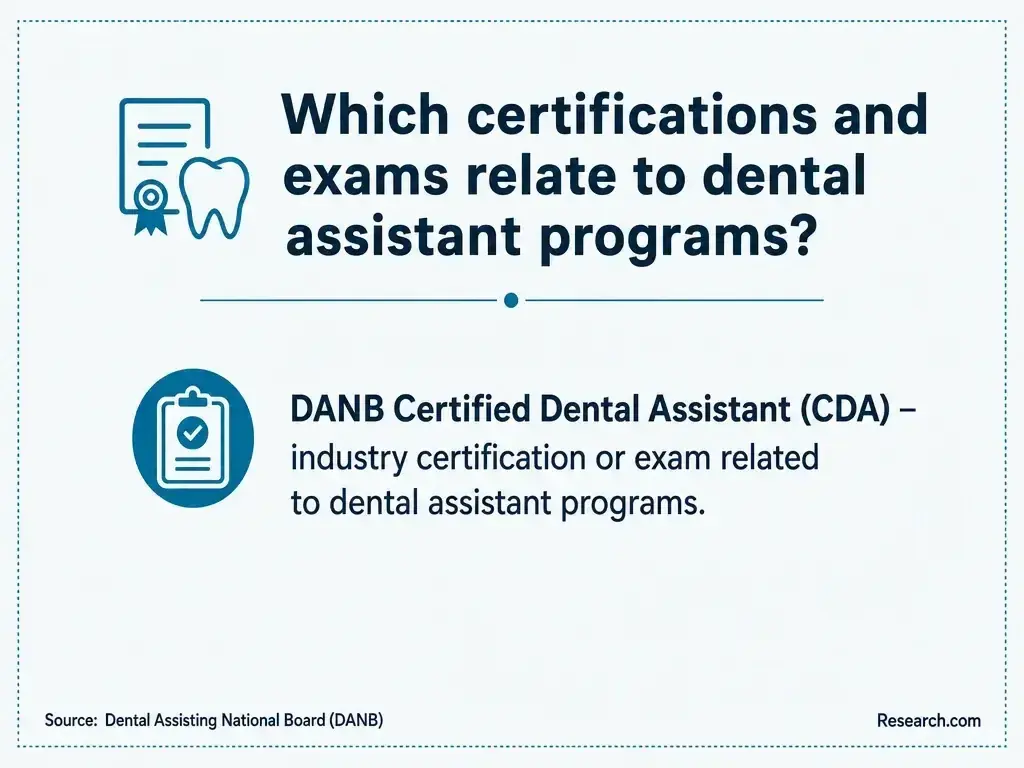
A provider may award a certificate or diploma; an eligible community college pathway may award an associate degree. These are educational awards, not automatically professional certification or Michigan registration. Confirm the exact credential printed on completion documents and whether the program is currently accredited by the Commission on Dental Accreditation if that distinction matters to your intended certification or registration route (Commission on Dental Accreditation; Dental Assisting National Board; Michigan Board of Dentistry).
Northwestern Michigan College is a local institution to ask about current offerings or advising, but do not assume it currently offers a dental assistant credential without checking its catalog. Likewise, information about colleges that offer dual degree programs concerns a different decision; two credentials are not inherently more useful than one that meets your dental assisting goal.
Requirements vary by provider and clinical site. Ask whether applicants need a high school diploma or equivalent, placement assessment, immunization or health documentation, background screening, or a clinical-site orientation. Check when each requirement is due and whether it carries an additional charge; an admission offer may not resolve a clinical site's separate conditions.
Employer-based entry has different screening: a practice may prioritize availability, patient-facing communication, and willingness to learn under supervision. If you have prior healthcare coursework or work experience, ask a school whether it awards documented prior-learning or transfer credit. Do not assume previous experience waives Michigan's requirements for a regulated function (Michigan Board of Dentistry).
Core learning commonly covers dental anatomy and terminology, instrument identification, chairside support, sterilization, infection prevention, dental materials, patient instructions, and records. A strong practical component lets students perform tasks under appropriate supervision and receive feedback - not merely watch demonstrations. Radiography and other regulated functions require particular attention to the training and permissions Michigan recognizes (Michigan Board of Dentistry).
Ask to see which skills are practiced in a lab, which are assessed with patients, and which are taught only in class. Digital records and imaging may appear in training, but software familiarity cannot replace hands-on technique, infection-control judgment, or clear communication with an anxious patient.
Do not treat "dental assistant" as a single credential category. Michigan distinguishes assisting under a dentist's supervision from registered dental assistant status and regulates who may perform particular duties. Check the Michigan Board of Dentistry's current rules for the tasks you want, including any education, examination, registration, or supervision conditions. Completion of a school program alone does not establish permission to perform every function (Michigan Board of Dentistry).
National certification through the Dental Assisting National Board is a separate credential with its own eligibility and examination rules; it is not itself a Michigan occupational registration (Dental Assisting National Board; Michigan Board of Dentistry). Institutional accreditation describes a school, Commission on Dental Accreditation accreditation describes a qualifying dental program, and state school authorization addresses a provider's authority to operate. None substitutes for the others or for the board's requirements. Ask admissions to identify the precise eligibility route its graduates can use, then verify it with the relevant authority.
Start with your intended job duties, then compare only routes that prepare you for them. A ranking can identify programs to investigate, but it cannot determine whether a particular clinical schedule, cost, or Michigan credential route works for you. Use these checks before making a deposit:
A red flag is a promise that an online certificate, accreditation label, or "guaranteed job" settles all three questions of practical competence, regulatory eligibility, and hiring. Consider the cost of finishing - and your chance of finishing - not just the sticker price. Guides to degrees for seniors may address different scheduling needs, but dental assistant applicants of any age still need to verify in-person training and clinical access.
Entry-level assisting can lead to broader chairside responsibilities as skills and permitted duties develop. Assistants may pursue national certification or Michigan registered dental assistant eligibility when those credentials fit the functions and employers they are targeting (Dental Assisting National Board; Michigan Board of Dentistry). Experience may also support a move into scheduling, treatment coordination, or office supervision; those roles depend on employer needs and experience, not simply on finishing a training program.
If your goal is another dental occupation with a different scope of practice, confirm that occupation's separate education and regulatory pathway before enrolling. Dental assistant training is valuable for dental assisting, but it should not be purchased on the assumption that it automatically converts into another credential.
U.S. employment of dental assistants is projected to grow 7.4% from 2025 to 2035 (U.S. Bureau of Labor Statistics, Employment Projections). That national forecast supports investigating the occupation; it does not quantify openings in Traverse City or promise a position after training. A smaller local search area can make clinical-site access and willingness to commute important parts of the decision.
Before enrolling, review current postings across the area you can travel, note the duties and credentials requested, and ask programs where students completed clinical practice. If the positions you want consistently require skills your proposed route does not teach, choose a different training route before taking on its cost.
Education is a consequential investment, so the Research.com team evaluates dental assistant programs against other programs in the same occupation and location rather than against unrelated trades. The ranking includes only programs with completions reported to IPEDS. That makes the comparison more consistent, but it also means an employer training route or a provider absent from IPEDS may be outside its scope - not necessarily unsuitable.
Best-program rankings assess student outcomes; earnings and return on investment; costs and debt; and quality and recognition. Programmatic accreditation or relevant industry recognition carries 20% of the score, institutional accreditation 10%, and student support services 10%. The remaining 60% covers outcomes, earnings, and costs, with an entropy-based method assigning more weight to indicators that distinguish programs. Measures include completion and full- and part-time retention; earnings one year after completion relative to attendance cost; tuition, total attendance cost, debt including for students who withdrew, and federal loan default rates. Most-affordable rankings instead score only cost and debt indicators using entropy-based weights; accreditation and other quality indicators are not part of that score.
The team draws on the following sources to check program records, outcomes, recognition, and training pathways. Some sources cover other trades as well and should not be read as dental-assisting approvals.
Use the ranking to narrow a shortlist, then confirm current program availability, Michigan eligibility, clinical arrangements, and your own net cost directly. More detail on the approach is available in Research.com's methodology.
# 1 position
# 2 position
Not for every entry-level assisting role. Supervised employer training may be an option, but Michigan regulates particular duties and registered dental assistant status. Check the Michigan Board of Dentistry's requirements for the work you intend to do.
No comparable local program average is presented here. Ask each provider for tuition, required fees, supplies, clinical travel, and any examination or application charges before comparing offers.
Some coursework can be remote, but practical skills and supervised clinical experience require in-person arrangements. Verify those arrangements and any Michigan eligibility claim before enrolling.
No. A certificate documents program completion; Michigan registration has separate requirements determined by the Michigan Board of Dentistry.
Choose based on the duties you want, the supervision and clinical practice available, total cost, and credential eligibility. Employer training may let you earn sooner; a suitable school program may offer a more structured route to your longer-term goal.