# 1 position


Audited and Verified:
Our Editorial and Data Verification Process
Research.com uses government datasets, official education statistics and primary institutional information to support its career and degree guides. Our review process checks factual accuracy, occupational definitions, source dates and the requirements associated with the credentials discussed.
How This Article Was Fact-Checked
Our editorial team verifies salary estimates, employment projections, education requirements and program information against original data providers and official organizations. Salary figures are checked against the relevant occupational definitions and reporting periods. Information about licensure, accreditation and required in-person training is reviewed separately.
Fact-checked and verified on:

Co-Founder and Chief Data Scientist

Reviewed by Karolina Broda
Fact-Checker and Data Verification
Choosing a dental assistant program means deciding what to pay for hands-on training - and whether that training prepares you for the duties you want to perform. The U.S. Bureau of Labor Statistics projects 7.4% national employment growth for dental assistants from 2025 to 2035. For career changers and first-time students, this guide compares Indiana pathways, costs, credentials, and career prospects. It also accompanies the Most Affordable Dental Assistant Trade Schools in Indiana for 2027 ranking, created by the Research.com team of data scientists to help students identify programs worth considering.
Expect instruction in infection control, dental instruments, patient preparation, chairside assisting, and office procedures, followed by practice in a lab or dental setting. Dental assisting is a hands-on occupation: two programs with similarly named certificates may differ substantially in supervised clinical experience and preparation for particular duties.
The pathways below suit different goals. Ask each provider which credential it awards and exactly where students practice with patients.
| Pathway | Typical credential and training | Best fit and main trade-off |
| Short career-school or college program | Certificate or diploma; classroom and lab work, with clinical experience varying by program | Students seeking faster entry; verify externship access and what the price includes. |
| Longer community-college program | Certificate or, where offered, associate degree; may include broader coursework and clinical training | Students who value a more extensive curriculum; compare added time and total cost with the duties it prepares you to perform. |
| Employer-based training | Workplace training rather than necessarily a school credential | Students with a willing dental employer; may reduce upfront cost, but training breadth and eligibility for additional duties need checking. |
Employer training is a realistic alternative to school for some entry-level duties, not automatically a substitute for a program with supervised clinical work or recognized certification preparation. A registered apprenticeship is a distinct, formally structured pathway; do not assume an ordinary dental-office trainee position is one. The U.S. Bureau of Labor Statistics describes both postsecondary education and on-the-job training as routes into dental assisting.
Dental offices are the principal workplace for dental assistants, according to the U.S. Bureau of Labor Statistics. Depending on the employer and your training, work may center on general dentistry, a specialty practice, or a larger group practice with more divided clinical and administrative roles. Ask prospective employers which procedures new assistants actually perform; a job title alone does not establish the permitted scope of practice.
Location affects the practicality of training as well as employment. Someone outside a major Indiana employment center should compare commute time to both the school and any required externship site. A low-cost program can become less affordable if clinical placements require frequent long trips or unpaid time away from work.
A verified Indiana-specific median is not available here, so the sound benchmark is the $48,070 U.S. median annual wage in May 2025 for dental assistants, reported by the U.S. Bureau of Labor Statistics. The median covers workers at different experience levels and locations; it should not be used as an expected first-job offer in Indiana.
Before borrowing, compare actual local job postings and offers with the program's full cost. Check hourly pay, expected hours, benefits, commuting expense, and whether the role requires radiography or other additional qualifications. For a state comparison using the same occupation and reference period, consult the U.S. Bureau of Labor Statistics' state occupational wage estimates or Indiana labor-market data rather than mixing figures from unrelated surveys.
There is no single Indiana-wide program length or universal clock-hour requirement for every dental assistant training route. Short certificate schedules, longer college programs, part-time attendance, and employer training differ. Request the published calendar, total instructional hours, lab hours, and required clinical or externship hours for each option; confirm whether placement time is included in the advertised finish date.
Faster completion is useful if it gets you into a suitable job sooner, but only if you can complete the required practical work and meet your intended employer's expectations. An accelerated online associate's programs comparison addresses a different scheduling question: online academic speed cannot replace dental assisting practice with instruments and patients.
Online or hybrid delivery may make terminology, anatomy, scheduling, and other classroom study easier to fit around work. Instrument handling, infection-control procedures, chairside practice, and any supervised clinical experience require an appropriate in-person setting. A fully online course should not be treated as equivalent to a program with documented practical training.
Compare formats by asking where labs occur, who arranges an Indiana clinical site, how skills are assessed, and whether attendance requires travel on weekdays. Institutional accreditation is worth checking - even when browsing best accredited non-profit online schools - but it does not establish that a particular dental assisting course includes clinical training or meets requirements for additional duties. Verify those separately with the provider and relevant Indiana authority.
There is no defensible single statewide average covering Indiana college programs, career schools, and employer training: providers publish different prices and include different items. For a useful comparison, obtain an itemized, current quote from each provider rather than relying on an advertised tuition figure. Public-college resident rates, when available, may differ from nonresident rates; confirm your eligibility directly.
The quote should let you compare the following costs on the same basis. Items that do not appear on a school bill can still determine whether a program is affordable.
Ask whether the specific program qualifies for federal student aid; institutional eligibility alone does not establish program eligibility. Check Indiana workforce-funding options with the state workforce agency, and compare your likely debt with conservative local pay - not the national median. The Federal Student Aid office distinguishes grants from loans, which must generally be repaid.
Depending on the provider, you may earn a school certificate, diploma, or associate degree. Those are education credentials, not interchangeable with professional certification or authorization to perform a regulated duty. Employer training may instead produce documented work experience without a school award.
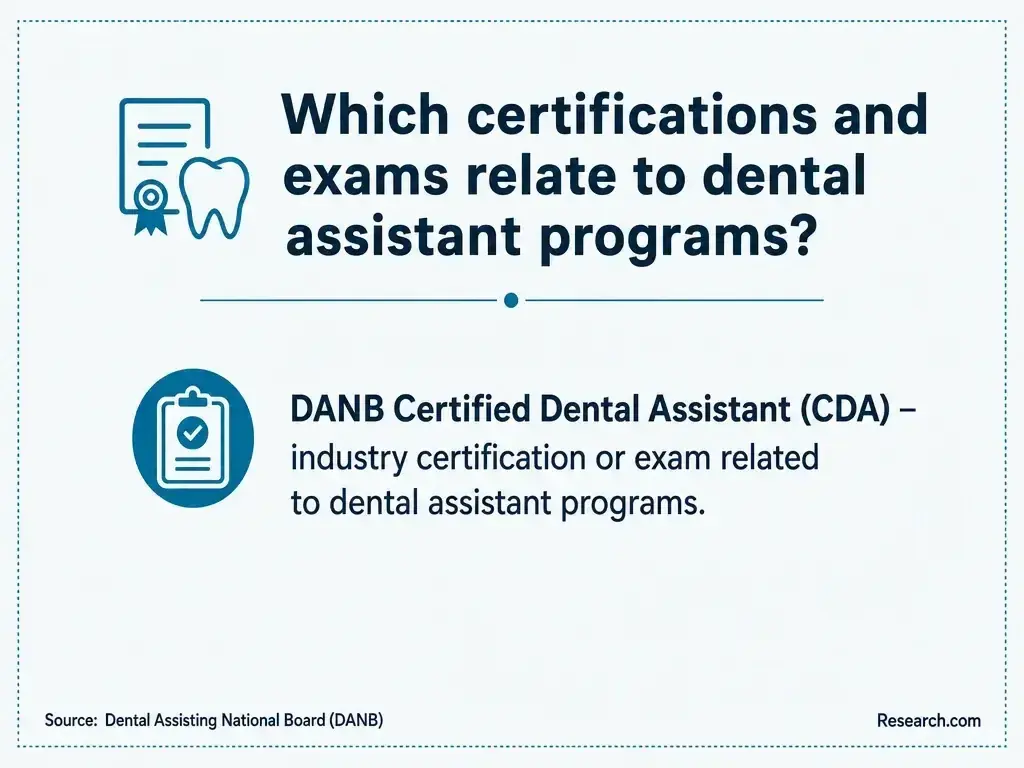
The Dental Assisting National Board (DANB) administers dental assisting certifications with their own eligibility and examination requirements. A program's claim that it "prepares" students for an exam is not a promise that every graduate is eligible to take it. Among broader guides to certifications programs that pay well, dental assisting requires an especially careful distinction between a school award, a voluntary professional credential, and permission to perform particular clinical functions.
Requirements vary by provider. Ask whether admission requires a high school diploma or equivalent, placement assessment, immunization or health documentation, a background check, or proof of eligibility for a clinical site. An externship site can impose conditions beyond classroom admission, so confirm them before paying a nonrefundable deposit.
For employer training, the entry decision belongs to the dental practice rather than a school admissions office. Ask what instruction and supervision the practice provides, whether training time is paid, and how it documents competencies. Previous healthcare experience may help you learn faster, but do not assume it waives dental-specific labs, clinical work, or certification eligibility requirements.
A relevant curriculum should develop patient communication, dental terminology and anatomy, instrument identification, infection prevention, chairside workflow, recordkeeping, and knowledge of materials and procedures. Programs may also teach dental imaging concepts and office software. The U.S. Bureau of Labor Statistics describes both patient-care and administrative tasks in this occupation; the mix in a particular Indiana job will vary.
Look for evidence of performed skills, not just topics listed in a catalog. Ask which procedures students practice in lab, which they observe or perform at a clinical site, who supervises them, and how competence is assessed. If your goal includes taking radiographs or performing expanded functions, have the school identify the specific training it provides and confirm the current Indiana requirements independently.
Do not assume that every entry-level dental assisting task requires the same credential, or that graduation authorizes every task. Indiana rules concerning dental radiography and expanded functions are especially important if those duties appear in your target job postings. Confirm the current scope-of-practice and any applicable training, examination, supervision, or credential requirements with the Indiana State Board of Dentistry before choosing a program. Requirements for taking radiographs should also be checked with the Indiana authority responsible for the applicable radiography credential.
Institutional accreditation concerns the school; CODA programmatic accreditation concerns an eligible dental program; DANB certification has separate eligibility and examination rules; and state authorization or permission for particular duties is a regulatory matter. None automatically substitutes for another. The Commission on Dental Accreditation, Dental Assisting National Board, and Indiana State Board of Dentistry are the respective primary sources to check.
Start with the job you want, then work backward to its required skills. The cheapest ranked option is not necessarily the cheapest way to become job-ready if it omits practical experience, creates a long commute, or requires additional training afterward.
Use these checks when speaking with admissions staff and, where possible, a potential employer. Request answers in writing so that programs can be compared fairly.
A ranking is a starting filter, not a substitute for these checks. Broad education comparisons such as easy bachelor degrees do not answer the dental-specific questions that determine whether this trade-school investment fits your goal.
An entry-level assistant may build experience in chairside care or office workflow, then seek additional training for duties permitted under Indiana rules. With experience, some assistants move toward lead-assistant, training, or practice-coordination responsibilities. These are potential paths, not automatic promotions or guaranteed wage increases; employers set job duties, while regulated clinical functions remain subject to state requirements.
If you want to change occupations rather than advance within dental assisting, check the other occupation's education and regulatory requirements separately. A search such as what is the fastest masters degree program does not identify a shortcut into an Indiana dental assisting role; for this decision, practical dental training and the duties you can perform matter more.
The U.S. Bureau of Labor Statistics projects 7.4% growth in U.S. dental assistant employment from 2025 to 2035. That national projection indicates continued demand but is not an Indiana hiring forecast, an estimate of local vacancies, or a guarantee of placement after training.
For a local decision, review Indiana workforce projections and current postings within commuting distance. Note whether employers ask for radiography qualifications, chairside experience, or particular schedules. If nearby openings routinely require skills your prospective program does not teach, either choose a program with documented preparation or ask employers about a supervised training route before committing to tuition.
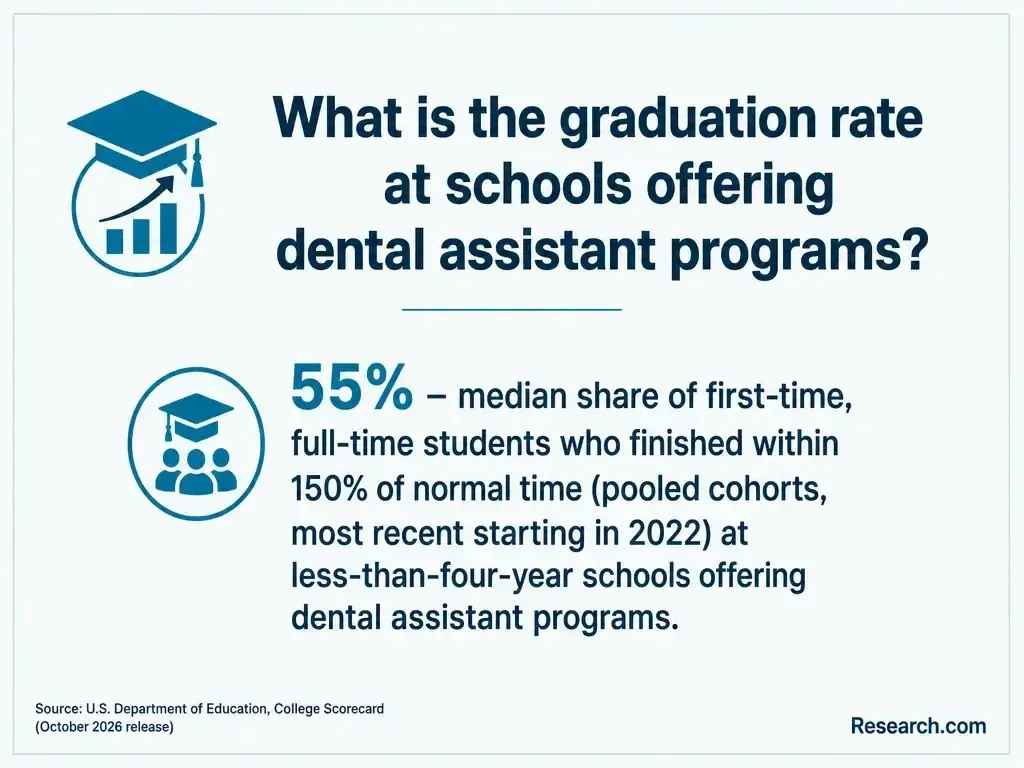
Investing in training is an important decision, and a low advertised tuition price does not tell the whole story. The Research.com team built this ranking to help readers compare dental assistant programs against other programs in the same occupation and location. It includes only programs with completions reported to IPEDS; a provider's absence does not mean it is unapproved or poor quality.
The most affordable ranking evaluates tuition, cost of attendance, median student debt, and federal loan default rate. Its indicator weights are assigned using an entropy-based method, which gives more weight to measures that vary more across programs. Accreditation and other quality indicators are not part of this affordability score. For context, Research.com's separate best-program rankings consider student outcomes; earnings and return on investment; costs and debt; and quality and recognition. In those rankings, relevant programmatic accreditation or industry recognition carries 20%, institutional accreditation 10%, student support 10%, and outcomes, earnings, and costs share the remaining 60% through entropy-based weighting.
The team used the following data sources in developing its trade-school rankings. Some cover institutions broadly or occupations other than dental assisting; their inclusion should not be read as dental-program approval.
Use the ranking as a cost-screening tool, then verify each program's current price, clinical training, and fit with your intended duties. More detail on the ranking approach appears in Research.com's methodology.
# 1 position
# 2 position
# 3 position

# 4 position

# 5 position
# 6 position

# 7 position

# 8 position

# 9 position

# 10 position

# 11 position

# 12 position

# 13 position
# 14 position
It can be if its practical training and credential match the jobs you want and its full cost is manageable against conservative local pay. Compare it with paid employer training before enrolling.
Employer-based training is a possible route into some entry-level work. Confirm what supervision it provides and whether additional training or authorization is needed for the duties you hope to perform.
Some classroom content can be online, but chairside skills and clinical experience require in-person practice. Ask who provides and assesses that practice.
No. A school award and DANB certification are separate credentials. Check the Dental Assisting National Board's current eligibility and exam requirements.
Get the total price, refund terms, clinical-site requirements, practical-training hours, exact credential, and evidence that the program supports your intended duties under current Indiana rules.