2027 How to Become a Licensed Pharmacist in Dallas, TX: License Requirements

Co-Founder and Chief Data Scientist
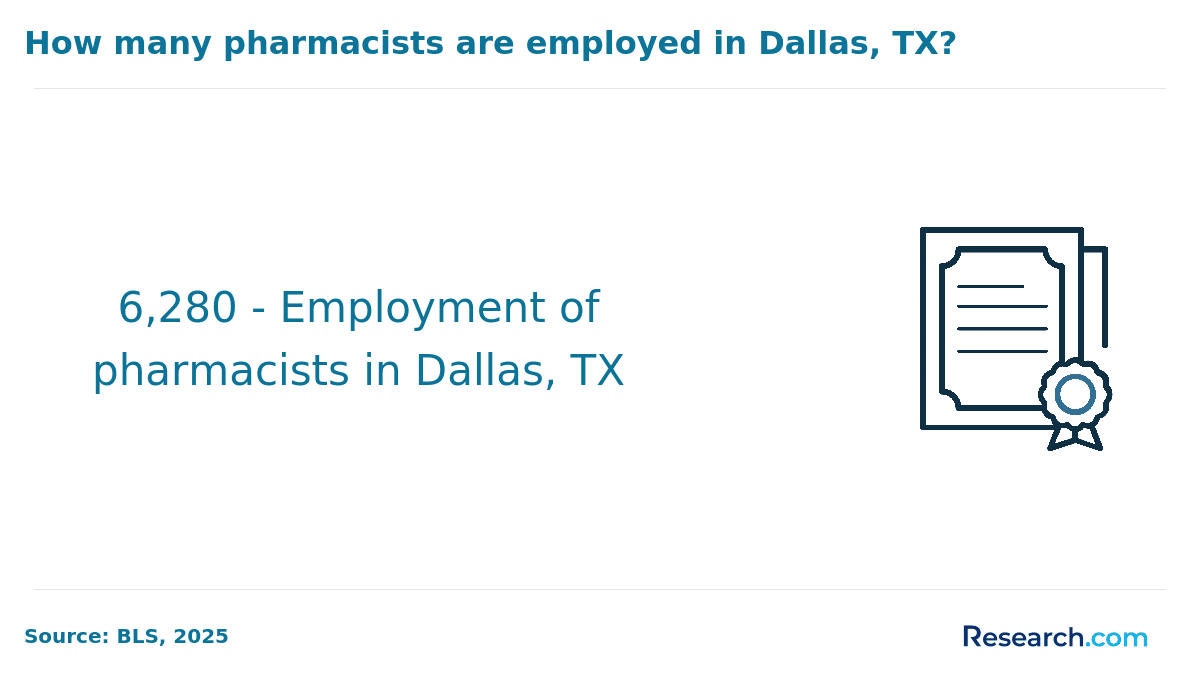
Becoming a pharmacist in Dallas is a clear but highly regulated path: you need the right pharmacy education, supervised experience, exams, background checks, and Texas State Board of Pharmacy approval before you can legally practice. Dallas is also a competitive healthcare market. According to 2025 BLS data, 6,280 pharmacists already work in the Dallas-Fort Worth-Arlington area, which means new graduates must be prepared not only to qualify for licensure but also to stand out for hospital, retail, specialty, and clinical pharmacy roles.
This guide explains how to become a licensed pharmacist in Dallas, TX, from PharmD requirements and Texas licensing exams to timelines, salary expectations, renewal rules, and career options. It is designed for pre-pharmacy students, current PharmD students, pharmacy graduates, out-of-state pharmacists considering Texas, and career changers comparing pharmacy with other healthcare paths.
Key Insights
- Dallas pharmacists are licensed by Texas, not by the city, so your main authority is the Texas State Board of Pharmacy.
- The core licensure path is PharmD completion, 1,500 supervised hours, NAPLEX, Texas MPJE, fingerprint-based background check, application approval, and ongoing renewal.
- The full pathway commonly takes about 6 to 8 years, so students should compare pharmacy with faster healthcare credentials if time-to-employment is a priority.
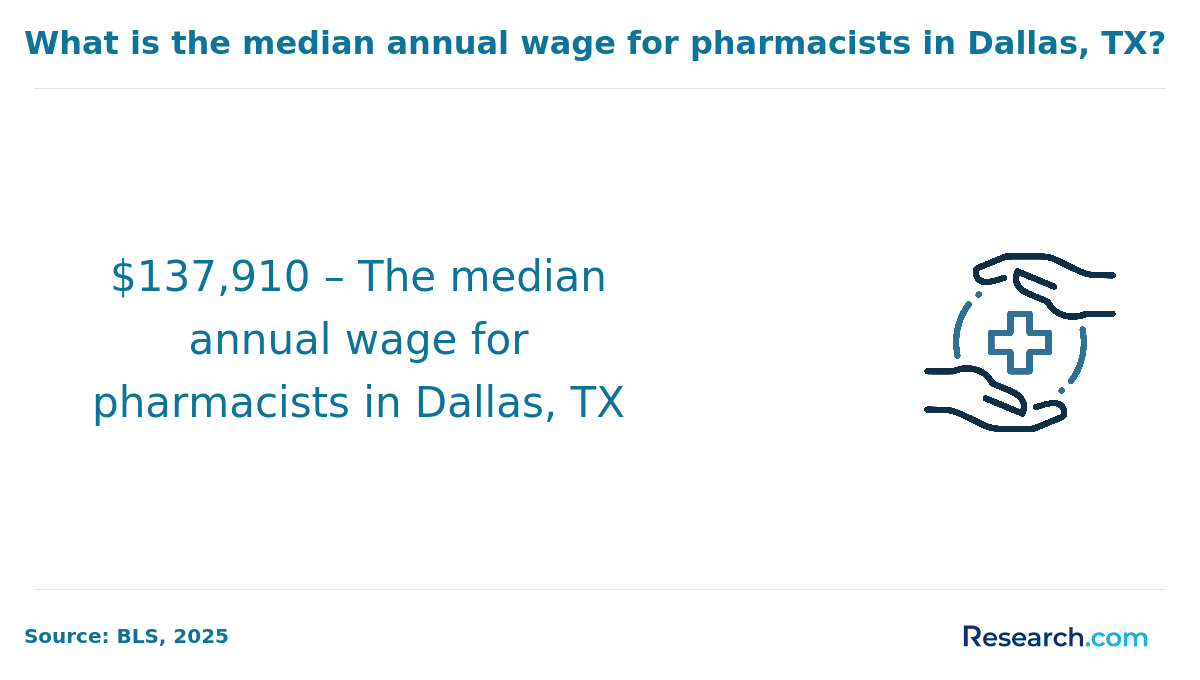
- Dallas offers a large pharmacist workforce, with 6,280 professionals reported in 2025 BLS data, and an average pharmacist salary of approximately $137,910 per year.
- Program choice matters. Verify ACPE accreditation, Texas eligibility, clinical rotation support, total cost, exam preparation, and supervised hour documentation before enrolling.
- The Texas MPJE deserves serious preparation because state pharmacy law can delay licensure if underestimated.
- Pharmacy can lead to more than retail practice. Dallas pharmacists may pursue hospital roles, specialty pharmacy, clinical work, administration, informatics, consulting, or interdisciplinary healthcare paths.
- Your Texas license will not automatically let you practice in every other state; relocation usually requires applying through the new state’s pharmacy board.
Quick answer: How do you become a licensed pharmacist in Dallas, TX?
To work as a pharmacist in Dallas, you must complete a Doctor of Pharmacy degree from an ACPE-accredited program, finish Texas-required supervised pharmacy experience, pass the NAPLEX, pass the Texas MPJE, submit fingerprints for a background check, and receive licensure through the Texas State Board of Pharmacy. The full pathway commonly takes about 6 to 8 years.
- Minimum professional degree: A PharmD is required for pharmacist licensure in Texas.
- Required exams: Candidates must pass the NAPLEX and the Texas MPJE before practicing independently.
- Practice experience: Texas requires 1,500 hours of supervised pharmacy experience.
- Dallas salary context: Pharmacists in the area earn approximately $137,910 per year on average, while many summaries describe pharmacist pay in Dallas as around $130,000 a year.
- Best fit: Dallas is a strong option for candidates who want access to hospitals, community pharmacies, specialty practices, and a large regional healthcare market.
- What education do you need to become a pharmacist in Dallas?
- Which pharmacy schools serve Dallas students?
- What skills help pharmacists succeed in Dallas?
- What are the Texas pharmacist licensure requirements?
- What is the step-by-step licensing process?
- How many years does it take to become licensed?
- Can certifications improve your pharmacy career options?
- Can pharmacists move into nontraditional healthcare roles?
- Can pharmacists build interdisciplinary clinical careers?
- What professional development options are available?
- How do renewal and continuing education work?
- Can a Texas pharmacist license transfer to another state?
- How much do pharmacists earn in Dallas?
- What is the job demand for Dallas pharmacists?
- Is Dallas a good city for a pharmacy career?
What are the educational requirements to become a licensed pharmacist in Dallas, TX?
The educational path to pharmacist licensure in Dallas follows Texas requirements. You do not earn a “Dallas pharmacist license”; you earn a Texas pharmacist license and may then work in Dallas if you meet employer and practice requirements.
The required academic foundation usually includes college science prerequisites followed by a professional PharmD program. Because pharmacy schools and state boards review coursework carefully, students should confirm prerequisites early instead of assuming that any biology or chemistry sequence will qualify.
- High school diploma or equivalent: This is the starting point before college-level prerequisite coursework.
- Pre-pharmacy college coursework: Most applicants complete at least two years of subjects such as biology, chemistry, anatomy, physiology, math, and related sciences before entering pharmacy school.
- Doctor of Pharmacy degree: Texas pharmacist candidates must graduate from a PharmD program accredited by the Accreditation Council for Pharmacy Education.
- Supervised pharmacy experience: Texas requires structured practical experience under a licensed pharmacist, often completed through internships, rotations, or other approved settings during pharmacy training.
| Education stage | Why it matters | Decision tip |
| Pre-pharmacy coursework | Builds the science background needed for PharmD admission. | Check each pharmacy school’s prerequisite list before enrolling in classes. |
| ACPE-accredited PharmD | Provides the professional credential required for pharmacist licensure. | Do not choose a program unless it meets Texas licensing expectations. |
| Internship or experiential training | Develops supervised practice skills before independent licensure. | Track hours and documentation carefully to avoid delays. |
| Licensure exam preparation | Prepares candidates for the NAPLEX and Texas MPJE. | Start Texas law review early; the MPJE is not just a general pharmacy test. |
Some students compare campus-based programs with online PharmD degree options for scheduling flexibility. If you consider an online or hybrid route, confirm accreditation, rotation placement support, Texas eligibility, and whether the program can help you complete supervised experience in or near Dallas.
Are there schools in Dallas, TX that offer pharmacy programs?
Dallas students have access to pharmacy education pathways, but not every option is a full PharmD program located inside the city. Some learners complete pre-pharmacy coursework locally and then apply to PharmD programs elsewhere in Texas. Others choose nearby or statewide programs that include clinical rotations, flexible formats, or regional healthcare partnerships.
Options commonly considered by Dallas-area students include:
- University of Texas at Austin: The College of Pharmacy offers a PharmD curriculum covering areas such as medicinal chemistry, patient care, and clinical practice. Tuition is around $30,000 per year for in-state students.
- Texas A&M University Health Science Center: This PharmD pathway emphasizes pharmacology, pharmacy law, clinical preparation, and hands-on learning. Tuition typically runs between $25,000 and $35,000 annually.
- Texas Woman’s University: While it is not described here as a full pharmacy school, it can support students through pre-pharmacy and health sciences coursework before transfer or PharmD application.
Students who are not ready to commit to a PharmD may consider pharmacy technician training first. A technician pathway can help you test your interest in pharmacy work, gain exposure to medication systems, and enter the workforce sooner. If that route fits your goals, compare programs such as a pharmacy technician associate degree online with shorter certificate or continuing education options.
| Pathway | Best for | Important caution |
| Full PharmD program | Students committed to becoming licensed pharmacists. | Requires significant time, tuition planning, exams, and supervised experience. |
| Pre-pharmacy coursework | Students building prerequisites before applying to PharmD programs. | Prerequisites vary, so course planning must match target schools. |
| Pharmacy technician program | Students who want quicker entry into pharmacy settings or a lower-risk first step. | Technician training does not replace the PharmD required for pharmacist licensure. |
| Online or hybrid PharmD | Students needing scheduling flexibility. | Accreditation, rotation access, and state eligibility must be verified before enrollment. |
The chart below lists the most common majors for pharmacists, as reported by Zippia in 2025.
What skills do you need to become a licensed pharmacist in Dallas, TX?
Pharmacists in Dallas need more than strong science knowledge. They work with patients, prescribers, insurers, technicians, electronic health records, controlled substance rules, and medication safety systems. The strongest candidates combine clinical judgment with accuracy, communication, and comfort using pharmacy technology.
- Medication expertise: Pharmacists must understand indications, contraindications, interactions, dosing, adverse effects, and therapeutic alternatives.
- Dispensing accuracy: Small mistakes can create serious patient safety risks, so attention to dose, drug form, route, labeling, and patient instructions is essential.
- Prescription verification: Pharmacists review prescriptions for clinical appropriateness, legal compliance, duplication, allergies, and potential interactions.
- Texas pharmacy law knowledge: Dallas pharmacists must follow Texas rules as well as federal requirements, especially when controlled substances or high-risk medications are involved.
- Patient counseling: Clear, culturally aware communication helps patients understand how to take medications safely and when to seek help.
- Technology competence: Modern pharmacy work involves dispensing platforms, inventory systems, insurance processing tools, electronic records, and automated medication systems.
- Team-based care: Hospital and clinic pharmacists often collaborate with physicians, nurses, case managers, and specialists on medication management.
| Skill area | Where it shows up in practice | How to strengthen it |
| Clinical decision-making | Medication therapy reviews, hospital rounds, dosing adjustments, patient counseling. | Seek strong clinical rotations and review guideline-based therapy regularly. |
| Precision and documentation | Dispensing, controlled substance records, immunization records, error prevention. | Build checklists and practice consistent workflow habits. |
| Communication | Patient education, prescriber calls, difficult conversations, adherence support. | Practice explaining complex medication information in plain language. |
| Legal compliance | Texas MPJE preparation, audits, prescription validity, board rules. | Study Texas-specific law instead of relying only on national exam materials. |
| Digital fluency | Pharmacy software, automated dispensing, inventory tracking, EHR review. | Use experiential rotations to become comfortable with multiple systems. |
What are the requirements for pharmacist licensure in Dallas, TX?
Dallas pharmacists are licensed at the state level, so the key authority is the Texas State Board of Pharmacy. Employers in Dallas may add their own hiring requirements, but the legal baseline is state licensure.
- ACPE-accredited PharmD: Candidates must complete the professional pharmacy degree required for pharmacist practice.
- 1,500 hours of supervised pharmacy experience: Texas requires this practical training under appropriate supervision in approved pharmacy or healthcare environments.
- NAPLEX passing score: The North American Pharmacist Licensure Examination assesses whether candidates can apply pharmacy knowledge safely in practice.
- Texas MPJE passing score: The Multistate Pharmacy Jurisprudence Examination for Texas focuses on pharmacy law and state-specific practice rules.
- Fingerprint-based criminal background check: Applicants must complete background screening as part of the licensing review.
- Application and board documentation: Candidates must submit required forms, proof of eligibility, fees, and any supporting records requested by the Texas State Board of Pharmacy.
If you are still comparing healthcare fields, review the broader education requirements for healthcare careers. Pharmacy is one of the longer routes, so it is worth comparing timelines, licensure rules, patient-care responsibilities, and debt risk before committing.
| Requirement | Who verifies it | Common mistake to avoid |
| PharmD degree | Pharmacy school and licensing board documentation. | Choosing a program without confirming ACPE accreditation and Texas eligibility. |
| 1,500 supervised hours | Texas State Board of Pharmacy or approved documentation process. | Waiting until graduation to resolve missing or unverified hours. |
| NAPLEX | Exam administrator and state board reporting. | Studying only memorized facts instead of patient-care application. |
| Texas MPJE | Exam administrator and state board reporting. | Underestimating Texas-specific law questions. |
| Background check | Texas licensing process. | Submitting fingerprints late and delaying final review. |
What is the licensing process for licensed pharmacists in Dallas, TX?
The licensing process is manageable when you treat it like a project with deadlines, documentation, and exam milestones. The biggest delays often come from incomplete applications, missing internship records, late fingerprints, or not preparing adequately for the Texas MPJE.
- Confirm your PharmD eligibility: Make sure your program is ACPE-accredited and that your graduation documentation can be sent to the Texas State Board of Pharmacy.
- Track supervised experience: Complete and document the required 1,500 hours of supervised pharmacy practice.
- Apply through the Texas State Board of Pharmacy: Submit the pharmacist license application and follow all board instructions exactly.
- Complete fingerprinting and background screening: Do this early enough that background processing does not hold up your license.
- Prepare for and pass the NAPLEX: Focus on clinical decision-making, calculations, patient safety, pharmacotherapy, and medication-use systems.
- Prepare for and pass the Texas MPJE: Study Texas pharmacy law, controlled substance rules, board regulations, and practice-specific requirements.
- Submit remaining documentation and fees: Provide proof of exam completion, experience, and any final materials requested by the board.
- Receive your pharmacist license: Do not begin independent pharmacist practice until licensure is issued and active.
- Maintain your license: Track renewal dates and continuing education requirements so your license remains in good standing.
A practical way to avoid delays is to create a licensing checklist during your final year of pharmacy school. Include exam registration dates, graduation documentation, internship hour verification, fingerprinting, application fees, MPJE study targets, and employer credentialing requirements.
How long does it take to become a licensed pharmacist in Dallas, TX?
The typical timeline is around 6 to 8 years, depending on how quickly you complete prerequisites, whether you enter a traditional or accelerated PharmD pathway, and how efficiently you finish licensure steps after graduation.
- Pre-pharmacy coursework: Many students complete at least two years of college prerequisites before applying to pharmacy school.
- PharmD program: A Doctor of Pharmacy degree generally takes 4 years after prerequisite coursework.
- Supervised experience: Texas requires at least 1,500 hours of practical experience, which is often completed through the PharmD program and related internship training.
- Licensing exams and processing: NAPLEX, Texas MPJE, application review, fees, and fingerprint-based background checks can add several weeks or more, depending on timing and documentation.
| Stage | Estimated time based on this pathway | What can slow you down |
| College prerequisites | At least two years for many students. | Missing required science labs, low prerequisite grades, or changing schools late. |
| PharmD | Generally 4 years. | Course failures, rotation scheduling issues, or not meeting program progression rules. |
| Supervised experience | 1,500 hours required in Texas. | Poor hour tracking or incomplete verification. |
| Exams and licensing | Several weeks or more after eligibility is documented. | Late applications, delayed fingerprints, MPJE failure, or incomplete paperwork. |
| Total pathway | About 6 to 8 years. | Program changes, exam retakes, financial interruptions, or documentation problems. |
If your main goal is to enter healthcare quickly, pharmacy may not be the fastest route. You may want to compare PharmD training with short medical certifications with strong salary potential before deciding whether the time investment fits your goals.
The chart below lists the metropolitan areas with the highest employment levels for pharmacists, as reported by the BLS in 2024.
Can additional certifications broaden your career opportunities in Dallas, TX?
Additional credentials can help licensed pharmacists move beyond standard dispensing roles, especially in a large healthcare market like Dallas. Certifications or specialized training may support careers in ambulatory care, hospital pharmacy, oncology, compounding, immunization services, medication therapy management, clinical research, informatics, or behavioral health-adjacent settings.
The right certification depends on your target role. For example, a retail pharmacist who wants more patient counseling responsibility may choose a different path than a hospital pharmacist aiming for specialty clinical practice. Some pharmacists also explore related helping professions, such as learning how to become a substance abuse counselor in Dallas, when they want to combine medication knowledge with behavioral health support.
| Career goal | Credential strategy | When it makes sense |
| Clinical specialization | Pursue training aligned with a hospital, oncology, infectious disease, or ambulatory care focus. | You want deeper patient-care responsibilities and can document relevant experience. |
| Community pharmacy leadership | Build skills in immunization, medication therapy management, operations, and staff supervision. | You want to manage pharmacy teams or improve patient service lines. |
| Compounding or specialty pharmacy | Seek specialized preparation for complex medications, sterile processes, or specialty therapies. | You want to work in a niche pharmacy setting with stricter workflows. |
| Behavioral health-adjacent work | Combine pharmacy knowledge with counseling, addiction, or care coordination training. | You want to support patients with medication adherence, substance use issues, or complex care needs. |
Can licensed pharmacists in Dallas, TX pivot to alternative healthcare careers?
Yes. Pharmacists can use their medication expertise, documentation skills, regulatory knowledge, and patient-care background in nontraditional roles. Common pivots include healthcare consulting, pharmaceutical industry work, prior authorization, medication safety, managed care, health informatics, administration, compliance, clinical research, and medical billing or coding support.
A pivot is most realistic when you identify the skill gap between pharmacy practice and the target role. For example, a pharmacist moving toward revenue cycle or coding work may need targeted training in billing systems, payer rules, and healthcare documentation. If that direction interests you, compare pharmacist-adjacent options with guidance on how to become a medical biller and coder in Dallas.
Can pharmacists pursue interdisciplinary roles to expand their clinical expertise?
Pharmacists who want broader clinical responsibility sometimes pursue interdisciplinary healthcare roles. This may involve additional licensure, a new degree, or formal clinical training outside pharmacy. The decision should be made carefully because some routes require a major time and tuition commitment.
For example, pharmacists interested in diagnosis, prescribing authority, or advanced direct patient management may research advanced nursing pathways, including how to become a nurse practitioner in Dallas. Others may move into care coordination, chronic disease education, behavioral health collaboration, or medication safety leadership without leaving pharmacy entirely.
| Option | Best fit | Trade-off |
| Stay in pharmacy and specialize | Pharmacists who want deeper expertise without starting a new profession. | May still require certification, residency, or experience in a competitive setting. |
| Move into administration or consulting | Pharmacists who like systems, operations, compliance, or business strategy. | May involve less direct patient care. |
| Pursue another licensed clinical role | Pharmacists seeking a different scope of practice. | Can require a new degree, new clinical hours, and separate licensing exams. |
| Enter health technology or informatics | Pharmacists who enjoy data, software, medication systems, or workflow design. | May require technical upskilling beyond traditional pharmacy education. |
What are the continuing education and professional development opportunities for pharmacists in Dallas, TX?
Dallas pharmacists can keep their skills current through employer training, accredited continuing education, professional association events, clinical seminars, specialty certification preparation, and networking with hospital, retail, academic, and specialty pharmacy professionals. Continuing education is not just a renewal requirement; it is also a way to stay aligned with changing regulations, medication therapies, technology, and patient-care expectations.
Professional development is especially important for pharmacists who want to move into leadership, clinical specialization, public health, teaching, or interdisciplinary work. Some pharmacists also explore adjacent care fields to better understand patient needs, including resources on how to become an MFT in Dallas, when their interests include family systems, counseling, or behavioral health collaboration.
- Employer-based training: Hospitals and pharmacy chains may offer internal training on safety protocols, systems, compliance, and patient care.
- Accredited continuing education: CE courses help pharmacists meet renewal requirements and learn updated practice standards.
- Specialty preparation: Pharmacists pursuing advanced roles can choose education aligned with oncology, infectious disease, ambulatory care, geriatrics, or other areas.
- Professional associations: Local and state pharmacy groups can support networking, mentoring, policy awareness, and leadership development.
- Interdisciplinary learning: Training in communication, behavioral health, informatics, management, or public health can improve career flexibility.
What are the license renewal and continuing education requirements for pharmacists in Dallas, TX?
Pharmacists practicing in Dallas must follow Texas State Board of Pharmacy renewal rules. Renewal generally involves completing required continuing education, submitting renewal materials, paying applicable fees, and maintaining accurate documentation in case of audit or board review.
The safest approach is to track CE throughout the renewal period instead of waiting until the deadline. Pharmacists should verify current requirements directly with the Texas State Board of Pharmacy because CE topics, deadlines, and documentation expectations can change.
| Renewal task | Why it matters | Best practice |
| Complete required CE | Shows continued professional competence. | Choose accredited courses that match Texas requirements and your practice area. |
| Keep documentation | Protects you if your CE record is reviewed. | Save certificates, course details, dates, and provider information. |
| Monitor board deadlines | Late renewal can disrupt employment and practice authority. | Set reminders well before the renewal date. |
| Review rule changes | Texas pharmacy regulations may evolve. | Check official board communications rather than relying on old advice. |
| Plan career-aligned CE | CE can support advancement, not just compliance. | Select topics tied to your next role, such as leadership, clinical care, or compliance. |
Pharmacists interested in broader patient-care and counseling roles may also compare pharmacy renewal expectations with other licensed fields, such as Dallas LPC license requirements, to understand how continuing education differs across healthcare professions.
Will a pharmacist license from Dallas, TX allow you to work in other states?
A Texas pharmacist license does not automatically authorize you to practice in every other state. Texas doesn’t offer full reciprocity with other states, so pharmacists who want to relocate must usually apply through the pharmacy board in the new state.
Requirements vary by jurisdiction, but pharmacists commonly need to:
- Apply to the new state’s board of pharmacy.
- Provide evidence of an active Texas license in good standing.
- Complete any state-specific law exam or jurisprudence requirement.
- Submit background check materials or fingerprints if required.
- Provide education, exam, experience, or license verification documents.
If you expect to move after graduation, research licensure transfer requirements before choosing rotations, job offers, or residency options. State law exams can be a major difference, especially for pharmacists who have only studied Texas requirements.
How much do Dallas, TX licensed pharmacists earn?
Licensed pharmacists in the Dallas area earn approximately $137,910 per year on average. Entry-level pay may start around $100,000, while pharmacists with more experience, leadership responsibilities, or specialized clinical roles can earn upwards of $130,000 per year.
Salary depends on practice setting, schedule, employer type, experience, specialization, and leadership duties. Hospital pharmacists, oncology pharmacists, nuclear pharmacy professionals, and pharmacists in complex clinical environments may see different compensation patterns than retail pharmacists. However, salary is never guaranteed; individual offers depend on credentials, local hiring demand, shift needs, and employer budgets.
| Factor | How it can affect pay | Question to ask before accepting an offer |
| Practice setting | Retail, hospital, specialty, and clinic roles may pay differently. | What responsibilities are included beyond dispensing? |
| Experience level | New graduates and experienced pharmacists may receive different offers. | Is there a salary progression or promotion structure? |
| Specialization | Clinical areas such as oncology or nuclear pharmacy can influence compensation. | Does the role require certification, residency, or prior specialty experience? |
| Schedule | Evening, overnight, weekend, or high-volume shifts may affect total compensation. | Are shift differentials, overtime rules, or on-call expectations clearly stated? |
| Benefits | Health insurance, retirement, tuition support, CE support, and bonuses affect total value. | What is the full compensation package, not just base salary? |
Is there a demand for licensed pharmacists in Dallas, TX?
Dallas has an active pharmacist labor market, supported by hospitals, clinics, retail chains, specialty pharmacies, long-term care settings, and a growing regional healthcare system. Recent projections discussed in the source material point to pharmacist job growth of around 3-5%, which is described as aligned with the national average.
Demand is not identical across all pharmacy jobs. Retail positions may differ from hospital or specialty openings in schedule, workload, advancement, and hiring requirements. Clinical pharmacists, oncology-focused pharmacists, infectious disease specialists, and pharmacists with residency or specialty experience may find different opportunities than candidates seeking traditional community pharmacy roles.
Students who want to enter the field sooner sometimes compare traditional PharmD routes with 6 year pharmacy programs. Accelerated options can reduce time in school for some students, but they should be evaluated carefully for accreditation, cost, academic intensity, experiential training, and Texas licensure alignment.
Current trends affecting pharmacist careers in Dallas
- More clinical involvement: Pharmacists are increasingly expected to support medication therapy management, chronic disease care, immunizations, adherence programs, and interprofessional care.
- Technology-heavy workflows: Automation, e-prescribing, inventory tools, and clinical decision-support systems make digital confidence important.
- Employer preference for specialization: Competitive hospital and specialty roles may favor candidates with residency training, certifications, or strong rotation experience.
- Patient access needs: Dallas’s diverse population increases the value of pharmacists who can communicate clearly, support adherence, and work across cultural and language differences.
- Regulatory complexity: Controlled substance rules, documentation, privacy, and state board compliance remain central to safe practice.
Is Dallas, TX a good place to work as a licensed pharmacist?
Dallas can be a strong location for pharmacists who want a large healthcare market, multiple employer types, and access to both community and clinical pharmacy roles. The city may be especially appealing to graduates who want to build experience across hospitals, retail pharmacies, specialty clinics, and healthcare systems without leaving a major metropolitan area.
- Wide employer base: Dallas offers opportunities in hospitals, retail pharmacies, specialty care, clinics, long-term care, and related healthcare organizations.
- Competitive compensation: Reported pharmacist pay in Dallas is strong, with an average of approximately $137,910 per year.
- Career mobility: Pharmacists can pursue clinical specialization, management, consulting, industry, informatics, or interdisciplinary healthcare roles.
- Licensure clarity: The route is structured: PharmD, 1,500 hours, NAPLEX, Texas MPJE, background check, and board approval.
- Cost-of-living consideration: Dallas is often viewed as more manageable than markets such as New York or San Francisco, but candidates should still compare salary offers against housing, commuting, student loan payments, and benefits.
| Dallas is a good fit if... | Consider another path or city if... |
| You want access to a large metro healthcare market. | You prefer a smaller market with less competition. |
| You are open to retail, hospital, clinic, or specialty pharmacy work. | You want only one very specific role and are unwilling to relocate or build experience first. |
| You can manage a long education and licensing timeline. | You need to enter healthcare employment quickly and cannot commit to PharmD training. |
| You are comfortable with exams, regulation, documentation, and continuing education. | You want a healthcare job with minimal licensing complexity. |
| You value career options in both patient care and healthcare systems. | You are not interested in medication safety, patient counseling, or clinical accountability. |
The chart below illustrates the age distribution of pharmacists in the US, as published by Zippia in 2025.
What do licensed pharmacists in Dallas, TX say about their careers?
My pharmacy training through Texas A&M University gave me the clinical foundation I needed for hospital pharmacy work in Dallas. The pace can be demanding, but the ability to support medication safety, counsel patients, and work with healthcare teams makes the role meaningful. Dallas’s diverse patient population has also pushed me to become a better communicator and a more adaptable clinician. — Enzo
Graduating from the University of North Texas Health Science Center helped me enter a healthcare environment where pharmacists are treated as important members of the care team. Working in Dallas has shown me how much medication decisions affect patient outcomes. The city’s diversity has strengthened my empathy and made patient education a central part of my daily work. — Marianne
Texas Woman’s University challenged me academically and helped me build the discipline needed for pharmacy practice. Starting in a Dallas hospital setting exposed me to complex medication cases and continuous learning. I appreciate that pharmacy offers stability, but also room to grow into leadership, specialization, and more advanced patient-care responsibilities. — Kathy
Common mistakes to avoid when pursuing pharmacist licensure in Dallas
| Mistake | Why it causes problems | Better approach |
| Choosing a program without checking accreditation. | Licensure depends on completing an appropriate PharmD program. | Verify ACPE accreditation and Texas eligibility before enrolling. |
| Ignoring Texas MPJE preparation until the last minute. | Texas law is state-specific and can be challenging if you rely only on general pharmacy knowledge. | Schedule dedicated Texas law study time before testing. |
| Tracking internship hours informally. | Missing documentation can delay board approval. | Keep organized records and confirm how hours are verified. |
| Focusing only on tuition. | Total cost includes fees, living expenses, books, exam costs, commuting, and lost work time. | Estimate full cost of attendance and compare expected salary, debt, and benefits. |
| Assuming online programs are automatically acceptable. | Flexibility does not guarantee licensure alignment or local rotation access. | Ask about accreditation, experiential placements, and Texas board compatibility. |
| Waiting to start licensing paperwork after graduation. | Applications, fingerprints, exam eligibility, and documentation can take time. | Create a licensing timeline during the final year of pharmacy school. |
| Assuming salary outcomes are guaranteed. | Pay varies by employer, role, schedule, and experience. | Compare real job postings, benefits, loan obligations, and advancement paths. |
Questions to ask before choosing a pharmacy program or career path
- Is the PharmD program ACPE-accredited and accepted for Texas pharmacist licensure?
- How does the program help students complete the 1,500 hours of supervised experience?
- Where are clinical rotations located, and are Dallas-area placements available?
- What are the total costs, including tuition, fees, housing, transportation, exams, and licensing expenses?
- What percentage of graduates pass the NAPLEX and MPJE, and how does the school support exam preparation?
- Does the program offer hospital, community, specialty, or ambulatory care exposure?
- Are accelerated options realistic for your academic preparation and schedule?
- How much debt would you likely take on, and how does that compare with Dallas pharmacist salaries?
- What employers recruit from the program?
- If you might move later, how will Texas licensure affect your ability to apply in another state?
Related Articles for Nearby Cities
- 2027 How to Become a Licensed Pharmacist in Irving, TX: License Requirements
- 2027 How to Become a Licensed Pharmacist in Garland, TX: License Requirements
- 2027 How to Become a Licensed Pharmacist in Plano, TX: License Requirements
- 2027 How to Become a Licensed Pharmacist in Arlington, TX: License Requirements
- 2027 How to Become a Licensed Pharmacist in Fort Worth, TX: License Requirements
- 2027 How to Become a Licensed Pharmacist in Austin, TX: License Requirements
- 2027 How to Become a Licensed Pharmacist in Oklahoma City, OK: License Requirements
- 2027 How to Become a Licensed Pharmacist in Houston, TX: License Requirements
- 2027 How to Become a Licensed Pharmacist in Tulsa, OK: License Requirements
- 2027 How to Become a Licensed Pharmacist in San Antonio, TX: License Requirements
References:
- Bureau of Labor Statistics (BLS). (2025a). Area: Dallas-Fort Worth-Arlington, TX. Occupational Employment and Wage Statistics Query System. BLS.
- Bureau of Labor Statistics (BLS). (2025b). Pharmacists. Occupational Outlook Handbook. BLS.
- Dallas College. (n.d.). Pharmacy Technician. Allied Health (Continuing Education). Dallas College.
- Gyfted. (n.d.). Become a licensed pharmacist in Dallas. Gyfted.
- Health Science Center at Fort Worth (HSC). (n.d.). Flex PharmD. HSC.
- Pharmacy Technician Certification Board (PTCB). (n.d.). Texas Pharmacy Tech License. PTCB.
- Texas A&M University. (n.d.). How to Apply to the PharmD Program. Pharmacy Degrees. Texas A&M University.
- Texas Southern University (TSU). (n.d.). Certification Requirements. Course Catalog. TSU.
- The US Oncology Network. (n.d.). Pharmacy/Admixture Technician-Dallas, TX. The US Oncology Network.
- Upwardly Global. (n.d.). Texas Licensing Guides for Immigrant Pharmacists. Upwardly Global.
- V-Tecs.org. (n.d.). Pharmacy Technician Classes Dallas, Texas. V-Tecs.org.
- Zippia. (2025a). Pharmacist Demographics and Statistics in the US. Zippia.
- Zippia. (2025b). Pharmacist Education Requirements. Zippia.
Other Things You Should Know About Becoming a Licensed Pharmacist in Dallas, TX
To become a licensed pharmacist in Dallas in 2027, you must earn a Doctor of Pharmacy (Pharm.D.) degree from an accredited program, pass the North American Pharmacist Licensure Examination (NAPLEX), the Texas Pharmacy Jurisprudence Exam, and complete any state-mandated internship hours.
To obtain your pharmacist license in Dallas, TX, you must pass both the NAPLEX and the MPJE for Texas. After completing your pharmacy degree, register for these exams through the National Association of Boards of Pharmacy (NABP). It usually takes about two to four weeks to get your exam results. Once you pass both exams, you can apply for your license with the Texas State Board of Pharmacy. They handle all licensing, so make sure your application is complete to avoid delays in starting your pharmacy career in Dallas.
In 2027, to become a licensed pharmacist in Dallas, TX, you must earn a Doctor of Pharmacy (Pharm.D.) degree, typically taking four years. Following this, you must pass the North American Pharmacist Licensure Examination (NAPLEX) and the Multi-state Pharmacy Jurisprudence Examination (MPJE), and complete Texas State Board of Pharmacy requirements, which may include internship hours.