# 1 position

Audited and Verified:
Our Editorial and Data Verification Process
Research.com uses government datasets, official education statistics and primary institutional information to support its career and degree guides. Our review process checks factual accuracy, occupational definitions, source dates and the requirements associated with the credentials discussed.
How This Article Was Fact-Checked
Our editorial team verifies salary estimates, employment projections, education requirements and program information against original data providers and official organizations. Salary figures are checked against the relevant occupational definitions and reporting periods. Information about licensure, accreditation and required in-person training is reviewed separately.
Fact-checked and verified on:

Co-Founder and Chief Data Scientist

Reviewed by Karolina Broda
Fact-Checker and Data Verification
Choosing dental assistant training in San Antonio means comparing more than tuition: you need a program that teaches chairside skills and fits Texas rules for the duties you want to perform. The U.S. Bureau of Labor Statistics projects 7.4% national growth in dental assistant employment from 2025 to 2035. This guide explains local training routes, costs, credentials, and career prospects. It also accompanies the Best Dental Assistant Trade Schools in San Antonio for 2027 ranking, created by the Research.com team of data scientists to help students identify programs worth considering.
Expect instruction in chairside procedures, infection control, dental anatomy, patient communication, and office workflow, followed by practice with equipment and patients where the program provides a clinical placement. A dental assistant supports a dentist; the job is distinct from practicing dental hygiene or dentistry. The U.S. Bureau of Labor Statistics describes both clinical and administrative duties, but Texas rules determine which regulated procedures an assistant may perform.
San Antonio applicants can compare public-college training, private career-school programs, and supervised training offered by dental practices. Ask San Antonio College, The College of Health Care Professions-South San Antonio, Concorde Career College-San Antonio, Pima Medical Institute-San Antonio, or Lamson Institute for current dental-assisting offerings rather than assuming every campus offers the same credential or schedule. Employer training may reduce upfront cost and let you earn while learning; a structured program may offer broader lab practice and more predictable preparation for certification.
The comparison that matters is whether you will practice instrument transfer, sterilization, patient positioning, and radiography-related procedures under appropriate supervision - not whether two brochures use the same word, "certificate." If you are also exploring certification programs that pay well, assess dental assisting by its actual clinical training and Texas eligibility, not the credential name alone.
Most dental assistants work in dentists' offices, including general and specialty practices; other settings can include clinics and public-health services (U.S. Bureau of Labor Statistics). In San Antonio, compare vacancies in general dentistry with orthodontic, pediatric, and oral-surgery practices: each may use different equipment, schedules, and chairside routines. A placement in the kind of practice you hope to join can make training more relevant.
Ask whether a program arranges supervised clinical experience or expects you to find a site. Confirm the site's location and schedule before enrolling: an unpaid placement across the metro area can change both commuting costs and the hours you can keep at a current job.
A verified San Antonio-specific wage is not established here, so the national figure is a benchmark rather than a local offer: the median annual wage for dental assistants was $48,070 in May 2025 (U.S. Bureau of Labor Statistics, Occupational Outlook Handbook). Half of workers nationally earned less and half earned more; the figure includes experienced assistants and should not be treated as likely first-job pay.
For an investment decision, compare actual local postings that accept your prospective credential. Note whether quoted pay requires experience, expanded duties, evening or weekend work, or certification. Then compare expected take-home earnings with training costs and income you would forgo while studying.
There is no single program length or universal Texas dental-assisting classroom-hour requirement that makes every graduate eligible for every duty. Short courses, longer certificate or diploma programs, and employer training differ in scheduling, supervised practice, and scope. Request each school's current calendar and its breakdown of classroom, lab, and clinical hours; ask whether clinical hours are guaranteed and when they occur.
If speed is your priority, compare the complete path to job readiness - not just the advertised finish date. A course in a collection of 6 month online programs that pay well is not a substitute for demonstrating clinical competence or satisfying Texas requirements for particular dental-assisting duties. Part-time training may preserve income but extend the time before you can seek a new role.
Online delivery can suit terminology, anatomy, scheduling, and some infection-control coursework. It cannot replace supervised chairside practice, equipment handling, or any required in-person clinical experience. A hybrid option is useful when travel or work hours make classroom attendance difficult, provided its lab and placement schedule still works for you.
The distinction is practical: accredited colleges online with no application payment may help someone compare application costs, but online institutional accreditation alone does not establish that a dental-assisting course supplies hands-on training or meets Texas requirements. Ask where practical skills are assessed and who secures the clinical site.
A defensible San Antonio-wide average is not available here: program prices may cover different lengths, supplies, and clinical services. Compare written, current total job-ready costs instead of treating a tuition quote as the final bill.
Ask each provider to identify these charges and whether they are included in its advertised price:
Ask the school's aid office what federal aid, grants, scholarships, or payment arrangements apply to that specific program; eligibility is not automatic (Federal Student Aid). Also ask local workforce services about training assistance and practices about paid training. To judge return on investment, weigh net cost and potential debt against completion likelihood, current earnings, realistic post-training pay, and how long you expect to work in the occupation - not institution type alone.
A school may award a certificate or diploma; an applicable college program may offer a different academic credential. These school awards are not the same as Texas registration or voluntary professional certification. Request the exact credential name on the transcript or completion document and ask which employers and certification routes recognize it.
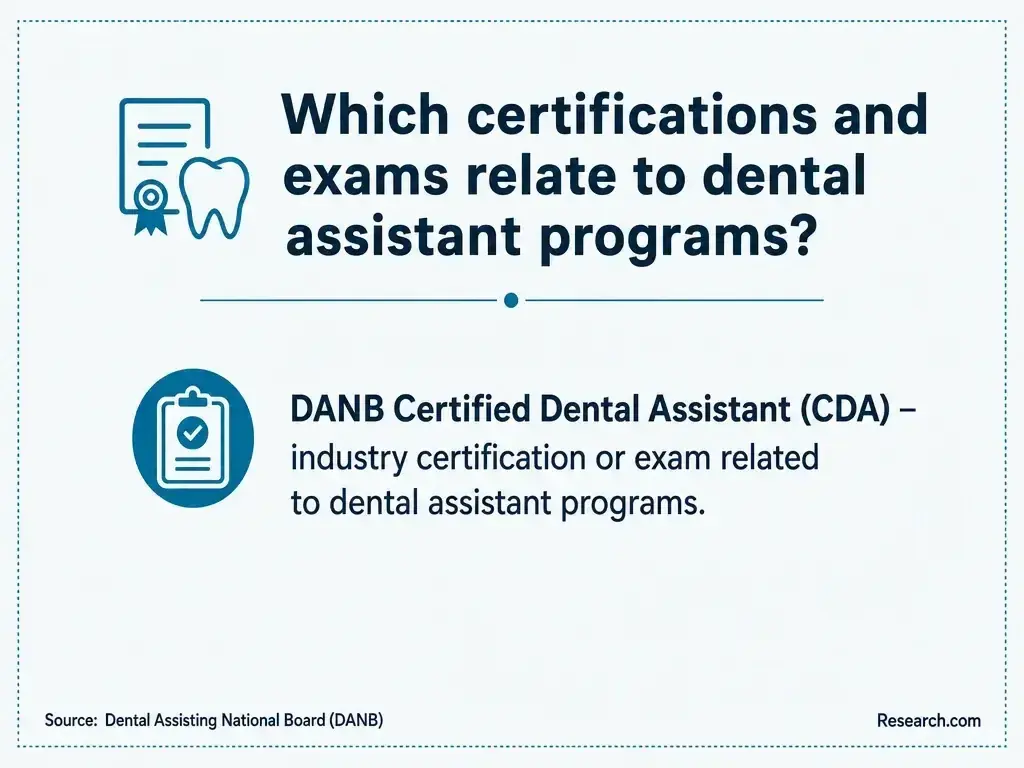
The Dental Assisting National Board's Certified Dental Assistant (CDA) credential has its own eligibility and examination requirements. CODA programmatic accreditation may matter to a particular certification pathway, while institutional accreditation concerns the school as a whole; neither automatically grants Texas authorization for regulated duties (Dental Assisting National Board; Commission on Dental Accreditation; Texas State Board of Dental Examiners). Ask the school to document its current accreditation status and explain precisely how its graduates qualify for the credential they advertise.
Requirements vary by provider. Schools may ask for proof of secondary-school completion, an application, and documents needed for clinical placement; a practice offering supervised training may instead hire and train an entry-level applicant. Obtain the written requirements for the program and its clinical sites, including any health, background, or scheduling conditions, before paying a deposit.
If you are returning to training later in life, a broad search for top online degrees for seniors will not tell you whether a dental-assisting clinical schedule is manageable. Ask about evening labs, placement travel, and whether documented prior training can reduce coursework. Do not assume that previous work experience waives Texas requirements for a regulated procedure.
Core training typically covers dental terminology and anatomy, instrument identification, infection prevention, chairside assistance, patient records, and practice communication (U.S. Bureau of Labor Statistics; Dental Assisting National Board). Depending on the program and intended duties, it may also address radiography, dental materials, impressions, or office software. Digital records and imaging make equipment-specific practice particularly valuable; ask what systems students actually use rather than relying on a technology list in an advertisement.
A useful skills demonstration should let you perform procedures under supervision and receive feedback. Before enrolling, compare the lab tasks and clinical responsibilities - not merely course titles - with the duties in local job postings and with Texas rules.
Texas does not make one professional certification a blanket prerequisite for every dental assistant job. The distinction is what you will do: the Texas State Board of Dental Examiners regulates dental assistants' performance of specified duties and its Registered Dental Assistant (RDA) process. Check the board's current requirements for radiographs and any other procedures you expect to perform; completing a school course does not itself confer board registration or permission to perform every task (Texas State Board of Dental Examiners).
CDA certification from the Dental Assisting National Board is a separate professional credential, not a Texas occupational license. Before choosing training, ask the provider to identify its preparation for board requirements, any required applications or assessments, and the separate eligibility route for a certification exam. Confirm the answers directly with the board or certifying organization because rules and eligibility pathways can change.
Start with your intended first job and duties, then compare the programs that can credibly prepare you for them. The accompanying ranking is a shortlist tool, not a substitute for checking current campus offerings or Texas eligibility. In particular, do not confuse a school's authorization to operate, institutional accreditation, CODA programmatic accreditation, certification preparation, and board registration: each answers a different question.
Use these questions when speaking with admissions staff and, where possible, a clinical-placement coordinator:
Be wary of guaranteed employment claims, vague clinical promises, or statements that accreditation alone makes you registered. Keep the comparison focused on occupational entry: even search results for unrelated options such as cheap doctoral programs cannot answer whether dental-assisting training is the right investment for your goal.
An entry-level assistant may begin in a general practice and develop experience in orthodontics, pediatrics, oral surgery, or administrative coordination. Additional duties can require training and Texas authorization; optional CDA certification may help demonstrate professional knowledge but is not a blanket entry requirement (Texas State Board of Dental Examiners; Dental Assisting National Board).
Choose clinical training if you want frequent patient contact and chairside work. If you prefer scheduling, records, and billing, ask whether an employer offers a front-office route rather than paying for a clinical program you do not intend to use. Advancement to lead or specialty-assistant work depends on experience, employer needs, and authorization for the tasks involved; no short course guarantees it.
The U.S. Bureau of Labor Statistics projects 7.4% growth in dental assistant employment nationally from 2025 to 2035. That supports considering the occupation, but it is not a San Antonio forecast or a promise of a local opening. Review current postings across general and specialty practices before choosing a program, noting how often they request experience, radiography eligibility, certification, or particular schedules.
For a new entrant, the most useful demand signal is whether reachable employers hire people with the credential and supervised experience your program actually supplies. Ask schools for recent, program-specific placement information and compare it with what local practices advertise.
Education is a significant investment. To make the accompanying ranking useful and credible, the Research.com team compares dental assistant programs with others in the same occupation and location, using reported outcomes, costs, debt, and quality indicators. Only programs with completions reported to IPEDS are included; a provider's absence does not establish that it is unavailable or unsuitable.
For best-program rankings, student outcomes include completion and full-time and part-time retention. Earnings measures include median earnings one year after completion and earnings relative to annual attendance cost. Cost measures include tuition, attendance cost, median debt - including for students who withdrew - and federal loan default rates. Institutional accreditation receives 10% of the score, relevant programmatic accreditation or industry recognition 20%, and student support services 10%. Outcomes, earnings, and costs share the remaining 60% through an entropy-based method that assigns more weight to indicators that vary more across programs. Most-affordable rankings instead score only costs and debt with entropy-based weights; accreditation and other quality measures are not part of that score.
The team uses the following sources to evaluate reported information and relevant forms of recognition. Some sources cover broader trades or health education and do not, by themselves, establish Texas dental-assisting eligibility.
The ranking can narrow a shortlist, but it cannot replace checking a program's current curriculum, total price, clinical arrangements, and alignment with Texas requirements. More detail on the ranking approach appears in Research.com's methodology.
# 1 position
# 2 position
# 3 position
# 4 position
# 5 position
# 6 position
Dental Assisting/Assistant
Delivery mode: On Campus (May Include Online Courses)
18.37
/ 100
Final score
Accreditation
Institutional accreditation from Accrediting Council for Continuing Education & Training.
Lamson Institute received a Research.com Trade Program Score of 18.37/100.
Some Texas practices train assistants on the job. Check which duties you could perform initially and what additional board requirements apply to the duties you want later (Texas State Board of Dental Examiners).
Do not assume so. Chairside skills require in-person practice, and online completion alone does not establish eligibility for Texas-regulated duties.
No. CODA accredits programs; it is not an individual license. It can matter for a chosen certification pathway, so verify that pathway before enrolling (Commission on Dental Accreditation; Dental Assisting National Board).
Only if it provides enough supervised practice, fits your schedule, and prepares you for the duties and credentials your target employers expect. Compare total cost and time to job readiness, not course length alone.
No. The May 2025 national median of $48,070 covers workers at different experience levels and is not a local entry-level offer (U.S. Bureau of Labor Statistics).