# 1 position


Audited and Verified:
Our Editorial and Data Verification Process
Research.com uses government datasets, official education statistics and primary institutional information to support its career and degree guides. Our review process checks factual accuracy, occupational definitions, source dates and the requirements associated with the credentials discussed.
How This Article Was Fact-Checked
Our editorial team verifies salary estimates, employment projections, education requirements and program information against original data providers and official organizations. Salary figures are checked against the relevant occupational definitions and reporting periods. Information about licensure, accreditation and required in-person training is reviewed separately.
Fact-checked and verified on:

Co-Founder and Chief Data Scientist

Reviewed by Karolina Broda
Fact-Checker and Data Verification
Choosing the cheapest dental assistant training in Alaska is not as simple as comparing tuition: clinical practice, travel, and eligibility for specific duties can change the value of a program. The U.S. Bureau of Labor Statistics projects 7.4% national growth in dental assistant employment from 2025 to 2035. This guide explains the costs, credentials, and work-based alternatives behind that opportunity. It also features a Most Affordable Dental Assistant Trade Schools in Alaska for 2027 ranking, created by the Research.com team of data scientists to help students identify programs worth considering.
Dental assistant training prepares students to support dentists during patient care, prepare instruments and rooms, maintain infection-control procedures, and handle records or scheduling. A program may award a certificate or diploma; an associate-degree pathway takes longer and may include more general education. The credential's name alone does not show how much supervised chairside practice it includes (U.S. Bureau of Labor Statistics; Commission on Dental Accreditation).
Alaska students can compare college-based training, career-school programs, and positions that provide employer-led training. Availability, schedules, and clinical placements can change, so confirm current offerings directly with the University of Alaska Fairbanks, University of Alaska Anchorage, or Charter College if considering those providers. For someone outside a training center, travel or temporary housing may matter more than a small tuition difference.
A structured program can be worthwhile if it supplies practice, an attainable clinical placement, and preparation for the duties local employers request. Someone who has a suitable paid training offer may prefer to learn on the job rather than pay for a program whose practical experience is limited.
Dental assistants primarily work in dental offices, where they may divide their time between chairside care, sterilization, imaging-related tasks permitted under applicable rules, and front-office work (U.S. Bureau of Labor Statistics; Alaska Board of Dental Examiners). Ask employers which duties new assistants actually perform and what training they provide before choosing a curriculum.
Location affects access to both training and jobs. A student in a smaller community should confirm whether a local practice will host required clinical work and whether openings exist nearby; an Anchorage-based placement is less useful if relocating is not feasible. A program's statewide marketing does not establish that it has a clinical site in your community.
Do not substitute a national figure for a local offer. The U.S. Bureau of Labor Statistics reports a May 2025 national median annual wage of $48,070 for dental assistants. That figure covers experienced and newly trained workers alike; it neither predicts Alaska pay nor represents a typical first paycheck.
For a realistic return-on-investment estimate, compare current Alaska dental assistant wage data from the Alaska Department of Labor and Workforce Development with posted pay in the community where you intend to work. Then weigh likely earnings against total training cost, time away from paid work, financial aid, debt, your chance of completing the program, and how long you expect to remain in the occupation. The median is a benchmark - not a guaranteed return.
Duration depends on the route: employer training can begin with a job, while a certificate or diploma follows its provider's academic and clinical schedule. An associate-degree pathway generally requires a longer commitment because it includes additional coursework. There is no single program length or set of clock hours that applies to every Alaska dental assistant pathway (U.S. Bureau of Labor Statistics; Alaska Board of Dental Examiners).
Ask for the current program calendar and a written breakdown of classroom, lab, and supervised clinical hours. Also ask whether clinical hours must be completed in a particular location and whether a delayed placement could postpone completion. An accelerated calendar only saves time if you can attend every practical component.
Online coursework can help with terminology, records, and infection-control concepts. It cannot, by itself, demonstrate chairside technique, instrument handling, or patient-facing skills. A hybrid option makes sense for a student who can reach its required lab and clinical sites; a campus-based option may be easier when practice facilities and placements are coordinated locally (U.S. Bureau of Labor Statistics; Commission on Dental Accreditation).
Search results for accredited accelerated degree programs online describe a different educational choice. For dental assisting, ask exactly which activities happen in person, who arranges the placement, and whether its location and schedule work for you. Do not assume an online certificate establishes eligibility for certification or for particular Alaska duties.
There is no reliable single Alaska-wide average that covers college programs, career schools, and employer training on the same basis. Published tuition can also omit substantial costs. Lists of most affordable online degrees are therefore not a substitute for a dental assistant training budget.
Request an itemized, current quote from each provider and compare the amount needed to become job-ready:
Federal aid depends on the student's and program's eligibility, not simply on a school being accredited (Federal Student Aid). Confirm aid before subtracting it from your estimate. A lower-priced program may cost more overall if clinical travel is substantial or its schedule prevents you from working.
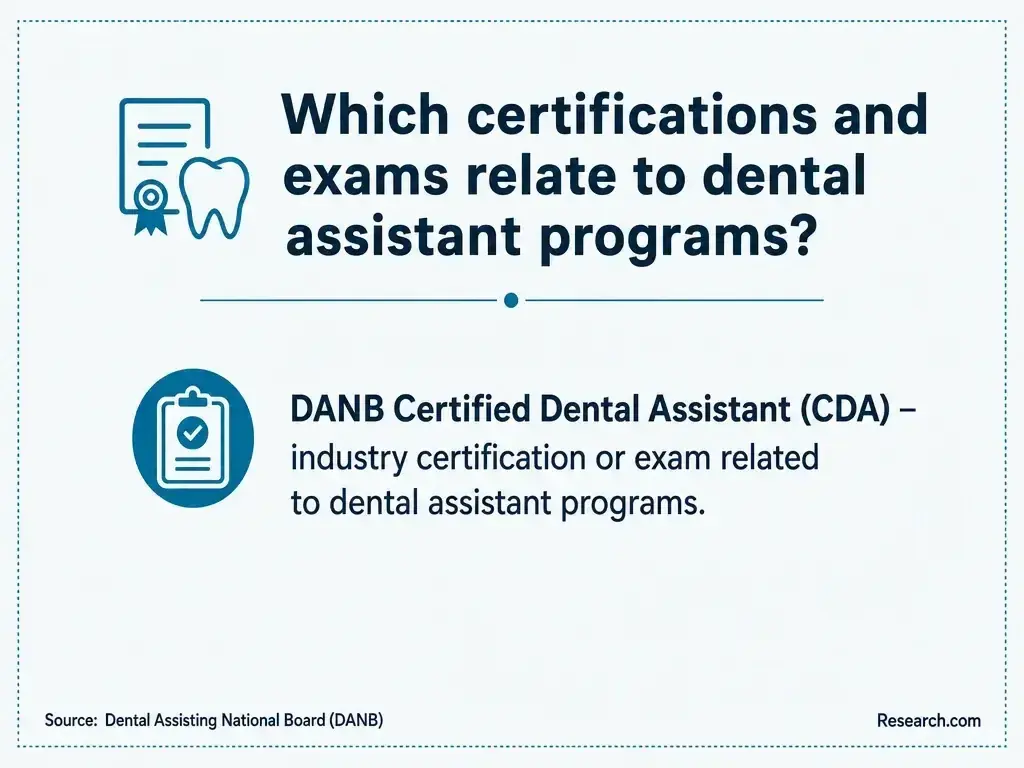
The award depends on the provider: it may be a certificate, diploma, or associate degree. Employer training may lead to work experience without an academic award. Certified Dental Assistant (CDA) is a separate professional certification administered by the Dental Assisting National Board (DANB), not another name for a school certificate. DANB sets its own eligibility and examination rules; verify the current pathway before assuming a particular program qualifies you.
Institutional accreditation concerns a school, while Commission on Dental Accreditation (CODA) recognition concerns a specific dental program. State authorization, professional certification, and permission to perform regulated duties are separate questions. Ask a provider to identify its exact award and document any claimed CODA status or DANB exam eligibility (CODA; DANB; Alaska Board of Dental Examiners).
Requirements vary by provider and clinical site. Before applying, check the school's current admissions rules and ask whether placement requires health documentation, a background check, or other site-specific clearance. Also confirm when those requirements are due and whether their costs are included in the quoted price.
For an employer-training route, ask whether the practice hires beginners, which tasks it teaches under supervision, and whether the position is paid from the start. School admission is not the same as permission to perform every dental assisting function; check the intended duties against Alaska Board of Dental Examiners requirements.
Relevant training covers dental terminology, patient communication, instrument preparation, infection control, chairside assistance, and office procedures. Programs may also teach dental imaging and additional clinical techniques, but students should verify how the instruction aligns with current Alaska rules for the tasks they want to perform (U.S. Bureau of Labor Statistics; Alaska Board of Dental Examiners).
The important comparison is demonstrated practice, not a course title. Ask how students practice on equipment, who supervises them, how clinical competence is assessed, and whether they work with patients before completion. A program focused mostly on online modules may suit someone already training in a dental office better than a beginner who needs structured hands-on experience.
Do not assume that dental assistants hold the same occupational license as dentists or dental hygienists. Alaska's rules distinguish assisting work from functions that have specific training, supervision, or authorization conditions. The Alaska Board of Dental Examiners is the authority to consult for current rules, especially if you intend to take radiographs or perform additional functions. A school award alone does not authorize every task (Alaska Board of Dental Examiners).
DANB certification is a distinct professional credential with its own eligibility and exams; it should not be confused with a state license or a certificate of program completion (Dental Assisting National Board). Before paying a deposit, describe your intended duties to the program and ask for the applicable board rule, the training provided, and any remaining steps.
Start with the job you want and the community where you expect to work. The lowest listed price is useful only if the program provides accessible clinical practice and a credential that fits that goal. Someone comparing highest paying trade school jobs should also consider whether they want the daily patient-care and chairside work of dental assisting, rather than choosing on a wage figure alone.
Use this sequence to test a shortlist:
Beware of a program that advertises certification without explaining exam eligibility, calls itself fully online without accounting for practical training, or will not provide an itemized price. Rankings can start the search; they cannot replace these checks. A phd that does not require a dissertation is an unrelated educational path, not an advancement requirement for dental assistants.
A common starting point is general chairside assistance, with experience potentially leading to a broader mix of clinical or administrative responsibilities. Assistants may pursue DANB certification or training for additional permitted functions where useful to their employer and consistent with Alaska rules. Experienced workers may also take on scheduling, patient coordination, or team-training responsibilities (U.S. Bureau of Labor Statistics; Dental Assisting National Board; Alaska Board of Dental Examiners).
These are possible steps, not automatic promotions. When considering online courses for jobs that pay well, distinguish knowledge-building from a credential an employer recognizes or training that satisfies a practical requirement. Ask local practices what responsibilities they assign to experienced assistants before paying for an additional course.
The U.S. Bureau of Labor Statistics projects 7.4% growth in dental assistant employment nationally from 2025 to 2035. That signals a growing national occupation, but it does not establish the number of openings in a particular Alaska community or guarantee a job after training.
Use Alaska Department of Labor and Workforce Development projections and recent local postings to assess where you plan to live. In a small labor market, the availability of a supervising practice and a realistic clinical placement can matter more to your immediate prospects than national growth. If you need to remain in one community, investigate employer training and local vacancies before committing to travel-dependent schooling.
Investing in training is an important decision, particularly when Alaska students may need to travel for hands-on instruction. Research.com designed this ranking to compare dental assistant programs with other programs in the same occupation and location. Only programs reporting completions to IPEDS are eligible; a provider's absence does not mean it is unapproved or unsuitable.
The most affordable ranking scores tuition, cost of attendance, median student debt, and federal loan default rates. An entropy-based method gives more weight to cost and debt measures that distinguish programs most clearly. Accreditation and other quality indicators are not part of this affordability score. Research.com separately evaluates those indicators in its best-program rankings, so readers should check training quality and career fit themselves. More detail is available in the Research.com methodology.
The team used the following sources to check education data and relevant recognition. Some sources cover the broader trade-school landscape; their inclusion does not mean they accredit dental assisting programs.
Use the ranking to narrow a cost-conscious shortlist, then confirm each program's current price, clinical arrangements, and suitability for the duties you want to perform. College-oriented datasets do not cover every employer-training or other noncollege route.
# 1 position
# 2 position
# 3 position

# 4 position
# 5 position

Paid employer training may minimize upfront school costs if a practice hires beginners. Compare its pay and supervised instruction with a program's full cost, including clinical travel; the cheapest tuition is not necessarily the cheapest route to job readiness.
You may complete some coursework online, but beginners still need practical instruction and supervised experience to develop chairside skills. Confirm in-person requirements and their location before enrolling.
No. A school certificate documents program completion. DANB certification is a separate professional credential with its own eligibility and examination requirements (Dental Assisting National Board).
No. It includes eligible programs reporting completions to IPEDS. Employer training and some other routes may not appear, so compare them separately.
Get the total price, clinical schedule and location, exact credential, and any certification-eligibility claims in writing. Check current rules for your intended duties with the Alaska Board of Dental Examiners.