# 1 position


Audited and Verified:
Our Editorial and Data Verification Process
Research.com uses government datasets, official education statistics and primary institutional information to support its career and degree guides. Our review process checks factual accuracy, occupational definitions, source dates and the requirements associated with the credentials discussed.
How This Article Was Fact-Checked
Our editorial team verifies salary estimates, employment projections, education requirements and program information against original data providers and official organizations. Salary figures are checked against the relevant occupational definitions and reporting periods. Information about licensure, accreditation and required in-person training is reviewed separately.
Fact-checked and verified on:

Co-Founder and Chief Data Scientist

Reviewed by Karolina Broda
Fact-Checker and Data Verification
Choosing a dental assistant program in Nevada means weighing more than tuition: hands-on training, radiography preparation, and time away from work can change its value. The U.S. Bureau of Labor Statistics reports a $48,070 national median annual wage for dental assistants in May 2025. This guide helps prospective students compare costs, credentials, and routes into the occupation. It will feature a Most Affordable Dental Assistant Trade Schools in Nevada for 2027 ranking, created by the Research.com team of data scientists to help students make an informed choice about programs worth considering.
Expect a mix of classroom instruction, simulated practice, and, in many programs, supervised experience in a dental office. The essential question is whether you will practice infection control, chairside procedures, and patient communication before an employer expects you to perform them. Program titles alone do not establish how much clinical experience you receive.
These pathways differ in cost, structure, and the evidence of training you can show an employer.
| Pathway | Typical credential or outcome | Best fit and trade-off |
| Community college program | Certificate or, where offered, associate degree | Useful for structured labs and an academic credential; check course sequence and total time. |
| Private career-school program | Certificate or diploma | May offer a focused schedule; compare all fees, clinical placement, and financing terms. |
| Dental-office training | Employer-specific experience, sometimes alongside optional certification preparation | Can reduce upfront school costs and allow earnings while learning; training breadth and supervision vary. |
In Nevada, compare the clinical arrangements available near your home as carefully as the classroom location. A program that requires frequent travel to a distant office may be less affordable than its advertised tuition suggests. Office-based training is a realistic alternative for general entry, but it should not be mistaken for a registered apprenticeship or a standardized credential unless the sponsor confirms those features.
Most dental assistants work in dental offices, supporting dentists during procedures, preparing treatment rooms, managing instruments, and helping patients. Nevada opportunities also include specialty practices, such as orthodontic or oral-surgery offices, and some larger group practices. Exact duties depend on the employer's services and Nevada's rules governing particular procedures (U.S. Bureau of Labor Statistics; Nevada State Board of Dental Examiners).
Location affects the search. Students near Las Vegas or Reno-Sparks can compare more potential clinical sites within a manageable commute; someone in a rural area should ask whether the school can arrange a placement nearby. Before enrolling, ask where recent students completed practical training - not just whether the school advertises employer connections.
Pay varies by location, experience, duties, and employer. The U.S. Bureau of Labor Statistics reports a $48,070 national median annual wage for dental assistants in May 2025. That is a midpoint for employed workers across experience levels, not a Nevada starting salary or a promised return on a certificate.
For a local decision, compare the latest Nevada and metropolitan-area dental assistant wage estimates from the U.S. Bureau of Labor Statistics or Nevada's labor-market agency with actual entry-level job postings. Use the location where you intend to work. Then compare likely pay with what you earn now, the time you would spend training, and any debt - not with a national median alone.
Focused certificates generally take less time than associate-degree programs, while employer training may let you begin paid work sooner. There is no single program length or statewide clock-hour minimum that makes every general dental assistant training route equivalent. Ask each provider for its published calendar, total contact hours, lab hours, required clinical hours, and the schedule for any off-site placement (Nevada State Board of Dental Examiners; U.S. Bureau of Labor Statistics).
A short course can be worthwhile if it covers the procedures your intended employer expects and provides credible hands-on practice. It may be a poor bargain if you must later purchase separate radiography instruction or find your own clinical experience. Readers comparing short occupational credentials more broadly can consult best 6 month courses that pay well, but should judge dental assisting on its practical training, not its speed alone.
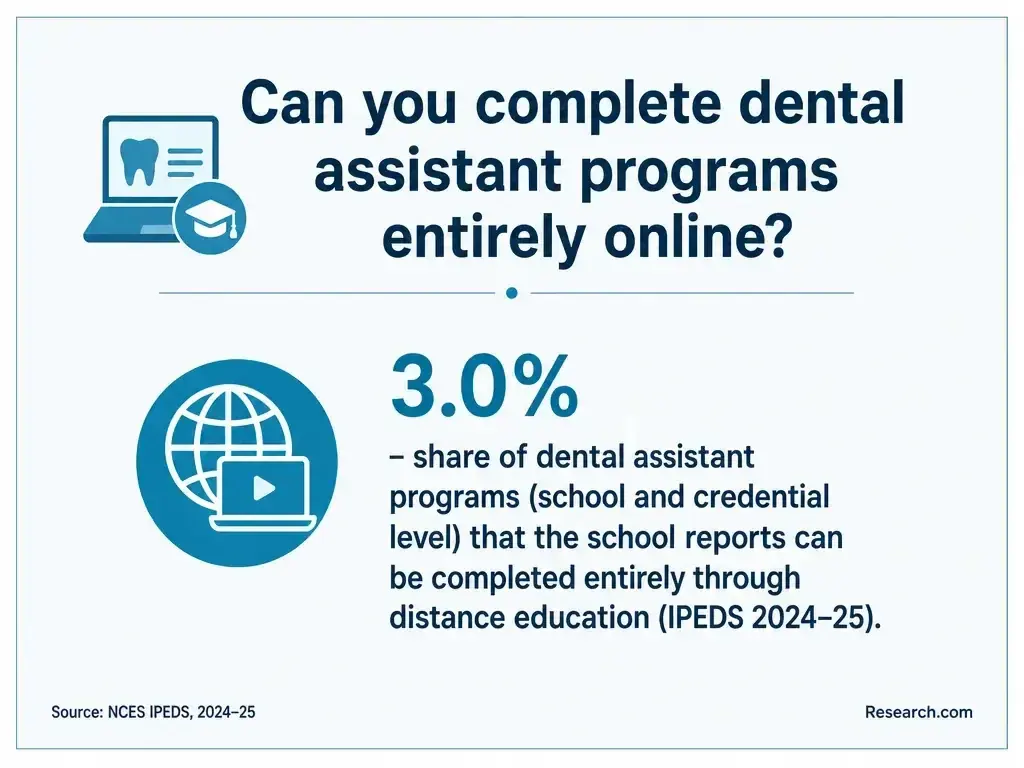
Online coursework can cover terminology, anatomy, scheduling, and infection-control principles. It cannot replace practicing instrument transfer, chairside assistance, equipment setup, or other physical tasks with appropriate supervision. A hybrid program can work well for a student with a job if its in-person labs and clinical schedule are feasible.
Before choosing among top accredited online schools or a local campus option, ask where the hands-on instruction takes place and who secures the clinical site. Institutional accreditation does not establish that a particular online dental assistant course includes adequate practical training or prepares you for duties governed by Nevada rules. A fully remote certificate without a clear practice plan is a red flag for someone seeking chairside work.
There is no reliable single statewide average that covers community colleges, career schools, and office-based training on comparable terms. Published tuition may exclude costs needed to become job-ready, and an employer-trained assistant may pay little tuition while receiving a different amount of structured instruction. Request a written, itemized estimate from every provider you are considering.
This breakdown shows what to include when comparing offers; it is a cost checklist, not a price quote.
| Cost category | What to verify |
| School charges | Tuition, mandatory fees, books, software, supplies, uniforms, and protective equipment. |
| Career-entry expenses | Any separate radiography training, certification exams, required checks or health documentation, and travel to labs or clinical sites. |
| Financing and time | Grants, scholarships, eligible aid, loan interest, unpaid clinical time, and earnings forgone while attending. |
Ask whether federal aid is available for the specific program, not merely for the institution, and check Nevada workforce-service eligibility if you need retraining assistance (Federal Student Aid; Nevada Department of Employment, Training and Rehabilitation). Paid office training can offset lost earnings, but compare the skills and supervision provided before treating it as the cheaper equivalent of a school program.
A school may award a certificate or diploma; an associate-degree pathway, where available, awards a degree. These are educational credentials, not a Nevada occupational license. The Dental Assisting National Board's Certified Dental Assistant (CDA) credential is a separate professional certification with its own eligibility and examination requirements. Check current eligibility directly with the Dental Assisting National Board rather than assuming every school certificate qualifies you.
Programmatic accreditation is separate again: the Commission on Dental Accreditation accredits eligible dental assisting programs, while institutional accreditation concerns the school. Neither should be confused with Nevada school authorization or permission to perform a regulated duty (Commission on Dental Accreditation; Nevada State Board of Dental Examiners). If you want a credential that may support further study, ask about credit transfer before enrolling; an affordable online associate's degree is not, by itself, a substitute for dental assisting labs or clinical practice.
Schools set their own admissions rules, which may include a high school diploma or equivalent, an application, and placement or orientation steps. Clinical sites may have additional health, background-check, or scheduling requirements. Request the current admissions and placement policies in writing before paying an enrollment deposit; do not assume another provider uses the same rules.
Office-based entry is different from school admission: an employer may hire and train an assistant under its own hiring standards. If that route appeals to you, ask who supervises new assistants, which duties you can learn, and whether the employer pays for any later instruction or examinations.
Relevant training covers dental terminology and anatomy, infection prevention, instrument handling, chairside assistance, patient communication, records, and office workflow. Many programs also teach dental materials and radiography concepts; the extent of supervised radiography preparation needs separate verification against Nevada requirements for the duties you want to perform (U.S. Bureau of Labor Statistics; Nevada State Board of Dental Examiners).
When comparing similarly named programs, ask to see the skills checklist and how students are assessed in person. Demonstrating safe instrument processing and working effectively with a patient matters more to a chairside employer than completing online quizzes alone. Digital records and imaging are also reasons to look for practice with current office workflows, while confirming that any equipment instruction is supervised and appropriate to a student's permitted role.
Nevada does not issue a general occupational license that every dental assistant must obtain before working. That does not mean every assistant may perform every task: check Nevada State Board of Dental Examiners rules and employer supervision requirements for radiography and any other specific duty you hope to perform. Obtain the board's current requirements before buying a course advertised as "license-ready" (Nevada State Board of Dental Examiners).
National certification, such as the Dental Assisting National Board's CDA, is distinct from state permission to work and may be useful to an employer without being a general entry requirement. Likewise, school authorization, institutional accreditation, and Commission on Dental Accreditation program accreditation answer different questions. Ask the school to identify exactly which credential its graduates receive and which examinations its curriculum prepares them to take (Dental Assisting National Board; Commission on Dental Accreditation).
Start with the job you want, then compare programs on the training needed to do it safely. The affordability ranking can narrow the field, but it does not score clinical quality or determine whether a program meets your goals. For each option, request answers to these questions before enrolling:
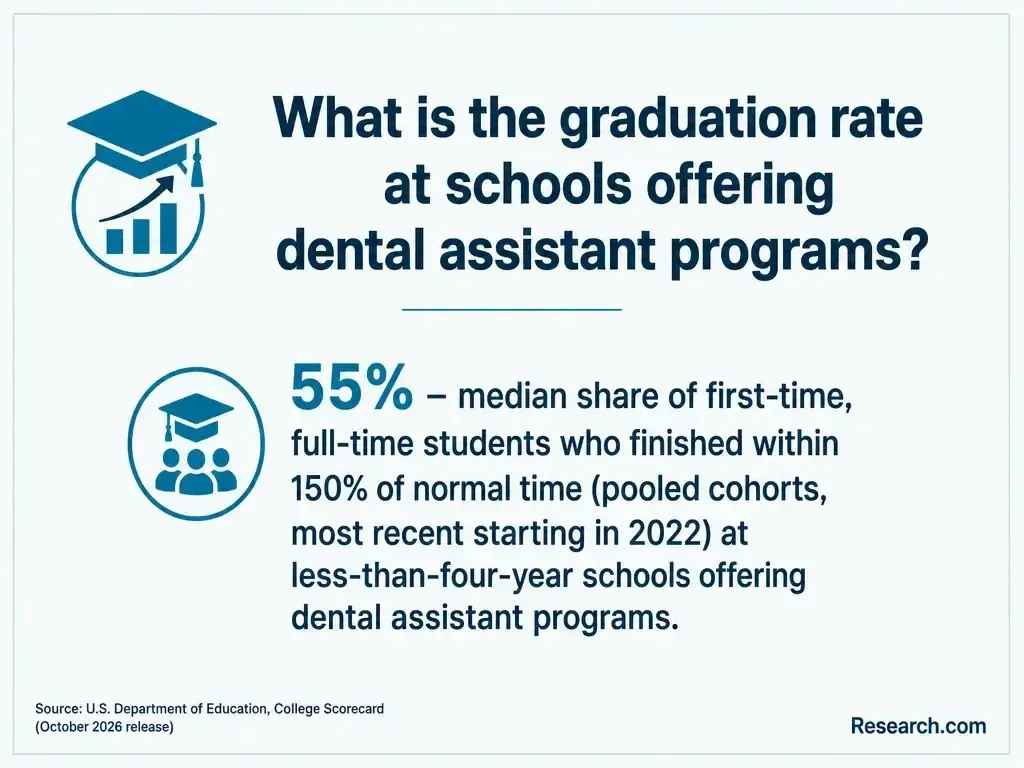
Compare the answers with an office-based training offer, too. A worthwhile investment depends on completion probability, financial aid, debt, earnings you give up while training, and realistic post-training pay over time - not institutional type or sticker price alone. If your main question is which bachelor degree is the easiest, that is a different education decision; for this occupation, prioritize the shortest appropriate route to supervised practical competence.
The direct route is a general dental assistant position. With experience and suitable training, an assistant may take on more specialized chairside responsibilities, move into orthodontic or oral-surgery office work, coordinate patients and treatment, or supervise office workflows. Duties remain subject to Nevada rules and employer policies; a promotion or optional certification does not independently authorize a restricted procedure (Nevada State Board of Dental Examiners).
Dental assisting training should not be marketed as a shortcut into a different licensed dental occupation. If you are comparing what jobs can you get with a vocational education, evaluate each occupation's own training and entry rules rather than assuming one certificate transfers to another role.
The U.S. Bureau of Labor Statistics projects 7.4% growth nationally in dental assistant employment from 2025 to 2035. This supports considering the occupation, but it is not a Nevada forecast and does not show how many openings will be convenient to a student's home. Local hiring also depends on office turnover, specialty mix, and the duties an employer needs covered.
Before committing to training, review current Nevada labor-market projections alongside job advertisements in the area where you can commute. Note whether postings seek experience, radiography preparation, or certification, then compare those expectations with each program's practical training. That local match is more useful than treating a national growth figure as a guarantee of employment (U.S. Bureau of Labor Statistics; Nevada Department of Employment, Training and Rehabilitation).
Investing in training is an important decision, so Research.com's team assembled the ranking to make local cost comparisons more credible and useful. Programs are compared with other dental assistant programs in Nevada, and only programs with completions reported to the Integrated Postsecondary Education Data System (IPEDS) are eligible. That scope is important: an employer training route or a school absent from IPEDS is not necessarily unavailable or unsuitable.
The most affordable ranking scores tuition, cost of attendance, median student debt, and federal loan default rate. An entropy-based method gives more weight to measures that distinguish programs more clearly. Accreditation, student support, and earnings are not part of this affordability score. For context, Research.com's separate best-program rankings consider student outcomes; earnings and return on investment; costs and debt; and quality and recognition. Their weights assign 20% to occupation-relevant programmatic accreditation or industry recognition, 10% to institutional accreditation, 10% to student support, and 60% to outcomes, earnings, and costs distributed through an entropy-based method.
The team used the following sources to assemble and check ranking information. Some sources address particular provider or training types; listing one does not mean its approval applies to every dental assistant program.
The ranking is a starting point for a shortlist, not a finding that the lowest-ranked-cost option provides every clinical skill or certification pathway a student needs. Readers can review Research.com's methodology for more on how rankings are created, then verify current prices and training details directly with each provider.
# 1 position
# 2 position
# 3 position

# 4 position
# 5 position

# 6 position
# 7 position
# 8 position
# 9 position

Compare an itemized school quote with paid office-based training. The cheaper tuition option may cost more after supplies, clinical travel, debt, and unpaid time are included.
Yes, office-based training can be a route into general dental assisting. Confirm the employer's supervision and training plan, and check Nevada rules before performing any duty subject to specific requirements (Nevada State Board of Dental Examiners).
You can study some subjects remotely, but chairside skills require in-person practice. Ask where labs and supervised experience occur before enrolling.
No. A school certificate and the Dental Assisting National Board's CDA certification are different credentials; certification has separate eligibility and examination requirements (Dental Assisting National Board).
No. Confirm its full cost, practical training, schedule, and fit with your intended duties. The affordability score does not assess every feature that affects career readiness.