# 1 position


Audited and Verified:
Our Editorial and Data Verification Process
Research.com uses government datasets, official education statistics and primary institutional information to support its career and degree guides. Our review process checks factual accuracy, occupational definitions, source dates and the requirements associated with the credentials discussed.
How This Article Was Fact-Checked
Our editorial team verifies salary estimates, employment projections, education requirements and program information against original data providers and official organizations. Salary figures are checked against the relevant occupational definitions and reporting periods. Information about licensure, accreditation and required in-person training is reviewed separately.
Fact-checked and verified on:

Co-Founder and Chief Data Scientist

Reviewed by Karolina Broda
Fact-Checker and Data Verification
Choosing dental assistant training in Florida means checking more than tuition: the program must teach the hands-on skills and Florida-approved functions you want to perform. The U.S. Bureau of Labor Statistics projects 7.4% national growth for dental assistants from 2025 to 2035, but demand alone cannot tell you which credential is worth buying. This guide compares training routes, costs, and career requirements. It also accompanies the Best Dental Assistant Trade Schools in Florida for 2027 ranking, created by the Research.com team of data scientists to help students identify programs worth considering.
Expect a mix of classroom instruction, simulation, and patient-care practice. Dental assistants prepare treatment rooms, support dentists during procedures, handle instruments, document care, and help patients understand instructions, according to the U.S. Bureau of Labor Statistics. A useful program lets you practice infection control and four-handed dentistry before expecting you to work at chairside speed.
Florida students have several distinct routes. A public technical or community-college certificate may suit someone seeking structured skills at a price worth comparing with a private career-school diploma. A CODA-accredited dental-assisting program may be particularly valuable if eligibility for Dental Assisting National Board certification is a priority. Employer-sponsored, on-the-job training can be a lower-upfront-cost route into basic duties, but ask whether the employer will provide documented training for radiography or expanded functions. A registered apprenticeship should be considered only if an actual local sponsor offers a dental-assisting opening; apprenticeship status is not a general Florida entry requirement.
The right route depends on the work you want to do, not the credential's name. Before committing, compare clinical placement, Florida-approved coursework, and certification eligibility. If chairside healthcare work is not your goal, a broader college majors list and careers comparison may help you reconsider the occupation before paying a deposit.
Most dental assistants work in dentists' offices, according to the U.S. Bureau of Labor Statistics. In Florida, that can mean a general practice, a pediatric or orthodontic office, a group practice, or a public-health setting. The employer and practice type affect your daily work: a small office may combine chairside and front-desk responsibilities, while a specialty practice may train you on its procedures and equipment.
When comparing programs, ask where students complete clinical practice and whether the school has placement relationships within a commute you can sustain. That matters especially if attending a campus outside a major metro area would require separate travel to a clinic. Chairside assisting also involves sustained patient interaction and close teamwork; readers comparing workplace styles can explore best paying jobs for introverts, but should judge dental assisting by its actual patient-facing duties.
The U.S. median annual wage for dental assistants was $48,070 in May 2025, according to the U.S. Bureau of Labor Statistics. That is a national, occupation-wide midpoint - not a Florida wage, a starting salary, or a return guaranteed by a training program. For a local pay decision, consult the latest Florida occupational wage estimates from the Florida Department of Commerce or the BLS Occupational Employment and Wage Statistics program, then compare the metro area where you intend to work.
Ask prospective employers for their entry-level range and whether they pay more for radiography authorization, expanded-functions training, or relevant certification. Compare an offer's hours and benefits as well as its annualized pay: a higher quoted hourly rate may not offset fewer scheduled hours. Use realistic first-job earnings, rather than the national median, when deciding how much training debt you can afford.
There is no single Florida-wide clock-hour requirement for every dental assistant training route. Length varies with the credential, attendance schedule, clinical component, and whether the course covers radiography or expanded functions. Short courses focused on particular skills are not interchangeable with a comprehensive certificate or diploma; part-time study can make either route take longer.
Request the program's published calendar and a breakdown of classroom, lab, and supervised clinical hours. Confirm when clinical placement begins, who arranges it, and whether completing it could extend your graduation date. If a school promises rapid completion, check what you will actually be qualified and prepared to do at the end - not merely how soon it issues a certificate.
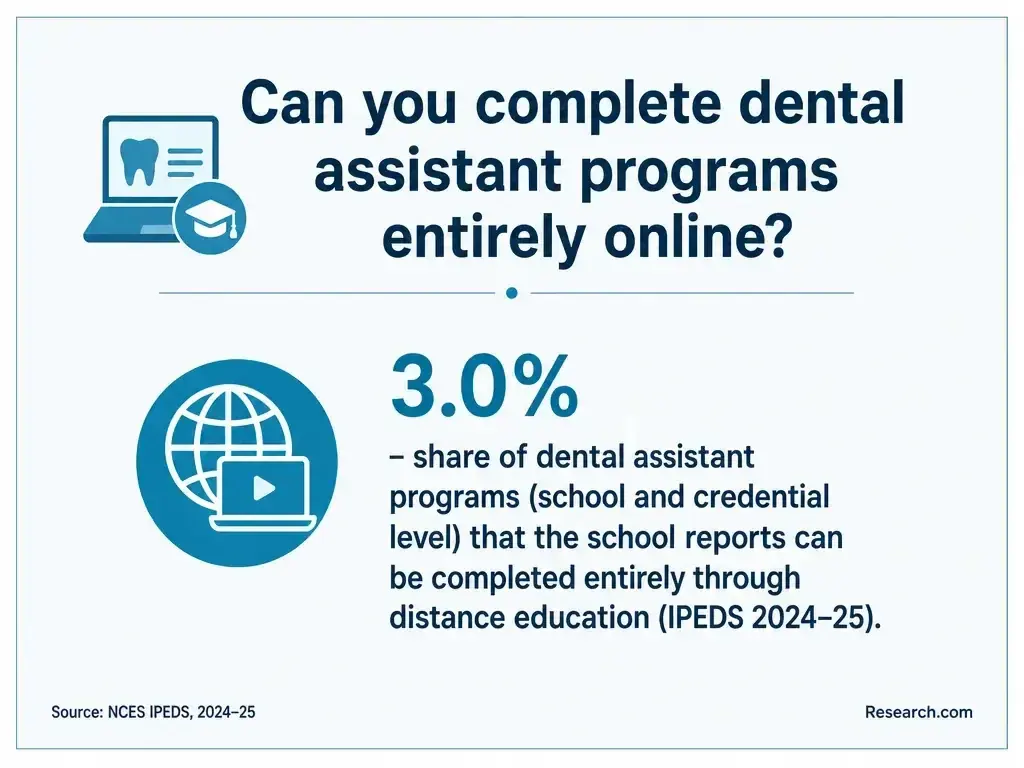
Online instruction can cover terminology, anatomy, recordkeeping, and some infection-control concepts. It cannot replace supervised practice in instrument handling, chairside assisting, patient positioning, or radiographic procedures. A hybrid program can work if its in-person labs and clinical experience are accessible; a fully online certificate should not be assumed to satisfy Florida requirements for radiography or expanded functions.
Ask for the address, schedule, and cost of every required in-person session before enrolling. If you are comparing remote study more broadly, a list of accredited non-profit online schools can help frame questions about institutional recognition, but institutional accreditation alone does not establish dental-assisting practical skills or Florida authorization.
There is no dependable single statewide price that captures Florida public programs, private career schools, short courses, and employer training on the same basis. Published tuition can omit substantial costs, and IPEDS coverage does not include every training provider. Instead of treating an advertised price as an average, request a written, itemized estimate for each route you are considering.
Use the same cost categories for every school so an accelerated option and a longer program can be compared fairly.
| Cost category | What to confirm |
| School charges | Tuition, mandatory fees, textbooks, supplies, uniforms, and any additional charge for labs or clinical placement. |
| Job-entry expenses | Required health screening or background checks, transportation to clinical sites, and applicable certification examination or Florida authorization fees. |
| Financing and time | Grants, scholarships, eligible federal or state aid, employer-paid training, borrowing costs, and earnings you may give up while attending. |
Florida public-program residency rules and aid eligibility can change the amount an individual pays; confirm both with the school. Eligible students can also ask a local CareerSource Florida center about workforce-training assistance. For a realistic return-on-investment comparison, account for completion probability, debt, earnings before and after training, program length, and how long you expect to work in the occupation. A lower sticker price is not necessarily the better investment if it leaves you paying separately for needed practical training.
Depending on the provider, you may earn a school certificate, a career or technical certificate, or a diploma. These document completion of that provider's curriculum; they are not automatically a Florida occupational license, a state radiography authorization, or the national Certified Dental Assistant (CDA) credential. A short expanded-functions course may award its own completion document rather than a comprehensive dental-assisting credential.
CODA accredits qualifying dental-assisting programs, while institutional accreditation concerns the school and state school authorization concerns permission to operate; these are different checks. DANB sets its own eligibility rules for CDA certification, including examination and pathway requirements. Ask a school to identify its exact credential and show how its curriculum meets the current requirements for your intended Florida duties and any DANB examination pathway you plan to pursue (sources: CODA, DANB, Florida Board of Dentistry).
Admissions requirements are set by the provider rather than by one statewide dental-assisting school standard. A school may require proof of prior education, an application, an assessment, or documentation needed for clinical placement. A clinic may separately require health records, screening, or a background check. Get the school's current written requirements before paying a nonrefundable fee.
If you are comparing school with direct employment, ask practices whether they hire and train assistants with no prior chairside experience and which duties trainees may perform. Also ask whether documented work experience could count toward a later certification pathway. Do not assume that prior learning or employer training transfers into a school program: request a written credit or advanced-standing decision from the receiving provider.
Core instruction typically covers dental anatomy and terminology, infection prevention, instrument processing, treatment-room setup, chairside assistance, patient communication, dental records, and practice workflow. The U.S. Bureau of Labor Statistics identifies these clinical and administrative tasks as part of the occupation. Programs may also teach dental materials, impressions or digital workflows, and radiography, but the permitted duties and required training must be checked against Florida rules.
Look past a course catalog's topic list. Ask how students demonstrate instrument transfer, protective procedures, patient positioning, and teamwork under supervision, and whether they practice with current equipment before entering a clinic. These are practical competencies an employer can assess directly; a similarly named credential from another provider may offer a different amount of hands-on practice.
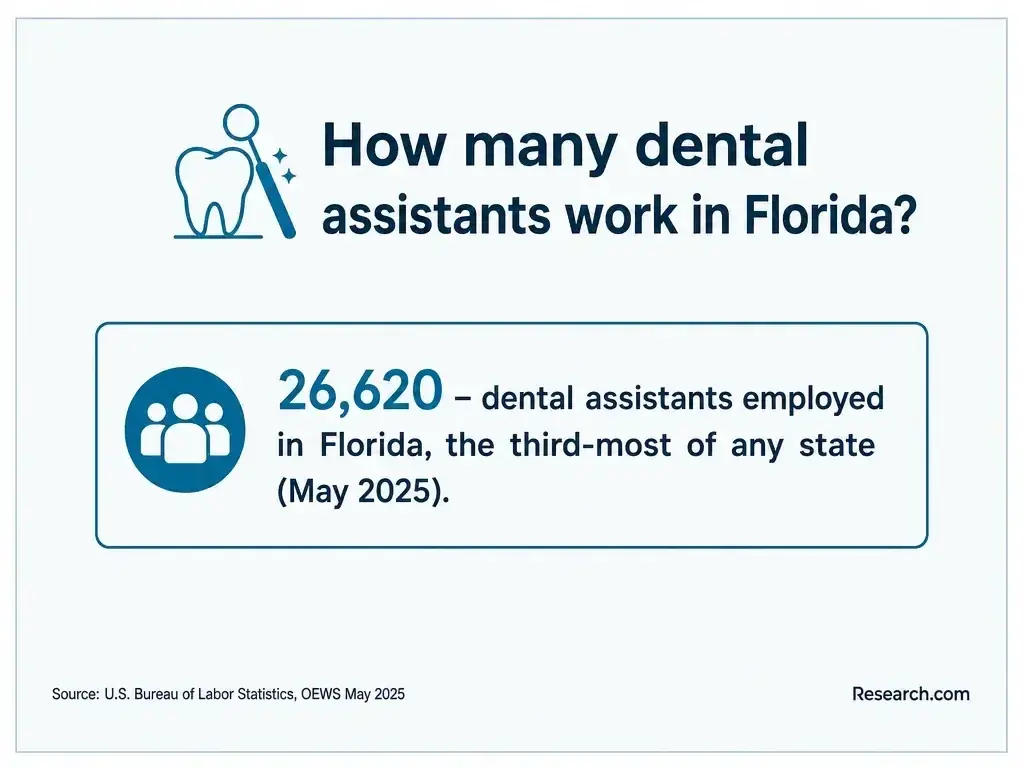
Florida does not issue a general dental assistant license for basic entry into the occupation. That does not mean every dental-office task is open to an untrained assistant. Florida regulates the delegation of expanded functions, and dental radiography has separate state training and certification requirements. Check the specific duty against current Florida Board of Dentistry and Florida Department of Health rules before relying on a school's description of what graduates can do.
National CDA certification through DANB is distinct from Florida permission to perform particular duties; it is not a substitute for state requirements. Likewise, graduating from an institutionally accredited school does not, by itself, establish radiography authorization or expanded-functions eligibility. Request the school's written explanation of the approved coursework it offers, the documentation you receive, and any additional state application or examination steps that apply (sources: Florida Board of Dentistry, Florida Department of Health, DANB).
Choose for your intended duties and likely first job, not ranking position alone. A structured program is more compelling when you need dependable labs, clinical practice, and a clear certification pathway. Employer training may make more sense when a practice offers paid supervision and will document the additional training you need. Compare both options against the same questions:
A red flag is a promise that an online-only course or a school completion certificate automatically authorizes every Florida dental-assisting duty. Another is an advertised placement or earnings claim without a defined period and population. Verify consequential claims with the relevant regulator, accreditor, certifying body, or employer before enrolling.
The immediate path is an entry-level chairside or combined clinical-and-administrative dental assistant role. With appropriate training and authorization, an assistant may take on additional permitted functions or radiography duties. Experience may also support work in a specialty practice, training new staff, or coordinating office operations; those are possible career moves, not automatic outcomes of a certificate (sources: Florida Board of Dentistry, U.S. Bureau of Labor Statistics).
Dental assisting training does not itself qualify someone for a different licensed dental occupation. If your goal is another role, compare that occupation's separate entry requirements before paying for an assistant program. Readers weighing a substantially different education investment can review easy bachelors degree options, but those routes are not substitutes for Florida-approved dental-assisting skills training.
The U.S. Bureau of Labor Statistics projects 7.4% growth in dental assistant employment nationally from 2025 to 2035. This supports considering the occupation, but it is not a Florida forecast or a promise of a vacancy in your preferred town. Review Florida Department of Commerce projections and local openings before choosing a campus or planning a commute; ask employers which practical skills and permitted functions they seek in new hires.
A sound investment decision pairs that local demand check with the program's total cost and your likely entry-level pay. If earnings are your primary reason for changing careers, bachelor's degree that pay well provides a separate comparison; do not use earnings from a different education path to estimate a dental assistant program's return.
Investing in training is an important decision, so Research.com compares dental assistant programs with other programs serving the same occupation and location - not with unrelated trades. The ranking includes only programs with completions reported to the Integrated Postsecondary Education Data System (IPEDS). That makes the comparison more consistent, but it also means the ranking does not cover every legitimate employer-training or short-course option.
The best-programs methodology evaluates student outcomes; earnings and return on investment; costs and debt; and quality and recognition. Programmatic accreditation or relevant industry recognition carries 20% of the score, institutional accreditation 10%, and student support services 10%. Completion, full-time and part-time retention, earnings one year after completion, earnings relative to annual cost of attendance, tuition, total attendance cost, debt - including debt held by students who withdrew - and federal loan default rates share the remaining 60% through an entropy-based method. Indicators that differ more across programs receive more weight. The separate most-affordable-programs methodology scores only tuition, attendance cost, debt, and loan default rates, with entropy-based weights; accreditation and other quality measures do not enter that score.
The team used the following sources to check reported education, outcome, recognition, and training information. Cross-trade sources are part of the broader ranking research; their inclusion does not make them dental-assisting accreditors or establish a Florida credential requirement.
Readers can use the ranking to narrow a shortlist, then verify each program's current price, clinical training, Florida approvals, and certification eligibility directly. More detail about the scoring approach appears on the Research.com methodology page.
# 1 position
# 2 position
# 3 position
# 4 position

# 5 position
# 6 position

# 7 position
# 8 position
# 9 position
# 10 position
# 11 position
# 12 position
# 13 position
# 14 position
# 15 position
# 16 position
# 17 position
# 18 position

# 19 position
# 20 position
Yes. Some employers train assistants for basic duties on the job. Ask who supervises that training and how you would obtain any separate preparation required for radiography or expanded functions (source: Florida Board of Dentistry).
No. CODA accreditation applies to qualifying education programs, not to every Florida entry-level job. It can matter for a particular certification pathway, so check your goals against current DANB eligibility rules.
Do not assume so. Florida dental radiography requirements are separate, and practical training cannot be inferred from an online certificate. Confirm the course's approval and required steps with the Florida Board of Dentistry and Department of Health.
Choose the option that provides the skills, clinical practice, and Florida-specific training you need at a manageable total cost. Compare written fee estimates and clinical schedules; speed and low tuition are useful only if the resulting training fits your intended job.
No. DANB certification has its own eligibility and examination rules, and hiring decisions belong to employers. Ask the school for its current certification-pathway explanation and clearly defined employment outcomes.