# 1 position
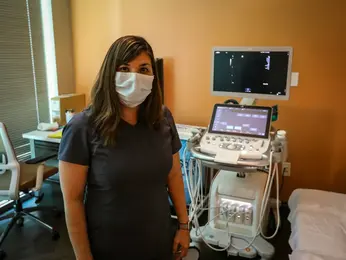
American Institute-Toms River - Dental Assisting/Assistant.
certificate or diploma

Audited and Verified:
Our Editorial and Data Verification Process
Research.com uses government datasets, official education statistics and primary institutional information to support its career and degree guides. Our review process checks factual accuracy, occupational definitions, source dates and the requirements associated with the credentials discussed.
How This Article Was Fact-Checked
Our editorial team verifies salary estimates, employment projections, education requirements and program information against original data providers and official organizations. Salary figures are checked against the relevant occupational definitions and reporting periods. Information about licensure, accreditation and required in-person training is reviewed separately.
Fact-checked and verified on:

Co-Founder and Chief Data Scientist

Reviewed by Karolina Broda
Fact-Checker and Data Verification
Choosing dental assistant training in Toms River means looking beyond a school's name: the program must teach chairside skills and fit New Jersey's rules for the duties you want to perform. The U.S. Bureau of Labor Statistics (BLS) projects 7.4% national growth in dental assistant employment from 2025 to 2035. For career starters and working adults, this guide explains training routes, costs, credentials, and local decision points. It also accompanies the Best Dental Assistant Trade Schools in Toms River for 2027 ranking, created by the Research.com team of data scientists to help students identify programs worth considering.
Expect instruction in chairside assisting, infection control, instrument processing, patient communication, and dental-office workflow, followed by practice with equipment and patients when the program includes a clinical placement. Ask each provider how many hours occur in a lab and how many occur in an actual dental practice; no single clock-hour figure describes every New Jersey pathway. A completion certificate documents training, but it does not itself confer registration or radiography authorization (New Jersey State Board of Dentistry).
A short school-based program can suit someone who wants structured practice before applying for jobs. Supervised training with a dental employer may suit someone who can secure an entry-level position and earn while learning, though access to procedures and the time available for instruction will depend on that office. A longer program is worthwhile only if its added clinical experience or credential preparation supports your intended duties. When comparing best certificate programs that pay well, use dental-assisting requirements - not the certificate label - as the test of job readiness.
Dental offices are the principal setting for dental assistants, including general and specialty practices such as orthodontic and oral-surgery offices (BLS). In Toms River, consider the practices you can realistically reach for both clinical placement and employment: a placement that requires an impractical commute can undermine an otherwise appealing program.
Ask whether a program arranges placements, how it selects offices, and whether students must find their own. An employer-training route can provide immediate exposure to one practice's systems; a school placement may let you assess a practice before accepting a job. Neither arrangement promises employment.
BLS reports a $48,070 national median annual wage for dental assistants in May 2025. That is the midpoint for employed assistants across experience levels nationwide - not a verified Toms River wage or an expected first-job offer. Use it as a broad career benchmark, then compare current Ocean County job postings by duties, required credentials, schedule, and benefits before estimating your own likely pay.
For a training investment, compare a realistic entry-level offer with what you could earn without enrolling. Registration or radiography authorization may widen the duties you can seek in New Jersey, but neither guarantees a particular pay increase (New Jersey State Board of Dentistry; New Jersey Department of Environmental Protection).
There is no universal program length or training-hour requirement for every entry-level dental assistant job in New Jersey. School calendars, attendance intensity, lab time, and clinical placements differ, while eligibility for particular expanded duties follows separate state rules (New Jersey State Board of Dentistry). Request each provider's published start-to-completion schedule and a breakdown of classroom, lab, and practice-site hours.
An accelerated schedule can get you to job applications sooner, but only if it leaves enough time to practice instrument handling, infection control, and chairside procedures. Part-time attendance may protect current earnings while extending the time to completion. Even when exploring an associates degree online fast, do not assume an accelerated online timetable can replace the in-person competencies needed for dental assisting.
Online instruction can cover terminology, anatomy, office procedures, and some infection-control concepts. It cannot by itself demonstrate safe instrument processing, chairside positioning, or patient-facing skills. A hybrid program is useful when it combines remote theory with accessible labs and supervised practice; a campus program may make equipment practice easier to schedule.
The format matters less than the verified practical component. Before enrolling, obtain the lab schedule, clinical-site location, supervision arrangements, and any required travel costs in writing. Do not infer that an "online dental assistant" credential satisfies New Jersey requirements for registration or dental radiography (New Jersey State Board of Dentistry; New Jersey Department of Environmental Protection).
A defensible Toms River average cannot be calculated without comparable, current prices for the programs a student could actually attend. Published tuition alone is not the price of becoming job-ready. Request an itemized quote from each provider and compare it with the costs and possible earnings of supervised employer training.
The following cost categories belong in the same comparison, even when one school includes an item in tuition and another bills for it separately.
| Cost category | What to verify |
| School charges | Tuition, mandatory fees, textbooks, software, materials, and withdrawal terms |
| Practical training | Uniforms, protective equipment, required health checks, and travel to labs or placements |
| Career entry | Any certification examination, state application, or radiography-related charges relevant to your goal |
| Time and financing | Lost earnings, available grants or aid, borrowing costs, and wages from employer training |
Federal aid depends on the student's and program's eligibility, not simply on a school's accreditation (Federal Student Aid). Ask about eligible aid and New Jersey workforce-training assistance before borrowing. The same total-cost test applies when comparing high paying jobs with trade school: headline wages alone cannot establish a return on training.
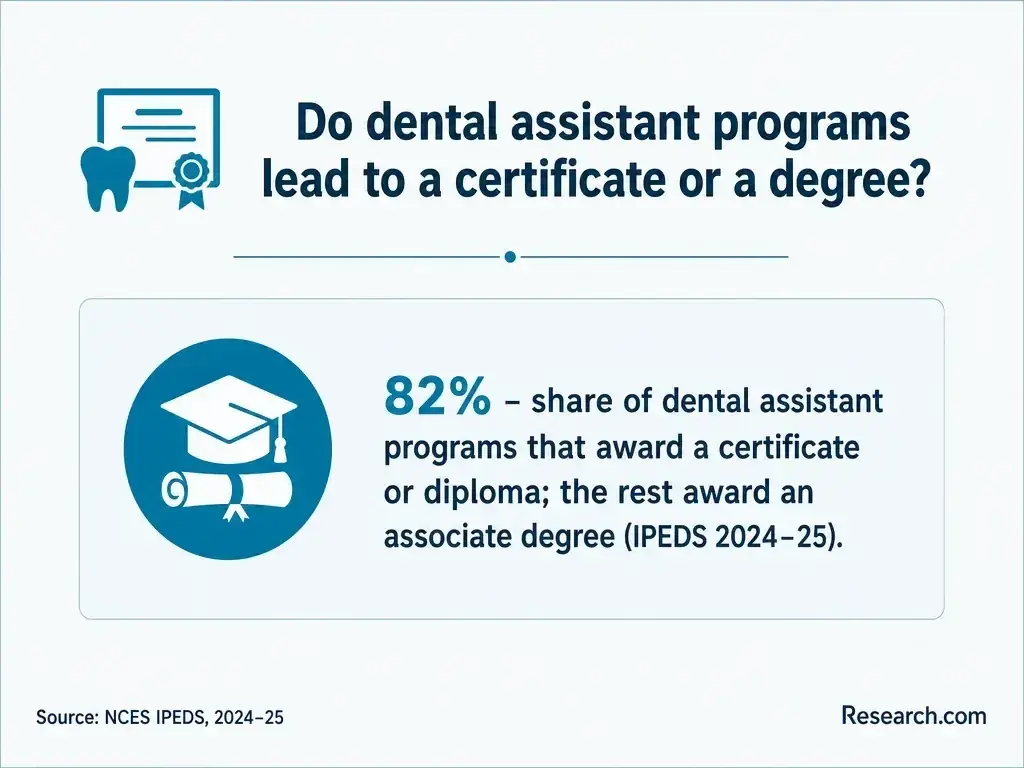
A school-based program may award a certificate or diploma; the exact award depends on the provider. That school credential is distinct from DANB professional certification, New Jersey registration for expanded dental-assisting duties, and authorization for dental radiography (DANB; New Jersey State Board of Dentistry; New Jersey Department of Environmental Protection).
Ask the school to identify its award and specify which, if any, certification examinations and New Jersey applications its curriculum prepares you for. Institutional accreditation concerns the school; CODA programmatic accreditation concerns a specific dental assisting program. Neither should be treated as automatic occupational authorization (CODA; New Jersey State Board of Dentistry).
Admissions rules are set by the provider and may differ from an employer's hiring requirements. Ask about education prerequisites, age requirements, immunizations, background checks, attendance expectations, and the ability to travel to a clinical site before applying. If a placement has additional requirements, find out whether failing to meet them would prevent completion.
Employer training is a realistic alternative for applicants who can find a practice willing to train and supervise them, but it is not equivalent to being cleared for every dental duty. New Jersey limits what assistants may do according to their status and applicable rules (New Jersey State Board of Dentistry).
Core training should connect dental anatomy and terminology to actual chairside tasks: preparing treatment areas, passing instruments, maintaining infection-control procedures, communicating with patients, and documenting care under the dentist's direction (BLS). Practice with equipment matters because recognizing a procedure on a screen is different from performing your assigned role safely in an occupied operatory.
Compare syllabi for supervised practice, feedback on technique, and preparation for the particular duties you hope to perform. Digital records and imaging may appear in training, but instruction in imaging should not be mistaken for permission to take dental radiographs in New Jersey (New Jersey Department of Environmental Protection).
Not for every entry-level, supervised dental-assisting task. New Jersey also has a registered dental assistant pathway for specified expanded duties, and dental radiography is separately regulated. The New Jersey State Board of Dentistry sets dental-assisting scope and registration rules; the New Jersey Department of Environmental Protection regulates radiologic technology. DANB certification is a professional credential, not a substitute for a required state authorization (New Jersey State Board of Dentistry; New Jersey Department of Environmental Protection; DANB).
Before choosing training, identify the duties listed in jobs you want. Then check the current board and radiography requirements against the program's accreditation status, instruction, examination preparation, and clinical experience. Ask the provider to explain any gap; graduation alone does not close it.
Start with the duties you want, then compare the training needed to reach them. For local options, ask American Institute-Toms River and Ocean County Vocational-Technical School whether they currently offer relevant dental-assisting training, what the award is, and where practical work takes place. Do not assume either provider's current offerings or eligibility from its name.
Use this sequence to test whether a program is the right investment:
A common mistake is choosing the shortest or cheapest option before checking practical training and regulatory fit. Another is treating an institutional label as proof of program quality: even lists of best accredited non-profit colleges cannot establish that a particular dental assisting program prepares students for New Jersey duties. Compare the specific program, not ownership type or a ranking alone.
An assistant may begin with permitted supervised duties in a general dental office, then seek broader responsibilities through the applicable New Jersey registration or radiography pathway. Experience can also support movement into specialty practices, patient coordination, or office operations; employers determine hiring requirements for those roles (BLS; New Jersey State Board of Dentistry).
Choose training for the next role you can realistically enter, not for a distant title. Comparisons with highest paying four year degrees address a different investment decision; they do not predict dental assistant earnings or make a longer school-based dental program worthwhile by themselves.
BLS projects 7.4% growth in U.S. dental assistant employment from 2025 to 2035. This national projection indicates continuing demand for the occupation, but it does not measure vacancies in Toms River or guarantee a job after training. Before committing, review current openings within your commuting range and note how often employers request experience, registration, or radiography authorization.
That check also helps distinguish a training gap from a hiring gap: if available entry-level jobs offer supervision, employer training may be viable; if the positions you want require duties you cannot yet perform, choose a program and credential pathway that addresses those requirements.
Investing in training is an important decision, so Research.com designed the accompanying ranking to compare dental assisting programs with other programs in the same occupation and location. The team checks multiple education, outcomes, accreditation, and occupational sources to support the ranking's quality and accuracy. Only programs with completions reported to the Integrated Postsecondary Education Data System (IPEDS) are eligible; an unlisted employer-training or other provider should not be assumed to be unavailable or low quality.
Best-program rankings assess student outcomes, earnings and return on investment, costs and debt, and quality and recognition. Programmatic accreditation or relevant industry recognition accounts for 20% of the score, institutional accreditation for 10%, and student support services for 10%. The remaining 60% covers completion, full- and part-time retention, earnings one year after completion, earnings relative to annual attendance cost, tuition, attendance cost, median debt - including debt held by students who withdrew - and federal loan default rates. Weights within that group use an entropy-based method that assigns more weight to indicators that vary more across programs. Most-affordable rankings score only tuition, attendance cost, median debt, and loan default rates using that method; accreditation and other quality indicators are not part of the affordability score.
The ranking draws on these sources, which readers can also use to check a program's claims:
These sources help readers compare measurable outcomes without mistaking a ranking for confirmation of New Jersey eligibility or current program availability. More detail is available in Research.com's methodology.
# 1 position
# 2 position
Potentially. New Jersey permits certain supervised dental-assisting work without school-based training, but expanded duties and radiography have separate rules. Confirm the proposed job duties with the New Jersey State Board of Dentistry and, for imaging, the New Jersey Department of Environmental Protection.
No. A school certificate records program completion; DANB awards professional certifications under its own requirements. Neither automatically grants New Jersey registration or radiography authorization (DANB; New Jersey State Board of Dentistry).
Online lessons can cover theory, but chairside skills require in-person practice. Ask where and under whose supervision a program assesses practical competencies before enrolling.
No. Entry-level duties and eligibility for particular New Jersey credentials are different questions. Verify whether CODA accreditation matters for the specific credential route you intend to use (CODA; New Jersey State Board of Dentistry).
School may provide structured labs and a defined curriculum; employer training may let you earn while learning. Choose based on supervised practice, total cost, access to jobs, and whether the route supports your intended New Jersey duties.