# 1 position


Audited and Verified:
Our Editorial and Data Verification Process
Research.com uses government datasets, official education statistics and primary institutional information to support its career and degree guides. Our review process checks factual accuracy, occupational definitions, source dates and the requirements associated with the credentials discussed.
How This Article Was Fact-Checked
Our editorial team verifies salary estimates, employment projections, education requirements and program information against original data providers and official organizations. Salary figures are checked against the relevant occupational definitions and reporting periods. Information about licensure, accreditation and required in-person training is reviewed separately.
Fact-checked and verified on:

Co-Founder and Chief Data Scientist

Reviewed by Karolina Broda
Fact-Checker and Data Verification
Choosing dental assistant training in Bedford, Massachusetts, means looking beyond a program's price or completion time: you need practical experience and a route that fits state rules. The Research.com team of data scientists created the Best Dental Assistant Trade Schools in Bedford for 2027 ranking to help students identify programs worth considering. Dental assistants' national median pay was $48,070 in May 2025, according to the U.S. Bureau of Labor Statistics (BLS). This guide explains how to compare training, costs, credentials, and career prospects before enrolling.
Expect instruction in chairside procedures, infection control, patient communication, dental materials, and office workflow, followed by supervised practice. A certificate or diploma is generally the most direct school-based route; an associate-degree program may include more general coursework and take longer. Neither credential name tells you how much clinical practice you will receive.
For a Bedford resident, Middlesex Community College is a public-college option to investigate alongside authorized career schools and dental practices offering supervised entry-level training. Confirm the current program, teaching location, schedule, and clinical-placement arrangements with each provider. Employer training may let you earn while learning, but its duties and progression depend on Massachusetts Board of Registration in Dentistry rules and the practice's supervision capacity. Do not assume it is a registered apprenticeship; verify registration separately if a provider uses that term.
Dental offices are the clearest employment target. Depending on training and employer needs, assistants may also work in specialty practices such as orthodontics or oral surgery, community dental clinics, or larger group practices. The BLS identifies dentists' offices as the principal U.S. employer of dental assistants.
Bedford applicants should consider the practical reach of a commute, not just the town boundary: a clinical placement and a first job may be in a different community. Ask programs where students complete supervised practice and whether those sites are accessible on your schedule. Experience with a particular specialty can strengthen an application, but a training certificate does not independently authorize every procedure performed there.
The BLS reports a $48,070 national median annual wage for dental assistants in May 2025. A median describes workers across experience levels, not likely starting pay. It should not be treated as a Bedford salary quote.
When evaluating a local offer, compare the hourly rate, expected hours, benefits, commuting costs, and whether the practice pays for required training or examinations. Ask employers what duties a newly trained assistant can perform and how pay changes with demonstrated skills. A national figure is useful for testing whether a program's debt seems manageable, but a Bedford-area offer is more useful for an individual budget.
Length depends on the credential, attendance schedule, and clinical requirements. A focused certificate may be shorter than an associate-degree program, while part-time study can extend either route. Employer-sponsored training follows a different timetable because learning occurs alongside supervised work. Massachusetts does not have one universal school-program clock-hour requirement that makes every dental assisting pathway interchangeable; check the Board's requirements for the duties you intend to perform (Massachusetts Board of Registration in Dentistry).
Ask for the published calendar, classroom and lab hours, clinical hours, and earliest realistic completion date. An accelerated timetable is valuable only if it leaves enough supervised practice to build competence. If an associate degree is under consideration, a guide to the best accelerated associates degree can help frame scheduling questions, but it does not establish dental assisting clinical or Massachusetts eligibility.
Online delivery can work for subjects such as terminology, records, and some infection-control theory. Chairside positioning, instrument handling, sterilization practice, and supervised patient care require in-person assessment. A hybrid program can reduce classroom trips, but its lab and clinical sites may still determine whether it is feasible from Bedford.
Before choosing either format, get the location and schedule of every required in-person session and ask who arranges clinical placements. Be wary of a fully online advertisement that does not explain how practical skills are verified. Directories of open enrollment online colleges may help you explore flexible admissions, but open enrollment does not establish that a dental assisting program meets Massachusetts requirements.
A reliable Bedford-wide average is not available from a comparable set of current dental assisting program prices. Published tuition can omit charges that matter especially for hands-on training. Compare each provider's total cost to become job-ready, including mandatory fees, books, uniforms, protective supplies, clinical travel, and any applicable examination or application charges. Add lost earnings if the schedule requires reducing work hours.
Request a written cost breakdown and ask whether aid covers the specific program. Federal aid eligibility depends on the school, program, and student; employer-paid training, scholarships, or workforce assistance may reduce out-of-pocket cost (Federal Student Aid). A directory of the cheapest regionally accredited online colleges can provide general cost-comparison context, but it is not a substitute for a dental assisting program quote or clinical-site plan.
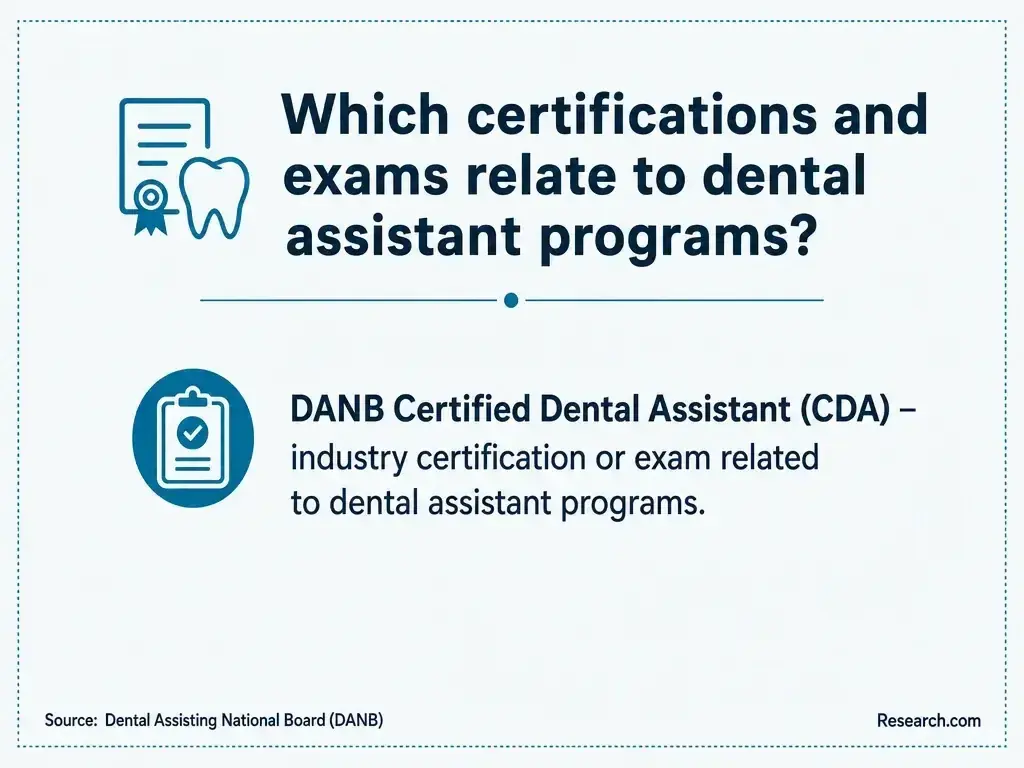
A school may award a certificate, diploma, or associate degree. These are educational credentials, not the same thing as professional certification or authorization to perform particular dental assisting duties. The Dental Assisting National Board (DANB) administers the Certified Dental Assistant credential and component examinations; eligibility must be checked against DANB's current rules. The Commission on Dental Accreditation (CODA) accredits dental assisting programs, not every individual certificate with a similar name.
Ask the provider for the exact award, its CODA accreditation status if applicable, and which DANB examination pathways it supports. An associate degree may suit a student who wants broader coursework, but the fastest route to an associate credential is not necessarily the fastest route into appropriate clinical work. A guide addressing what are the fastest online associate degrees available? should be read with that distinction in mind.
Schools set their own admissions requirements, so request the current checklist rather than assuming that one Bedford-area provider's rules apply elsewhere. Ask about prior education, prerequisite coursework, immunizations or health documentation, background screening for clinical placements, and any CPR requirement. An employer-training route has a separate hiring and supervision process.
Easy admission should not be confused with readiness for clinical placement or a particular state-recognized role. Resources on open enrollment online colleges can illustrate the difference, but this article uses that directory only as background; verify the dental program's own entry and placement conditions directly.
Core training connects safety with chairside efficiency: preparing treatment areas, passing instruments, managing dental materials, documenting care, and communicating with patients. Instruction may also cover radiography concepts, scheduling, and billing. The BLS describes these as common dental assistant duties, although permitted duties vary by state and training level.
The most revealing curriculum question is not simply "Do you teach radiography?" It is "What supervised practice and assessment support the radiography-related duties I hope to perform in Massachusetts?" Ask the same question about expanded functions. A program that teaches a topic in a lecture may not provide the hands-on preparation or documentation needed for the work you want.
Massachusetts regulates dental assistants through the Board of Registration in Dentistry. The applicable registration or licensure category, permitted duties, supervision, and requirements for activities such as radiography depend on the worker's qualifications. Check the Board's current rules and application instructions for the role you plan to enter; do not assume that completing a school program automatically grants permission to perform every duty (Massachusetts Board of Registration in Dentistry).
Keep four checks separate: state authorization allows a school to operate; institutional accreditation concerns the institution; CODA accreditation concerns an eligible dental assisting program; and DANB certification is a professional credential with its own eligibility rules. None replaces the Massachusetts Board's occupational requirements (Massachusetts Board of Registration in Dentistry; CODA; DANB).
Start with the job you want, then compare programs against the training and authorization that job requires. A low-priced or highly ranked option is a poor investment if its clinical schedule is inaccessible or its credential does not support your intended duties.
Use this sequence when speaking with admissions staff and potential employers:
For return on investment, consider completion probability, aid, debt, lost earnings during training, likely starting pay rather than an occupational median, and how long you expect to work in the field. A list of nationally accredited universities may explain one institutional label, but it cannot verify CODA status or Massachusetts dental assisting eligibility. Treat claims that accreditation alone guarantees either outcome as a red flag.
An entry-level assistant can build experience in general dentistry and then seek specialty-practice work, greater responsibility for office coordination, or duties allowed after additional training and qualification. DANB certification may be useful for professional recognition or advancement, but its value for a particular job depends on employer expectations and Massachusetts rules (DANB; Massachusetts Board of Registration in Dentistry).
If your goal is primarily front-office work, ask whether an intensive chairside program is worth its cost. If your goal involves expanded clinical duties, choose training based on documented hands-on preparation and the Board's applicable requirements, not a promising program title.
The BLS projects 7.4% U.S. employment growth for dental assistants from 2025 to 2035. That national projection indicates continuing demand across the occupation, but it does not measure vacancies in Bedford or guarantee that a particular graduate will be hired.
For a local decision, test the projection against current openings within your commuting range. Look at requested experience, schedules, and radiography or other duty requirements. If nearby employers consistently seek qualifications a program does not support, the national growth figure is not a strong reason to enroll in that program.
Investing in training is a consequential decision. Research.com created the ranking to compare dental assistant programs with other programs serving the same occupation and location, rather than with unrelated schools. Only programs reporting completions to the Integrated Postsecondary Education Data System (IPEDS) are eligible; an unlisted employer-training route or career school is not necessarily a poor option.
Best-program scores consider completion and retention, earnings one year after completion, earnings relative to annual attendance cost, tuition, debt, loan default rates, accreditation or relevant industry recognition, and student support. Programmatic accreditation or industry recognition accounts for 20% of the score, institutional accreditation for 10%, and student support for 10%. The remaining 60% covers outcomes, earnings, and costs, with weights assigned through an entropy-based method that gives more weight to indicators that vary more across programs. An affordability ranking, if presented separately, scores only costs and debt; it does not include quality indicators.
The team used the following sources to check education data and occupation-specific recognition:
These sources help readers compare reported results, but a ranking cannot confirm an individual student's eligibility for Massachusetts dental assisting duties. Check program details and current state requirements before committing. More information about the scoring approach appears on the Research.com methodology page.
# 1 position
# 2 position
Not necessarily. Supervised employer training may be a route for some roles, but Massachusetts rules govern qualifications, supervision, and permitted duties. Compare that route with a school program before paying tuition (Massachusetts Board of Registration in Dentistry).
Do not assume so. Ask the provider what radiography training it documents and check the Massachusetts Board's current requirements for the specific duty (Massachusetts Board of Registration in Dentistry).
No. CODA accredits eligible dental assisting programs; DANB certifies individuals who meet its examination and eligibility rules (CODA; DANB).
Online theory may be possible, but chairside skills and supervised clinical practice require in-person participation. Confirm where and when those components occur before enrolling.
Only if its practical training, credential, and Massachusetts eligibility fit your goal. Compare the extra cost with saved time, lost earnings, and the likelihood that you can complete the clinical schedule.