# 1 position

Audited and Verified:
Our Editorial and Data Verification Process
Research.com uses government datasets, official education statistics and primary institutional information to support its career and degree guides. Our review process checks factual accuracy, occupational definitions, source dates and the requirements associated with the credentials discussed.
How This Article Was Fact-Checked
Our editorial team verifies salary estimates, employment projections, education requirements and program information against original data providers and official organizations. Salary figures are checked against the relevant occupational definitions and reporting periods. Information about licensure, accreditation and required in-person training is reviewed separately.
Fact-checked and verified on:

Co-Founder and Chief Data Scientist

Reviewed by Karolina Broda
Fact-Checker and Data Verification
Choosing dental assistant training in Bayamón means looking beyond a school's name: Will you practice clinical skills, earn the right credential, and be ready for Puerto Rico employers? The U.S. Bureau of Labor Statistics reports a $48,070 national median annual wage for dental assistants in May 2025, but that is not a Bayamón starting salary. This guide compares training routes, costs, practical experience, and career-entry requirements. It will also feature a Best Dental Assistant Trade Schools in Bayamon for 2027 ranking created by the Research.com team of data scientists to help students make an informed choice about programs worth considering.
Expect instruction in preparing treatment rooms, infection control, instrument handling, dental terminology, patient communication, and chairside support. Clinical tasks require demonstration and feedback, not just reading or video lessons. The U.S. Bureau of Labor Statistics describes these as core dental assistant duties; a school should explain which tasks students actually perform in its lab or supervised placement.
The routes below lead to different learning experiences. Compare the credential and practical training before treating them as interchangeable.
| Route | Likely credential or outcome | Best fit and trade-off |
| Career-school or technical certificate/diploma | School-awarded occupational credential | Focused preparation for entry-level assisting; check clinical access and total price. |
| Associate-level occupational program | Associate degree, if the program awards one | Broader coursework; usually a larger time commitment than a focused certificate. |
| Employer-sponsored training | Work experience; school credential not assured | May reduce upfront school costs, but the employer must provide adequate supervision and training for permitted duties. |
For a quick entry route, compare a well-supervised certificate with an actual employer training offer. A broader program makes more sense if its additional coursework serves a specific career goal. Lists of certifications that pay well cannot substitute for checking dental-assisting duties and local requirements.
Dental offices are the principal workplace for dental assistants nationally, according to the U.S. Bureau of Labor Statistics. In Bayamón, search both local practices and offices across the San Juan metropolitan area: a wider commute may expand the openings you can realistically pursue, while transport time increases the effective cost of the job.
General and specialty practices may emphasize different routines, from restorative chairside support to orthodontic patient flow. Ask a program where its supervised placements occur and whether students must arrange their own transportation. A placement location matters more than a broad claim that the school has "local connections."
A reliable Bayamón-specific wage figure is not established here. The U.S. Bureau of Labor Statistics reports a $48,070 U.S. median annual wage in May 2025 for dental assistants. It covers experienced workers as well as newer entrants across the country; it is neither a Puerto Rico estimate nor an expected first-job offer.
For a usable local comparison, collect current offers from offices within your commuting range and compare hourly pay, scheduled hours, benefits, and travel costs. Then weigh those offers against your total training expense and what you could earn while training. A higher advertised wage farther from Bayamón may be less attractive after commuting costs.
The U.S. Bureau of Labor Statistics says accredited dental assisting programs typically take about one year, while some take as long as two years. That describes a national pattern, not a required Puerto Rico training period or a promise about any Bayamón schedule. Part-time attendance, course sequencing, and placement availability can extend the calendar time.
Ask for the program's published clock or credit hours, separate lab and supervised clinical hours, and the earliest realistic completion date for your schedule. A search for a top associate degree in 6 months online should not lead you to assume dental chairside competencies can be completed remotely or on that timetable. Compare the date you can become job-ready, not just the advertised class length.
Online coursework can cover terminology, anatomy concepts, recordkeeping, and infection-control principles. Instrument transfer, room setup, protective procedures, and patient-facing chairside work need in-person practice and assessment. A hybrid program can suit a working student if its lab and placement times are genuinely accessible from Bayamón; an entirely online course should not be assumed to establish clinical competence or regulatory eligibility.
Request the exact campus, lab, and placement schedule in writing. Even a directory of leading online universities cannot verify that a particular dental assistant program provides local hands-on training. The decisive question is where and under whose supervision you will practice each required skill.
There is no verified Bayamón-wide average in this guide. Tuition alone would be a poor substitute: two programs with similar tuition can have different fees, clinical travel demands, and time away from paid work. Request an itemized, program-specific estimate rather than relying on an advertised starting price.
Build a job-ready budget that includes tuition, mandatory fees, books or software, uniforms and protective equipment, consumable supplies, any required health or background documentation, examinations or applications relevant to your goal, transportation, and foregone earnings. Subtract grants, scholarships, eligible aid, or wages from employer-sponsored training only when you have confirmed them. Federal Student Aid notes that federal aid depends on school and program eligibility; do not assume every short occupational course qualifies.
Articles on what certificate programs pay well can suggest alternatives, but they cannot tell you whether a particular Bayamón dental assistant program pays off. Compare its net cost, completion likelihood, expected earnings change, debt, and the time needed to recover your investment.
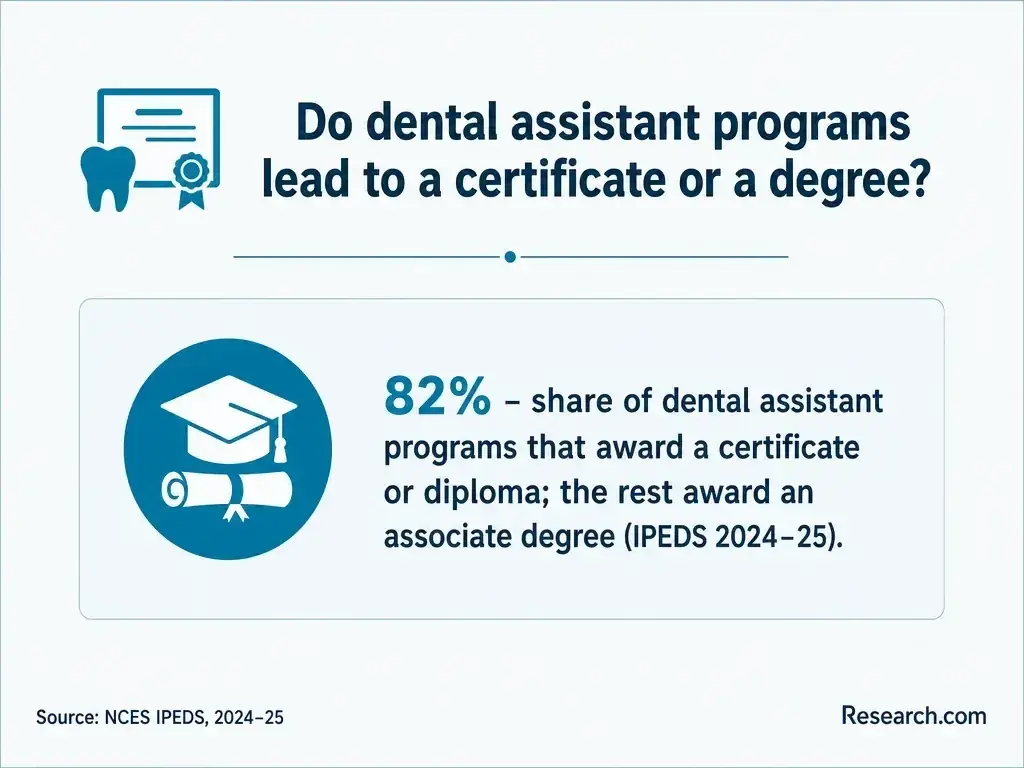
The award depends on the program: it may be an occupational certificate, a diploma, or an associate degree. A school credential documents completed training; it is not the same thing as professional certification or permission to perform every dental procedure. Ask for the exact award name and whether the training supports the duties in the jobs you want.
CODA programmatic accreditation, a school's institutional accreditation, Puerto Rico school authorization, DANB certification, and any applicable Puerto Rico occupational authorization answer different questions. CODA and DANB publish their respective program and certification information. Do not infer one status from another, or assume an accredited school automatically makes every graduate eligible for a particular examination or clinical duty.
Requirements vary by provider. Ask whether admission calls for a secondary-school credential, an application or placement assessment, and documentation needed before clinical work, such as immunization records or a background check. Distinguish a school's admission conditions from a placement site's health and safety conditions; acceptance into classes does not necessarily secure a clinical placement.
If you have previous healthcare training, ask whether the school awards prior-learning or transfer credit and whether that changes tuition or your completion date. Obtain the answer in writing before counting on a shorter route. For employer training, ask who supervises beginners and when they can perform particular tasks.
A useful curriculum joins dental anatomy and terminology with sterilization, infection prevention, patient preparation, chairside instrument handling, documentation, and communication. The U.S. Bureau of Labor Statistics also identifies duties involving appointments, records, and patient instruction, although an assistant's permitted clinical tasks depend on applicable rules and supervision.
Look for repeated skill demonstrations and supervised patient-care opportunities, not a course list alone. Ask how students are assessed on infection-control routines and what happens if a placement is delayed. Digital records and imaging may appear in training, but verify the equipment available and whether the program prepares you for the specific tasks employers advertise; technology exposure is not permission to perform a regulated task.
Do not apply a U.S.-wide rule to Bayamón. Puerto Rico's health-professional licensing authorities determine the applicable requirements and permitted duties locally; requirements for a particular function may differ from those for general office support. Before enrolling, ask Puerto Rico's Department of Health, Oficina de Reglamentación y Certificación de los Profesionales de la Salud, which education, examination, registration, supervision, or other authorization requirements apply to your intended role.
DANB certification is a professional credential with its own eligibility and examination rules, not an automatic substitute for Puerto Rico authorization (Dental Assisting National Board). Ask the school which examinations its curriculum prepares students for, whether graduates meet current eligibility conditions, and which clinical duties the credential would actually support. Get the regulator's answer directly if a school makes a broad "licensed upon graduation" claim.
Start with the dental-assisting job you want, then test each program against that goal. A ranking is useful for narrowing options, but reported completion and cost measures cannot tell you whether a lab schedule fits your work hours or a clinical placement is reachable.
Use these checks before signing an enrollment agreement:
Common mistakes are choosing the shortest advertised course without checking hands-on practice, treating accreditation as a license, and using a national median wage as a guaranteed return. A search for what 4 year degree makes the most money answers a different investment question; for this decision, compare dental assistant training with your own costs, alternatives, and likely local work options.
A first role may combine chairside preparation, sterilization, patient communication, and office workflow. With experience, an assistant may seek more specialized practice settings, train new staff, or take on permitted administrative responsibilities. Ask employers which tasks require additional training or authorization before planning a specialization; experience alone does not expand legally permitted duties.
Dental assisting is not the same credential or occupation as dental hygiene. If your goal is independent preventive clinical work rather than support under a dentist's direction, verify that profession's separate training and regulatory pathway before paying for an assisting program. For someone seeking a faster entry into a dental office, supervised assistant training or a suitable employer-training offer may be the better first comparison.
The U.S. Bureau of Labor Statistics projects 7.4% growth nationwide from 2025 to 2035 for dental assistants. That supports considering the occupation, but it does not measure Bayamón vacancies or guarantee a position after training.
Check current advertisements across your feasible Bayamón-San Juan commute for required skills, schedules, and pay. If many suitable openings demand experience or particular clinical capabilities, favor a program with documented supervised practice over one that only promises a quick certificate. Ask placement staff which employers have recently accepted students, while treating any reported placement rate according to its stated definition and period.
Investing in training is a consequential decision, so the Research.com team designed its ranking to compare dental assistant programs with other programs in the same occupation and location - not with unrelated schools. The team evaluates reported outcomes, costs, recognition, and student support to help readers identify options for closer investigation. Only programs with completions reported to IPEDS are eligible; an unlisted training provider is not necessarily unapproved or unsuitable.
Best-program scores cover student outcomes, including completion and full-time and part-time retention; earnings and return on investment, including earnings one year after completion relative to annual attendance cost; costs and debt, including tuition, attendance cost, debt for students who withdrew, and federal loan default; and quality and recognition. Programmatic accreditation or relevant industry recognition accounts for 20%, institutional accreditation for 10%, and student support for 10%. The remaining 60% covers outcomes, earnings, and costs, with entropy-based weights giving more influence to indicators that vary more across programs. Most-affordable-program rankings instead score only tuition, attendance cost, median debt, and federal loan default, using entropy-based weights; accreditation and other quality indicators do not enter that score.
To check coverage, outcomes, and occupation-relevant recognition, the ranking draws on these sources:
These sources help narrow the search, but a ranking cannot establish that a particular graduate meets Puerto Rico's current practice requirements or that an employer will hire them. Confirm those points directly before enrolling. More detail on the approach appears in Research.com's methodology.
# 1 position
# 2 position
It may be if the program provides relevant hands-on practice, an appropriate credential, and a realistic route to local work at a net cost you can manage. Compare it with an actual employer-sponsored offer before committing.
You can study some theory online, but chairside skills require in-person practice and assessment. Confirm the location and schedule of every required lab or placement.
The U.S. Bureau of Labor Statistics says accredited programs typically take about one year, with some taking up to two. Ask each provider for its own schedule, hours, and placement timeline.
No. A school award, DANB certification, and any applicable Puerto Rico authorization are distinct. Confirm the rules for the tasks you intend to perform with Puerto Rico's health-professional licensing authorities.
Request a written total covering tuition, fees, supplies, uniforms, clinical travel, and any required examinations. Ask which aid you qualify for and what happens financially if you withdraw.