# 1 position

Audited and Verified:
Our Editorial and Data Verification Process
Research.com uses government datasets, official education statistics and primary institutional information to support its career and degree guides. Our review process checks factual accuracy, occupational definitions, source dates and the requirements associated with the credentials discussed.
How This Article Was Fact-Checked
Our editorial team verifies salary estimates, employment projections, education requirements and program information against original data providers and official organizations. Salary figures are checked against the relevant occupational definitions and reporting periods. Information about licensure, accreditation and required in-person training is reviewed separately.
Fact-checked and verified on:

Co-Founder and Chief Data Scientist

Reviewed by Karolina Broda
Fact-Checker and Data Verification
Choosing dental assistant training in Clearwater means comparing more than program length: hands-on practice, Florida radiography requirements, and the full cost of becoming job-ready can change which option is worth it. The U.S. Bureau of Labor Statistics reports a national median annual wage of $48,070 for dental assistants in May 2025, but that is not a starting-pay estimate. This guide explains the pathways and trade-offs behind the Best Dental Assistant Trade Schools in Clearwater for 2027 ranking, created by the Research.com team of data scientists to help students make an informed choice.
Expect instruction in chairside support, infection control, instrument processing, dental materials, patient communication, and office records, followed by supervised practice. A lab lets you rehearse procedures; an externship or clinical placement shows how those skills hold up in a working dental office. Ask how much of each is included, who supervises students, and whether the school arranges placements within a commute you can manage.
Clearwater applicants can compare career-school certificates and diplomas with longer community-college dental assisting programs and employer-sponsored entry-level training. A short program may get you into the workplace sooner; a longer one may offer more structured clinical experience or certification preparation. For someone who needs to earn while learning, a dental office willing to train a new assistant may be a better fit than paying for school first. Do not assume that an unrelated 6 month online course with high salary offers the patient-contact training or Florida duty eligibility needed here.
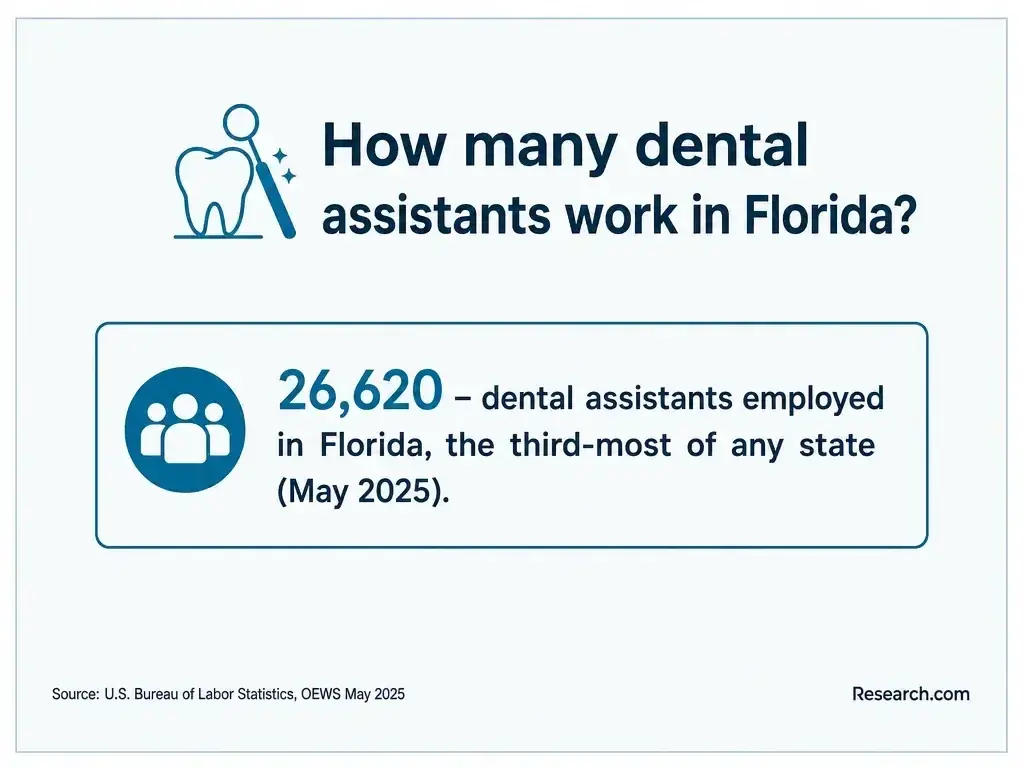
Dental assistants work chiefly in dentists' offices, according to the U.S. Bureau of Labor Statistics. In Clearwater, that makes general dental practices and specialty offices in the surrounding Pinellas County and Tampa Bay area relevant places to seek placements and jobs. A placement beyond Clearwater may widen your options, but travel time and transport costs belong in your program comparison.
Ask prospective programs whether their clinical sites include general dentistry, pediatric dentistry, orthodontics, or oral surgery if one interests you. Training in one setting can provide transferable chairside skills, but an employer may still provide additional supervision before assigning specialty-specific tasks.
The U.S. Bureau of Labor Statistics reports a May 2025 national median annual wage of $48,070 for dental assistants. A median describes workers across experience levels and locations; it is neither a Clearwater wage nor an expected first offer. For a local decision, compare current Clearwater-area job postings by pay, hours, benefits, required duties, and experience, and check the latest BLS metropolitan occupational wage release when available.
Expanded responsibilities, specialty experience, and office administration skills may affect an offer, but no training provider can promise a raise. To assess whether tuition is worthwhile, compare plausible entry pay with what you could earn during the months you would spend training, then account for debt payments and the time needed to recover your investment.
There is no single Florida-wide clock-hour requirement for every dental assistant entry route. Program schedules vary with curriculum, full- or part-time attendance, labs, and clinical placement. Employer training also follows a different schedule from a school certificate. Ask each provider for its published total clock hours, lab hours, externship hours, calendar length, and expected weekly schedule; these figures tell you more than an "accelerated" label.
A faster route reduces time away from paid work only if it provides enough supervised practice for your intended duties. If speed is your priority, compare the hands-on requirements behind claims about what are the fastest online associate degrees available? with those of a dental assisting certificate or diploma. An associate-degree option is not automatically a quicker route to a chairside job.
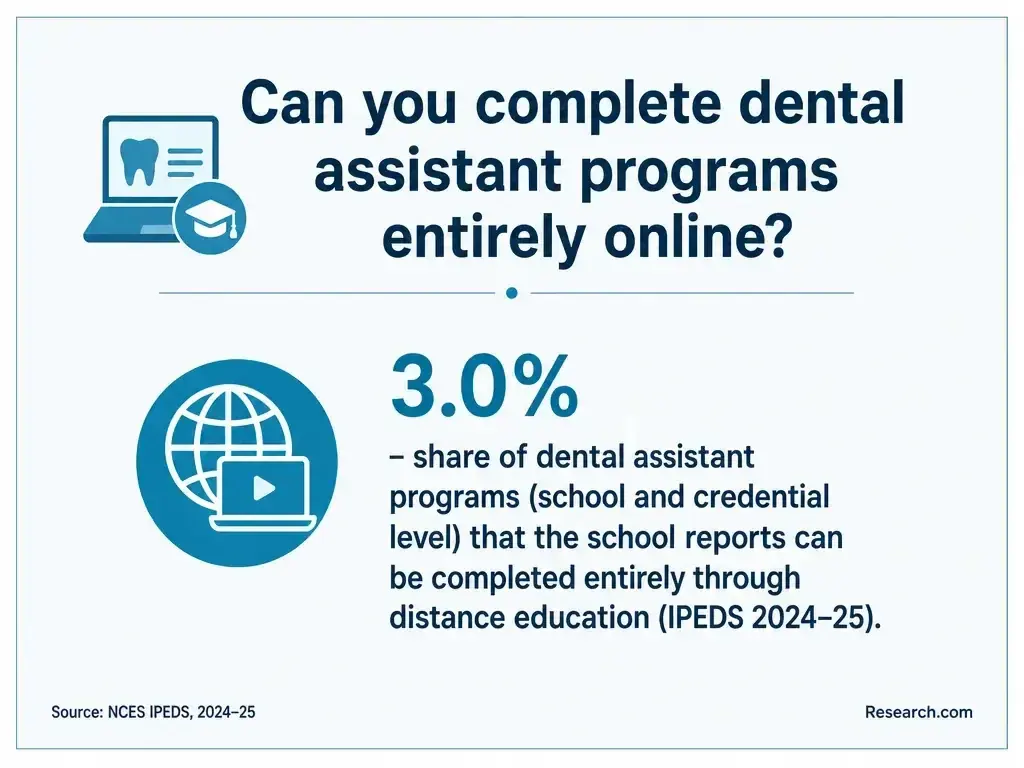
Online study can cover terminology, anatomy, infection-control principles, and records. It cannot replace supervised instrument handling, chairside assistance, radiography practice, or work with patients. A hybrid option can suit someone balancing work and study if its required labs and clinical sites are accessible from Clearwater; a campus-based schedule may be simpler if you need frequent instructor feedback.
Before choosing a top online trades school, obtain the dental assisting program's written lab schedule and clinical-placement policy. Confirm who secures the placement, whether travel is required, and how its instruction aligns with Florida requirements for the duties you want. An entirely online completion certificate should not be treated as proof of practical competence or regulatory eligibility.
A reliable Clearwater-wide average is not available from the cited sources, and a quoted tuition figure would not capture the cost of becoming job-ready. Request an itemized, current price from each provider before comparing offers. This is especially important when one program includes clinical supplies and another bills separately.
A useful total-cost comparison includes the following items and any costs the school says are included:
Federal aid depends on the institution and program, not simply on whether classes are online; Federal Student Aid advises students to check eligibility and submit the FAFSA where appropriate. A list of online school that accept financial aid cannot establish that a particular dental assisting course qualifies. Ask the financial-aid office for your estimated net price and borrowing terms, and ask employers whether they offer paid training or tuition support.
Depending on the provider, you may earn a certificate, diploma, or associate degree; employer training may instead produce a record of completed competencies. Those credentials document different amounts and types of education. They are not the same as the Dental Assisting National Board's voluntary Certified Dental Assistant credential, Florida authorization for expanded duties, or Florida dental radiographer certification (Dental Assisting National Board; Florida Board of Dentistry; Florida Department of Health).
Check the exact award on the program's catalog, whether its dental assisting program holds Commission on Dental Accreditation accreditation, and whether graduates meet the eligibility route for any exam they plan to take. Institutional accreditation, dental-assisting program accreditation, state school authorization, and individual certification answer different questions; none automatically substitutes for the others.
Admissions rules are provider-specific. A school may ask for proof of secondary-school completion, an application, and assessments; clinical sites may have separate health, immunization, background-check, or scheduling requirements. Verify these directly with the program rather than assuming that admission guarantees access to its clinical placement.
Ask whether previous healthcare coursework can count toward the credential, what evidence is required for prior-learning credit, and whether credit actually reduces tuition or time. If you are considering direct office employment instead, ask the dentist which tasks a new hire may perform under supervision and what additional training would be needed for expanded duties or radiography in Florida (Florida Board of Dentistry; Florida Department of Health).
A useful curriculum connects dental anatomy and terminology to chairside tasks: preparing treatment areas, transferring instruments, handling materials, documenting care, and communicating with patients. Infection prevention and instrument processing require repeated, observed practice - not just an online quiz. The U.S. Bureau of Labor Statistics identifies patient care, equipment preparation, records, and infection-control work among dental assistant duties.
Compare programs by the procedures students actually practice, the equipment they use, instructor feedback, and supervised clinical opportunities. Because dental offices use digital records and imaging, ask whether training includes current office systems while still teaching the safety and patient-care fundamentals behind them. A course description alone does not establish competence or permission to perform a regulated duty.
Florida does not issue a general occupational license that every dental assistant must hold before working. Specific duties are a separate matter: Florida's Board of Dentistry sets conditions for expanded functions, and the Florida Department of Health administers dental radiographer certification requirements. The duties an assistant may perform depend on applicable training and supervision rules; completing any school program does not automatically authorize every procedure (Florida Board of Dentistry; Florida Department of Health).
Before enrolling, identify the duties in Clearwater job postings that interest you. Then ask the school to show, in writing, which Florida expanded-function training requirements its curriculum meets and whether it prepares you for the state dental radiographer process. Ask separately about Dental Assisting National Board exam eligibility if you want its voluntary national certification. Confirm current rules with the Florida agencies because occupational requirements can change.
Start with the job you want, not a ranking position. A program is a sound investment only if its cost and schedule are manageable and its practice and regulatory alignment fit that job. Someone seeking a quick entry-level role may prefer paid office training; someone who wants structured labs, clinical experience, and a defined credential may prefer a school program.
Use these checks when speaking with admissions staff and, where possible, a prospective clinical supervisor:
Red flags include guaranteed jobs or wages, unclear clinical arrangements, and claims that accreditation alone authorizes Florida duties. An easy bachelor's degree search is likewise not a test of whether a dental assisting program provides the specific training you need. Use the ranking to narrow options, then verify the decisive details yourself.
The direct path is an entry-level chairside role in general dentistry. With employer training and experience, an assistant may move into specialty practice, treatment coordination, scheduling, or office supervision. Additional Florida-compliant training can broaden the duties an assistant is permitted to perform; voluntary certification can document knowledge but is not a substitute for state duty requirements (Florida Board of Dentistry; Dental Assisting National Board).
These paths involve different work. If you enjoy patient contact and fast-paced procedures, prioritize substantial chairside practice. If you prefer scheduling, records, or insurance tasks, ask how much office administration the program teaches before paying for extensive clinical training. Dental assisting training alone should not be mistaken for preparation to work as a dental hygienist or dentist.
The U.S. Bureau of Labor Statistics projects 7.4% growth nationally from 2025 to 2035 for dental assistants. This is an occupational projection, not a Clearwater hiring forecast or a promise that a particular graduate will find work. It makes the field worth examining, while local vacancy requirements should determine which training to buy.
Review current Clearwater and nearby Pinellas County postings for recurring requirements: chairside experience, radiography credentials, expanded-duty training, software familiarity, and schedule availability. If most attainable roles require skills absent from a program, its shorter duration or lower tuition may not be a bargain. Conversely, an employer willing to train new assistants may offer a lower-cost first step.
Education is a consequential investment, so Research.com evaluates dental assisting programs against other programs in the same occupation and location rather than treating unlike credentials as interchangeable. The team reviews outcomes, costs, recognition, and data quality to make the accompanying ranking a more credible starting point for comparison - not a substitute for verifying a program's current details.
Only programs with completions reported to IPEDS are eligible. Best-program scores consider student outcomes, earnings and return on investment, costs and debt, and quality and recognition. Programmatic accreditation or relevant industry recognition accounts for 20% of the score, institutional accreditation for 10%, and student support services for 10%. The remaining 60% covers completion and full- and part-time retention; earnings one year after completion and relative to annual attendance cost; and tuition, attendance cost, debt - including debt among students who withdrew - and federal loan default rates. An entropy-based method gives more weight to indicators that distinguish programs more strongly. Most-affordable-program rankings instead score only tuition, attendance cost, median debt, and default rates using entropy-based weights; accreditation and other quality measures are not part of that score.
The ranking draws on the following sources. Some provide context or verification rather than a dental-assisting accreditation standard:
IPEDS and college-oriented outcomes databases do not cover every private training provider or employer-based route. A missing provider is not necessarily unapproved or poor quality. Readers can review Research.com's methodology, then confirm current prices, practical training, and Florida eligibility directly before enrolling.
# 1 position
# 2 position
Potentially. An office may train an entry-level assistant, but Florida has separate requirements for certain expanded duties and dental radiography. Confirm the tasks, supervision, and required training before accepting a role (Florida Board of Dentistry; Florida Department of Health).
No. A school certificate records completion of its program; the Dental Assisting National Board's Certified Dental Assistant credential has its own eligibility and examination requirements (Dental Assisting National Board).
Academic topics may be online, but chairside skills require in-person, supervised practice. Check where labs and clinical experience occur and whether the training aligns with your intended Florida duties.
No. Accreditation and Florida dental radiographer certification are distinct. Verify the current state certification requirements and how the program prepares you to meet them (Florida Department of Health).
Compare mandatory fees, supplies, travel, lost earnings, supervised practice, Florida duty alignment, and any clinical-placement support. Similar tuition does not mean similar total cost or job preparation.