# 1 position


Audited and Verified:
Our Editorial and Data Verification Process
Research.com uses government datasets, official education statistics and primary institutional information to support its career and degree guides. Our review process checks factual accuracy, occupational definitions, source dates and the requirements associated with the credentials discussed.
How This Article Was Fact-Checked
Our editorial team verifies salary estimates, employment projections, education requirements and program information against original data providers and official organizations. Salary figures are checked against the relevant occupational definitions and reporting periods. Information about licensure, accreditation and required in-person training is reviewed separately.
Fact-checked and verified on:

Co-Founder and Chief Data Scientist

Reviewed by Karolina Broda
Fact-Checker and Data Verification
Choosing affordable dental assistant training in North Platte means comparing more than tuition: hands-on practice, travel, and Nebraska's rules for dental duties can change which option is worth paying for. The Research.com team of data scientists created its Most Affordable Dental Assistant Trade Schools in North Platte for 2027 ranking to help students identify programs worth considering. Nationally, dental assistant employment is projected to grow 7.4% from 2025 to 2035, according to the U.S. Bureau of Labor Statistics (BLS). This guide helps you compare training routes, total costs, credentials, and career prospects before enrolling.
Dental assistant training prepares students to support dentists during procedures, prepare and sterilize instruments, communicate with patients, and maintain records. A worthwhile program pairs classroom instruction with supervised chairside practice; watching demonstrations alone is not equivalent to performing procedures under supervision.
North Platte students should first check which offerings are actually available for their intended start term. Mid-Plains Community College is a local public-college provider to investigate, but do not assume a dental assisting credential or clinical placement is currently offered without confirming it. In a smaller market, a program that requires travel for labs or clinical work may be less affordable than its advertised tuition suggests.
The main pathways differ in what students pay for and how they learn:
| Pathway | What to expect | Best fit |
| Certificate or diploma | Focused dental assisting coursework and, where included, labs or clinical experience | Students seeking structured preparation without a longer college program |
| Associate degree | Dental assisting preparation plus additional college coursework | Students who value the academic credential and can justify the added time and cost |
| Employer-sponsored entry | Practice-based training arranged by a dental office; paid status and covered duties vary | Applicants with access to an employer willing to train and supervise them |
A dental-office job is not automatically a registered apprenticeship. If a provider advertises an apprenticeship, ask whether it is formally registered, what instruction it includes, and whether trainees are paid. For any route, verify that its hands-on experience matches the duties you hope to perform in Nebraska.
Dental assistants primarily work in dental offices, including general practices and specialty settings such as orthodontic or oral-surgery offices, according to the BLS. Duties may combine chairside support with sterilization, scheduling, and patient communication; the mix depends on the practice and on which tasks Nebraska permits an assistant to perform.
North Platte applicants should ask local practices which entry-level skills they hire for and whether they train new assistants. A smaller local market can make clinical-placement contacts especially useful, but a placement is not a job offer. If opportunities are limited at graduation, commuting or relocating may broaden the search and should be factored into the value of training.
A verified North Platte-specific wage figure is not available here, so the national figure should not be presented as local pay. The BLS reports a $48,070 median annual wage for U.S. dental assistants in May 2025. Half of workers in that national occupation earned less and half earned more; the figure includes experienced workers and is not a typical first-job offer.
For a useful local estimate, compare current dental-office postings by hourly pay, hours, benefits, and required duties. Ask whether an employer pays for radiography-related training or certification, if applicable. To judge return on investment, compare likely incremental earnings with your existing wages - not simply the national median - and account for debt, completion probability, time out of work, and how long you expect to stay in the occupation.
Focused certificate and diploma programs may take several months to about a year; an associate degree generally takes longer. These are pathway descriptions, not verified schedules for a specific North Platte offering. Part-time attendance, required courses, and the availability of clinical placements can extend the calendar time. There is no single training-hour total that describes every dental assistant pathway.
Ask for the program's published clock or credit hours, lab hours, supervised clinical hours, and earliest realistic completion date. Also ask whether prior coursework can reduce required classes without removing essential clinical training. An accelerated online associates degree may compress academic coursework, but speed alone does not establish that dental assisting labs, clinical experience, or Nebraska-specific requirements are covered.
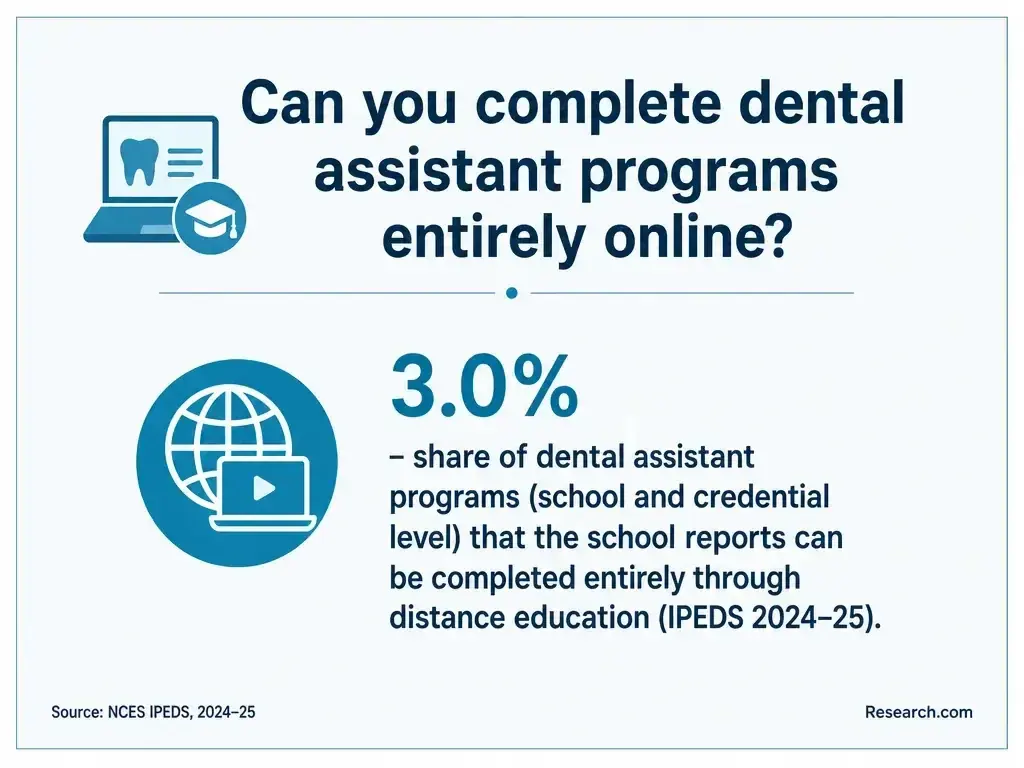
Online study can suit subjects such as terminology, dental anatomy, infection-control principles, and office procedures. Instrument handling, chairside assistance, and other practical competencies require in-person instruction or supervised practice. A hybrid option is useful only if its required lab and clinical sites are accessible from North Platte.
Before paying for an online program, get its hands-on requirements in writing: who arranges placements, where they occur, who supervises students, and whether additional travel is necessary. Lists of nationally accredited online colleges can help with an institutional check, but institutional accreditation alone does not establish dental assisting program accreditation, clinical quality, or eligibility for particular Nebraska duties. An entirely online credential should not be assumed to replace supervised practical training.
A defensible North Platte average cannot be stated without comparable, current prices for available programs and training routes. Published tuition may exclude mandatory fees, textbooks, uniforms, protective supplies, examination charges, health or background-check requirements, and travel to clinical sites. Employer-sponsored training may reduce tuition costs but can involve different schedules or access requirements.
Request an itemized, current estimate from each provider and compare the total cost to become job-ready. Subtract only grants, scholarships, or employer support you are eligible to receive; treat loans as financing, not a discount. Federal aid depends on the institution, program, and student, according to Federal Student Aid. Guides to affordable online colleges may help identify lower-priced coursework, but compare required in-person dental training and its travel costs before concluding an online route is cheaper.
The award depends on the provider: it may be a certificate, diploma, or associate degree. An employer may instead document completed workplace training without awarding a college credential. None of these labels, by itself, proves that a graduate holds a professional certification or may perform every dental assisting duty in Nebraska.
Ask the provider for the exact award title and whether its curriculum supports any certification or regulated tasks you want to pursue. If you are considering an associate degree, advice about the fastest way to get your associate's degree should be weighed against dental-specific labs and clinical experience. The more useful question is whether the additional coursework advances your goal enough to justify its time and cost.
Requirements vary by provider and training site. A program may ask for a high school diploma or equivalent, an application, placement information, immunization records, or checks required for clinical access. An employer-training route instead begins with that employer's hiring and supervision requirements. Do not assume a school's admission requirements are the same as Nebraska's rules for performing particular dental duties.
Before applying, request separate written lists of admission requirements, requirements for entering clinical training, and requirements for completing the credential. This helps prevent a costly surprise if a student can start classes but cannot meet a placement site's conditions.
Core preparation commonly includes dental terminology and anatomy, infection control, instrument processing, chairside workflow, patient communication, and dental records. Programs may also teach radiography concepts, materials, or office administration, but coverage and supervised practice differ. The BLS describes clinical and administrative responsibilities for the occupation; Nebraska's rules determine which duties an assistant may actually perform.
Compare syllabi and practical assessments, not just course titles. Ask which skills students perform on equipment and in supervised clinical settings, how performance is evaluated, and whether radiography-related instruction meets the applicable Nebraska requirements. Digital records and imaging make technology practice valuable, but software familiarity cannot substitute for safe patient-care skills.
Do not assume every entry-level dental assistant needs an occupational license, or that a school credential authorizes every expanded duty. Nebraska's dental statutes and Nebraska Department of Health and Human Services, Board of Dentistry, rules govern delegated dental-assisting functions; requirements can differ by task, including radiography or expanded functions. Verify the current rule for the duties named in a job posting before choosing training.
Professional certification through the Dental Assisting National Board (DANB) is distinct from a school award and from state authorization to perform a duty. Likewise, institutional accreditation concerns the school, while Commission on Dental Accreditation (CODA) accreditation concerns qualifying dental programs. Ask the Nebraska board and the program which education, examination, supervision, or documentation applies to your intended tasks. Graduation or certification should not be treated as automatic state approval.
Start with the job you want: entry-level chairside assistant, an office-focused role, or a position involving particular regulated duties. Then compare programs against that goal rather than assuming the highest-ranked or shortest option is the best investment. Lists of easy degrees do not answer whether a dental assisting program teaches safe chairside practice.
Use these checks before accepting an offer; each addresses a common source of unexpected cost or an unusable credential:
A low-cost certificate can make sense for someone who can reach its clinical site and wants a direct route into chairside work. Employer training may be preferable when a suitable office will hire and supervise you. Avoid paying extra for a faster or fully online option if it leaves you to arrange essential practice or cannot demonstrate alignment with your intended duties.
Initial work often combines chairside assistance, infection control, and patient preparation. With experience and task-specific training where required, an assistant may take on additional responsibilities permitted under Nebraska rules. Some assistants move toward scheduling, treatment coordination, or office supervision; these roles depend on employer needs and experience, not automatically on a longer credential.
Choose training for the role you expect to seek first. An office-oriented learner should check administrative instruction, while someone interested in more clinical duties should examine supervised practice and Nebraska eligibility. Optional professional certification can help document skills, but its value depends on employers and should not be confused with permission to perform regulated tasks.
The BLS projects 7.4% growth in U.S. dental assistant employment from 2025 to 2035. This is a national occupational projection, not a forecast of openings in North Platte. It supports considering the occupation, but it cannot establish that a particular local program will lead to a nearby job.
For a local decision, review recent vacancies over time, speak with dental offices about hiring and training, and ask programs where their clinical students are placed. Compare the qualifications employers request with the credential you would earn. If your search must stay within North Platte, a smaller set of potential employers makes placement support and flexibility about duties especially important.
Investing in training is a consequential decision. Research.com created this ranking to make cost comparisons more consistent among dental assisting programs in the same location, using reported data and checking relevant institutional and occupational information. Only programs with completions reported to the Integrated Postsecondary Education Data System (IPEDS) are eligible; an unlisted employer-training option is not necessarily unavailable or inferior.
The most affordable ranking scores tuition, cost of attendance, median student debt, and federal loan default rate. Indicator weights are assigned through an entropy-based method, which gives more weight to measures that vary more among included programs. Accreditation, support services, earnings, and completion are not part of this affordability score. Research.com's separate best-program rankings use those additional measures, but readers should not mistake this cost ranking for an assessment of clinical quality or Nebraska practice eligibility.
Research.com used the following data sources for ranking data, institutional checks, or occupation-specific context, as applicable. Not every source supplies a scored affordability measure:
Use the ranking to narrow a price search, then confirm the current program offering, itemized charges, clinical arrangements, and Nebraska eligibility directly with the provider. More detail about Research.com's approach appears on its methodology page.
# 1 position
# 2 position
Not necessarily. Some dental offices train entry-level employees. Structured training may be worthwhile if you need supervised practice, a credential, or preparation for duties with additional Nebraska requirements.
A ranking can compare eligible programs' reported cost and debt measures, but it may not include employer training or every provider. Confirm current offerings and compare itemized costs before deciding which route is cheapest for you.
Theory may be available online, but chairside and other practical skills need in-person training or supervision. Check how each program arranges those experiences before enrolling.
Not automatically. Check Nebraska Department of Health and Human Services, Board of Dentistry, requirements for the specific radiography duties and ask whether the program meets them.
It may be if you value the academic credential or additional coursework. For an entry-level chairside goal, compare its added cost and time with a shorter program's clinical preparation and employer recognition.