# 1 position


Audited and Verified:
Our Editorial and Data Verification Process
Research.com uses government datasets, official education statistics and primary institutional information to support its career and degree guides. Our review process checks factual accuracy, occupational definitions, source dates and the requirements associated with the credentials discussed.
How This Article Was Fact-Checked
Our editorial team verifies salary estimates, employment projections, education requirements and program information against original data providers and official organizations. Salary figures are checked against the relevant occupational definitions and reporting periods. Information about licensure, accreditation and required in-person training is reviewed separately.
Fact-checked and verified on:

Co-Founder and Chief Data Scientist

Reviewed by Karolina Broda
Fact-Checker and Data Verification
Choosing affordable dental assistant training near Granite Falls, Minnesota, means comparing more than tuition: hands-on practice, travel, and eligibility for the work you want all matter. The U.S. Bureau of Labor Statistics projects 7.4% national growth in dental assistant employment from 2025 to 2035. This guide explains local training routes, costs, credentials, and Minnesota's rules. It also accompanies the Most Affordable Dental Assistant Trade Schools in Granite Falls for 2027 ranking, created by the Research.com team of data scientists to help students make an informed choice about programs worth considering.
A dental assistant training program prepares students to support dentists during patient care, manage infection control, prepare instruments, and handle records. For a Granite Falls resident, the decisive question is whether nearby instruction and clinical placements provide the practical experience - and, if desired, the educational basis for Minnesota licensure - needed for a particular job.
Routes differ substantially. An employer may train an unlicensed assistant at work, allowing an earlier paycheck but limiting duties under Minnesota rules. A short certificate or diploma may provide structured practice without necessarily meeting every requirement for licensed dental assisting. A longer, appropriately accredited program may better fit someone pursuing that license; an associate-degree program may include additional general education, but its extra time is not automatically necessary for entry. Minnesota West Community and Technical College is one institution to check for current dental assisting availability, delivery site, and credential details; do not assume a program runs at its Granite Falls location or that every course can be taken there.
Unlike searches for easy associate's degree programs, a useful comparison here starts with supervised chairside practice and the duties the credential supports. Ask each provider for its current curriculum, clinical-site arrangements, credential awarded, and a written explanation of how graduates can pursue their intended Minnesota role.
Dental offices are the primary setting for dental assistants nationally, according to the U.S. Bureau of Labor Statistics. In and around Granite Falls, that makes general dentistry and specialty practices the most relevant employers to investigate. A rural job search may require looking beyond the city and factoring in a reliable commute; a training placement outside town may also be where a student first meets potential employers.
Compare job postings by duties and required status, not title alone. A practice seeking someone to perform duties reserved for a Minnesota licensed dental assistant offers a different entry route from one willing to train an unlicensed assistant. Ask prospective employers whether they sponsor training, reimburse certification expenses, or require a particular clinical background before investing in school.
There is no Granite Falls-specific wage figure established here. The U.S. Bureau of Labor Statistics reports a $48,070 national median annual wage for dental assistants in May 2025. Half of workers nationally earned more and half earned less; the figure includes experienced assistants and should not be used as expected entry pay in Granite Falls.
For a useful local comparison, request pay ranges from practices within your actual commuting area and distinguish unlicensed openings from positions requiring a Minnesota license. Compare those ranges with your present earnings, likely work hours, and training costs. A higher advertised hourly rate may not compensate for a long unpaid clinical placement or a costly commute.
Time to employment depends on the route, not just the credential name. Employer training can begin with a job, while certificate, diploma, and associate-degree programs require their own sequences of coursework, labs, and possibly externships. Part-time attendance or a distant clinical site can lengthen the calendar even when classroom requirements appear modest.
Do not rely on a generic promise that dental assisting takes a set number of hours. Ask for the program's published total clock or credit hours, required in-person lab hours, clinical hours, and next available completion date. If your goal is Minnesota licensure, confirm that the specific curriculum and examinations align with current Minnesota Board of Dentistry requirements before choosing the fastest option. A shorter course is only faster to your goal if it supports the duties you intend to perform.
A search result for 1 year masters degrees does not answer this timing question: dental assisting is an occupational-entry decision measured partly by completed practical training, not by an unrelated academic program's calendar.
Online delivery can make dental terminology, scheduling, and some theory easier to study from Granite Falls. It cannot replace direct practice in instrument handling, infection control, patient interaction, and chairside procedures. A hybrid program may reduce classroom trips, but students still need accessible labs and any required clinical site.
The comparison below separates convenience from the practical training needed for work. Delivery format alone does not establish Minnesota licensure eligibility.
| Format | Potential advantage | Constraint to verify |
| On-campus | Scheduled access to equipment and instructor feedback | Travel to campus and clinical sites |
| Hybrid | Some coursework completed remotely | Dates, location, and supervision of in-person work |
| Online coursework only | Flexible theory study | No assumption that it supplies required practical training |
Lists of best accredited online colleges can help readers investigate institutional standing, but they cannot establish whether a dental assisting program has an acceptable local clinical component. Before enrolling, obtain the exact lab and placement addresses and ask who arranges clinical supervision.
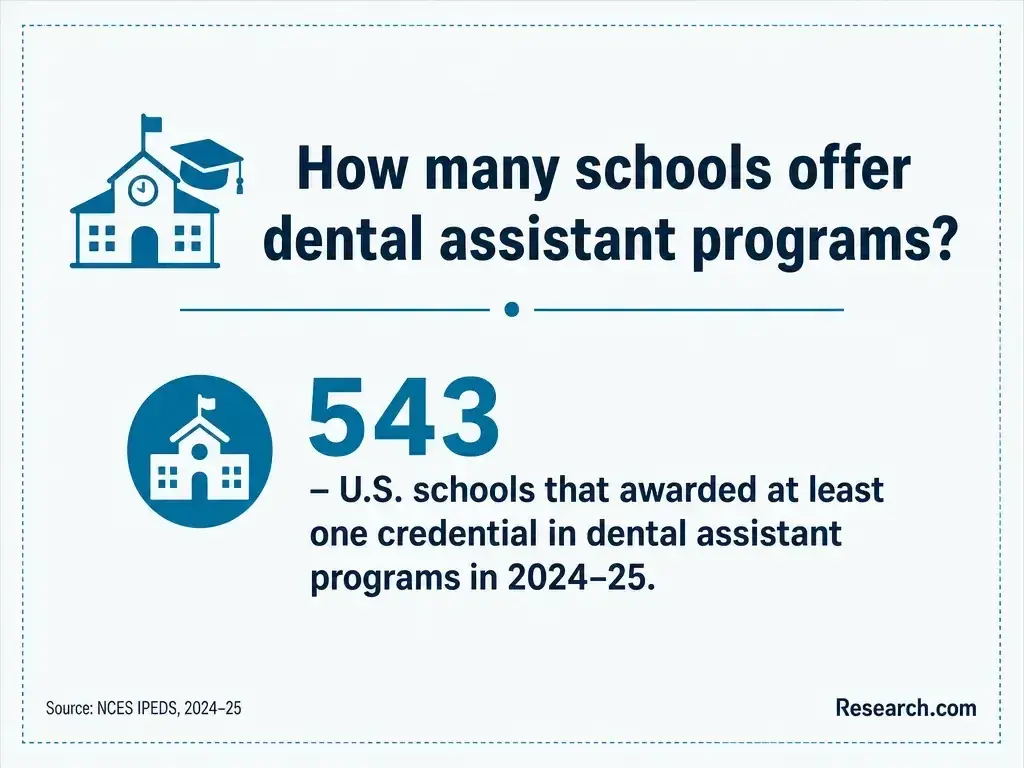
A reliable Granite Falls program-cost average is not established here, and a published 2027 price should not be assumed until a provider posts one. Compare total cost to become job-ready rather than tuition: mandatory fees, books, uniforms and protective equipment, supplies, examinations, travel to labs or clinical sites, and earnings forgone during unpaid training. For a commuter, distance can change which program is truly affordable.
Request an itemized, current quote and separate costs paid to the school from costs paid elsewhere. Then subtract aid you are actually eligible to receive, not advertised maximum awards. Federal Student Aid determines federal-aid eligibility by student and institution; Minnesota state aid and workforce assistance also have eligibility rules. Ask the school's aid office and Minnesota's CareerForce system about applicable options. An employer-paid training position may reduce upfront expense, but compare its wages, training quality, and limits on permitted duties.
Searches for cheapest online masters degrees illustrate why the word "cheap" needs context: an unrelated program's tuition cannot price the supervised practice or commute required for dental assisting.
The school credential might be a certificate, diploma, or associate degree; employer instruction may instead yield documented work experience. None is automatically a Minnesota occupational license. The Minnesota Board of Dentistry controls licensed dental assistant status, while the Dental Assisting National Board (DANB) administers professional certification. The Commission on Dental Accreditation (CODA) accredits qualifying dental education programs; institutional accreditation and state school authorization answer different questions.
Before accepting an enrollment offer, ask the provider to name the exact credential on the transcript, verify its current CODA status if Minnesota licensure is your goal, and identify which additional examinations or applications graduates must complete. Check those claims against the Minnesota Board of Dentistry and DANB rather than treating a school certificate as proof of eligibility.
Requirements vary by provider and route. A school may assess academic readiness and require health documentation or a background check for clinical placement; an employer training an unlicensed assistant may instead prioritize availability and patient-facing skills. Neither route should be assumed to have the same entrance requirements as Minnesota licensed dental assistant status.
Ask admissions staff which requirements apply before enrollment and which arise before clinical placement, including immunizations, CPR training, background screening, and transportation. Confirm whether a missed requirement could postpone your clinical term and whether related expenses appear in the quoted price. If you have prior healthcare learning, ask whether credit is awarded and whether accepting it changes clinical or licensure eligibility.
Relevant training covers infection prevention, instrument processing, dental materials, chairside assisting, patient communication, charting, and office workflow. Radiography training and the authority to perform particular procedures must be checked against Minnesota rules; learning about a task in class does not itself authorize a graduate to perform it. The U.S. Bureau of Labor Statistics identifies both clinical support and recordkeeping among dental assistant duties.
Look for supervised repetition with equipment and patients or appropriate simulations, plus specific feedback on safety and workflow. If a provider advertises entirely remote practical training, ask how it verifies hands-on competence and arranges any required in-person experience. In a small practice, versatility matters, but sound infection-control habits matter more than a long list of topics with little practice.
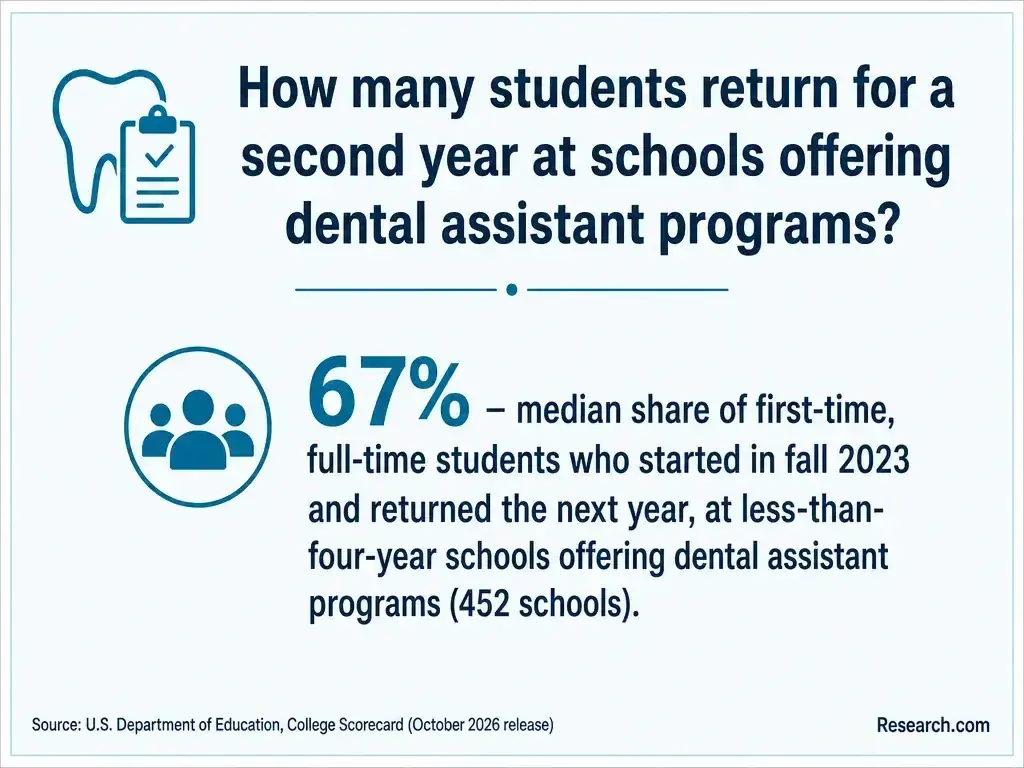
Not for every dental assisting position. Minnesota permits an unlicensed dental assistant role, with duties limited by state rules and dentist supervision. Performing duties assigned to a licensed dental assistant requires meeting Minnesota Board of Dentistry requirements; a school certificate alone does not confer that status. DANB certification is a separate professional credential that may be relevant to the licensure pathway or an employer's preferences, according to DANB and the Minnesota Board of Dentistry.
Work backward from the duties in local job postings. For a licensed role, check the Board's current education, examination, application, and any other requirements, then confirm in writing that the specific program supports that pathway. For an unlicensed role, compare school costs with an employer willing to provide supervised training. Do not assume that a program's institutional accreditation, an online completion certificate, or experience alone substitutes for the Board's requirements.
Start with the job you want - unlicensed assistant, licensed assistant, or a role requiring particular clinical skills - then compare routes against that goal. An affordability ranking is a useful shortlist, but its score does not measure program quality or whether clinical training fits your commute.
Use these checks before paying a deposit:
A common mistake is treating an attractive online price or institutional accreditation as proof of clinical fit. Guides to best online universities with national accreditation address a different comparison; for dental assisting, verify occupation-specific training and Minnesota rules separately. Judge return on investment over a realistic time horizon using completion probability, aid, debt, lost earnings, and plausible post-training pay - not an assumed salary increase.
An entry route may lead to supervised unlicensed assisting or, after meeting state requirements, licensed dental assisting. With experience, assistants may take on more office coordination, patient education, or specialty-practice responsibilities, depending on employer needs and permitted duties. DANB certification may document additional skills, but optional credentials and employer recognition should not be confused with Minnesota licensure.
For someone who wants to earn while learning and is comfortable with the unlicensed scope, an employer route may be the better first investment. Someone targeting duties reserved for licensed assistants should weigh the cost and travel of an eligible training pathway against the greater range of positions it could allow them to pursue. Neither path promises promotion; ask local employers which credentials they actually seek.
The U.S. Bureau of Labor Statistics projects 7.4% growth in dental assistant employment nationwide from 2025 to 2035. That supports considering the occupation, but it does not predict the number of openings in Granite Falls. A small local market can have few vacancies at any given time even when national demand grows.
Check current postings across a commute you can sustain, noting whether practices seek licensed assistants, accept trainees, or offer clinical placements. Also ask programs where recent students completed practical training and whether those sites hire. This gives a more decision-useful picture than applying a national growth rate to one town.
Education is a substantial investment, particularly when a low advertised price may exclude clinical travel or other expenses. Research.com developed this ranking to help readers compare affordable options against other dental assistant programs in the same location and occupation. The team draws on education, cost, debt, and occupation-specific sources to check the quality and credibility of the underlying information.
Only programs with completions reported to the Integrated Postsecondary Education Data System (IPEDS) are eligible. The most affordable ranking scores tuition, cost of attendance, median student debt, and federal loan default rate; an entropy-based method assigns more weight to indicators that vary more across eligible programs. Accreditation and other quality indicators are not part of this affordability score. Readers should therefore verify clinical training and Minnesota credential eligibility separately. Providers absent from IPEDS, including some employer-based training routes, are not necessarily unavailable or poor quality.
The following data sources inform the ranking and its occupation-specific checks:
Some sources cover the wider trade-school provider ecosystem rather than dental assisting specifically. For more detail on the ranking process, see Research.com's methodology. Use the ranking to narrow your search - not as proof that a program is the cheapest route to becoming job-ready.
# 1 position
# 2 position
Not for every role. Minnesota has an unlicensed assistant route, but licensed-assistant duties have separate state requirements. Check the Minnesota Board of Dentistry's current rules and the duties in the jobs you want.
No. Add required supplies, examinations, clinical travel, and lost earnings, then compare the result with eligible aid and any paid employer training. The ranking covers eligible programs with IPEDS-reported completions, not every route into the occupation.
Some theory can be taught online, but chairside skills need in-person practice. Ask where labs and clinical experience occur and whether the program supports your intended Minnesota role.
No. A school credential, DANB certification, and Minnesota licensure are distinct. Verify the Board's current education, examination, and application requirements before enrolling for a licensed-assistant goal.
Ask for its exact credential, current total price, in-person training and clinical locations, and written explanation of how its graduates can qualify for the Minnesota duties you want to perform.