# 1 position


Audited and Verified:
Our Editorial and Data Verification Process
Research.com uses government datasets, official education statistics and primary institutional information to support its career and degree guides. Our review process checks factual accuracy, occupational definitions, source dates and the requirements associated with the credentials discussed.
How This Article Was Fact-Checked
Our editorial team verifies salary estimates, employment projections, education requirements and program information against original data providers and official organizations. Salary figures are checked against the relevant occupational definitions and reporting periods. Information about licensure, accreditation and required in-person training is reviewed separately.
Fact-checked and verified on:

Co-Founder and Chief Data Scientist

Reviewed by Karolina Broda
Fact-Checker and Data Verification
Choosing dental assistant training in Watertown means comparing more than tuition: hands-on practice, travel, and eligibility for the duties you want to perform all matter. The U.S. Bureau of Labor Statistics reports a $48,070 national median annual wage for dental assistants in May 2025, though that is not a local starting wage. This guide helps prospective students and career changers compare pathways and costs. It also features a Most Affordable Dental Assistant Trade Schools in Watertown for 2027 ranking created by the Research.com team of data scientists to help students identify training programs worth considering.
Expect classroom instruction alongside practice in a dental lab or clinical setting. Dental assistants prepare treatment areas, support dentists during procedures, manage infection control, and may handle records or scheduling; permitted clinical duties depend on state rules and supervision (U.S. Bureau of Labor Statistics; South Dakota Board of Dentistry). A program is most useful when it lets you practice the work - not merely read about it.
These pathways differ in cost, time away from work, and access to supervised practice. The comparison can help you decide what to ask a provider or employer before committing.
| Pathway | What it typically provides | Best fit and key check |
| Trade-school or technical-college certificate or diploma | Structured dental assisting coursework and, where offered, labs or clinical experience | Fits students seeking organized preparation; confirm the actual clinical placement and credential awarded. |
| Associate-degree dental assisting program | Occupational training plus additional academic coursework | Fits students who value the additional coursework; check whether its extra time and cost serve a specific goal. |
| Employer-sponsored entry training | Practice-based instruction in a dental office, sometimes while earning wages | Fits someone with an available employer opportunity; verify supervision, training scope, and access to required credentials. |
Lake Area Technical College is a Watertown provider to investigate. Ask for its current dental assisting curriculum, award, clinical requirements, and full price rather than assuming that programs with similar names offer equivalent preparation. Employer training is a realistic alternative for some duties, but it should not be mistaken for an automatically recognized apprenticeship or a substitute for any required qualification.
Dental offices are the principal setting for dental assistants nationally (U.S. Bureau of Labor Statistics). In Watertown, a prospective student should investigate openings with general and specialty practices and ask whether an employer trains new hires or expects prior chairside experience. That distinction can determine whether paying for a structured program is worthwhile.
Be willing to assess commuting distance as well as the city itself. A clinical placement or first job outside Watertown can add transport costs, but it may also expand the number of offices where you can gain experience. Ask a program where recent students completed clinical work; do not assume it places every student locally or guarantees employment.
A reliable Watertown-specific dental assistant wage is not established here. The national median was $48,070 annually in May 2025 (U.S. Bureau of Labor Statistics). That figure covers experienced and newly employed workers across the country, so it is a benchmark for comparing the occupation - not an expected offer after graduation in Watertown.
For a useful local estimate, compare current offers from dental practices by hourly pay, scheduled hours, benefits, and any paid training. Then weigh the likely increase over what you could earn without enrolling against the program's total cost and time away from paid work. A higher national median alone does not demonstrate a positive return on your investment.
Length depends on the award, course schedule, and clinical component. A shorter certificate or diploma can provide a faster route to office work than an associate-degree program, but an accelerated calendar is only valuable if it leaves enough supervised practice for the duties you want. Ask for the current calendar and the number, location, and scheduling of lab and clinical hours; do not infer clock hours from a program's title.
Part-time study may preserve earnings while extending the time until completion. If you are comparing what is the easiest 2 year degree to get?, focus instead on whether a dental assisting credential delivers the clinical preparation and job access you need. Ease or speed is a poor substitute for occupational fit.
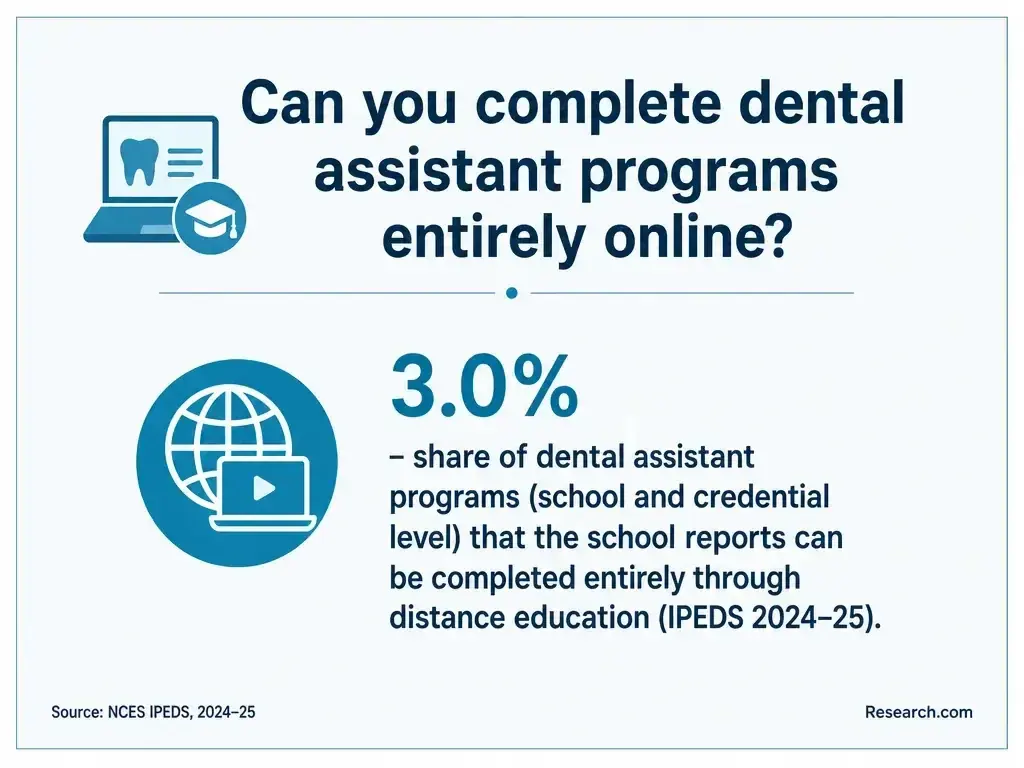
Online coursework can cover topics such as terminology, records, and infection-control principles. Chairside techniques, instrument handling, and other practical competencies require in-person practice and assessment. A hybrid option can reduce classroom trips from Watertown, but only if its lab and clinical locations - and their schedules - are workable for you.
Before choosing a remote option, get written answers about who arranges local clinical experience, how skills are assessed, and whether its training supports the South Dakota duties or certification route you want. An entirely online course should not be assumed to establish practical competence or regulatory eligibility. Lists of top accredited online schools with no application charge may help with an application-fee search, but they cannot answer those dental assisting questions.
There is no verified Watertown-wide average price that reliably covers technical-college, career-school, and employer-based dental assisting routes. Treat a quoted tuition figure as a starting point, not the amount required to become job-ready. Request an itemized, current estimate from each provider before comparing offers.
Include mandatory fees, books, uniforms, protective supplies, immunizations or background checks if required, certification-exam charges, and travel to labs or clinical sites. Also count earnings you would give up while attending. Employer-paid training, scholarships, workforce assistance, or eligible student aid can lower your out-of-pocket cost, but availability varies. Federal aid eligibility depends on the institution and program, not simply on whether the training is occupational (Federal Student Aid).
The better comparison is net cost to complete against the earnings opportunity the route plausibly opens for you. Account for aid that need not be repaid, likely borrowing, completion risk, and how long you expect to work in the occupation. Avoid choosing a longer program solely because its monthly payment looks manageable.
The school-awarded credential may be a certificate, diploma, or - if you enroll in a degree-granting program - an associate degree. An employer training route may award no school credential. Ask the provider for the exact award printed on completion documents and whether employers in your intended setting recognize it.
Keep four different things separate: institutional accreditation evaluates a school; CODA programmatic accreditation concerns a specific dental program; DANB certification is an individual credential; and permission to perform regulated duties comes from applicable South Dakota rules (Commission on Dental Accreditation; Dental Assisting National Board; South Dakota Board of Dentistry). One does not automatically confer the others. If national certification matters to you, check DANB's current eligibility routes against the specific program before enrolling.
Requirements are provider-specific. Request the current admissions checklist, including any prerequisite education, placement assessment, health documentation, immunizations, background screening, or clinical-site requirements. An acceptance letter does not necessarily mean you have satisfied every condition for clinical placement.
Ask admissions staff what happens if a required clinical site is unavailable or a screening delays your start. If you have prior healthcare coursework or office experience, ask whether it earns credit or advanced standing and whether that changes the cost or clinical requirements. Employer-based entry can have different hiring criteria, so compare an actual offer with the full cost of school rather than assuming either route is open to everyone.
Core training commonly addresses dental terminology, infection prevention, instrument preparation, chairside support, patient communication, and office records (U.S. Bureau of Labor Statistics). Depending on the program and applicable rules, instruction may also address dental imaging or other specialized duties. A topic appearing in a syllabus does not, by itself, establish that a graduate may perform it independently.
Evaluate how students demonstrate skills: supervised lab practice, feedback during clinical work, and documented competencies are more informative than a course list alone. Dental offices increasingly rely on digital records and imaging workflows, so ask whether the equipment used in training resembles what prospective employers use. The practical goal is to be ready to work safely under the appropriate supervision.
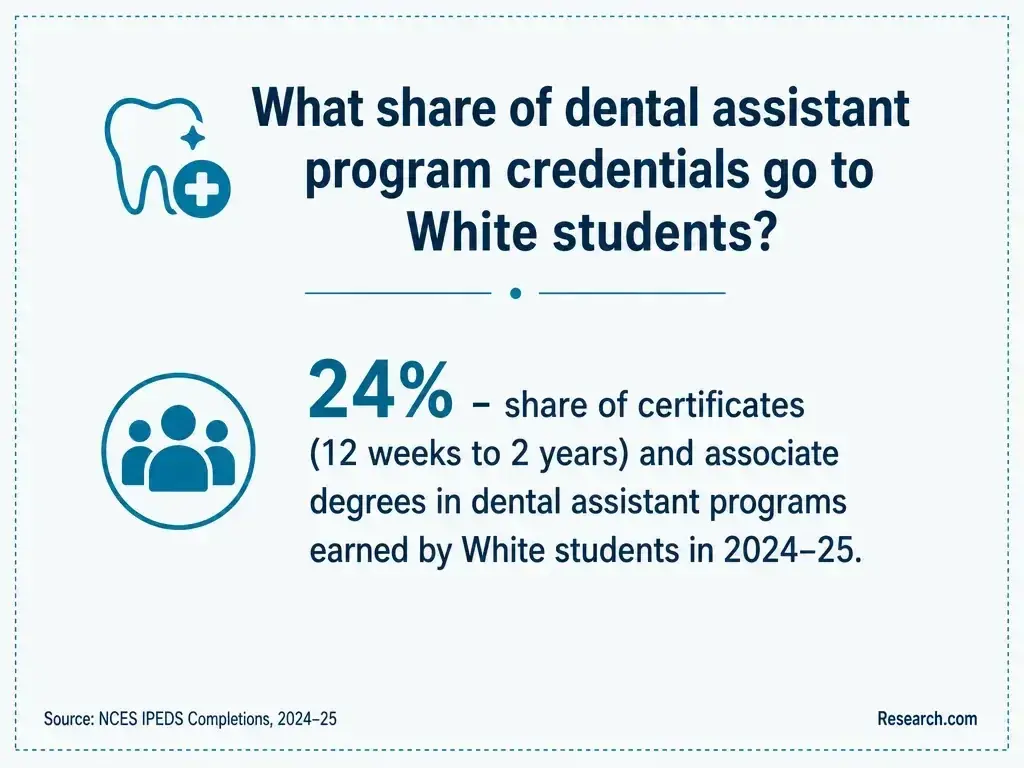
Do not assume that one dental assistant credential covers every task. South Dakota's rules distinguish permissible duties and supervision, and additional qualifications may apply to duties such as dental radiography or expanded functions (South Dakota Board of Dentistry). Check the board's current requirements for the specific tasks in the job you want, including any required training, examination, application, or registration.
DANB certification is a professional credential with its own eligibility requirements; it is not the same as a South Dakota occupational authorization (Dental Assisting National Board; South Dakota Board of Dentistry). Ask a program to identify, in writing, which duties its graduates are prepared and eligible to perform. Graduation or accreditation alone should never be treated as proof of permission to perform a regulated task.
Start with the job you want, then work backward to its required skills and permitted duties. An affordable ranking helps identify programs to investigate, but it cannot tell you whether a clinical schedule fits your life or whether an employer offers a less costly training route. Use these checks before paying a deposit:
A warning sign is a promise of certification, licensure, employment, or a particular salary without explaining eligibility and evidence. Another is an advertised low price that excludes clinical travel or required supplies. If your actual goal is a different career pathway - even one you found while searching for a fast bachelor's degree online - do not buy dental assisting training merely because it is shorter or cheaper. Choose it for the work and entry route it provides.
The direct path is an entry-level dental assisting role in a practice. With experience and any additional qualifications required for particular duties, an assistant may take on more specialized chairside responsibilities or move toward scheduling, patient coordination, or office supervision (U.S. Bureau of Labor Statistics; South Dakota Board of Dentistry). Those steps are possibilities, not automatic promotions attached to a certificate.
Chairside work involves close, frequent contact with patients and coworkers. If you are exploring careers for an introvert, assess the actual work environment rather than assuming dental assisting is primarily a quiet technical role. Ask to observe a practice when possible; that can reveal whether its pace and patient contact suit you before you invest in training.
The U.S. Bureau of Labor Statistics projects 7.4% national employment growth from 2025 to 2035 for dental assistants. This indicates continued demand across the occupation, but it is not a forecast of vacancies in Watertown or a guarantee of a first job.
For a local decision, check current practice openings, their experience requirements, and whether nearby communities are within your commuting range. Compare those findings with a program's clinical connections and any program-specific employment information it can substantiate. A student with access to supervised practice and a realistic search area is better positioned to evaluate the investment than one relying on a national projection alone.
Investing in training is a consequential decision, so Research.com evaluates affordable programs against other programs in the same occupation and location. The most-affordable ranking scores tuition, cost of attendance, median student debt, and federal loan default rates; an entropy-based method assigns more weight to measures that vary more across programs. Accreditation and other quality indicators are not part of the affordability score. Only programs with completions reported to IPEDS can appear, so the ranking is a comparison tool - not an inventory of every local training route.
The Research.com team uses multiple data sources to check program information and improve the ranking's credibility. Some sources inform broader provider or credential checks rather than establishing that a particular dental assisting program qualifies students for a specific duty:
Use the ranking to narrow your options, then confirm current prices, clinical arrangements, and South Dakota requirements directly. More detail on the approach appears in Research.com's methodology.
# 1 position
# 2 position
It may be if structured hands-on training helps you qualify for the work you want at a manageable net cost. Compare that benefit with available employer training, clinical travel, lost earnings, and your likelihood of completing the program.
Some employers train assistants on the job. Confirm which duties the employer will teach and supervise, and check South Dakota requirements before assuming that route qualifies you for radiography or other regulated tasks (South Dakota Board of Dentistry).
You may be able to complete some coursework online, but chairside skills need in-person practice. Ask where labs and clinical work occur and who arranges them.
No. Compare total job-ready cost with supervised experience, completion prospects, credential eligibility, and the time needed to enter paid work. A low tuition price can conceal other required expenses.
No. School completion and DANB certification are separate. Check the current DANB eligibility route and examination requirements for the certification you want (Dental Assisting National Board).