# 1 position

Audited and Verified:
Our Editorial and Data Verification Process
Research.com uses government datasets, official education statistics and primary institutional information to support its career and degree guides. Our review process checks factual accuracy, occupational definitions, source dates and the requirements associated with the credentials discussed.
How This Article Was Fact-Checked
Our editorial team verifies salary estimates, employment projections, education requirements and program information against original data providers and official organizations. Salary figures are checked against the relevant occupational definitions and reporting periods. Information about licensure, accreditation and required in-person training is reviewed separately.
Fact-checked and verified on:

Co-Founder and Chief Data Scientist

Reviewed by Karolina Broda
Fact-Checker and Data Verification
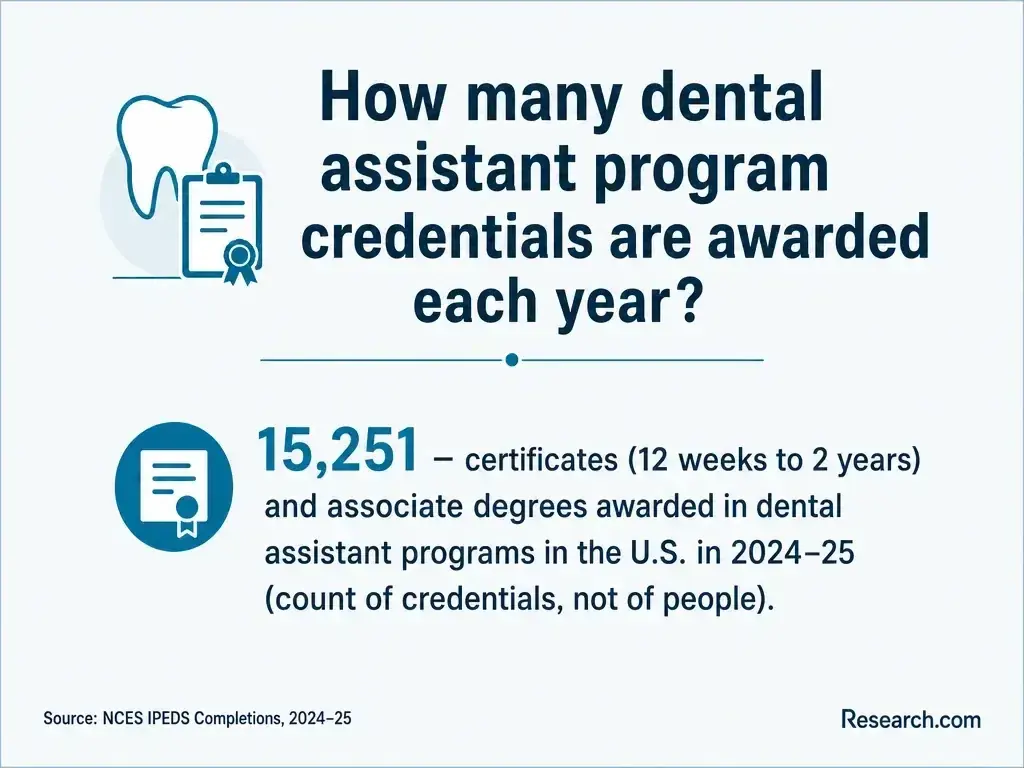
A low tuition price does not tell you whether a dental assistant program will prepare you for chairside work - or for Texas radiography registration. This guide helps prospective students and career changers compare San Antonio training by total cost, practical experience, credentials, and time to employment. The Research.com team of data scientists created a Most Affordable Dental Assistant Trade Schools in San Antonio for 2027 ranking to help students make an informed choice about programs worth considering. Nationally, dental assistant employment is projected to grow 7.4% from 2025 to 2035, according to the U.S. Bureau of Labor Statistics (BLS).
Expect instruction in chairside procedures, instrument handling, infection control, patient communication, dental records, and often radiography. The strongest comparison is not the credential's name but how often you practice with equipment, receive feedback, and work with patients under appropriate supervision. Ask each provider for its current lab and externship schedule; a short course with limited clinical exposure is not equivalent to a longer program with substantial supervised practice.
San Antonio students can compare community-college and career-school routes, including offerings they verify directly with San Antonio College, Lamson Institute, The College of Health Care Professions-South San Antonio, Pima Medical Institute-San Antonio, and Concorde Career College-San Antonio. Programs and locations can change, so confirm that the specific campus currently offers dental assisting before comparing prices. A dental office willing to train a new hire is another possible entry route, though it may provide less structured instruction and may not cover every step needed for Texas radiography registration.
Dental assistants primarily support dentists in general practices; opportunities can also include specialty practices such as orthodontics and oral surgery. Work may mix chairside care, sterilization, scheduling, and patient records, depending on the office. The BLS identifies dentists' offices as the principal employer nationally, so an externship with a local practice is especially useful for testing the work environment and making employment contacts.
Ask whether a program helps arrange placements accessible from your part of the metro area. An unpaid placement across town can change both the real cost of training and whether you can keep working while enrolled.
Use $48,070, the BLS national median annual wage for dental assistants in May 2025, as occupational context - not as a local pay quote. A median includes experienced workers, and a newly trained assistant's offer may differ with duties, registration status, schedule, and employer. Before borrowing, compare current San Antonio job postings for positions you would actually qualify for and ask employers whether radiography registration affects their hiring or pay.
For a realistic return-on-investment calculation, weigh those prospective earnings against your current pay, the likelihood of completing training, aid received, debt payments, time away from work, and how long you expect to remain in the occupation. The sticker price alone cannot answer whether a program pays off.
Duration depends on the route: accelerated certificate courses may run for months, while more extensive certificate or diploma programs can take about a year; a program awarding an associate degree generally takes longer. These are planning ranges, not verified schedules for the San Antonio providers named above. Request each program's current calendar, total contact hours, lab hours, and required externship hours rather than comparing advertised completion dates alone.
An accelerated schedule suits someone who can attend frequent labs and travel promptly to a placement. Part-time study may preserve income but delay entry into paid dental work. If you are comparing what 6 month certificate course can lead to a higher salary online, check the dental-specific hands-on and Texas radiography requirements before treating a short timeline as an advantage.
Online instruction can cover terminology, records, and some infection-control concepts. It cannot replace supervised practice positioning equipment, maintaining a sterile field, assisting at chairside, or working with patients. A hybrid program can be practical if its labs and clinical placement are reachable from home; a fully online course should not be assumed to establish clinical competence or Texas radiography eligibility.
Ask precisely where skills are assessed and who secures the clinical placement. For a working student, a flexible lecture schedule loses much of its value if required daytime clinical shifts are undisclosed until enrollment.
There is no reliable single San Antonio average that covers community-college programs, career schools, short courses, and employer training on the same basis. Published tuition may omit mandatory fees and clinical expenses. Request an itemized, current quote for your campus and schedule before calling any option affordable.
Build a job-ready cost that includes tuition; registration and lab fees; textbooks and supplies; scrubs and protective equipment; any required health checks or background screening; certification or Texas application costs; travel to labs and externships; and wages lost while training. Subtract only grants or employer support you have confirmed. Federal aid eligibility depends on the institution and program, not the occupation; ask the financial-aid office what applies to your specific enrollment. The cheapest course may cost more overall if it requires separate clinical or radiography preparation.
The school may award a certificate, diploma, or, where offered, an associate degree. Those are education credentials, not Texas occupational registration. A school's institutional accreditation, a dental-assisting program's CODA accreditation, Texas school authorization, and eligibility for Texas Registered Dental Assistant (RDA) registration are distinct checks. DANB's Certified Dental Assistant (CDA) is a separate professional certification with its own eligibility rules; it is not automatically awarded at graduation (CODA; DANB; Texas State Board of Dental Examiners).
Ask the provider to identify the exact credential printed on completion documents and to show, in writing, how its coursework relates to the Texas requirements for the duties you want. A broad search for career certifications that pay well cannot establish that a dental-assisting certificate meets those requirements.
Admissions requirements vary by provider and are separate from employer hiring requirements. Ask whether entry requires a high school diploma or equivalent, an assessment, immunization documentation, a background check, or a drug screen - and when each expense is due. Clinical sites may set additional access requirements, so an admission offer alone does not confirm that you can complete an externship.
If you already work in a dental office, ask whether documented experience can satisfy any coursework or placement requirement. Do not assume prior-learning credit transfers between providers or replaces a Texas board requirement.
Core learning typically includes dental anatomy and terminology, instrument transfer, operatory preparation, sterilization, infection prevention, patient communication, charting, and administrative workflow. Radiography instruction matters particularly in Texas because exposing dental radiographs is tied to state registration requirements (Texas State Board of Dental Examiners). Compare syllabi and skills checklists, not just course titles, to see whether students actually practice the duties advertised.
Digital imaging and electronic records make equipment access worth checking: ask what systems you will use in lab and what you will only observe. If a program's clinical component is optional, clarify how you will demonstrate chairside competence to a first employer.
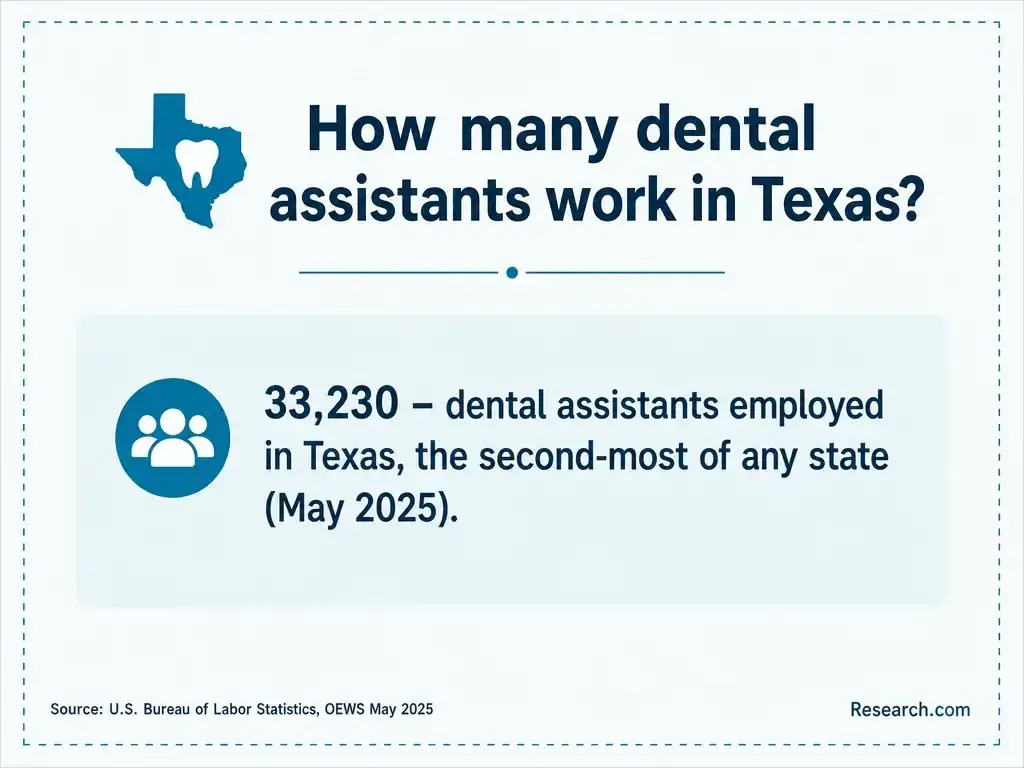
Texas does not require every dental assistant to hold an occupational license simply to assist in a dental office. Radiography is different: a dental assistant seeking to expose dental radiographs must meet the Texas State Board of Dental Examiners' RDA registration requirements. The board sets applicable education, examination, application, and other eligibility conditions; verify its current instructions before paying for a course. Completing a school certificate does not itself grant registration (Texas State Board of Dental Examiners).
DANB's CDA certification is a separate, nationally recognized voluntary credential, not a replacement for Texas registration (DANB; Texas State Board of Dental Examiners). If an employer offers on-the-job training, ask who will provide any additional preparation needed before you perform regulated duties.
Start with the duties you want to perform, then compare only programs that can demonstrate an appropriate path to those duties. The ranking helps identify potentially lower-cost options, but its affordability score does not measure clinical quality or registration eligibility.
Before enrolling, get written answers to these questions so similar-looking offers become comparable:
Verify institutional accreditation with the accreditor, CODA status with CODA if advertised, and Texas registration rules with the board. A low tuition quote, an "accredited" label without the accreditor's name, or a promised job is a reason to ask more questions - not to skip these checks.
A common progression is entry-level chairside assistance followed by broader duties where permitted, specialty-practice experience, or a lead-assistant role. Office coordination may suit assistants who prefer scheduling and patient communication. Additional certification can signal skills, but experience and an employer's needs still matter; dental-assisting training does not automatically qualify someone for a different regulated occupation.
If your immediate goal is paid chairside work, compare structured school training with a dental office prepared to train a new hire. If your goal instead concerns the easiest degree to get, that is a different decision from choosing the practical preparation needed for this occupation.
The BLS projects 7.4% growth in U.S. dental assistant employment from 2025 to 2035. This national projection suggests continuing demand for the occupation, but it does not predict openings for an individual San Antonio graduate. Check current local postings for required experience, radiography duties, and schedules; these reveal whether a program's training matches the jobs you could pursue immediately.
For a near-term career change, local placement access and completion probability may matter more than a long-range national growth rate. Training that you cannot finish - or that omits skills repeatedly requested by nearby employers - offers little practical advantage.
Investing in training is an important decision. To make the ranking credible and useful, the Research.com team compares programs with others in the same occupation and location, checks multiple education and occupational sources, and limits the ranked set to programs with completions reported to the Integrated Postsecondary Education Data System (IPEDS). That limit means an unlisted employer-sponsored course or other provider is not necessarily a poor option.
The most affordable ranking evaluates tuition, cost of attendance, median student debt, and federal loan default rates. It assigns weights through an entropy-based method, which gives more weight to measures that differ more across programs. Accreditation and other quality measures do not contribute to this affordability score; readers should check them separately. The following sources inform the ranking and its verification:
Use the ranking to narrow a local shortlist, then verify each program's current price, clinical access, and Texas registration preparation. More detail about the ranking approach appears on the Research.com methodology page.
# 1 position
# 2 position
# 3 position
Dental Assisting/Assistant
Delivery mode: On Campus (May Include Online Courses)
65.07
/ 100
Final score
Accreditation
Institutional accreditation from Accrediting Council for Continuing Education & Training.
Lamson Institute earned a Research.com Affordability Score of 65.07/100, supported by $7,600 median student debt and 12% federal loan default rate.
# 4 position
# 5 position
# 6 position
Some Texas dental offices train assistants on the job. Ask what supervision and training they provide, and check Texas RDA requirements separately if the role involves dental radiographs (Texas State Board of Dental Examiners).
Not necessarily. Compare total cost, clinical hours, completion prospects, and whether the training supports your intended duties. An inexpensive course that requires substantial additional training may not be the lowest-cost route.
Some coursework can be remote, but chairside and other practical skills need in-person training and assessment. Confirm where labs and any clinical placement occur before enrolling.
No. School completion and Texas RDA registration are separate. Check the board's current eligibility and application requirements before choosing a program (Texas State Board of Dental Examiners).
Choose the faster option if it provides the practical preparation you need and fits your schedule. A longer program may be worthwhile for additional supervised experience, but request its current costs and hours rather than assuming duration means better preparation.