# 1 position
Milan Institute-Visalia - Dental Assisting/Assistant.
certificate or diploma

Audited and Verified:
Our Editorial and Data Verification Process
Research.com uses government datasets, official education statistics and primary institutional information to support its career and degree guides. Our review process checks factual accuracy, occupational definitions, source dates and the requirements associated with the credentials discussed.
How This Article Was Fact-Checked
Our editorial team verifies salary estimates, employment projections, education requirements and program information against original data providers and official organizations. Salary figures are checked against the relevant occupational definitions and reporting periods. Information about licensure, accreditation and required in-person training is reviewed separately.
Fact-checked and verified on:

Co-Founder and Chief Data Scientist

Reviewed by Karolina Broda
Fact-Checker and Data Verification
Choosing dental assistant training in Visalia means comparing more than tuition: the program must teach chairside skills and fit California's rules for the duties you want to perform. The U.S. Bureau of Labor Statistics projects 7.4% national employment growth for dental assistants from 2025 to 2035. For career starters and working adults, this guide explains training routes, costs, credentials, and job prospects. It also accompanies the Best Dental Assistant Trade Schools in Visalia for 2027 ranking, created by the Research.com team of data scientists to help students identify programs worth considering.
A dental assistant program prepares students to support dentists before, during, and after treatment. Expect instruction in infection prevention, instrument preparation, chairside procedures, patient communication, records, and dental imaging within the duties California allows. A useful program provides supervised practice - not just lectures - because handling instruments, maintaining asepsis, and positioning patients cannot be learned reliably from reading alone.
The main entry routes have different strengths. The table compares what each route offers before you commit to a schedule or payment plan; availability and exact credentials must be confirmed with the provider.
| Route | Training and credential | Best fit and key limitation |
| Career-school certificate or diploma | Scheduled coursework, simulated labs, and potentially clinical experience; school-issued credential | Fits students seeking a structured transition; verify hands-on hours and total cost. |
| Community-college certificate or associate program | Occupational coursework and labs, sometimes with broader general education | Fits students who value a public-college option; compare time to completion and admission availability. |
| Supervised employer training | Practice-based instruction; may not award a school credential | Fits someone with a willing employer; verify how required courses and future RDA eligibility will be documented. |
In Visalia, compare the current offerings of Milan Institute-Visalia and San Joaquin Valley College-Visalia with any viable employer-training opportunity. Do not assume either campus currently offers a particular dental-assisting credential, externship, or start date without written confirmation. A registered apprenticeship, if one is available for this occupation and location, is distinct from ordinary on-the-job training: registration, wages, instruction, and completion terms must be verified with the sponsor (U.S. Department of Labor, Apprenticeship.gov).
Dental assistants chiefly work in dental offices, where they prepare treatment rooms, support procedures, and help patients move through appointments (U.S. Bureau of Labor Statistics). In and around Visalia, prospective students should look at general and specialty practices and ask whether a position is primarily chairside, front-office, or a mix. That distinction affects which clinical skills an employer will expect immediately.
A small practice may offer exposure to scheduling, sterilization, and chairside work in one role; a specialty office may expect familiarity with its procedures. Ask prospective employers which duties they train new hires to perform and which California-authorized courses or credentials they prefer. Willingness to train is more useful than a broad promise that a school has "local connections."
The national median annual wage for dental assistants was $48,070 in May 2025 (U.S. Bureau of Labor Statistics, Occupational Outlook Handbook). Half of employed dental assistants nationally earned less and half earned more. This figure includes experienced workers and should not be read as an entry-level offer in Visalia.
Before borrowing for training, compare actual Tulare County-area job postings or offers by hourly wage, scheduled hours, benefits, and required qualifications. An advertised hourly rate does not establish annual earnings if shifts vary. Earnings may rise with experience and additional permitted duties, but neither a certificate nor an RDA license guarantees a raise.
There is no single required length for entry-level dental assistant training in California: supervised employment and school-based programs follow different schedules. A short certificate can get someone into a practice sooner, while a longer program may include more lab, clinical, and general coursework. Calendar length alone cannot show whether students get enough supervised repetition to work safely.
Ask each school for its current catalog showing total clock or credit hours, the split between classroom, lab, and externship work, and the time a typical student actually takes to finish. Check evening or part-time schedules against externship hours; a flexible classroom schedule may still require daytime clinical attendance. If the goal is Registered Dental Assistant (RDA) eligibility, obtain a written explanation of how that specific route meets the Dental Board of California's current requirements. Do not assume time spent in any program automatically counts toward an experience-based route.
Online instruction can work for terminology, records, and some infection-control theory. It cannot replace supervised chairside practice, instrument processing, or clinical assessment. A hybrid program is therefore only a practical option for a Visalia student if its required labs and clinical sites are reachable and its schedule is workable.
Campus training offers immediate access to equipment and instructor feedback, but commuting and fixed sessions can add cost or conflict with work. When comparing online advertising with low cost accredited online colleges, check the dental assistant program itself: institutional accreditation and a low online price do not establish California eligibility for particular clinical duties. Request the address, hours, supervision arrangements, and any additional charge for every in-person component before enrolling.

There is no defensible single "average Visalia program cost" without comparable, current published prices for the available dental assistant programs. A quoted tuition figure is not the cost of becoming job-ready. Build a side-by-side budget from written school estimates for tuition and mandatory fees, books, scrubs, supplies, immunizations or screening if required, travel to labs and externships, and any examination or application charges.
Ask for a total cost based on your own start date and schedule, then subtract only grants or employer contributions for which you are actually eligible. Federal aid depends on both student and program eligibility (Federal Student Aid); do not assume every short training course qualifies. California aid and workforce funding likewise have specific eligibility rules. Employer training may lower tuition expense or pay wages while you learn, but compare the supervision and any required outside courses as well.
For return on investment, consider the time you will be out of paid work, the chance of finishing, expected borrowing, realistic entry pay, and how long you expect to work in the occupation - not just the sticker price. An accelerated program may save time yet be a poor bargain if it leaves you paying separately for the practical training your target job requires.
A trade-school graduate generally receives the credential named in the program's catalog, commonly a certificate or diploma. A school may instead award an associate degree if its actual program is designated as one. None of these school-issued credentials is, by itself, a California RDA license or a Dental Assisting National Board certification (Dental Board of California; Dental Assisting National Board).
For a student drawn to an associate degree in 6 months online, the decisive question is not the advertised speed or credential name. Ask whether the dental-assisting curriculum includes the in-person competencies and documented coursework needed for the duties and California pathway you intend to pursue. Also ask whether prior coursework receives credit and whether that credit changes clinical requirements; transfer or advanced standing should never be assumed.
Admission criteria differ by provider. Request the current catalog rather than assuming every school requires the same diploma, assessment, background check, immunizations, or placement process. Clinical sites may impose requirements beyond classroom admission; failing to meet them could prevent an externship even after tuition is paid.
Before applying, ask when the next cohort begins, whether admission guarantees access to required labs and clinical placements, and what happens if a placement falls through. An employer-training route has a different entry hurdle: securing a practice willing to supervise a beginner and explaining how any courses needed for restricted duties will be completed. Confirm these arrangements before leaving a job to train.
Effective instruction connects dental anatomy and terminology to actual chairside tasks: setting up procedures, transferring instruments, maintaining a clean field, communicating with patients, and recording information accurately. Programs should also teach infection prevention and workplace safety through observed practice, not just a quiz. These skills reflect the work described by the U.S. Bureau of Labor Statistics and the duties regulated by the Dental Board of California.
Dental imaging deserves special scrutiny because California sets conditions for performing certain duties (Dental Board of California). Ask whether imaging instruction includes supervised equipment practice, how competence is assessed, and what documentation students receive for any board-recognized coursework. A program that teaches the concept of a procedure has not necessarily qualified a graduate to perform it on patients.
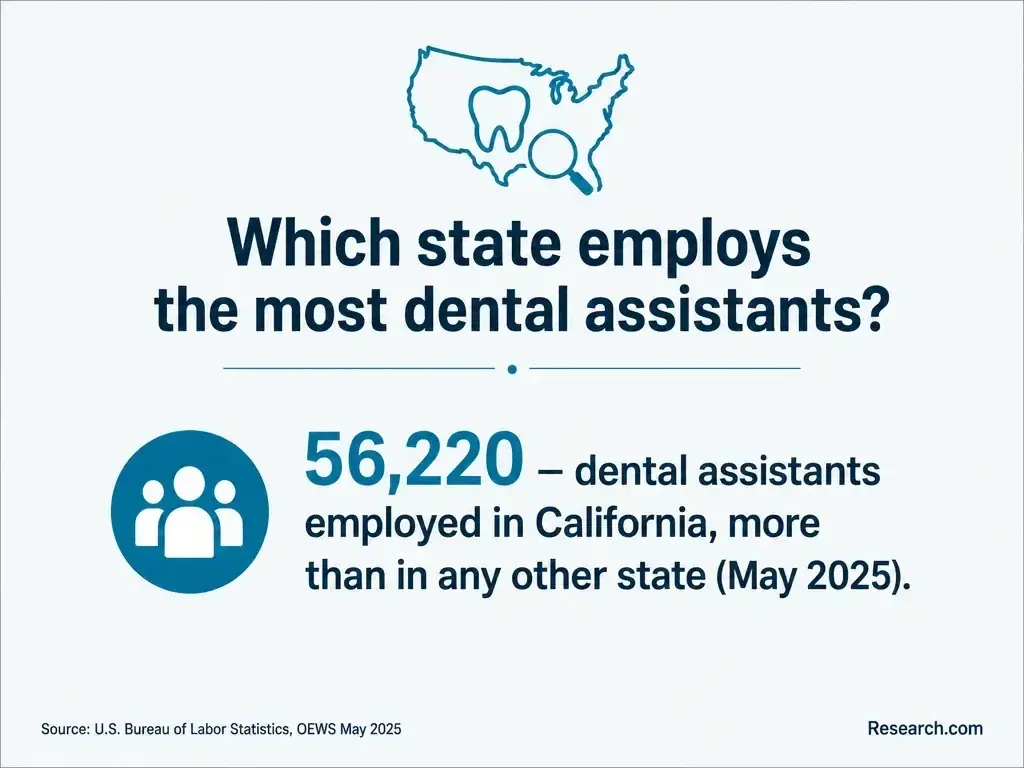
No RDA license is required for every entry-level dental assistant position in California. Unlicensed assistants can perform duties permitted under dentist supervision, while other duties have specified training, course, or licensing conditions. Registered Dental Assistant is a separate California credential with board-established eligibility and examination requirements; national certification from the Dental Assisting National Board is also separate (Dental Board of California; Dental Assisting National Board).
Before paying a deposit, identify the duties you want to perform and check the Dental Board of California's current requirements for each. Ask the school which courses are board-approved where approval is required, whether the program offers a qualifying RDA pathway, and what steps remain after graduation. Institutional accreditation, state authorization to operate a school, Commission on Dental Accreditation recognition, professional certification, and an occupational license answer different questions; none automatically substitutes for another.
The best choice is the route that gets you competently into your intended role at a cost and pace you can sustain. A structured program may suit someone who needs guided practice and help arranging clinical experience. Direct employer training may make more sense for someone with a confirmed, well-supervised position. Avoid paying for an accelerated course solely because it advertises fast completion if it cannot show how you will practice clinical skills.
Use these checks when comparing the current options at Milan Institute-Visalia and San Joaquin Valley College-Visalia - or assessing an employer's offer:
A ranking can help build a shortlist, but it cannot tell you whether a particular cohort has an accessible externship or whether its credential matches your goal. Treat vague answers about "certification upon graduation," undisclosed fees, and outcomes without a defined student group as reasons to investigate further.
Many graduates seek entry-level chairside work, then develop experience in a general or specialty practice. Others move toward scheduling, treatment coordination, or practice administration. California RDA registration can expand permitted duties for those who meet its requirements; it is an advancement pathway, not a credential automatically conferred by employment or graduation (Dental Board of California).
Dental assisting is a relatively direct route into patient-facing work, but it should be compared on its own costs and earnings rather than grouped with the highest paying trade school careers. Someone whose main goal is a different clinical occupation should first check that occupation's training and licensing route instead of assuming dental assistant hours will transfer.
The U.S. Bureau of Labor Statistics projects 7.4% national employment growth for dental assistants from 2025 to 2035. That supports considering the occupation, but it is a national projection - not a forecast of openings in Visalia or a promise of placement after training.
For a local decision, review recent openings within a commute you would actually accept. Note whether employers request prior chairside experience, imaging qualifications, RDA status, or only entry-level training. If few suitable jobs appear within your travel range, a shorter, lower-debt route may reduce risk; if openings consistently request skills your proposed program does not teach, the program's low price may be misleading.
Investing in occupational training is a consequential decision, so Research.com evaluates dental assistant programs against other programs serving the same occupation and location - not against unrelated schools nationwide. The ranking includes only programs with completions reported to the Integrated Postsecondary Education Data System (IPEDS). That makes comparisons more consistent, but it also means an employer training route or other provider absent from IPEDS may not appear; exclusion does not mean it is unapproved or ineffective.
For its best-program rankings, Research.com considers completion and full- and part-time retention; earnings one year after completion and earnings relative to annual attendance cost; tuition, attendance cost, debt, and federal loan default rates; and accreditation, relevant program recognition, and student support. Occupation-relevant programmatic accreditation or industry recognition accounts for 20% of the score, institutional accreditation for 10%, and student support for 10%. An entropy-based method distributes the remaining 60% across outcomes, earnings, and costs, giving more weight to indicators that vary more among programs. Most-affordable rankings instead score only costs and debt using that method; they do not include accreditation or other quality indicators.
The team draws on the following sources to check program information and relevant recognition. Some sources cover the broader trade-school landscape and should not be mistaken for dental-assisting approval authorities:
These measures help narrow a shortlist, not replace checking current program offerings, clinical training, and California eligibility directly. Readers can find more detail on the scoring approach in Research.com's methodology.
# 1 position
# 2 position

Yes. California allows entry-level dental assisting through supervised employment, subject to limits on permitted duties. Confirm that an employer will provide training and identify any additional courses needed for the work you want to do (Dental Board of California).
No. A school certificate and California RDA registration are different credentials. Check the Dental Board of California's current eligibility, coursework, and examination requirements for your intended pathway.
Online coursework may cover theory, but chairside and other practical competencies require supervised in-person training. Ask exactly where and when those components take place.
Compare current, written total-cost estimates from programs you confirm are operating, including fees, supplies, clinical travel, and likely borrowing. Tuition alone cannot answer that question.
It may be if the program provides relevant supervised practice, a workable route to your intended duties, and a total cost you can support with realistic local pay. Compare it with a genuine employer-training offer before committing.