# 1 position


Audited and Verified:
Our Editorial and Data Verification Process
Research.com uses government datasets, official education statistics and primary institutional information to support its career and degree guides. Our review process checks factual accuracy, occupational definitions, source dates and the requirements associated with the credentials discussed.
How This Article Was Fact-Checked
Our editorial team verifies salary estimates, employment projections, education requirements and program information against original data providers and official organizations. Salary figures are checked against the relevant occupational definitions and reporting periods. Information about licensure, accreditation and required in-person training is reviewed separately.
Fact-checked and verified on:

Co-Founder and Chief Data Scientist

Reviewed by Karolina Broda
Fact-Checker and Data Verification
Choosing dental assistant training in East Liverpool means looking beyond a program's name: you need clinical practice, a manageable total cost, and a route to the duties you want to perform in Ohio. The U.S. Bureau of Labor Statistics (BLS) reports a May 2025 national median wage of $48,070 for dental assistants. This guide explains training options, credentials, costs, and career prospects. It also accompanies the Best Dental Assistant Trade Schools in East Liverpool for 2027 ranking, created by the Research.com team of data scientists to help students identify programs worth considering.
A dental assistant training program prepares students to support a dentist during procedures, maintain infection-control procedures, prepare instruments and patients, and handle records or scheduling. Training can range from supervised employer instruction to a school-based certificate or diploma. An associate degree is a longer academic option, not an entry requirement for every assisting job. The BLS notes that education and entry requirements vary by state.
These pathways differ most in how they provide practice and what they award. Compare the actual curriculum and clinical arrangement, not just the credential label.
| Pathway | Practical training and credential | Best fit and principal trade-off |
| Employer-sponsored entry training | Supervised work in a dental office; a school credential may not be awarded. | Fits someone with an employer willing to train. Ask who supervises each duty and whether training supports later certification or radiography authorization. |
| Trade-school certificate or diploma | Classroom and simulation-lab work, ideally with documented clinical experience; school-awarded credential. | Fits someone seeking structured preparation. Compare clinical placement, time away from work, and total cost. |
| Associate degree program | Dental-assisting instruction plus additional coursework; academic degree. | Fits someone who values the broader credential. Its extra time and expense do not automatically expand Ohio's permitted duties. |
Registered apprenticeships are not interchangeable with informal on-the-job training: a registered program has an approved training structure and paid work component, according to the U.S. Department of Labor. If a local dental office offers training, ask whether it is registered or simply employer-sponsored. East Liverpool's location near Pennsylvania and West Virginia also makes clinical-site location consequential; training across a state line does not establish eligibility for an Ohio credential.
Most dental assistants work in dentists' offices, according to the BLS. In East Liverpool, that makes access to practices in the surrounding Ohio area - and a realistic commute to any clinical site - more useful to assess than a school's broad employment claims. Some assistants also work in specialty practices, such as orthodontic or oral-surgery offices, where duties and employer expectations can differ.
Ask a prospective program where its recent students completed hands-on training and whether placement is arranged or left to students. If you expect to work across the nearby Pennsylvania or West Virginia border, check that state's dental-board rules separately before selecting courses intended to prepare you for particular duties.
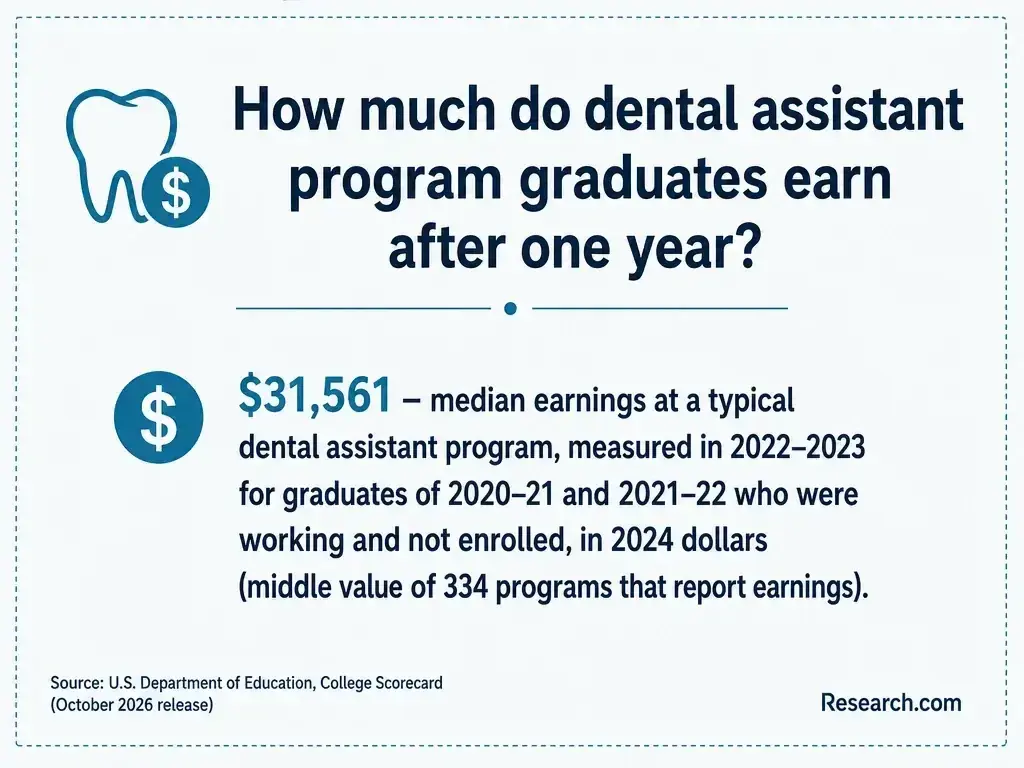
The national median annual wage for dental assistants was $48,070 in May 2025, according to the BLS. A median describes workers across experience levels and locations; it is neither an East Liverpool wage estimate nor a likely first-job offer. Compare actual local postings by pay, hours, benefits, and required radiography duties before estimating what training might return.
Pay also depends on the job you can perform after training. A program's certificate alone does not establish eligibility for every expanded duty. If a school advertises an earnings figure, ask whether it measures dental-assisting graduates, which completion group it covers, and whether it reflects local employment rather than a national occupational median.
Dental-assisting certificate and diploma programs commonly take about a year, while an associate degree generally takes longer; the BLS describes programs that typically last about one year but notes variation in training routes. An employer-training route follows the office's supervised training schedule rather than a standard school calendar. Part-time attendance, course sequencing, and clinical-site availability can extend the time to completion.
There is no single training-hour total that applies to every East Liverpool program or every Ohio dental-assisting duty. Before enrolling, request the program's published clock or credit hours, the hours spent practicing in a lab, and the separately documented clinical hours. Then ask the Ohio State Dental Board whether the specific training route supports any radiography authorization you intend to seek.
Online coursework can cover dental terminology, anatomy, office procedures, and infection-control principles. It cannot by itself demonstrate safe chairside technique, instrument handling, or radiography positioning. An on-campus or hybrid program with supervised labs and accessible clinical experience is generally the stronger choice for someone who has not worked in a dental office.
A working assistant may find hybrid theory convenient, provided the required practical instruction is available. When comparing best ranked online schools, look past the delivery label: ask exactly where skills are assessed, who arranges clinical practice, and whether the proposed route meets the applicable Ohio requirements. Do not assume an entirely online certificate qualifies you for radiography authorization or a professional exam.
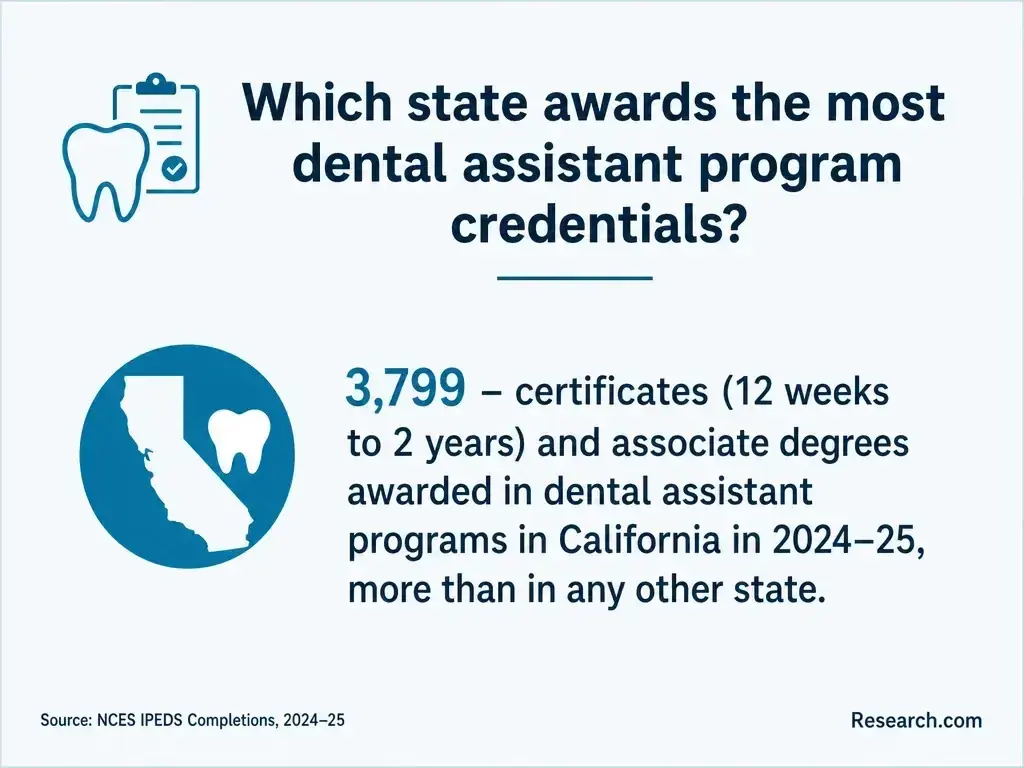
There is no reliable single average cost that describes every dental assistant training route available to an East Liverpool resident. Published tuition may omit mandatory fees, books, uniforms, protective equipment, lab materials, examinations, background checks if required, and travel to clinical sites. A longer program also carries an opportunity cost if attendance reduces paid work.
Request a written, itemized cost and aid estimate from each provider, including what you would owe if you withdrew. Compare the net price and likely borrowing of a school program with any paid employer-training option, while checking whether each route leads to the duties you want. Federal Student Aid eligibility depends on the institution and program, not simply on calling a course a certificate. Ask about eligible federal aid and Ohio workforce assistance without assuming either will cover your costs.
A cheap associates degree online may be useful for comparing general education costs, but an online price alone cannot establish the cost or adequacy of dental-assisting labs and clinical training. For return on investment, consider completion probability, aid, debt, lost earnings during training, your current pay, plausible post-training pay, and how long you expect to work in the role.
A school-based course may award a certificate, diploma, or associate degree, depending on the program. Those are educational credentials. DANB certification is a separate professional credential with its own eligibility and examination rules; Ohio authorization for dental radiography is a separate state matter. Institutional accreditation, CODA program accreditation, state school authorization, certification, and permission to perform a regulated duty answer different questions.
Before choosing a credential, ask the program to identify its accreditor, whether its dental-assisting program is CODA-accredited, and the precise DANB examinations or Ohio authorization routes for which graduates may qualify. Verify the answers with CODA, DANB, and the Ohio State Dental Board. A program can offer worthwhile entry preparation without granting every optional advancement credential; likewise, a credential described among certification that pay well does not guarantee a particular salary or scope of practice.
Entry requirements depend on the provider. A school may ask for proof of secondary-school completion and require health documentation or a background check for clinical placement; an employer-training opportunity instead depends on hiring criteria and the practice's ability to supervise a beginner. Confirm requirements and deadlines with the provider rather than assuming admission to a course includes a clinical placement.
For any East Liverpool option, including East Ohio College if it offers the relevant program for your intended start date, request the current catalog and ask whether admission, enrollment in the dental-assisting program, and placement in clinical training are separate decisions. If you have previous healthcare coursework or office experience, ask whether documented prior learning reduces coursework or cost - and whether it leaves all required practical training intact.
A useful curriculum connects knowledge to the work of a dental office: tooth and oral anatomy; infection prevention and sterilization; preparing patients and operatories; assisting during procedures; dental materials; records; and patient communication. Radiography instruction needs particular scrutiny because understanding X-ray concepts is not the same as being authorized to take dental images in Ohio.
Ask to see how students practice and are assessed on infection control, chairside workflows, and equipment use before working with patients. Program descriptions should distinguish simulation-lab time from supervised clinical time. If a provider cannot explain who observes students performing practical skills, a similarly named credential elsewhere may offer substantially stronger preparation.
Ohio does not make a general occupational license the universal entry credential for dental assistants, but it regulates which duties an assistant may perform and has a separate dental assistant radiographer authorization process. The Ohio State Dental Board, rather than a school's marketing materials, is the authority on current requirements and permitted duties. DANB certification is distinct from state authorization; neither a school certificate nor institutional accreditation automatically confers permission to take X-rays.
Choose training backward from the job duties listed in local postings. If those duties include radiography, confirm the board's current eligibility, training, examination, and application requirements before paying a deposit. If you plan to work outside Ohio, check the destination state's board; proximity across the river does not make credentials automatically portable.
The best choice is the route that gets you competent in your intended duties at a cost and schedule you can sustain - not necessarily the highest-ranked or shortest course. Use the ranking to identify programs for closer review, then obtain comparable answers from each provider and, where possible, a prospective employer.
These checks expose the most consequential differences before you enroll:
Red flags include an "online-only" promise of clinical readiness, an unexplained clinical placement, or a claim that accreditation itself provides an Ohio radiography credential. Avoid choosing on tuition alone. Broader education searches such as what are the easiest masters degrees address a different decision; for this occupation, verified practical training and duty eligibility should drive the comparison.
An entry-level assistant can develop from general chairside and office work toward greater responsibility in radiography, specialty-practice workflows, or team coordination, subject to Ohio's rules and employer supervision. DANB certification and other advanced credentials may support later goals, but their eligibility requirements are separate from initial school admission and not every advancement route is required to enter the occupation.
If you want an immediate income while learning, investigate supervised employer training before committing to school debt. If you want structured practice before approaching employers, compare programs with documented labs and clinical experience. Dental assisting also belongs in a broader comparison of best trade jobs, but choose it for the day-to-day patient care and dental-office work, not solely for a national wage figure.
The BLS projects dental assistant employment to grow 7.4% nationally from 2025 to 2035. This is an occupational projection, not a forecast of vacancies in East Liverpool or a promise of work after graduation. Local demand will depend on practices' hiring, turnover, specialty needs, and how far you are willing to commute.
Use current postings as a reality check: note which offices will train beginners, which ask for radiography authorization, and whether schedules fit your needs. Dental practices also use digital records and imaging, so training on current office workflows matters; technology familiarity does not replace supervised patient-care skills or state-required authorization.
Investing in training is a consequential decision, so Research.com evaluates programs against other programs in the same occupation and geography rather than treating every trade school as interchangeable. The ranking includes only programs with completions reported to the Integrated Postsecondary Education Data System (IPEDS). That boundary supports consistent comparisons, but it excludes some employer training and other providers; absence from the ranking is not a judgment about a provider's quality or authorization.
For its best-program rankings, Research.com evaluates student completion and full- and part-time retention; median earnings one year after completion and earnings relative to annual attendance cost; tuition, attendance cost, median debt - including for students who withdrew - and federal loan default rates; and accreditation, occupation-relevant recognition, and student support. Programmatic accreditation or industry recognition receives 20% of the score, institutional accreditation 10%, and student support 10%. Outcomes, earnings, and costs share the remaining 60%, with entropy-based weighting that gives more weight to indicators that vary more across programs. Most-affordable rankings instead score only tuition, attendance cost, debt, and loan default rates using entropy-based weights; accreditation and other quality indicators are not part of that score.
The Research.com team uses the following sources to check reported data and relevant recognition. Some cover multiple trades and should not be read as dental-assisting endorsements.
This approach helps readers compare reported outcomes and costs, but a ranking cannot confirm that a particular course meets an Ohio radiography requirement or that a clinical placement is convenient. Check those details directly before enrolling. More information about the ranking approach is available on Research.com's methodology page.
# 1 position
# 2 position
Some employers train beginners under supervision. Compare what an employer will teach with the practical experience and credential a school provides, especially if you want to perform radiography.
Not automatically. Check the Ohio State Dental Board's current dental assistant radiographer requirements and confirm whether the specific course supports an eligible route.
Online theory can help, but chairside skills require in-person practice and assessment. Verify clinical arrangements and any applicable state or certification requirements before enrolling.
Certificate and diploma programs commonly take about a year, but schedules and clinical placements vary. Request the actual calendar and documented practical hours for each option.
Possibly, if its supervised training, completion support, and credential alignment materially improve your route to the job you want. Compare total cost, aid, time out of work, and verifiable outcomes rather than tuition or ranking position alone.