# 1 position


Audited and Verified:
Our Editorial and Data Verification Process
Research.com uses government datasets, official education statistics and primary institutional information to support its career and degree guides. Our review process checks factual accuracy, occupational definitions, source dates and the requirements associated with the credentials discussed.
How This Article Was Fact-Checked
Our editorial team verifies salary estimates, employment projections, education requirements and program information against original data providers and official organizations. Salary figures are checked against the relevant occupational definitions and reporting periods. Information about licensure, accreditation and required in-person training is reviewed separately.
Fact-checked and verified on:

Co-Founder and Chief Data Scientist

Reviewed by Karolina Broda
Fact-Checker and Data Verification
Choosing dental assistant training in Reno means deciding whether a program offers enough chairside practice to justify its cost - or whether learning on the job would suit you better. The U.S. Bureau of Labor Statistics projects 7.4% national growth in dental assistant employment from 2025 to 2035, making training quality worth examining. This guide compares credentials, costs, Nevada rules, and career prospects. It also accompanies the Best Dental Assistant Trade Schools in Reno for 2027 ranking, created by the Research.com team of data scientists to help students identify programs worth considering.
Expect instruction in patient preparation, infection control, instrument setup, chairside assistance, dental materials, records, and office workflow. A credible program makes students perform - not just watch - skills in a lab and, where offered, a supervised dental practice. The U.S. Bureau of Labor Statistics identifies both postsecondary programs and on-the-job training as routes into dental assisting; the right route depends partly on how much structured practice a prospective employer expects.
Ask where clinical practice takes place, who arranges the placement, whether it fits your work schedule, and which tasks students actually perform. An employer-training position may reduce upfront education costs and provide wages while learning, but its instruction and opportunities to practice different procedures depend on that office. A school program can offer a more consistent curriculum, but a similarly named certificate is not evidence of equivalent clinical experience.
Dental offices are the principal employment setting for dental assistants, according to the U.S. Bureau of Labor Statistics. In the Reno area, prospective students can look for general and specialty practices, including orthodontic, pediatric, and oral-surgery offices. The choice affects training: a general-practice placement may expose you to a broader routine workflow, while a specialty office may teach a narrower set of procedures in greater depth.
Ask prospective clinical sites or employers whether the role is primarily chairside, administrative, or mixed. A program focused heavily on scheduling and billing may be a poor fit if your goal is hands-on clinical assisting.
The U.S. Bureau of Labor Statistics reports a $48,070 national median annual wage for dental assistants in May 2025. That figure describes employed assistants nationwide - not Reno pay, entry-level offers, or what a new certificate holder will earn. Compare actual local job postings and written offers by hourly wage, benefits, schedule, and required duties before estimating your return.
For a useful personal calculation, compare the likely change from your current earnings with your full training cost, debt payments, and earnings forgone during classes or clinical work. Include the possibility that you may need time to secure a position after training; a national median alone cannot establish whether a particular Reno program will pay off.
Program length varies by credential, schedule, and clinical requirements. Dental assisting certificates and diplomas are generally shorter routes than associate degree programs, while employer training follows the pace and responsibilities available at the practice; the U.S. Bureau of Labor Statistics describes postsecondary dental assisting programs as generally taking about one year. Do not equate a short calendar duration with enough patient-care practice.
Ask each Reno-area provider for its current total clock or credit hours, lab hours, clinical hours, and expected completion date for your intended schedule. Also ask whether placement delays can extend completion. A faster program may let you apply for jobs sooner; part-time study may better protect current income. Neither an accelerated undergraduate degree nor its timeline is a substitute for checking the practical training in a dental assisting credential.
Online coursework may cover terminology, records, and infection-control concepts. It cannot replace physical practice in instrument handling, chairside positioning, or patient-facing workflow. A hybrid program can work if its required labs and supervised practice are accessible from Reno; an advertised "online" certificate with no workable hands-on component deserves closer scrutiny.
The distinction is practical, not simply whether an institution appears on a list of top accredited online colleges non profit. Confirm who supervises in-person work, where it occurs, whether the school arranges it, and whether the format supports the certification route and Nevada duties you intend to pursue.
There is no reliable single Reno average that captures college programs, private career training, and employer-paid instruction on the same basis. Published tuition alone can understate what it takes to become job-ready. Request a written, itemized estimate from every provider you consider, including Truckee Meadows Community College if it offers a current option matching your goal.
This comparison separates expenses you pay directly from costs or savings created by the training schedule.
| Cost or offset | What to confirm |
| School charges | Tuition, mandatory fees, books, supplies, and any additional lab or clinical charges |
| Career-entry expenses | Uniforms, protective equipment, immunizations or checks if required, exam fees, and travel to placements |
| Time and funding | Lost work hours, available grants or eligible student aid, and wages from employer-provided training |
Federal aid eligibility depends on both the student and the program; confirm it through the school and Federal Student Aid rather than assuming every short course qualifies. For a fair comparison, subtract confirmed grants or employer support from total costs, then consider debt, completion likelihood, and the time needed to recover the remaining investment.
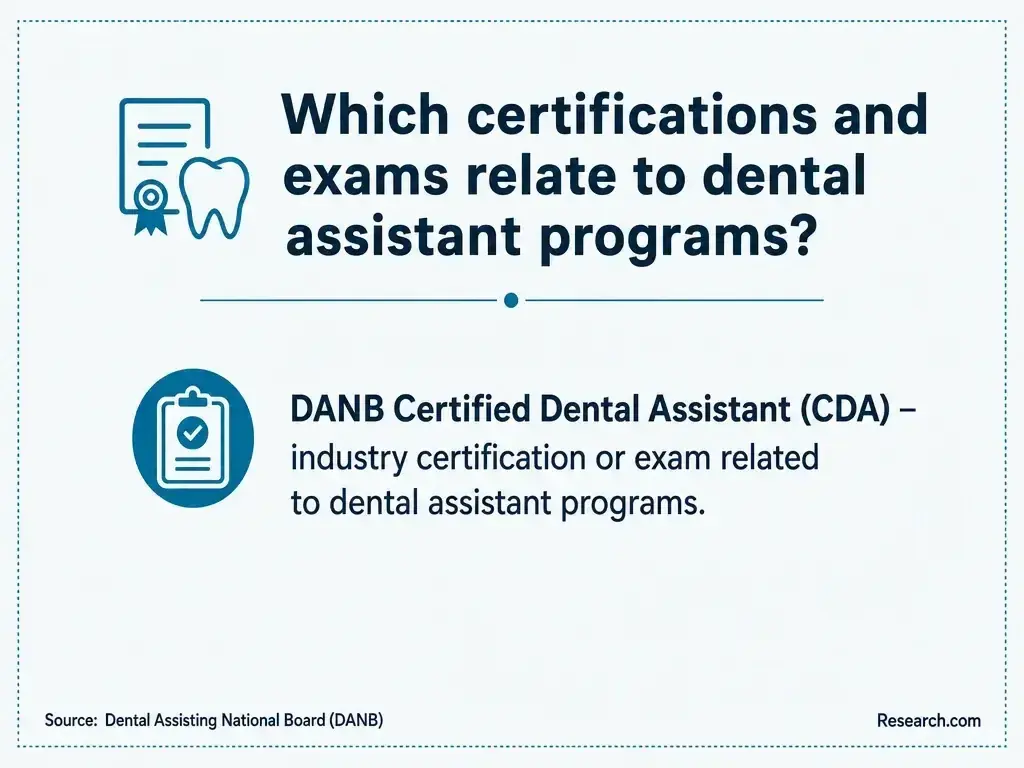
A school may award a certificate, diploma, or associate degree; an employer may provide documented training without an academic award. These are different from professional certification. The Dental Assisting National Board (DANB) sets separate eligibility and examination requirements for its Certified Dental Assistant credential, so finishing a course does not automatically confer that certification.
Look at the award's exact name and the program's stated certification preparation, not only its length. A general question such as what is the easiest degree to get in 2 years? will not establish whether a dental assisting program teaches the procedures you want to perform. If you may continue studying later, ask whether the credential's credits transfer; obtain the receiving institution's answer in writing.
Entry requirements vary by provider and placement site. Confirm the current application requirements directly: a school may require proof of prior schooling, an assessment, or prerequisites, while a clinical site may set separate health, immunization, or background-check conditions. An employer hiring and training new assistants can set different entry criteria from a school program.
Before enrolling, ask whether you must secure your own clinical site and whether unmet site requirements could delay completion. If you already work in a dental office, also ask whether documented experience can count toward placement or prior-learning credit; do not assume a provider awards it.
A job-focused curriculum should connect infection control and sterilization to real instrument flow; teach safe patient preparation and chairside assistance; and provide practice with dental materials, documentation, and communication. Some programs also address radiography, but a lesson on X-rays is not, by itself, proof that a graduate meets Nevada's requirements to perform a particular task. Check the curriculum and the Nevada State Board of Dental Examiners' current rules before selecting a program for that purpose.
Request a breakdown of demonstration, student practice, and supervised work with patients. That evidence is more useful than a course title when comparing two programs that both advertise "hands-on" training.
Do not confuse an entry-level assisting job with permission to perform every dental procedure. Nevada's rules governing supervision and particular dental-assisting duties should be checked with the Nevada State Board of Dental Examiners for the work you plan to do, especially radiography or expanded duties. A school's authorization to operate, institutional accreditation, and programmatic accreditation answer different questions; none independently grants permission to perform a regulated task.
DANB certification is a separate professional credential with its own eligibility and exam rules, according to DANB. Ask a prospective employer which credentials it requires or prefers, then verify that a program supplies the relevant preparation. If certification matters to your goal, obtain the school's claimed exam-eligibility route in writing and check it against DANB's current requirements.
Start with the duties and work setting you want, then compare only programs that offer a plausible route to them. Accreditation is worth checking, but a broad list of top schools with national accredited status cannot tell you whether a specific dental assisting program has a usable Reno clinical placement or meets your intended certification route.
These questions expose the differences that a ranking or tuition figure cannot show on its own.
A red flag is a promise that an online certificate, accreditation status, or projected wage alone makes you job-ready. Prefer a provider that gives specific written answers and lets you compare its clinical training with a lower-cost employer-training opportunity.
The direct path is an entry-level chairside or mixed clinical-and-office role. With experience, an assistant may move into a specialty practice, take on scheduling or treatment-coordination responsibilities, or pursue additional certification where it matches employer needs. Advancement depends on experience, demonstrated skills, and the rules for particular duties; it is not an automatic result of completing a certificate.
Judge this investment against the job you intend to seek, not against unrelated earnings lists such as highest paying master's programs. If your main interest is front-desk work, ask whether employer training would serve you better than a clinical program. If you want chairside work, prioritize repeated supervised practice.
The U.S. Bureau of Labor Statistics projects 7.4% growth in dental assistant employment nationally from 2025 to 2035. That signals continued occupational demand across the United States, but it does not predict Reno openings or guarantee a job after any particular program. Local hiring can differ by practice, specialty, schedule, and the experience an employer expects.
Use the national outlook as context, then test your plan against current Reno-area postings: note requested skills, pay, hours, and whether employers offer training. If postings commonly ask for experience your program cannot provide, a clinical placement or entry-level employer-training role may matter more than finishing sooner.
Investing in training is a consequential decision. Research.com's team created the ranking to help readers compare dental assisting programs against other programs in the same occupation and location, rather than against unrelated schools. The team draws on education, outcomes, accreditation, and occupational sources to check the quality and credibility of its comparisons. Only programs with completions reported to IPEDS are eligible; the ranking is therefore not a complete directory of Reno training options.
Best-program rankings assess student outcomes, earnings and return on investment, costs and debt, and quality and recognition. Programmatic accreditation or relevant industry recognition receives 20% of the score; institutional accreditation receives 10%; and student support services receive 10%. Completion, full- and part-time retention, earnings one year after completion, earnings relative to annual attendance cost, tuition, attendance cost, debt - including debt among students who withdrew - and federal loan default rates make up the remaining 60%, weighted through an entropy-based method. Most-affordable rankings instead score only tuition, attendance cost, median debt, and loan default rates, with entropy-based weights; accreditation and other quality measures are not part of that score.
The ranking draws on the following data sources. Some cover schools broadly, while others help assess recognition or alternative training pathways; none should be mistaken for proof that every listed dental assisting program qualifies a student for a particular duty in Nevada.
Use the ranking to narrow your search, then confirm current tuition, clinical arrangements, and Nevada duty requirements directly. Read more about how Research.com creates its rankings.
# 1 position
# 2 position
Yes. The U.S. Bureau of Labor Statistics recognizes on-the-job training as an entry route. Ask employers what they teach, whether the position is paid during training, and which duties a new hire may perform under Nevada rules.
No. A certificate is an award from a training provider; DANB certification requires meeting DANB's separate eligibility and examination rules.
Online lessons can cover theory, but chairside and other practical skills need in-person training. Confirm where and how a hybrid program arranges supervised practice before enrolling.
No. Compare its full cost, clinical experience, schedule, and fit with your intended duties against local alternatives, including paid employer training.
Get the credential name, complete cost, placement arrangements, and claimed certification preparation in writing. Check relevant Nevada duty rules with the Nevada State Board of Dental Examiners and certification eligibility with DANB.