# 1 position
Carrington College-Stockton - Dental Assisting/Assistant.
certificate or diploma

Audited and Verified:
Our Editorial and Data Verification Process
Research.com uses government datasets, official education statistics and primary institutional information to support its career and degree guides. Our review process checks factual accuracy, occupational definitions, source dates and the requirements associated with the credentials discussed.
How This Article Was Fact-Checked
Our editorial team verifies salary estimates, employment projections, education requirements and program information against original data providers and official organizations. Salary figures are checked against the relevant occupational definitions and reporting periods. Information about licensure, accreditation and required in-person training is reviewed separately.
Fact-checked and verified on:

Co-Founder and Chief Data Scientist

Reviewed by Karolina Broda
Fact-Checker and Data Verification
Choosing dental assistant training in Stockton means looking beyond a program's advertised price: you need hands-on practice and a route that fits California's rules for the work you want to do. The U.S. Bureau of Labor Statistics projects 7.4% national employment growth for dental assistants from 2025 to 2035, making training quality worth examining. This guide explains costs, credentials, career prospects, and questions to ask. It also features a Best Dental Assistant Trade Schools in Stockton for 2027 ranking, created by the Research.com team of data scientists to help students identify programs worth considering.
Expect classroom instruction alongside practice in infection control, instruments, patient preparation, dental materials, charting, and chairside assistance. A useful program lets you demonstrate procedures in a lab and, where offered, apply them in a supervised dental office. Ask who arranges placements and which procedures students actually practice; similarly named certificates can provide very different clinical experience (U.S. Bureau of Labor Statistics).
These pathways serve different goals. The credential awarded by a school is not the same thing as California occupational registration:
| Pathway | What it generally provides | Best fit and key limitation |
| Career-school certificate or diploma | Structured coursework and labs, sometimes with an externship | Students seeking a defined training schedule; verify clinical practice and RDA eligibility separately |
| Public college certificate | Occupational coursework and practical training | Students comparing local public-program costs and schedules; confirm available seats and the credential awarded |
| Employer-sponsored entry training | Paid or unpaid instruction tied to an office's needs | Students who can secure a suitable position; check how required courses and any later RDA application would be completed |
Dental assisting is not generally a trade that requires a registered apprenticeship for entry. If a provider advertises an apprenticeship or paid work-based route, verify its sponsor, pay terms, supervision, and whether its experience satisfies the specific California pathway you intend to use (Dental Board of California; Apprenticeship.gov).
Dental assistants primarily work in dental offices, including general and specialty practices; some work in other healthcare or public-health settings (U.S. Bureau of Labor Statistics). For a Stockton student, an externship at a practice within a manageable commute can be especially valuable because it lets you assess the daily work and build local references. A placement is an opportunity to gain experience, not a job offer.
Ask whether training includes the procedures used by your preferred employer. An orthodontic practice, for example, may value different chairside exposure than a general dental office. California controls which duties an assistant may perform according to their qualifications, so an employer's interest in a skill does not itself authorize you to perform it (Dental Board of California).
The U.S. median annual wage for dental assistants was $48,070 in May 2025 (U.S. Bureau of Labor Statistics, Occupational Outlook Handbook). That is an occupation-wide midpoint, not a Stockton starting salary or a forecast of what training will add to your earnings. Pay for a particular offer can differ with experience, duties, hours, and employer.
Before using wages to justify a program's price, compare current Stockton-area postings for the duties you would be eligible to perform. Calculate the difference between those offers and your present earnings, then weigh that potential gain against fees, borrowing, time out of work, and the chance of not finishing. Do not use the national median as a promised return on investment.
Many formal dental-assisting programs take about one year, although schedules and credentials vary (U.S. Bureau of Labor Statistics). Full-time, part-time, and employer-based routes therefore differ in both time to completion and time to paid work. An accelerated schedule may reduce time away from earnings but leave less flexibility for a student who needs steady employment.
California does not have one universal school-hour requirement for every person entering dental assisting. Requirements depend on the duties sought and, for RDA applicants, the eligibility route and required training documented to the Dental Board of California. Request a written breakdown of instructional hours, lab hours, externship hours, and any separately required board-approved courses before comparing program lengths.
Online coursework can cover terminology, anatomy, recordkeeping, and some infection-control concepts. It cannot replace direct assessment of chairside technique, instrument handling, radiography-related practice, or other hands-on competencies. A hybrid option makes sense only if its in-person labs and any office placement are accessible from Stockton and meet the requirements of the duties or credential you seek (Dental Board of California).
Flexibility alone is not an eligibility standard: even resources about best accelerated online bachelor degree programs for working adults address a different kind of study, not the practical requirements of dental assisting. For any remotely advertised certificate, ask where skills are assessed, who secures the clinical site, and which California-required courses the provider can document.
There is no single dependable average that captures every Stockton-area career-school, public-program, and employer-training route. Compare total cost to become job-ready: tuition, mandatory fees, textbooks, uniforms and protective equipment, required supplies, any exam or application charges, transportation to labs or placements, and earnings you give up while training. Request each provider's current written cost of attendance rather than relying on an advertised tuition figure.
Financial aid can change your out-of-pocket cost, but eligibility depends on the student and program; check federal aid status with Federal Student Aid and ask about California or local workforce assistance before borrowing. Paid employer training may reduce tuition and lost-income costs but may not supply every course needed for later RDA eligibility. General guides to how much does it cost to get an associate's degree online are not substitutes for a dental-assisting program's itemized quote.
Depending on the provider, you may earn a certificate, diploma, or - in a program that actually awards one - an associate degree. These are educational credentials. Registered Dental Assistant (RDA) is a separate California occupational credential obtained through the Dental Board of California's requirements and application process; graduating from a school does not automatically grant it (Dental Board of California).
Institutional accreditation concerns the school, programmatic accreditation concerns a particular program, state authorization concerns permission to operate, and board approval concerns specified regulatory requirements. None should be treated as interchangeable. The Commission on Dental Accreditation identifies accredited dental-assisting programs, while the Dental Board of California determines its own RDA eligibility rules. A list of top accredited non-profit online colleges, for instance, cannot establish that a dental-assisting program qualifies for California registration.
Admissions requirements vary by provider. Ask about prior schooling, placement assessments, immunization or health documentation, background checks for clinical sites, and the ability to attend scheduled labs and externships. A school may admit a student who still needs additional training or documentation for a particular California credential; obtain both sets of requirements before enrolling.
Accessible admissions are useful, but they do not establish occupational readiness. The availability of open enrollment colleges should not be confused with a dental-assisting program's clinical-site rules or California's separate RDA application requirements (Dental Board of California).
Core training commonly covers dental anatomy and terminology, infection prevention, patient communication, chairside procedures, instruments, dental materials, records, and office workflow (U.S. Bureau of Labor Statistics). Practice matters as much as topic coverage: students should know whether they will perform procedures under supervision, merely observe them, or practice only in a lab.
For California-specific goals, ask how the curriculum addresses radiation safety, infection control, and any other board-required instruction relevant to the duties or RDA route you want. Digital imaging and electronic records make technology practice useful, but software familiarity does not replace authorization to perform regulated procedures (Dental Board of California).
Not for every entry-level dental assistant job. California permits appropriately supervised, unlicensed dental assistants to perform specified supportive duties, while reserving other duties for assistants with required training or credentials. RDA registration involves a separate eligibility and examination process overseen by the Dental Board of California. Check the board's current duty lists and requirements for your intended role before choosing a school.
National certification through the Dental Assisting National Board is distinct from California RDA registration; one does not automatically replace the other (Dental Assisting National Board; Dental Board of California). Likewise, a school's accreditation, a completion certificate, and a course described as "RDA preparation" do not by themselves establish that you qualify to apply. Ask the provider to identify the precise California eligibility route its training supports and which steps remain after graduation.
Start with the job duties and credential you want, then compare programs on evidence - not rank alone. When speaking with Carrington College-Stockton or UEI College-Stockton, confirm the current availability and details of any dental-assisting offering directly rather than assuming a campus name establishes a particular curriculum.
These checks help expose costly gaps before you commit:
A red flag is a promise that a short online certificate automatically makes you an RDA, or a price quote that omits clinical travel and required courses. The better investment is the route you can complete and afford that prepares you for the duties you actually intend to perform.
A common progression is entry-level chairside assistance, broader duties after required training, and - if eligible and interested - California RDA registration. Experience may also support work in specialty practices or office coordination. Advancement depends on the position and applicable duty rules; it is not an automatic result of earning a school certificate (Dental Board of California; U.S. Bureau of Labor Statistics).
If your main goal is a higher-paying skilled occupation rather than dental patient care, compare the work and additional training required across best trade school jobs that pay well. Dental assisting can be a good fit for someone who wants patient-facing work and can attend clinical training; it is a weaker fit for someone who needs a fully remote route into hands-on practice.
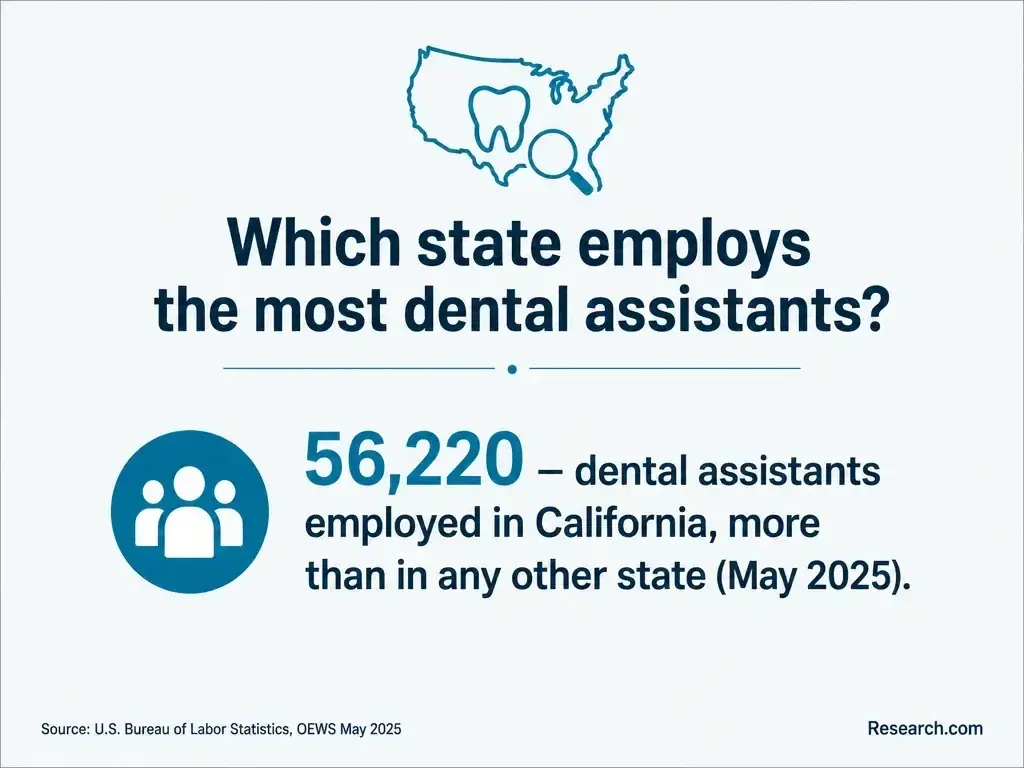
National employment of dental assistants is projected to grow 7.4% from 2025 to 2035 (U.S. Bureau of Labor Statistics, Employment Projections). That supports considering the occupation, but it is not a Stockton-specific forecast and does not establish how readily a new graduate will find work.
Use the national trend as context, then inspect current Stockton-area openings for requested credentials, experience, schedules, and duties. If many appealing positions specify RDA registration, choosing a training route without a workable plan for California eligibility could limit your options even in a growing occupation.
Investing in education is a consequential decision. Research.com created its ranking to help readers compare dental assistant programs against other programs serving the same occupation and location, rather than against unrelated schools nationwide. The team checks multiple education, outcomes, and recognition sources to improve the ranking's quality, credibility, and accuracy. Only programs reporting completions to the Integrated Postsecondary Education Data System (IPEDS) are eligible; that limitation does not mean other legitimate training routes do not exist.
For its best-programs rankings, Research.com evaluates student completion and full- and part-time retention; earnings one year after completion and earnings relative to annual attendance cost; tuition, attendance cost, debt - including debt held by students who withdrew - and federal loan default rates; and institutional accreditation, relevant programmatic accreditation or industry recognition, and student support. Relevant programmatic recognition receives 20% of the score, institutional accreditation 10%, and support services 10%. Outcomes, earnings, and costs account for the remaining 60%, with entropy-based weighting that gives more weight to indicators showing greater differences among programs. Most-affordable-programs rankings instead score only costs and debt using entropy-based weights; accreditation and other quality indicators are not part of that score.
The ranking draws on the following sources. Some cover education broadly or other trades and should not be mistaken for proof that a particular dental assistant program meets California requirements:
Use the ranking to narrow your options, then verify each program's current schedule, full price, clinical opportunities, and California Registered Dental Assistant eligibility directly. More detail about the ranking approach appears on Research.com's methodology page.
# 1 position
# 2 position
Some California entry-level duties can be learned through supervised employment. Confirm which duties an employer can train you for and what additional courses or experience you would need if your goal is RDA registration (Dental Board of California).
No. A school certificate documents program completion; California RDA registration has separate eligibility, training, examination, and application requirements (Dental Board of California).
Online classes may cover theory, but chairside skills and applicable clinical or lab requirements need in-person practice. Verify where and how the provider assesses those skills.
Not necessarily. Compare total cost, time away from work, supervised practice, and whether you can complete the California requirements tied to your intended duties.
Ask whether it is required, who finds the site, how many hours it involves, which procedures you can practice, and whether travel or screening adds to your costs.