# 1 position

Audited and Verified:
Our Editorial and Data Verification Process
Research.com uses government datasets, official education statistics and primary institutional information to support its career and degree guides. Our review process checks factual accuracy, occupational definitions, source dates and the requirements associated with the credentials discussed.
How This Article Was Fact-Checked
Our editorial team verifies salary estimates, employment projections, education requirements and program information against original data providers and official organizations. Salary figures are checked against the relevant occupational definitions and reporting periods. Information about licensure, accreditation and required in-person training is reviewed separately.
Fact-checked and verified on:

Co-Founder and Chief Data Scientist

Reviewed by Karolina Broda
Fact-Checker and Data Verification
Choosing a dental assistant program in Texas means comparing more than tuition: hands-on practice, the credential awarded, and eligibility for radiography duties can change the value of your training. The U.S. Bureau of Labor Statistics (BLS) projects 7.4% national employment growth for dental assistants from 2025 to 2035, making career-entry decisions timely. This guide explains the costs, pathways, and Texas rules behind those choices. It also features a Best Dental Assistant Trade Schools in Texas for 2027 ranking created by the Research.com team of data scientists to help students identify programs worth considering.
Expect instruction in chairside procedures, infection control, dental materials, patient communication, and radiography theory, followed by practice with equipment and, in many programs, supervised experience in a dental setting. A certificate or diploma is usually the most direct school-based route. Some community-college programs award an associate degree and include broader coursework; that additional time makes sense when its clinical opportunities or credential match your goals.
Texas also permits entry into certain assisting duties through employer training under a dentist's supervision, subject to state scope-of-practice rules (Texas State Board of Dental Examiners, or TSBDE). That route may suit someone with a willing employer and limited funds, but it is not interchangeable with a program that provides structured labs or a route to radiography authorization. Dental assisting is generally learned through school and supervised clinical or workplace training, not a required registered apprenticeship; if a provider advertises an apprenticeship, confirm whether it is formally registered and whether wages are paid.
The comparisons below focus on what changes the path to a first job. Program titles alone do not establish how much clinical experience a student receives.
| Pathway | Typical credential or outcome | Best fit and main trade-off |
| Career-school certificate or diploma | School-issued occupational credential | Focused entry preparation; confirm lab access, externship arrangements, and total charges. |
| Community-college certificate or associate degree | College certificate or academic degree | May offer more coursework or clinical time; compare schedule and time away from earnings. |
| Employer-sponsored training | Work experience; possibly no school credential | Potentially lower upfront cost and paid learning; training breadth and access to radiography authorization need separate verification. |
Most dental assistants work in dentists' offices, supporting treatment, preparing rooms, sterilizing instruments, and helping patients understand the next step in care (BLS Occupational Outlook Handbook). Texas opportunities also include group practices and specialty offices, such as orthodontic or oral surgery practices. The tasks offered in any office depend on the supervising dentist, the assistant's demonstrated skills, and TSBDE rules - not simply the name of a school credential.
Location affects the practical value of training. A program with clinical placements near the area where you intend to work may help you build local references; a distant placement can add commuting costs. Ask whether placements are arranged by the school, whether students must find their own, and whether a rural student could complete one locally.
Pay varies by employer, location, experience, and duties. The BLS reports a $48,070 national median annual wage in May 2025 for dental assistants. This describes employed workers across experience levels, not the likely first-year pay of a Texas program graduate. Use current local job postings and the latest BLS state and metropolitan occupational wage estimates to build a realistic starting-pay range for the area where you plan to work.
For an investment decision, compare the earnings you could reasonably expect with training against what you could earn without it, then account for tuition, debt payments, time out of work, and how likely you are to complete the program. A higher advertised wage is not evidence that a particular school caused it.
Program length depends on the credential and schedule: focused certificates can take months, while an associate-degree pathway generally takes longer. Part-time study extends the calendar even when required coursework is unchanged. Texas does not impose one universal school-program clock-hour requirement on every person entering dental assisting; the requirements relevant to a particular radiography or other authorization must be checked with TSBDE.
Ask for the published total clock or credit hours and a breakdown of classroom instruction, simulation labs, and supervised clinical work. Also ask when clinical placements occur. An accelerated course is useful only if its schedule leaves enough time to develop safe chairside skills and complete any required in-person assessments.
Online instruction can cover terminology, anatomy, recordkeeping, and some radiography theory. It cannot replace practicing instrument transfer, infection-control procedures, patient positioning, or other chairside skills with appropriate equipment and supervision. A hybrid program may work well if its in-person labs and clinical site are accessible; a fully online course should not be assumed to establish practical competence or Texas eligibility for radiography duties.
Compare the formats by looking at the training you must attend, not just where lectures are delivered. Ask who arranges the clinical site, how skills are assessed, and what happens if you cannot secure a placement. If schedule flexibility is your priority, broader guides to online certifications that pay well can offer context - but dental assisting still requires a workable hands-on plan.
There is no single dependable statewide average that captures every Texas college, private career school, and employer-training route. Published tuition also leaves out expenses that can change the cheapest-looking option. Request a written, program-specific estimate before enrolling.
Build a job-ready budget that includes mandatory fees, books and materials, uniforms and protective equipment, radiography-related training, any exam or TSBDE application charges, background-check or health requirements if applicable, and travel to labs and clinical sites. Add lost earnings if the schedule limits your work. Then subtract grants, scholarships, or employer-paid training you are actually eligible to receive. Federal aid eligibility depends on both the student and the institution or program; confirm it through the school and Federal Student Aid rather than assuming every short course qualifies.
An inexpensive remote course is not a bargain if it leaves you paying separately for local clinical practice. Comparing cheap college online options may help frame tuition questions, but for dental assisting, include required in-person costs before judging affordability.
The school may award a certificate, diploma, or associate degree. That award documents completion of its curriculum; it is not itself a Texas registration or a national professional certification. Ask the school to identify the exact credential on the transcript or completion document and whether its curriculum supports the TSBDE pathway relevant to the duties you want to perform.
CODA programmatic accreditation, institutional accreditation, state authorization to operate, DANB certification, and TSBDE registration answer different questions. In particular, a school's authorization or institutional accreditation does not automatically establish eligibility for radiography duties. If you are weighing an associate degree against a shorter credential, even a guide to what is the easiest associates degree to get online cannot tell you whether a specific dental assisting program has the clinical training your goal requires.
Admissions rules are set by the provider. Applicants may need proof of secondary-school completion or an equivalent credential, placement assessments, and documentation required before clinical work. Clinical sites may have separate health, immunization, or background-screening conditions. Request these requirements and their deadlines in writing; an offer of admission does not necessarily mean a student is ready for placement.
Compare admission requirements with the eventual job requirements. Someone who already has a dentist willing to provide supervised entry-level training may not need a full school program for that immediate role, but should still check what additional steps would be needed for radiography or other desired duties (TSBDE).
A useful curriculum connects knowledge to repeatable chairside performance: preparing treatment areas, selecting and passing instruments, controlling infection, handling dental materials, supporting radiographic procedures within the permitted scope, documenting care, and communicating with anxious patients. The BLS Occupational Outlook Handbook identifies clinical and patient-support tasks as central to the occupation.
Look beyond a topic list. Ask how many hours are spent practicing with dental equipment, who observes and signs off on skills, and whether the program provides supervised experience with patients. Two certificates with similar names can prepare students quite differently if one relies mainly on recorded lessons and the other includes substantial laboratory and clinical practice.
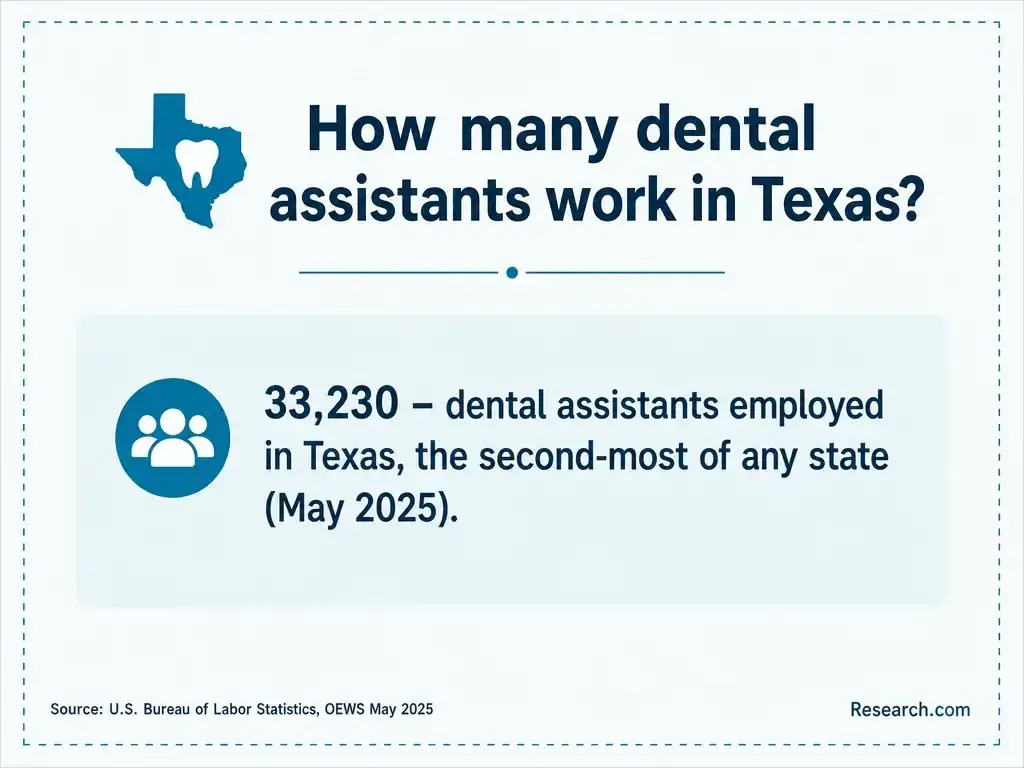
Not every entry-level dental assisting duty requires the same credential. Texas regulates what assistants may do under dentist supervision, and taking dental radiographs requires the applicable board authorization. The registered dental assistant (RDA) pathway is therefore important to investigate if taking radiographs is part of your target job. TSBDE sets the current application, education or examination routes, and other conditions; completing a school course does not by itself grant registration.
DANB's Certified Dental Assistant (CDA) is a professional certification, distinct from Texas registration. CODA accreditation is a program-level quality designation, also distinct from a state authorization to practice. Before paying a deposit, give the school your intended duties and ask it to show, in writing, which current TSBDE requirements its training satisfies and which steps remain your responsibility (TSBDE; DANB; CODA).
The best fit is the program that gets you safely to your intended duties at a manageable total cost - not necessarily the shortest course or highest-ranked school. Use a ranking to create a shortlist, then verify claims directly with the provider, TSBDE, and the relevant accreditor.
These checks expose the most consequential differences before you commit:
A red flag is a promise that a certificate alone guarantees registration, certification, a job, or a particular salary. Another is an "online" offer that cannot explain where practical skills will be learned. Readers comparing short credentials can use a guide to finding a certificate that pays well for broader perspective, but should base this decision on dental-assisting requirements and local employment options.
Initial roles commonly center on general chairside assisting. With experience and appropriate training or authorization, an assistant may seek work in a specialty practice, take on more responsibility within the permitted scope, or move toward scheduling, patient coordination, inventory, or office leadership. Additional duties are not automatically conferred by seniority or a school credential; check TSBDE rules and employer requirements for each role.
Training is most valuable when it matches the work you actually want. If your goal is clinical chairside care, prioritize supervised patient experience. If you prefer primarily administrative work, ask whether the program devotes enough time to scheduling, records, and insurance workflows to justify its cost. Longer-term comparisons such as what bachelor's degree pays the most address a different education decision and should not be used as a return-on-investment estimate for dental assisting training.
Nationally, the BLS projects dental assistant employment to grow 7.4% from 2025 to 2035. That indicates continuing demand across the occupation, but it does not predict hiring by a particular Texas practice or guarantee a position after training. For a local decision, compare recent openings in the area where you can commute and note whether employers request radiography authorization, experience, or a particular credential.
Demand is only one side of the investment. A student with a nearby clinical placement and a schedule compatible with work may have a more practical route to employment than one who chooses a faster program but must travel far for labs. Use the outlook alongside local requirements, program completion evidence, and your total budget.
Investing in education is a consequential decision. Research.com designed this ranking to help readers compare dental assisting programs with other programs serving the same occupation and location, rather than with unrelated schools. The team evaluates reported outcomes, costs, recognition, and student support, while checking multiple sources for credible, comparable information. Only programs with completions reported to IPEDS are eligible; an unlisted training provider is not necessarily unapproved or low quality.
Best-program rankings assess completion and full-time and part-time retention; earnings one year after completion and earnings relative to annual attendance cost; tuition, attendance cost, debt - including debt among students who withdrew - and federal loan default rates; plus accreditation, occupation-relevant recognition, and support services. Programmatic accreditation or relevant industry recognition accounts for 20% of the score, institutional accreditation for 10%, and student support for 10%. Outcomes, earnings, and costs make up the remaining 60%, with weights distributed through an entropy-based method that gives more weight to indicators that distinguish programs. Most-affordable rankings instead score only costs and debt, using entropy-based weights; quality indicators are not part of that score.
The ranking draws on the following sources. Some cover institutions broadly or occupations beyond dental assisting, so readers should verify a particular program's current status and Texas eligibility separately.
The ranking is a starting point, not a substitute for checking clinical training, current charges, and registration requirements. Readers can find further details on Research.com's ranking methodology.
# 1 position
# 2 position
# 3 position

# 4 position
# 5 position
Dental Assisting/Assistant
Delivery mode: On Campus (May Include Online Courses)
71.86
/ 100
Final score
Accreditation
Programmatic accreditation: CODA. Institutional accreditation from Southern Association of Colleges and Schools Commission on Colleges.
Tyler Junior College earned a Research.com Trade Program Score of 71.86/100. The program is CODA-accredited.
# 6 position

# 7 position
# 8 position
# 9 position

# 10 position
# 11 position
# 12 position

# 13 position
# 14 position
# 15 position
# 16 position
# 17 position
# 18 position
# 19 position
# 20 position
Some entry-level duties can be learned through supervised employer training. Check TSBDE rules before assuming that route permits radiography or any other duty you want to perform.
No. A school certificate and TSBDE registration are separate. Ask which current board requirements the course satisfies and what application or other steps remain.
Do not assume so. Chairside skills need hands-on practice, and Texas authorization requirements must be verified separately. Ask where in-person labs and clinical training take place.
It can be if the additional supervised practice or credential supports your target role. Compare total cost, time away from earnings, clinical access, and completion evidence with a shorter program or paid employer training.
Request its exact credential, full price, lab and clinical hours, placement policy, recent program outcomes, accreditation claims, and a written explanation of how training aligns with TSBDE requirements.