# 1 position


Audited and Verified:
Our Editorial and Data Verification Process
Research.com uses government datasets, official education statistics and primary institutional information to support its career and degree guides. Our review process checks factual accuracy, occupational definitions, source dates and the requirements associated with the credentials discussed.
How This Article Was Fact-Checked
Our editorial team verifies salary estimates, employment projections, education requirements and program information against original data providers and official organizations. Salary figures are checked against the relevant occupational definitions and reporting periods. Information about licensure, accreditation and required in-person training is reviewed separately.
Fact-checked and verified on:

Co-Founder and Chief Data Scientist

Reviewed by Karolina Broda
Fact-Checker and Data Verification
Choosing dental assistant training in South Dakota means deciding whether a program offers enough chairside practice to justify its cost - and whether its credential fits the duties you want to perform. The U.S. Bureau of Labor Statistics projects 7.4% national employment growth for dental assistants from 2025 to 2035. This guide compares training routes, costs, credentials, and state-specific questions. It also features a Best Dental Assistant Trade Schools in South Dakota for 2027 ranking created by the Research.com team of data scientists to help students identify programs worth considering.
Expect a mix of classroom instruction, simulated chairside work, and, where included, supervised experience in a dental setting. Dental assistants prepare treatment areas, support dentists during procedures, explain instructions to patients, and handle infection control and records; exact permitted duties depend on state rules and supervision (U.S. Bureau of Labor Statistics; South Dakota Board of Dentistry). A program that teaches terminology but provides little observed practice is not equivalent to one that assesses those tasks in a clinic.
The main pathways differ in what you pay for and how you gain practical experience. Confirm the current credential and placement arrangements before treating any route as job-ready preparation.
| Pathway | Typical credential or outcome | Best fit and main trade-off |
| Technical-school certificate or diploma | School-awarded credential, with labs and possibly a supervised placement | Fits someone seeking structured preparation; requires tuition and time away from paid work. |
| Associate-level dental assisting program, where offered | Academic associate degree plus occupational training | May fit someone wanting broader coursework; check that the added time and cost advance the intended job. |
| Employer-sponsored, on-the-job training | Work experience; any school credential or certification is separate | May fit someone who can secure an entry-level office position; instruction and access to advanced duties can vary by employer. |
South Dakota's smaller and more dispersed communities make placement logistics important. Ask whether a required clinical site is near home, who secures it, and whether travel is necessary. A paid office position can reduce lost earnings, but it should not be assumed to provide the same curriculum, assessment, or certification preparation as a formal program.
Dental offices are the principal workplace for dental assistants nationally (U.S. Bureau of Labor Statistics). In South Dakota, compare openings in the communities where you can realistically commute or relocate: a placement in a larger city may expose you to more offices, while a smaller community may offer a different mix of general-practice responsibilities. Neither setting guarantees a particular schedule or wage.
General dentistry is the most direct entry point. Specialty practices, such as orthodontic or oral-surgery offices, may value additional procedure-specific experience. Ask prospective employers which chairside, sterilization, imaging, and front-office duties they expect a new hire to perform - and check the South Dakota Board of Dentistry's rules before assuming training authorizes every advertised task.
The U.S. Bureau of Labor Statistics reports a $48,070 national median annual wage for dental assistants in May 2025. That is the midpoint for workers across experience levels and locations, not a forecast of a new graduate's pay in South Dakota. A verified, comparable current state figure is needed to make a reliable state-versus-national comparison.
For a local decision, look up the latest South Dakota dental assistant occupational wage estimates from the South Dakota Department of Labor and Regulation or BLS, then compare actual entry-level job postings in your commuting area. Ask whether an offer includes paid training, benefits, or compensation for additional authorized duties. When weighing tuition against earnings, use your likely starting offer - not the national median - as the near-term comparison.
Many formal dental assisting programs take about one year, although schedules and credentials vary; on-the-job training has no single school calendar (U.S. Bureau of Labor Statistics). A shorter advertised course may teach useful fundamentals without providing the supervised practice or preparation needed for every intended duty. Request the program's current calendar, total contact hours, lab hours, and clinical hours rather than relying on its advertised length.
Compare completion time with the date you could realistically start paid work. A part-time schedule may preserve income but extend the period before completion; an accelerated schedule may require more frequent travel to labs or clinics. Lists of quick courses that pay well can help frame a time-to-work comparison, but dental assisting requires a separate check of hands-on preparation and state rules.
Online coursework can cover terminology, anatomy, scheduling, and infection-control concepts. It cannot, by itself, demonstrate chairside instrument transfer, sterilization technique, patient interaction, or imaging procedures. An on-campus or hybrid program can provide assessed lab practice; either format may also arrange supervised experience in a dental office. Verify exactly where and when that practice occurs.
Hybrid study may reduce routine travel for someone far from a campus, but a distant clinical site can erase the savings. Ask whether the school finds placements near your South Dakota community, whether you must find one yourself, and how skills are evaluated. Flexible-learning resources such as best programs for older adults online may help you think about scheduling preferences, but they are not a substitute for checking a dental assisting program's in-person requirements. Do not assume an online completion certificate satisfies state rules or DANB exam eligibility.
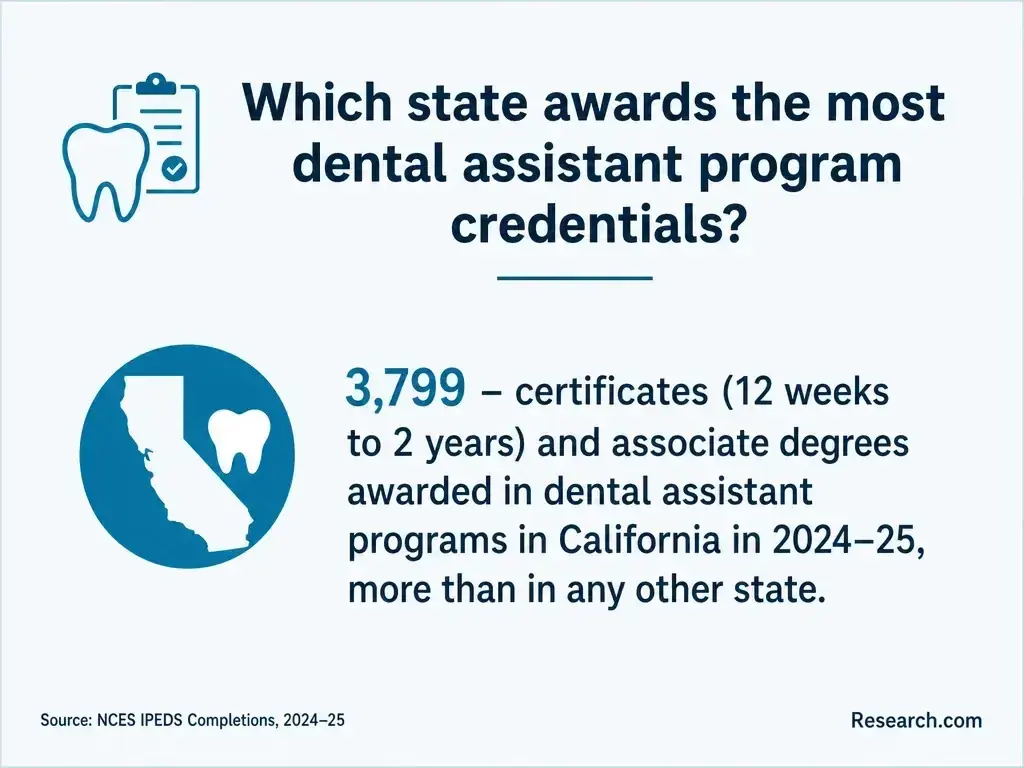
There is no single defensible statewide price for dental assistant training: the amount depends on the provider, credential, residency-based charges where applicable, and whether clinical and exam costs are included. Compare each school's total cost to become job-ready, not tuition alone. Request an itemized, current program budget covering mandatory fees, books, supplies, uniforms and protective equipment, any required health or background checks, certification exams, and travel to labs and clinical sites.
Lost wages also matter. A lower-tuition program with a long unpaid placement may cost more in practice than a shorter route that fits around work; an employer-paid training position may offset costs but offer less structured instruction. Ask each school's aid office about eligibility for federal aid and South Dakota workforce assistance rather than assuming every short course qualifies (Federal Student Aid; South Dakota Department of Labor and Regulation). Compare any borrowing with a realistic starting wage, completion likelihood, and how long you expect to work in the field.
The answer depends on the program: it may award a certificate, diploma, or, where available, an associate degree. A school-awarded credential documents completion; it is not the same as CODA programmatic accreditation, DANB professional certification, or permission from the South Dakota Board of Dentistry to perform a regulated duty. Institutional accreditation concerns the school, while CODA accreditation concerns a specific dental assisting program (Commission on Dental Accreditation; Dental Assisting National Board).
Ask for the precise credential title and whether the curriculum supports the DANB examination or South Dakota duty you want to pursue. If considering an associate pathway, compare its dental assisting content and clinical access with a shorter certificate rather than assuming the longer credential is automatically preferable. Even a search for best accelerated associates degree online cannot establish that an online route provides the required hands-on dental training.
Requirements are set by each provider, not by one statewide trade-school admissions standard. Ask whether admission requires a high school credential, placement assessment, prerequisite coursework, immunization documentation, or a background check for clinical placement. Also ask when those requirements must be completed: a student might enter classes but be unable to start a required placement without meeting a site's conditions.
For employer-led entry, an office may hire and train someone without a dental assisting school credential, subject to the duties it assigns and South Dakota rules (U.S. Bureau of Labor Statistics; South Dakota Board of Dentistry). If you have prior healthcare or dental-office experience, ask whether it earns credit or changes the training schedule; obtain that decision in writing before budgeting for a shortened program.
A useful curriculum connects dental anatomy and terminology to chairside workflow: preparing instruments, assisting during procedures, managing infection prevention, documenting care, and communicating with patients (U.S. Bureau of Labor Statistics). Programs may also teach dental imaging and administrative tasks. What matters is not simply whether a topic appears in a catalog, but whether students practice it, receive feedback, and demonstrate competence.
Ask for a skills checklist and the number and setting of supervised lab and clinical hours. In particular, confirm how the school teaches imaging and whether completing that instruction aligns with current South Dakota Board of Dentistry requirements for the duties you want. Digital records and imaging systems make adaptable technology skills useful, but software familiarity does not replace safe, observed clinical practice.
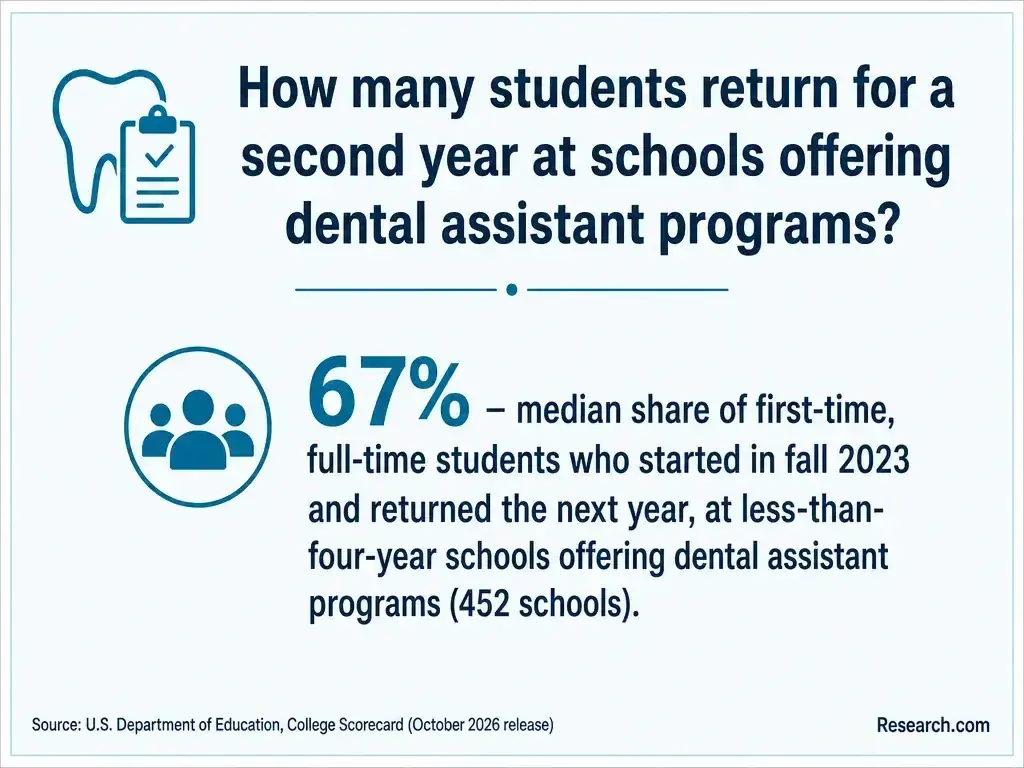
Do not treat "dental assistant" as a single authorization for every task. South Dakota's rules distinguish duties and supervision; requirements for activities such as dental radiography must be checked with the South Dakota Board of Dentistry before choosing training. Ask the board what registration, education, examination, or other documentation applies to your specific intended duties. Rules for another state may differ, which matters if you plan to move.
DANB certification is a professional credential with its own eligibility and examination rules; it is not a state occupational license (Dental Assisting National Board). Likewise, graduating from a CODA-accredited program does not itself grant permission to perform every regulated function (Commission on Dental Accreditation; South Dakota Board of Dentistry). Have a school identify the exact state requirement its curriculum addresses, then verify the answer with the board.
Start with the work you want to do, then compare programs on practical training, regulatory fit, total cost, and the likelihood that you can finish. The ranking can narrow a search, but its IPEDS completion requirement means it does not represent every employer-training option. Check current offerings directly with Lake Area Technical College, Western Dakota Technical College, and Southeast Technical College rather than assuming that a school's inclusion in a broader technical-school search means it offers your desired dental assisting credential.
Use the same questions with every provider so an appealing headline price or short timeline does not hide a weak fit:
A common mistake is using a credential's name - or a school's ranking - as proof of eligibility for a particular duty. Another is comparing tuition while ignoring clinical travel and lost income. Broader education searches, including shortest master degree programs, do not answer the occupation-specific question: will this training prepare you for the South Dakota dental assisting work you intend to seek?
The direct path is an entry-level chairside role in a dental office. With experience, an assistant may take on more complex duties where permitted, move toward specialty-practice work, help coordinate treatment or office operations, or train newer staff. Additional duties may require separate education, examination, or board authorization; advancement is not automatic (South Dakota Board of Dentistry; Dental Assisting National Board).
Consider the daily work before choosing the route. Assisting requires frequent patient and team interaction as well as careful behind-the-scenes preparation. Someone exploring career paths for introverts should assess whether that mix suits them rather than assuming dental assisting is exclusively solitary or social. If your goal is a different dental occupation, verify its separate training and regulatory requirements instead of assuming an assisting credential transfers directly.
National employment of dental assistants is projected to grow 7.4% from 2025 to 2035 (U.S. Bureau of Labor Statistics, Employment Projections). That signals demand across the country, not a guaranteed opening in a particular South Dakota town. A statewide or local projection from the South Dakota Department of Labor and Regulation is the better measure when deciding where to train and seek work.
Before committing, check current postings within a realistic commute and note which skills and authorized duties employers request. Ask a prospective clinical site about hiring needs, but do not treat a placement as a job offer. In a smaller labor market, being able to travel for clinical training or search across several communities may materially widen your options.
Investing in training is a consequential decision. Research.com created the ranking to help readers compare dental assisting programs with other options in the same occupation and location, rather than with unrelated schools. The team evaluates reported outcomes alongside cost and quality indicators, while recognizing that no ranking can replace a check of a program's current clinical training and regulatory fit.
Only programs with completions reported to IPEDS are eligible. Best-program rankings examine completion and full-time and part-time retention; earnings one year after completion and earnings relative to annual attendance cost; tuition, attendance cost, debt - including debt held by students who withdrew - and federal loan default rates; and accreditation, occupation-relevant recognition, and student support. Occupation-relevant programmatic accreditation or industry recognition receives 20% of the score, institutional accreditation 10%, and student support 10%. The remaining 60% covers outcomes, earnings, and costs, with entropy-based weights that give more influence to indicators that vary more across programs.
Most-affordable-program rankings use only tuition, attendance cost, median debt, and federal loan default rate, weighted through the entropy-based method; accreditation and other quality indicators do not enter that score. These are distinct rankings, so an affordable-program result should not be read as a quality endorsement. Research.com uses the following sources to assemble and check ranking information; a source's inclusion does not mean it accredits dental assisting programs:
IPEDS and College Scorecard do not capture every employer-led or noncollege training route. A provider's absence from this ranking does not establish that it is unavailable or unsuitable. Use the ranking to form a shortlist, then verify current offerings, clinical arrangements, and eligibility for your intended duties. More detail on the approach appears on Research.com's methodology page.
# 1 position
# 2 position
# 3 position
# 4 position
An employer may offer on-the-job training for entry-level duties (U.S. Bureau of Labor Statistics). Check South Dakota Board of Dentistry rules separately for any additional duties you want to perform.
It may teach concepts, but it cannot replace in-person assessment of chairside skills. Ask employers what training they expect and confirm that any required practical or state-specific preparation is included.
No. CODA accredits qualifying dental assisting programs; DANB awards professional certifications to individuals who meet its requirements. Neither is a blanket authorization for every South Dakota dental assisting duty (Commission on Dental Accreditation; Dental Assisting National Board; South Dakota Board of Dentistry).
Choose the least costly route that provides the credential, supervised practice, and regulatory preparation you need. Include fees, clinical travel, lost wages, and the risk of paying for training you cannot complete.
No. A placement provides supervised experience, not a promise of employment. Ask the program how placements are arranged and how it measures graduates' employment outcomes.