# 1 position
Concorde Career College-Aurora - Dental Assisting/Assistant.
certificate or diploma

Audited and Verified:
Our Editorial and Data Verification Process
Research.com uses government datasets, official education statistics and primary institutional information to support its career and degree guides. Our review process checks factual accuracy, occupational definitions, source dates and the requirements associated with the credentials discussed.
How This Article Was Fact-Checked
Our editorial team verifies salary estimates, employment projections, education requirements and program information against original data providers and official organizations. Salary figures are checked against the relevant occupational definitions and reporting periods. Information about licensure, accreditation and required in-person training is reviewed separately.
Fact-checked and verified on:

Co-Founder and Chief Data Scientist

Reviewed by Karolina Broda
Fact-Checker and Data Verification
Choosing a dental assistant program means comparing more than tuition: you need chairside practice, a credential employers recognize, and training that fits Colorado's rules. The U.S. Bureau of Labor Statistics projects 7.4% national employment growth for dental assistants from 2025 to 2035, making the pathway worth a close look - not a guaranteed job. This guide explains costs, formats, credentials, and career prospects. It also features the Best Dental Assistant Trade Schools in Colorado for 2027 ranking, created by the Research.com team of data scientists to help students make an informed choice about programs worth considering.
Expect instruction in infection control, dental terminology, instruments, patient preparation, and office procedures, followed by practice in a simulated lab or dental office. Depending on the program, students may complete a supervised externship. Ask for its actual hours and placement policy: similarly named certificates can offer very different amounts of chairside experience.
Colorado applicants can compare private career-school certificates with public technical or community-college training and dentist-led, on-the-job instruction. A school program suits someone who wants structured practice and a documented credential. Employer training may reduce upfront costs and let someone earn while learning, but the duties taught and time available for instruction depend on the employer. Dental assisting is not a standard route that requires a registered apprenticeship; verify any advertised apprenticeship's registration and training terms rather than assuming the label establishes a credential.
Dental assistants primarily work in dentists' offices, helping prepare treatment rooms, support procedures, manage instruments, and communicate with patients (U.S. Bureau of Labor Statistics). Opportunities may also arise in specialty practices, including orthodontic and oral-surgery offices, where employers can require training specific to their procedures.
Location changes the practical value of a program. In the Denver-Aurora area or Colorado Springs, compare externship sites with places you could realistically commute to and seek work after graduation. In western or rural Colorado, a nearby clinical placement may matter more than a distant school's shorter advertised schedule. Ask whether the school arranges placements locally or expects students to find their own.
Pay varies by employer, experience, duties, and location. The latest national median annual wage specified by the U.S. Bureau of Labor Statistics is $48,070 for May 2025. That is the midpoint for employed dental assistants nationwide - not an offer a new Colorado trainee should expect.
For a local decision, check the latest Colorado and metropolitan-area dental assistant estimates in BLS Occupational Employment and Wage Statistics, then compare actual entry-level postings in the area where you plan to work. Ask employers whether the posted rate assumes radiography training, expanded duties, or prior experience. Use a conservative expected starting wage - not the national median - to test whether training costs and any debt are manageable.
A certificate can take several months to roughly a year, depending on its schedule and clinical component; part-time attendance can take longer. Do not infer required hours from a program's calendar length. Request a written breakdown of classroom, lab, and supervised office hours, plus the earliest realistic completion date if an externship placement is delayed.
Colorado has no single statewide school-program hour requirement for entry into general dental assisting. Time to job readiness still depends on mastering the tasks an employer needs and meeting applicable rules for particular duties (Colorado Dental Board). An accelerated schedule makes sense if it preserves hands-on practice and you can sustain its workload; an employer-training route may fit better if you need income immediately.
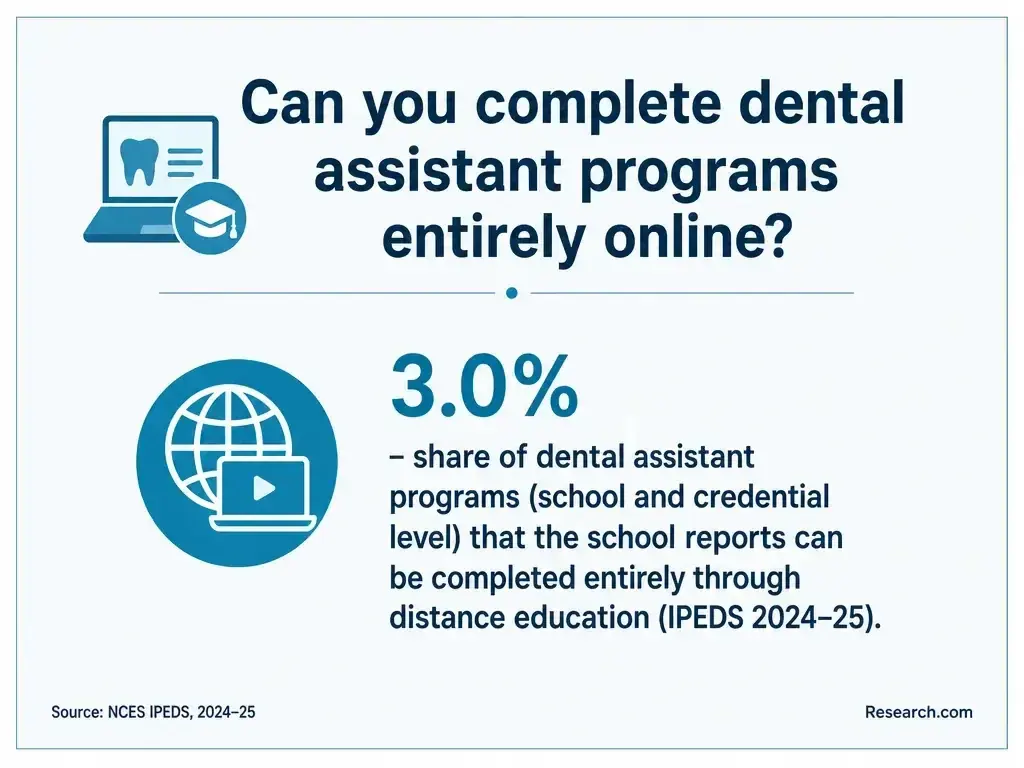
Online coursework can cover terminology, anatomy, scheduling, and infection-control concepts. Instrument handling, chairside positioning, sterilization practice, and clinical performance need in-person assessment. A hybrid program can reduce travel for lectures, but it does not eliminate trips to labs or dental offices.
Before enrolling, get the location and schedule of every required lab and externship in writing. If a provider advertises a fully online certificate, ask how - and where - it verifies hands-on competence and whether its training supports your intended certification route. A list of top online universities may help with a broader search, but it cannot establish that a dental assisting program supplies local clinical training.
There is no dependable single statewide average that captures private career schools, public providers, and employer training on comparable terms. Published tuition is only a starting point. Request an itemized, current cost sheet that includes mandatory fees, books, scrubs, protective equipment, supplies, examinations, any required screening, and travel to labs or externships. Add lost earnings if the schedule limits your work hours.
Compare the amount you would actually pay after grants or employer assistance, alongside likely debt and completion time. Federal aid depends on both the student's eligibility and the program's eligibility; do not assume every short certificate qualifies (Federal Student Aid). Ask a school about its aid status and Colorado workforce-funding options before borrowing. For working adults weighing schedules, fast degree college options for working adults address a different decision: for dental assisting, shorter training is valuable only if it still delivers the practical preparation you need.
Most short trade-school routes award a school certificate or diploma. That completion document is not the same as national professional certification or a state occupational license. Some programs may prepare students for Dental Assisting National Board (DANB) examinations, but eligibility for a particular DANB credential depends on its current pathway requirements, which can include an accredited program or qualifying work experience.
Check a program's exact award and whether it holds Commission on Dental Accreditation (CODA) programmatic accreditation if that matters to your intended certification pathway. Institutional accreditation evaluates the school; Colorado school authorization permits applicable providers to operate; neither automatically establishes CODA status or DANB eligibility. If you are comparing universities with double majors, keep the credential question separate: the relevant result here is documented dental assisting training and practical competence.
Requirements vary by provider. Common admissions checks include an application, proof of prior schooling or equivalent preparation, and the ability to attend scheduled labs. A clinical site may also impose health, immunization, or background-check conditions. Ask about these before paying a deposit, especially if they could prevent an externship placement.
Employer-led entry can have different screening and scheduling requirements from school admission. Neither a school acceptance letter nor payment of tuition establishes eligibility for every clinical site or certification examination; obtain each requirement in writing from the organization that sets it.
A useful curriculum connects dental anatomy and terminology to chairside work: preparing materials, anticipating instrument needs, maintaining infection-control procedures, recording information, and explaining routine instructions under a dentist's direction. Programs may also teach dental radiography concepts and administrative tasks such as scheduling and insurance workflows (U.S. Bureau of Labor Statistics).
Compare what students perform, not just what a catalog lists. Ask how many supervised opportunities they have to practice sterilization, assisting techniques, and patient communication, and how instructors evaluate those skills. Training for radiography or additional duties should be checked against current Colorado Dental Board requirements rather than assumed from a course title.
Colorado does not generally license dental assistants as a separate entry-level occupation. That does not authorize every assistant to perform every task: permitted duties, supervision, and preparation for activities such as dental radiography are governed by Colorado law and Dental Board rules. Confirm the current rule for the specific duties you hope to perform before choosing training.
National DANB certification is a separate professional credential, not a Colorado entry license. It may be useful for demonstrating skills or pursuing an employer's preferred qualifications, but a school certificate alone does not award it (DANB). If a school says its graduates are "certification ready," ask which examination and eligibility pathway it means.
Start with the job you want and the area where you can work. Then compare programs on clinical access, credential fit, total price, and the risk that scheduling or placement problems could delay completion. A ranking is a shortlist tool, not a substitute for these checks.
Ask each provider the same questions so the answers are comparable:
Verify institutional accreditation with the accreditor, applicable school authorization with Colorado's regulator, CODA status with CODA, and examination eligibility with DANB. A common mistake is choosing the cheapest or fastest advertised option without checking its clinical placement. Another is treating an unrelated search, such as cheapest phd in usa, as evidence about the return on a dental assisting certificate; compare occupation-specific costs and outcomes instead.
An entry-level assistant can build experience in general dentistry, then seek employer training for specialty-office workflows, administrative coordination, or additional duties permitted under Colorado rules. Some pursue DANB certification as an optional way to document their knowledge and experience. Advancement depends on an employer's needs and the applicable requirements for each duty; time in a job does not automatically expand legal scope of practice.
If your goal is immediate chairside employment, a practice-based training offer may be more economical than paying for a certificate. If you want structured instruction, a documented program and supervised externship may better fit. Resources such as best online college degrees for seniors serve a different education search; whatever your career stage, evaluate this pathway by its clinical access and intended dental-office role.
The U.S. Bureau of Labor Statistics projects 7.4% national growth in dental assistant employment from 2025 to 2035. This supports considering the occupation, but it does not predict Colorado openings, local competition, or an individual graduate's hiring prospects.
For a Colorado decision, review current state labor-market projections and postings in the communities where you could commute. Look at whether employers seek prior chairside experience, radiography preparation, or specialty-office skills. A program with accessible local externships may provide a more useful first connection than one whose clinical sites are far from your intended job market.
Investing in training is a consequential decision. Research.com created its ranking to help readers compare dental assistant programs against other programs in the same occupation and location, using outcomes, costs, and quality indicators rather than a school's name alone. Only programs with completions reported to IPEDS are eligible; the ranking therefore does not cover every employer-training route or provider.
Best-program scores assess student completion and retention; earnings one year after completion and earnings relative to annual attendance cost; tuition, attendance cost, debt, and loan defaults; and relevant recognition and support services. Programmatic accreditation or industry recognition contributes 20%, institutional accreditation 10%, and student support 10%. Outcomes, earnings, and costs account for the remaining 60%, distributed through an entropy-based method that gives more weight to indicators that vary more across programs. Where a most-affordable ranking is offered, it scores costs and debt only - not accreditation or other quality measures.
The Research.com team uses the following sources to check coverage, outcomes, recognition, and training pathways. A source's inclusion does not mean every listed organization accredits dental assisting programs or that every provider appears in the ranking:
Use the ranking to narrow your shortlist, then confirm each program's current price, clinical training, and credential claims directly. More detail on the approach appears in Research.com's methodology.
# 1 position
# 2 position
# 3 position
# 4 position
# 5 position
# 6 position
# 7 position

# 8 position
# 9 position

# 10 position
# 11 position
# 12 position

# 13 position
Yes. Employer-led training can be a route into general dental assisting. Compare its supervision and skills practice with a school program, and check Colorado's rules before performing particular duties (Colorado Dental Board).
No. A certificate documents completion of a school program; DANB certification requires meeting the certifying organization's applicable eligibility and examination requirements.
Online coursework can cover theory, but chairside and infection-control skills require in-person practice and evaluation. Confirm where a program's labs and clinical experience occur.
Only if its schedule, supervised practice, credential alignment, and total cost meet your needs. Ask whether a shorter calendar leaves enough time for an externship and whether placements can delay graduation.
Not generally for entry-level dental assisting. Colorado rules still govern permitted duties, supervision, and preparation for specific tasks; check the Dental Board's current requirements.