# 1 position

Audited and Verified:
Our Editorial and Data Verification Process
Research.com uses government datasets, official education statistics and primary institutional information to support its career and degree guides. Our review process checks factual accuracy, occupational definitions, source dates and the requirements associated with the credentials discussed.
How This Article Was Fact-Checked
Our editorial team verifies salary estimates, employment projections, education requirements and program information against original data providers and official organizations. Salary figures are checked against the relevant occupational definitions and reporting periods. Information about licensure, accreditation and required in-person training is reviewed separately.
Fact-checked and verified on:

Co-Founder and Chief Data Scientist

Reviewed by Karolina Broda
Fact-Checker and Data Verification
Choosing dental assistant training in North Mankato means checking more than tuition: the program must teach hands-on skills and support the duties you want to perform under Minnesota rules. The U.S. Bureau of Labor Statistics projects 7.4% national employment growth for dental assistants from 2025 to 2035. This guide compares training routes, costs, credentials, and career prospects. It also features a Best Dental Assistant Trade Schools in North Mankato for 2027 ranking created by the Research.com team of data scientists to help students identify programs worth considering.
Expect a mix of classroom instruction, simulated practice, and supervised work with patients if the program includes a clinical placement. Dental assistants prepare treatment rooms, help dentists during procedures, manage infection control, and may handle records or scheduling; permitted clinical duties depend on Minnesota rules and the worker's qualifications (U.S. Bureau of Labor Statistics; Minnesota Board of Dentistry).
South Central College is the local provider to investigate. Ask which campus hosts each lab and clinical component, whether placements require travel beyond North Mankato, and which Minnesota duties the training prepares you to seek. A shorter course can suit someone pursuing permitted entry-level duties; it should not be assumed equivalent to a CODA-accredited pathway intended to support licensed dental assisting.
Dental offices are the principal employment setting for dental assistants nationally (U.S. Bureau of Labor Statistics). North Mankato residents can also assess opportunities across the Mankato area, including general and specialty practices. A clinical placement may introduce students to an employer, but it is not a job offer.
Before choosing training, compare local postings for "dental assistant" and "licensed dental assistant." Note which positions require a Minnesota license, radiography qualifications, particular clinical duties, or prior experience. This makes the difference between a quick entry route and a longer licensure-oriented program concrete.
The national median annual wage for dental assistants was $48,070 in May 2025 (U.S. Bureau of Labor Statistics). It describes employed workers nationwide, not new graduates or the North Mankato labor market. Use it as a broad benchmark, then compare current Mankato-area postings by required license, experience, schedule, and benefits before estimating your own earnings.
For a training investment, compare likely additional earnings against fees, borrowing, and income forgone during school - not against the national median alone. Licensure may expand the duties for which an employer can hire you, but neither a credential nor a ranking guarantees higher pay.
Length depends on the credential, course load, and clinical schedule. An employer may train someone for permitted entry-level work while they earn wages; a formal certificate or diploma typically combines coursework with hands-on instruction and can take longer, especially part time. Ask South Central College for its current calendar, total credits or contact hours, required clinical hours, and the earliest realistic completion date. Do not assume every program has the same state-required number of classroom hours.
Shorter options, including some 6-month certificate programs for careers that pay well, deserve comparison on their actual occupational outcome. For dental assisting, finishing sooner only helps if the clinical training and resulting eligibility match your intended role.
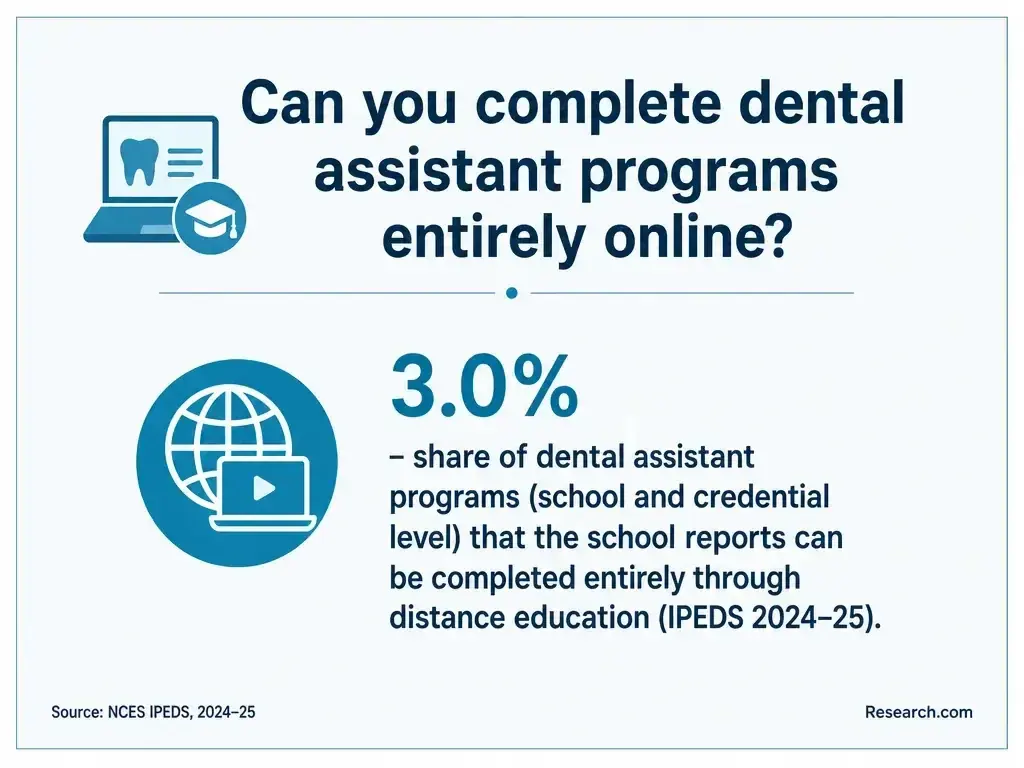
Online delivery can work for terminology, records, and some infection-control theory. Chairside assistance, instrument handling, radiography practice, and patient-facing clinical skills require appropriate supervised, in-person training. A course advertised as fully online should not be presumed to satisfy Minnesota licensure requirements or an employer's practical-skills expectations (Minnesota Board of Dentistry; Commission on Dental Accreditation).
If flexibility is essential, compare hybrid schedules rather than the online label alone. Ask where labs and clinical placements occur and who arranges them; a remote course with distant required placements can be impractical from North Mankato. A list of best online schools may help with general format research, but verify dental assisting requirements at the individual program level.
There is no reliable North Mankato-wide average that covers college programs and employer training on the same basis. Request South Central College's current program-specific estimate rather than using a general institutional tuition figure. Include mandatory fees, books, uniforms, protective equipment, clinical travel, any required checks or health documentation, examinations, license applications, and earnings lost while training.
Federal aid eligibility depends on the student and the program; ask the school's aid office about eligible aid and Minnesota assistance (Federal Student Aid; Minnesota Office of Higher Education). Employer-paid training can reduce upfront expense but may prepare you for fewer duties. When comparing investments, include completion likelihood, borrowing costs, expected earnings change, and the time needed to recover your costs - not tuition alone. A cheapest bachelor degree online comparison serves a different career goal and is not a substitute for pricing dental assisting training.
The award depends on the particular pathway: a school may award a certificate or diploma, while employer training may provide experience without an academic credential. School completion, DANB certification, and a Minnesota dental assistant license are different things. CODA accredits eligible dental assisting programs; institutional accreditation applies to the school, not automatically to every program; and the Minnesota Board of Dentistry determines state licensing requirements (Commission on Dental Accreditation; Dental Assisting National Board; Minnesota Board of Dentistry).
Ask the provider to name the exact award and show how its curriculum and accreditation status relate to the license or duties you want. Also ask whether prior coursework earns credit; credit transfer can shorten training but does not waive board requirements.
Requirements vary by pathway. A formal program may require an application, evidence of prior schooling, and health or safety documentation before clinical participation; an employer may set its own hiring and training criteria. Confirm South Central College's current admissions and clinical-placement requirements directly rather than assuming that admission to the college guarantees a place in the program.
Ask when clinical eligibility is checked and whether a missed requirement could delay placement. If you have previous dental-office experience, ask whether the program assesses it for credit or placement - and separately confirm that the Minnesota Board of Dentistry accepts your proposed route to any license you intend to seek.
Relevant instruction includes dental anatomy and terminology, infection prevention, instrument preparation, chairside techniques, patient communication, records, and radiography where included. The important distinction is how those skills are practiced: observation or online lessons alone do not replace supervised performance with equipment and patients (U.S. Bureau of Labor Statistics; Commission on Dental Accreditation).
Compare programs by requesting a curriculum and clinical plan. Look for the number and setting of hands-on sessions, who supervises them, and how competence is assessed. Digital imaging and electronic records matter in practice, but software familiarity should complement - not displace - safe clinical technique.
Not for every dental assisting task. Minnesota distinguishes permitted work by unlicensed assistants from duties reserved for qualified or licensed personnel. To pursue licensed dental assistant status, applicants must meet the Minnesota Board of Dentistry's current education, examination, and application rules; completing a course does not itself grant a license. DANB certification is a separate professional credential, although DANB examinations may be relevant to a particular eligibility route (Minnesota Board of Dentistry; Dental Assisting National Board).
Before paying a deposit, identify the duties in your target job postings and ask the board and program which pathway qualifies you for them. Verify current CODA program status separately: school accreditation, state school authorization, program accreditation, certification, and occupational licensure are not interchangeable.
Start with the job you want, then test each training route against its requirements. The following checks help separate a credible, usable pathway from an appealing but incomplete course.
A red flag is a promise of licensure based solely on finishing an online course. Another is a low tuition quote that excludes clinical travel or examination costs. Rankings help narrow a search, but the best investment is the eligible program you can complete at a sustainable cost. If your goal is outside clinical dental assisting, a low cost master degree online addresses a different decision, not this occupation's entry requirements.
One path is entry-level assisting within Minnesota's permitted duties, followed by further training or licensure to qualify for additional responsibilities. Experience can also support moves into specialty practices, patient coordination, or office supervision; these roles have different hiring expectations and no automatic promotion timeline (Minnesota Board of Dentistry; U.S. Bureau of Labor Statistics).
If you already work in an office, ask whether your employer will support supervised skill development and a licensure-oriented program. Training for dental assisting is not a shortcut into a separately regulated dental occupation. Readers considering the easiest masters degree are evaluating a different educational path; for this career, clinical competence and Minnesota duty eligibility should drive the choice.
The U.S. Bureau of Labor Statistics projects 7.4% growth in dental assistant employment nationally from 2025 to 2035. That supports considering the occupation, but a national projection does not measure openings in North Mankato or guarantee a local job.
For a local decision, review current Mankato-area vacancies over time and separate entry-level roles from those requiring a Minnesota license. If few suitable openings align with your expected completion date, ask programs about clinical-placement locations and be prepared to consider a wider commute. That check is more useful than treating national growth as a local hiring forecast.
Investing in training is a consequential decision, so the Research.com team evaluates programs against others in the same occupation and location rather than against unrelated schools. The ranking includes only programs with completions reported to IPEDS; an employer training route or other provider absent from that database is not necessarily unapproved or low quality.
For best-program rankings, student completion and retention, earnings after completion, costs and debt, accreditation or relevant industry recognition, and student support all inform the score. Programmatic accreditation or industry recognition carries 20%, institutional accreditation 10%, and student support 10%. The remaining 60% covers outcomes, earnings, and costs, with an entropy-based method assigning more weight to indicators that distinguish programs. Most-affordable rankings instead score tuition, attendance cost, debt, and federal loan default rates; they do not score accreditation or other quality indicators.
The team uses the following sources to assess reported outcomes, costs, recognition, and occupation-specific context. Some sources cover broader trades and are not evidence that a particular dental assisting program holds their accreditation.
This approach helps readers compare reported results without treating a ranking as proof of Minnesota licensure eligibility. See Research.com's ranking methodology for more information about how the rankings are created.
# 1 position
# 2 position
No. Employer-based training may be an option for duties Minnesota permits without a license. Compare that route with South Central College's current program if you want structured clinical instruction or plan to pursue licensure (Minnesota Board of Dentistry).
Do not assume so. Check the Minnesota Board of Dentistry's current eligibility rules and verify the program's required in-person training and accreditation status before enrolling.
No. Program completion and state licensure are separate. The Minnesota Board of Dentistry determines the examinations, application steps, and other current requirements.
Ask where they occur, who arranges them, how many hours are required, whether you can work while completing them, and what transportation costs you would bear.
It can be if the training qualifies you for your intended duties and the full cost fits your budget. Compare likely earnings improvement, debt, completion time, and an employer-training alternative before deciding.