# 1 position
Milan Institute-Visalia - Dental Assisting/Assistant.
certificate or diploma

Audited and Verified:
Our Editorial and Data Verification Process
Research.com uses government datasets, official education statistics and primary institutional information to support its career and degree guides. Our review process checks factual accuracy, occupational definitions, source dates and the requirements associated with the credentials discussed.
How This Article Was Fact-Checked
Our editorial team verifies salary estimates, employment projections, education requirements and program information against original data providers and official organizations. Salary figures are checked against the relevant occupational definitions and reporting periods. Information about licensure, accreditation and required in-person training is reviewed separately.
Fact-checked and verified on:

Co-Founder and Chief Data Scientist

Reviewed by Karolina Broda
Fact-Checker and Data Verification
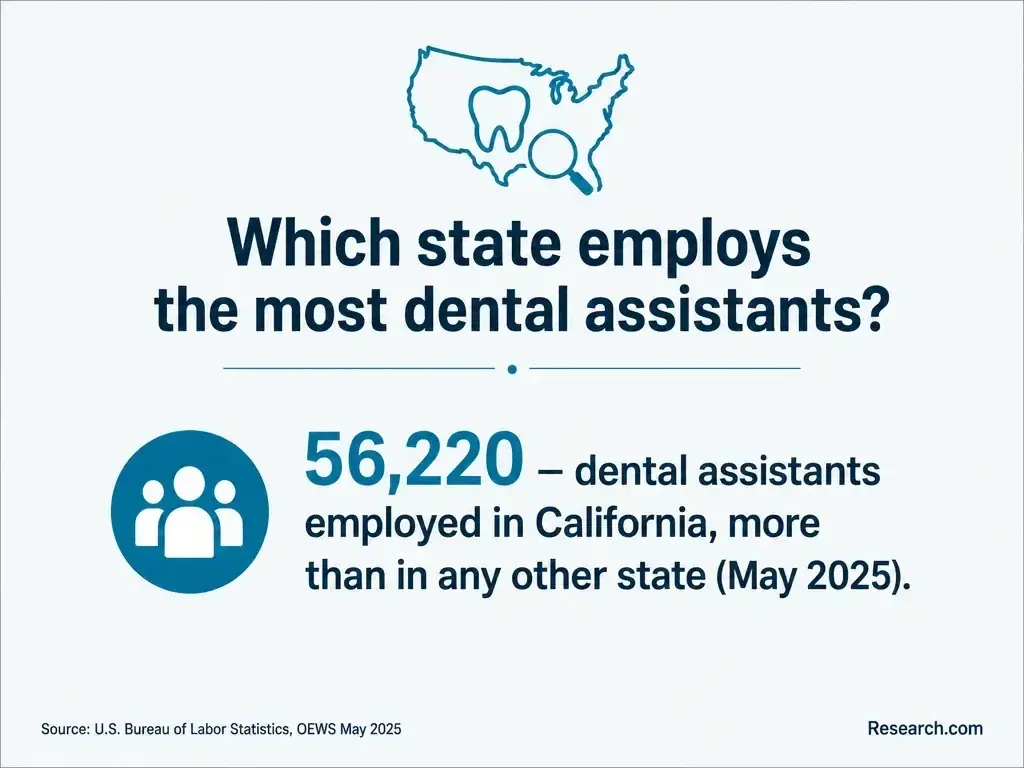
Choosing the cheapest dental assistant program can cost more if it leaves you without the hands-on training or California eligibility you need. The Research.com team of data scientists created the Most Affordable Dental Assistant Trade Schools in Visalia for 2027 ranking to help students identify programs worth considering. National employment of dental assistants is projected to grow 7.4% from 2025 to 2035, according to the U.S. Bureau of Labor Statistics (BLS). This guide helps prospective students compare costs, credentials, training formats, and routes into local dental offices.
Expect instruction in chairside support, infection prevention, instrument processing, dental materials, patient communication, and office workflow. Dental assistants prepare rooms, support dentists during procedures, and help maintain records; the exact duties a graduate may perform depend on California's scope-of-practice rules and any additional required training (BLS; Dental Board of California).
Programs with similar names can offer different preparation. A short entry-level course may teach foundational skills, while an RDA-oriented program should be evaluated against the Dental Board of California's requirements. Ask for a written breakdown of supervised lab practice, any clinical placement, and what happens if a placement is delayed. Classroom hours alone do not show whether you will practice safely in a dental setting.
For a Visalia student, a workable clinical schedule matters as much as a convenient classroom location. Confirm whether required practice takes place locally, during hours you can attend, and at a site the school arranges rather than one you must find yourself.
General dental practices are a common destination; specialty practices, including orthodontic and oral-surgery offices, may also hire assistants whose skills fit their procedures. Some jobs emphasize chairside work, while others combine it with scheduling, records, sterilization, or patient education (BLS).
Training does not grant every clinical duty. Before targeting a vacancy in Visalia or elsewhere in Tulare County, compare its requested radiography, coronal-polishing, and RDA qualifications with your actual training and California authorization. If a school advertises specialty-office placement, request recent, program-specific placement information and ask whether those positions required qualifications beyond graduation.
The latest national BLS Occupational Outlook Handbook figure supplied for this occupation is a $48,070 median annual wage in May 2025. A median describes workers across experience levels and locations, not what a new Visalia graduate will earn. Local offers can differ with duties, experience, employer, schedule, and RDA status.
Use current Visalia-area job postings and actual written offers when estimating your likely pay. For an investment comparison, calculate what you would borrow and the income you would forgo during training, then test whether a realistic entry-level wage - not the national median - makes the repayment manageable.
Duration depends on the credential, attendance schedule, and whether the program includes a clinical placement. Request each school's current calendar and its separate totals for classroom, lab, and clinical hours; do not infer those hours from a program's advertised length. Part-time study can reduce weekly schedule pressure but extend the time before you can seek work.
California also has an experience-based path to RDA examination eligibility that calls for at least 15 months and 1,280 hours of qualifying dental-assistant work, subject to the Dental Board of California's additional requirements. This makes supervised employment a meaningful alternative for someone who can secure a suitable job, although it is not the same as completing an RDA program. Confirm the current rules with the board before relying on work hours as your registration plan.
An accelerated schedule is useful only if you can attend every required practice session. A search for accelerated degree programs should not be confused with evidence that a dental assisting course meets California's occupation-specific requirements.
Online instruction can cover terminology, recordkeeping, and some infection-control theory. Instrument handling, chairside techniques, radiography practice, and supervised clinical work require appropriate in-person settings. A hybrid program may reduce commuting for lectures, but it cannot make hands-on competencies virtual (BLS; Dental Board of California).
The comparison below focuses on what each format changes for a Visalia student. Actual schedules and placements vary by provider.
| Format | Potential advantage | Decision-critical limitation |
| On-campus | Scheduled access to equipment and instructor observation | Regular travel and fixed lab times |
| Hybrid | Less travel for theory coursework | Mandatory in-person labs and possible clinical-site travel |
| Online-only coursework | Flexible study of theory | Does not, by itself, establish practical competence or California RDA eligibility |
Ask where practical training occurs, who supervises it, and whether the program - not just its online lessons - matches your intended duties. A listing among the best universities is not a substitute for those answers.

There is no reliable single Visalia average that covers every dental assisting route, including career-school programs and employer training. Published tuition alone also excludes costs that can change which option is most affordable. Obtain a current, itemized quote from each provider rather than treating a ranking position as your final bill.
Use the same cost categories for every option so a shorter course is not made to look cheaper by leaving required purchases out:
Federal aid depends on the school's and program's eligibility, not merely its price or accreditation; check eligibility and your individual award with the school and Federal Student Aid. Ask local workforce staff whether you qualify for training assistance. The cheapest route is the one with a manageable net cost that still prepares you for your intended job - not necessarily the smallest tuition figure. Likewise, choosing a nationally accredited online college does not establish that a dental assisting program covers California's practical requirements.
A training provider may award a certificate or diploma. That school-issued credential is distinct from California RDA registration and from a voluntary professional certification such as a credential administered by the Dental Assisting National Board (DANB). The Dental Board of California determines state registration and permitted duties; DANB sets its own certification eligibility and examination rules.
This distinction matters when comparing a short program with one designed around RDA preparation. Ask what document the school awards, whether the specific program is approved for the California pathway it advertises, and which additional courses, work experience, or exams you would still need. Institutional accreditation, CODA programmatic accreditation, state school authorization, and board approval answer different questions; none should be assumed to replace the others.
Admission requirements are set by each provider and may include proof of secondary-school completion, an application, and readiness for clinical work. A placement site may impose additional health, safety, or screening conditions. Request the current written policy before paying a nonrefundable charge; admission to a school is not a determination of RDA eligibility.
Ask Milan Institute-Visalia and San Joaquin Valley College-Visalia to confirm their currently offered dental assisting options, admissions criteria, and any clinical-site prerequisites before comparing them. Do not assume either institution offers a particular credential, schedule, or placement in 2027 without checking its current catalog. If you already have relevant training, ask whether documented prior learning can reduce repeated coursework - and whether any resulting exemption still satisfies the California requirements for your goal.
Core training typically covers dental anatomy and terminology, infection control, instrument setup and sterilization, chairside assisting, dental materials, patient communication, and records. Some programs also teach radiography and other procedures that California restricts to workers who meet specific training or credential conditions (BLS; Dental Board of California).
Look beyond a course list. Ask how students demonstrate instrument processing, patient positioning, and safe assistance under observation; whether radiography instruction includes the required practical component; and how instructors document competency. Digital imaging and electronic records make technology practice useful, but software familiarity cannot replace a required clinical skill or California authorization.
Not for every entry-level dental assisting duty. California distinguishes unlicensed dental assistants from Registered Dental Assistants, and it restricts particular procedures according to training and registration status. The Dental Board of California - not a school certificate - defines those permissions. Radiography and other expanded duties have separate requirements, so do not assume a general assisting course authorizes them.
To pursue RDA registration, verify a current board-recognized eligibility route, required supplementary coursework and life-support training, examinations, and the application process directly with the Dental Board of California. The experience-based route and an approved-program route are not interchangeable without checking every applicable condition. DANB certification is a separate professional credential; ask an employer whether it values that credential, but do not treat it as California registration.
Start with the job you want: entry-level chairside assistance or a route toward RDA duties. Then compare programs on the requirements for that goal, not ranking position alone. A low-cost course can be a poor investment if you later have to pay again for missing practical training.
Before enrolling, work through these checks in order:
Watch for claims that "online," "accredited," or "certified" automatically means RDA-eligible. They refer to different things. An affordable masters degree search result is similarly not evidence about entry-level dental assisting training; verify the specific occupational program instead.
An entry-level assistant may begin with room preparation, sterilization, patient support, and permitted chairside tasks. With qualifying training, experience, and registration, an RDA can pursue the broader duties California allows. Experienced assistants may also move into specialty-practice support, training new staff, or office coordination, depending on employer needs (BLS; Dental Board of California).
Choose a pathway according to the work you want to do next. A short entry course can suit someone seeking an initial position and willing to train further on the job. An RDA-focused program may better suit someone who wants a structured route toward expanded duties, provided its current approval and total cost check out. Neither route guarantees promotion or a particular wage. Searches for an easiest doctoral degree do not answer the practical question here: what training and authorization does the intended dental-office role require?
BLS projects 7.4% national employment growth for dental assistants from 2025 to 2035. That projection indicates a growing U.S. occupation, but it is not a forecast of openings in Visalia or a promise that a particular graduate will be hired.
For a local decision, review current Tulare County-area vacancies for their requested duties, schedules, and credentials, then compare those requirements with each program's training. A program with accessible clinical practice and preparation for the qualifications local employers request may offer better value than a lower-priced program whose graduates must arrange additional training before applying.
Education is a significant investment, so Research.com developed this ranking to help readers compare dental assisting programs with other options in the same occupation and location. The team checks multiple education and occupation-specific sources for quality and accuracy. Only programs with completions reported to the Integrated Postsecondary Education Data System (IPEDS) are eligible; that coverage rule does not mean other training providers are unavailable or unsuitable.
The most affordable ranking scores costs and debt: tuition, cost of attendance, median student debt, and federal loan default rate. It uses an entropy-based method that gives more weight to measures that differ more across eligible programs. Accreditation, outcomes, and other quality indicators are not part of this affordability score. A low rank by cost is therefore a starting point for investigation, not proof that a program meets California registration requirements or offers the best value. Research.com explains its ranking approach further on its methodology page.
The following sources inform the ranking and its occupation-specific context. Readers can also use them to check a school's claims independently:
Some listed sources cover occupations beyond dental assisting; their inclusion does not make them dental-program accreditors. Because this is an affordability ranking, readers should separately confirm current program availability, California-specific training alignment, practical experience, and the full amount they would pay.
# 1 position
# 2 position

Potentially. California permits certain entry-level duties without RDA registration, and some employers train assistants on the job. Verify which duties you may perform and whether the job supplies the training you need (Dental Board of California).
No. A school certificate documents program completion; California RDA registration has separate eligibility, coursework, examination, and application requirements (Dental Board of California).
Online lessons can cover theory, but clinical and hands-on skills require appropriate in-person practice. Ask where those components occur before enrolling.
No. Compare total out-of-pocket cost, debt, time away from work, supervised practice, and whether the training supports your intended California duties.
Choose one if RDA duties are your goal and you have confirmed its current California eligibility pathway and full cost. If you want to enter an allowable assistant role sooner, compare it with a suitable employer-training opportunity.


