# 1 position
ABC Adult School - Dental Assisting/Assistant.
certificate or diploma

Audited and Verified:
Our Editorial and Data Verification Process
Research.com uses government datasets, official education statistics and primary institutional information to support its career and degree guides. Our review process checks factual accuracy, occupational definitions, source dates and the requirements associated with the credentials discussed.
How This Article Was Fact-Checked
Our editorial team verifies salary estimates, employment projections, education requirements and program information against original data providers and official organizations. Salary figures are checked against the relevant occupational definitions and reporting periods. Information about licensure, accreditation and required in-person training is reviewed separately.
Fact-checked and verified on:

Co-Founder and Chief Data Scientist

Reviewed by Karolina Broda
Fact-Checker and Data Verification
Choosing affordable dental assistant training near Cerritos means looking beyond tuition: the least expensive program may not provide the practical skills or California eligibility you need. The Research.com team of data scientists created its Most Affordable Dental Assistant Trade Schools in Cerritos for 2027 ranking to help students identify programs worth considering. With dental assistant employment projected to grow 7.4% nationally from 2025 to 2035 (U.S. Bureau of Labor Statistics), this guide helps you compare training, costs, credentials, and career-entry routes before enrolling.
Expect instruction in chairside assistance, infection prevention, dental materials, patient communication, and office procedures, followed by supervised practice. A useful program makes clear which competencies students demonstrate in a lab and which they practice in a dental office. Dental assisting is hands-on work: a classroom-only credential does not establish that you can safely perform chairside duties.
The main choice is between a shorter entry-level certificate or diploma, training designed to support California RDA eligibility, and employer-based learning. A shorter program may suit someone seeking supervised entry-level work quickly. Someone intending to perform expanded duties should check the Dental Board of California's current RDA pathways before paying for training. An office willing to train a new assistant may reduce upfront school costs, but the applicant must establish how they will obtain any separately required coursework or certificates.
Providers' offerings and schedules can change. If comparing ABC Adult School or PCI College, request the current dental-assisting curriculum, lab schedule, clinical arrangements, credential awarded, and a written explanation of how the training relates to California requirements. Programs marketed broadly as programs for seniors online are not a substitute for verifying in-person dental skills training.
Dental assistants primarily work in dental offices, including general dentistry and specialty practices such as orthodontics and oral surgery (U.S. Bureau of Labor Statistics). Cerritos residents can consider practices across the surrounding Los Angeles and Orange County labor markets. That wider search may increase the number of openings, but commute time and the location of any clinical placement can materially change the value of a low-cost program.
Ask prospective employers which duties they expect a new assistant to perform and which California certificates or RDA status they require for those duties. A job title alone does not establish permission to perform radiography or expanded functions; scope of practice is governed by the Dental Board of California.
The U.S. median annual wage for dental assistants was $48,070 in May 2025 (U.S. Bureau of Labor Statistics). That figure covers experienced and newly employed workers nationwide; it is neither a Cerritos wage nor a predicted first-job offer. Compare actual offers by hourly pay, paid hours, benefits, commute expense, and whether the employer pays for required training.
For a local decision, look for the most recent Los Angeles-Long Beach-Anaheim occupational wage estimate from the U.S. Bureau of Labor Statistics or California Employment Development Department. Check its reference year and geographic coverage before comparing it with an offer. A higher-paying position farther from Cerritos may leave less take-home value after travel costs and unpaid commuting time.
Completion time depends on the credential, attendance schedule, clinical placement, and whether the program is designed for entry-level assisting or a California RDA pathway. Do not assume that two certificates with similar names include the same instruction or practice hours. Ask each provider for its published total clock or contact hours, the portion spent in supervised labs or offices, and the expected time from enrollment to completion.
An accelerated schedule can get you into the job market sooner, but it may limit paid work while you study or leave less time for practice. Part-time attendance may preserve income while extending the period before you qualify for your intended duties. A fast track associates degree is a different commitment; choose it only if its actual dental-assisting curriculum and credential justify the added time for your goal.
Online instruction can cover terminology, anatomy, scheduling, and some infection-control concepts. Chairside techniques, instrument handling, radiography practice, and supervised patient-facing work require suitable in-person training. A hybrid program can be convenient for a working student only if its labs and clinical sites are realistically reachable from Cerritos.
Compare formats by the location and timing of required practice, not by the proportion of lessons delivered online. Before choosing from best online trades school options, obtain written confirmation of who arranges local hands-on training and whether the completed coursework supports the California credential or duties you intend to pursue. Do not assume an entirely online certificate establishes RDA eligibility (Dental Board of California).
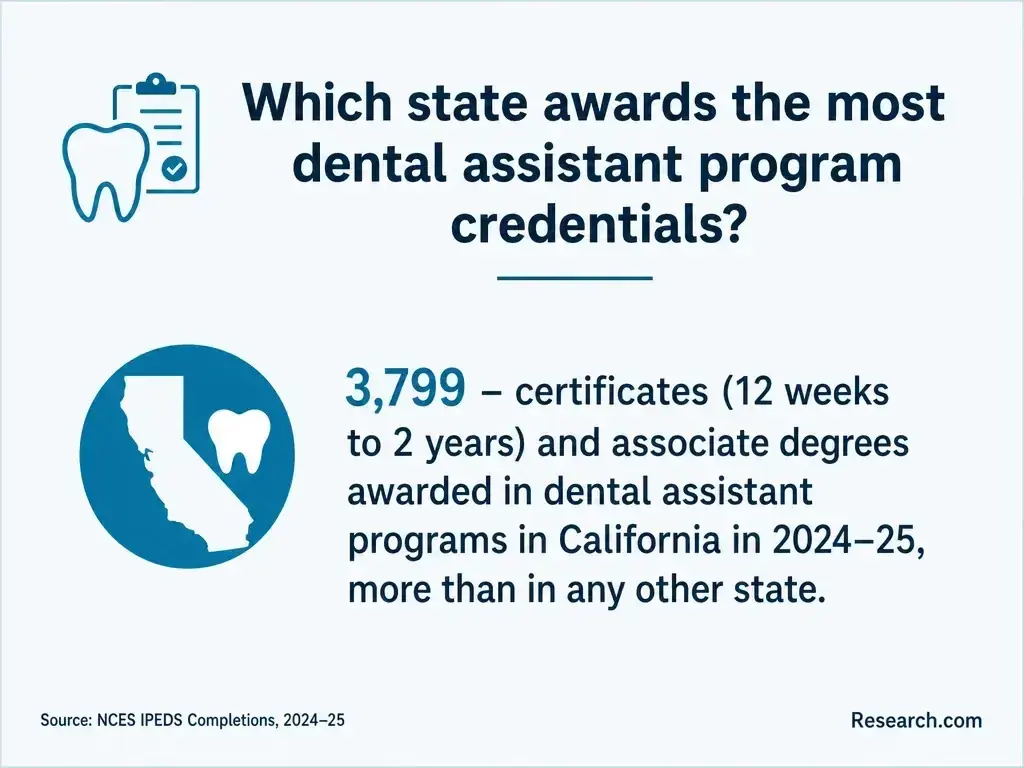
There is no defensible single average for Cerritos dental assistant training without a defined set of current programs and comparable published prices. A tuition quote also may omit what it takes to become job-ready. Request an itemized, current-year cost sheet from each provider rather than treating the ranking's cost measures as your final bill.
The following comparison separates charges that appear on a school bill from expenses that can arise outside it. Use it to check whether two quoted prices cover the same things.
| Cost category | What to verify |
| School charges | Tuition, enrollment and lab fees, materials, and refund terms |
| Training supplies | Uniforms, protective equipment, textbooks, and required devices |
| Career-entry costs | Required coursework, examinations, applications, and other applicable credential fees |
| Indirect costs | Travel to classes and clinical sites, childcare, and income forgone during training |
Ask whether grants, eligible federal or California aid, workforce funding, or employer-paid training can reduce your net cost; availability depends on the student and provider (Federal Student Aid; California Student Aid Commission). When comparing value, weigh net cost and likely debt against completion probability, time away from work, your current earnings, plausible post-training earnings, and how long you expect to work in the field. No wage figure guarantees that an expensive program will pay for itself.
A provider may award a certificate or diploma showing completion of its training. That school-issued award is distinct from California RDA registration, a duty-specific certificate, and voluntary professional certification. Ask for the exact credential name in writing and confirm which body issues each additional credential (Dental Board of California; Dental Assisting National Board).
Institutional accreditation evaluates a school, while programmatic accreditation evaluates a particular program; neither automatically grants permission to perform regulated duties. California school authorization and Dental Board approval serve different purposes as well. Before enrolling, verify the provider's applicable school status with the California Bureau for Private Postsecondary Education or other relevant oversight body, and check any claimed RDA program approval directly with the Dental Board of California.
Admissions requirements vary by provider and should not be confused with California's rules for performing particular dental-assisting duties. Ask the school whether it requires proof of prior education, an assessment, immunization or health documentation, a background check for clinical placement, or the ability to attend scheduled in-person sessions. Obtain the requirements and any associated charges before paying a deposit.
Use this sequence to distinguish getting into a program from becoming ready for work:
If you already work in a dental office, ask whether the provider recognizes prior learning or documented experience. Do not assume it will reduce required instruction or satisfy a Board requirement; get any credit or pathway decision confirmed by the appropriate organization.
Core training usually covers dental terminology and anatomy, instrument identification, chairside procedures, sterilization and infection control, patient records, and communication (U.S. Bureau of Labor Statistics). Depending on the program and intended duties, students may also study dental materials, radiography, and expanded-function procedures. California regulates who may perform particular functions, so a course description is not proof of authorization to perform them (Dental Board of California).
Ask to see how skills are assessed: Does the program include supervised lab demonstrations, feedback on infection-control technique, and a documented clinical experience? Employers increasingly use digital records and imaging workflows, making practice with current office technology useful - but it should complement, not replace, safe hands-on technique (U.S. Bureau of Labor Statistics).
California does not make RDA registration a universal prerequisite for every entry-level dental assistant task. It does restrict particular duties and establish separate requirements for RDA registration and certain functions, including dental radiography (Dental Board of California). The practical question is not simply whether a school offers a certificate, but whether your intended job duties require training, a duty-specific certificate, or registration beyond that certificate.
RDA eligibility can involve an approved educational route or another Board-recognized pathway, together with applicable coursework and examinations; graduation alone does not confer registration (Dental Board of California). Dental Assisting National Board certification is a separate professional credential, not a substitute for California authorization. Check current Board instructions before enrolling or accepting duties outside your permitted scope.
Start with the job you want: supervised entry-level chairside work or a pathway toward RDA duties. Then compare programs on the training and eligibility needed for that goal. A ranking helps identify affordable candidates, but it cannot tell you whether a clinical schedule, placement location, or credential fits your circumstances.
Ask each provider the same questions so the answers are comparable:
Be wary of a provider that will not document costs, practical training, or its California eligibility claims. Broad lists of degrees that pay well cannot answer those occupation-specific questions. For dental assisting, the better investment is the route that supplies necessary competencies at a manageable net cost - not automatically the cheapest or fastest listing.
A common starting point is supervised chairside or administrative assisting in a dental practice. With qualifying training and the applicable California authorization, an assistant may pursue RDA duties; experience can also support work in a specialty practice, patient coordination, or office leadership. Those moves depend on employer needs and individual qualifications, not on the school certificate alone (Dental Board of California; U.S. Bureau of Labor Statistics).
Someone primarily interested in office administration may find employer training more direct than paying for extensive chairside instruction. Conversely, someone seeking regulated clinical duties should not choose a low-cost course that omits the needed pathway. A fast online bachelor's degree for working adults does not replace dental-assisting practical training or California authorization.
U.S. dental assistant employment is projected to grow 7.4% from 2025 to 2035 (U.S. Bureau of Labor Statistics, Employment Projections). That national projection suggests continuing demand for the occupation, but it is not a Cerritos hiring forecast or a guarantee of a position after training.
For a more useful local check, review current openings across commutable parts of Los Angeles and Orange counties. Note how often employers request RDA status, radiography eligibility, specialty experience, or particular schedules. If most appealing openings require duties your proposed program does not prepare you for, its low price may offer poor value even in a growing occupation.
Education is a significant investment, so the Research.com team designed this ranking to make local cost comparisons more credible and useful. Programs are compared with others in the same occupation and location. Only programs with completions reported to the Integrated Postsecondary Education Data System (IPEDS) are eligible; absence from the ranking does not mean another training provider is unavailable or unsuitable.
The most affordable ranking scores tuition, cost of attendance, median student debt, and federal loan default rate. Its weights are distributed using an entropy-based method, which gives more weight to measures that differ more across eligible programs. Accreditation, training quality, and outcomes are not part of this affordability score. By contrast, Research.com's best-program rankings also evaluate student outcomes, earnings, support, and recognition. Readers should therefore use the affordability ranking as a shortlist, then independently check California eligibility and hands-on training.
The team used the following sources to check costs, outcomes, institutional information, and occupation-specific context:
Some sources provide broader educational or workforce context rather than a dental-assisting quality score. For more detail on the approach, see Research.com's methodology.
# 1 position
# 2 position

Compare the net cost of a suitable training program with an employer willing to train an entry-level assistant. Include supplies, travel, lost work time, and any later California-required coursework; the lowest advertised tuition may not be cheapest overall.
Some entry-level duties can be learned through supervised employment. California restricts certain duties, however, so verify the training and authorization needed for the work you intend to do (Dental Board of California).
Do not assume so. Check the Dental Board of California's current RDA pathways and confirm how a provider supplies required practical training and any other eligibility components.
It may be a poor fit for someone who needs documented hands-on experience or help entering chairside work. Ask employers what experience they expect and ask the provider how students practice and demonstrate clinical skills.
Not by itself. California has specific requirements for dental radiography; verify the current rules with the Dental Board of California before performing that duty.