# 1 position

Audited and Verified:
Our Editorial and Data Verification Process
Research.com uses government datasets, official education statistics and primary institutional information to support its career and degree guides. Our review process checks factual accuracy, occupational definitions, source dates and the requirements associated with the credentials discussed.
How This Article Was Fact-Checked
Our editorial team verifies salary estimates, employment projections, education requirements and program information against original data providers and official organizations. Salary figures are checked against the relevant occupational definitions and reporting periods. Information about licensure, accreditation and required in-person training is reviewed separately.
Fact-checked and verified on:

Co-Founder and Chief Data Scientist

Reviewed by Karolina Broda
Fact-Checker and Data Verification
Choosing a dental assistant program in Pasadena, California, means comparing more than tuition: clinical practice, commuting costs, and eligibility for California credentials can change the value of a short course. The U.S. Bureau of Labor Statistics projects 7.4% national employment growth for dental assistants from 2025 to 2035. For career changers and first-time students, this guide explains the costs, training routes, and requirements behind that opportunity. It also accompanies the Most Affordable Dental Assistant Trade Schools in Pasadena for 2027 ranking, created by the Research.com team of data scientists to help students identify programs worth considering.
Expect instruction in chairside assistance, infection prevention, dental materials, patient communication, and office workflow, followed by supervised practice. The decisive difference between programs is what students actually practice: ask whether radiography, impressions, and other procedures are taught in person, assessed, and permitted for students under California rules.
Pasadena City College is a local public-college option to investigate alongside private career-school programs and employer training. A school certificate documents completion of its curriculum; it is not itself California RDA registration or DANB certification. Direct-entry employment may suit someone who can find a practice willing to train them, while a structured program may better suit someone seeking scheduled labs and documented preparation for later credentials. A ranking of price alone cannot settle that choice.
If you are comparing career changes, an best accelerated online associates business degree list addresses a different occupation; it does not establish competence in dental procedures. Judge dental-assisting training by its supervised practice and eligibility for the duties you want.
Dental offices are the principal setting for this occupation, according to the U.S. Bureau of Labor Statistics. Around Pasadena, students can consider general practices as well as specialty offices, but specialty hiring may call for additional experience with a practice's instruments, scheduling, and procedures. Ask a program where its clinical placements occur: a placement that requires substantial travel across the Los Angeles area can raise the real cost of training and complicate work schedules.
An initial position may combine patient preparation, sterilization, chairside support, and records work. The tasks an assistant may perform depend on California rules, supervision, and any additional credentials - not merely on an employer's job title (Dental Board of California).
A reliable Pasadena-only wage figure is not available here. The appropriate published benchmark is the $48,070 national median annual wage for dental assistants in May 2025 (U.S. Bureau of Labor Statistics). It describes the midpoint for employed assistants nationwide, not likely starting pay for a newly trained Pasadena applicant.
For a useful local estimate, compare current job postings by required duties and credentials, then ask placement staff what recent entrants were offered. Account for hours, benefits, commuting, and whether a role offers paid training. Those details matter more to a personal pay calculation than comparing an entry-level offer with an experienced-worker median.
There is no single California-wide duration for every dental assistant certificate. A full-time program may move faster on the calendar than part-time study, but a short course may cover fewer supervised procedures. Request the program's published calendar and clock or contact hours, separating classroom, laboratory, and clinical time. If the goal is RDA eligibility, confirm the applicable pathway and training requirements with the Dental Board of California before treating a completion date as the date you can perform expanded duties.
Employer training can let someone start earning sooner, but progression depends on the practice's instruction and the worker's ability to document any experience required for a later credential. An accelerated schedule is worthwhile only if it leaves enough time to develop and demonstrate safe chairside skills.
Online delivery can work for terminology, records, and some infection-control theory. It cannot replace in-person assessment of instrument handling, patient positioning, or chairside procedures. A hybrid program is credible only when it identifies where practical sessions occur, who supervises them, and whether its training supports the California duties or credentials the student intends to pursue (Dental Board of California).
The comparison below focuses on the practical difference behind a format label. Confirm the actual schedule with each provider; neither format, by itself, establishes credential eligibility.
| Format | Potential advantage | Point to verify |
| On-campus | Regular access to labs and instructors | Clinical placement location and additional travel |
| Hybrid | Less travel for theory coursework | Required in-person labs, assessments, and clinical hours |
| Online theory only | Flexible academic study | Where supervised practical skills will be learned and assessed |
General lists of cheapest online colleges for job holders can help frame scheduling questions, but an online price comparison cannot answer whether dental clinical training is included.
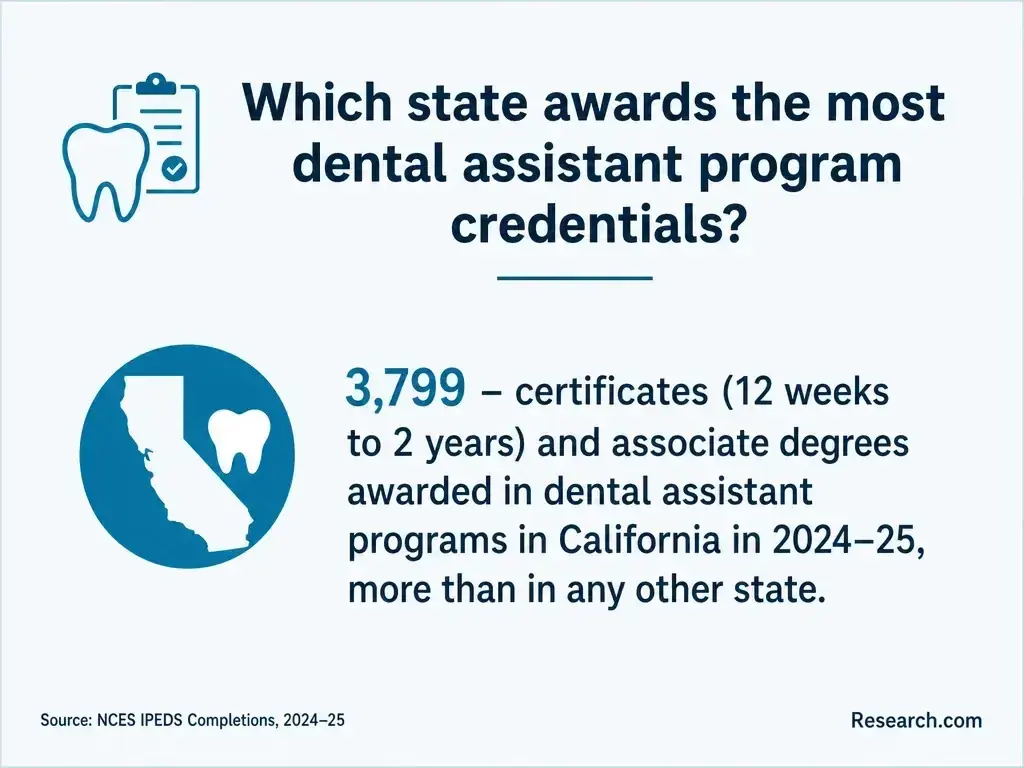
There is no defensible Pasadena-wide average to quote without a current, comparable set of published program budgets. Published tuition can also conceal meaningful differences in what a student must buy separately. Ask each provider for an itemized cost to become job-ready, not just a tuition figure.
The following categories belong in a like-for-like comparison. Separate unavoidable charges from costs that depend on your commute or circumstances.
Then subtract confirmed grants, scholarships, or employer support and compare the likely amount you would borrow. Federal aid depends on both student and program eligibility; do not assume every short course qualifies (Federal Student Aid). Broader lists of regionally accredited online colleges with no application fee do not reveal the mandatory clinical costs of dental-assisting training.
Depending on the provider and curriculum, a student may earn a school certificate or diploma. That award confirms completion of a particular training program. RDA is a California registration tied to the Dental Board of California's eligibility and examination rules; DANB certification is a separate professional credential with its own requirements (Dental Board of California; Dental Assisting National Board).
Institutional accreditation concerns the school, CODA accreditation concerns an eligible dental-assisting program, and state authorization concerns permission to operate; none should be confused with occupational registration. Before enrolling, ask the provider to name the exact credential awarded and show how its curriculum fits your intended California pathway. If you may later study elsewhere, ask whether another provider will accept the completed training - transfer or advanced standing is not automatic.
Requirements vary by provider. Confirm the stated education prerequisite, application deadlines, and any conditions for clinical participation, such as health documentation or background screening. Ask whether those requirements must be met before enrollment or only before a placement begins; a delayed placement can extend both the calendar and the cost of training.
Admission is a separate question from eligibility to perform particular dental procedures. Someone considering flexible enrollment - perhaps after reading about online open college enrollment - should still check the dental program's laboratory capacity, clinical arrangements, and California credential alignment. An easy application process does not remove practical-training requirements.
Dental assistant training typically combines dental anatomy and terminology with infection control, equipment preparation, chairside assistance, patient communication, and administrative tasks (U.S. Bureau of Labor Statistics). Practical instruction should show how students move safely between patients, handle instruments, and support a dentist during treatment - not just identify equipment on a screen.
Curricula differ in radiography and other procedures governed by California rules. Ask for the skills checklist and where each skill is practiced and assessed. Familiarity with digital records and imaging workflows is useful, but software instruction cannot substitute for authorized, supervised procedural training (Dental Board of California).
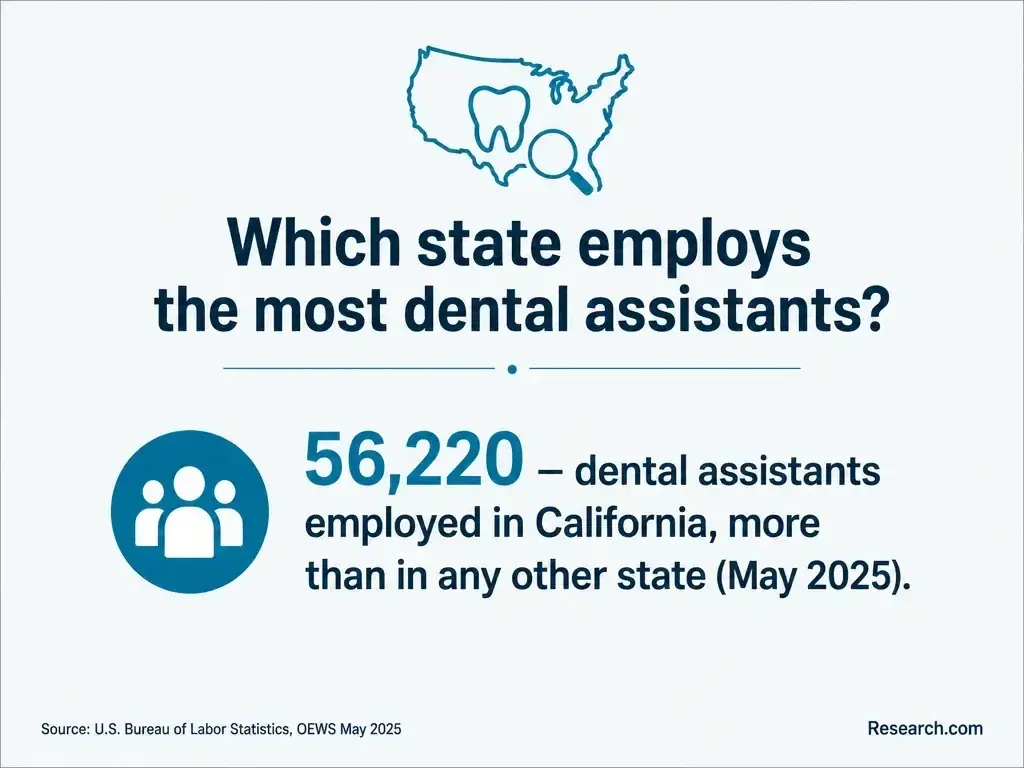
Not for every entry-level dental assisting role. California distinguishes unlicensed assistants' permitted duties from duties requiring additional authorization or RDA registration. RDA applicants must meet a qualifying pathway and the Dental Board of California's current examination and other requirements; completing an arbitrary certificate does not confer the registration. Rules for specific procedures, including radiography, must be checked separately (Dental Board of California).
Before paying a deposit, tell the program which duties you hope to perform and request its written explanation of the relevant California pathway. Verify that explanation with the Dental Board. DANB certification may be valuable to an employer, but it is not a substitute for state authorization to perform a regulated duty (Dental Assisting National Board; Dental Board of California).
Start with the job you want, then work backward to the required skills and California permissions. The least expensive listed program is not the best value if it omits practice you will have to obtain later. Likewise, a higher price needs a concrete benefit - not merely a faster advertised finish date.
Use these checks before committing or borrowing. Request documents rather than relying only on a sales conversation.
For return on investment, consider whether you are likely to finish, how long training keeps you from paid work, your current earnings, plausible post-training offers, debt payments, and the years over which the training may help you. Avoid treating a national median wage or a ranking position as a promised personal return.
An entry-level assistant can develop chairside and office experience, then pursue additional authorized duties or RDA registration if they meet California's requirements. Experience may also support a move into specialty-office coordination or team supervision. These are potential progressions, not automatic outcomes of a certificate (Dental Board of California; U.S. Bureau of Labor Statistics).
If your goal is to work in a dental office soon, compare structured training with an employer willing to teach entry-level duties and support later skill development. If your goal is a different occupation, even an accelerated master's program is not a substitute for the supervised dental skills and California permissions relevant to this one.
The U.S. Bureau of Labor Statistics projects 7.4% national growth in dental assistant employment from 2025 to 2035. That supports considering the occupation, but it is not a Pasadena hiring forecast or a guarantee of an opening when a student finishes.
Use the national projection alongside current local vacancies. Check whether nearby employers seek entry-level assistants, RDA registration, radiography qualifications, or prior specialty experience. That distinction can change which affordable training route is useful: demand for a credential you will not yet hold does little to improve the return on a short introductory course.
Investing in training is an important decision, especially when a low advertised price may omit fees or leave a student without the practical preparation they need. Research.com developed this ranking to help readers compare dental assistant programs against other local options using documented cost and debt measures, rather than promotional claims.
Only programs with completions reported to IPEDS are eligible for this ranking. The most affordable score uses tuition, cost of attendance, median student debt, and federal loan default rate; an entropy-based method gives more weight to measures that differ more across programs. Unlike a best-program ranking, it does not score accreditation, student support, earnings, or completion. An employer-trained route or another provider absent from IPEDS should not be assumed nonexistent or inferior.
The Research.com team used the following sources to assemble and check the ranking. Some provide context on credentials or recognition rather than a cost-score input; their inclusion does not mean every organization accredits dental assistant programs.
Readers can use the ranking to narrow a cost-conscious shortlist, then verify each program's current charges, hands-on training, and California credential eligibility directly. Research.com explains its broader approach on its methodology page.
# 1 position
# 2 position
It can be if the program teaches the skills you need, fits your schedule, and costs less than the benefit you reasonably expect from completing it. Compare its full price and clinical training with employer-sponsored entry routes before enrolling.
Some entry-level work is possible through employer training in California. The duties you may perform and any later RDA pathway are separate questions governed by Dental Board of California rules.
Theory may be available online, but chairside skills require in-person practice. Ask where supervised labs and clinical assessments take place and whether they support your intended California duties.
No. A school certificate records program completion; California RDA registration has separate eligibility and examination requirements (Dental Board of California).
Ask for its total itemized cost, exact credential, practical-training schedule, clinical-site location, and written explanation of how its training relates to your intended California credential.