# 1 position

Audited and Verified:
Our Editorial and Data Verification Process
Research.com uses government datasets, official education statistics and primary institutional information to support its career and degree guides. Our review process checks factual accuracy, occupational definitions, source dates and the requirements associated with the credentials discussed.
How This Article Was Fact-Checked
Our editorial team verifies salary estimates, employment projections, education requirements and program information against original data providers and official organizations. Salary figures are checked against the relevant occupational definitions and reporting periods. Information about licensure, accreditation and required in-person training is reviewed separately.
Fact-checked and verified on:

Co-Founder and Chief Data Scientist

Reviewed by Karolina Broda
Fact-Checker and Data Verification
Choosing dental assistant training in Puerto Rico means looking beyond a school's name: you need a program that teaches chairside skills and fits your budget and career goal. The U.S. Bureau of Labor Statistics projects 7.4% national employment growth for dental assistants from 2025 to 2035, but local pay and entry requirements need separate checking. This guide explains those trade-offs. It also accompanies the Best Dental Assistant Trade Schools in Puerto Rico for 2027 ranking, created by the Research.com team of data scientists to help students identify programs worth considering.
Dental assistant training prepares students to support a dentist during patient care, prepare instruments and treatment rooms, follow infection-control procedures, and handle records or scheduling. It is not training to practice dentistry independently. The U.S. Bureau of Labor Statistics describes both clinical and administrative duties; the exact tasks an assistant may perform depend on Puerto Rico's applicable rules and employer supervision.
These pathways differ most in who provides the hands-on instruction and what credential the learner receives. Ask each provider for its actual curriculum and clinical arrangements rather than assuming that similarly named programs are equivalent.
| Pathway | Typical credential or outcome | Best fit and principal trade-off |
| Career-school or college certificate or diploma | School-issued occupational credential | Fits students seeking structured labs and a defined schedule; compare cost, clinical access, and regulatory alignment. |
| Associate-level dental assisting program, if offered | Associate degree | Fits students who want a broader curriculum; extra time and expense do not necessarily expand permitted duties. |
| Employer-sponsored training | Workplace training; any school or certification credential must be confirmed separately | May reduce upfront cost and provide immediate practice, but instruction and access to duties depend on the employer and local rules. |
A registered apprenticeship should be treated as a distinct option only if a sponsor confirms that a relevant position is available: registration, paid work, related instruction, and its resulting credential are not implied by an ordinary dental-office job. The U.S. Department of Labor's Apprenticeship.gov distinguishes registered apprenticeships from other workplace training.
Dental offices are the clearest employment target. Depending on hiring needs and the duties a worker is qualified to perform, training can also be relevant to specialty practices, group practices, or clinics. The U.S. Bureau of Labor Statistics identifies dentists' offices as the principal U.S. employer of dental assistants; a student should still check actual vacancies near home rather than assume the national workplace mix describes every Puerto Rico municipality.
Location changes the value of a program's clinical placement. If a school is far from where you plan to work, ask whether it can arrange supervised experience near your intended job market and whether travel to both classes and the practice site is realistic.
The U.S. median annual wage for dental assistants was $48,070 in May 2025, according to the U.S. Bureau of Labor Statistics. It describes employed workers nationally, across experience levels - not new graduates or Puerto Rico pay. Do not use it as your expected first offer.
For a local budget, consult the latest Puerto Rico dental assistant figures in the Bureau of Labor Statistics' Occupational Employment and Wage Statistics and compare actual postings by municipality, schedule, and duties. A comparison with majors that make a lot of money cannot answer whether this particular training investment will pay off: estimate your likely local wages against the program's full cost and any earnings you would give up while studying.
There is no single completion time that applies to every Puerto Rico dental assistant program. A certificate or diploma may take less time than an associate-level program, while part-time study or a delayed clinical placement can extend either route. Request the school's published calendar, required clock or contact hours, lab hours, and any separately scheduled supervised practice; do not infer hours from the credential name.
Accelerated options can reduce time away from work, but only if they still provide enough in-person practice for the duties you hope to perform. When comparing 6 month online courses that pay well, check whether a dental assistant offering actually includes local labs or clinical training. A short online completion date alone does not establish job readiness.
Online coursework can suit dental terminology, records, and other classroom subjects. Instrument handling, chairside positioning, infection-control technique, and any supervised patient-care tasks require a suitable in-person setting. A hybrid program can therefore reduce classroom travel without eliminating trips to a lab or dental practice.
Ask for the location, schedule, and availability of every required practical session before enrolling - especially if you live far from the campus. Older career changers exploring best online college courses for seniors should apply the same test: remote convenience is useful, but it does not replace the clinical practice needed for this occupation. Neither an online label nor institutional accreditation by itself establishes eligibility for a particular certification, duty, or local authorization.
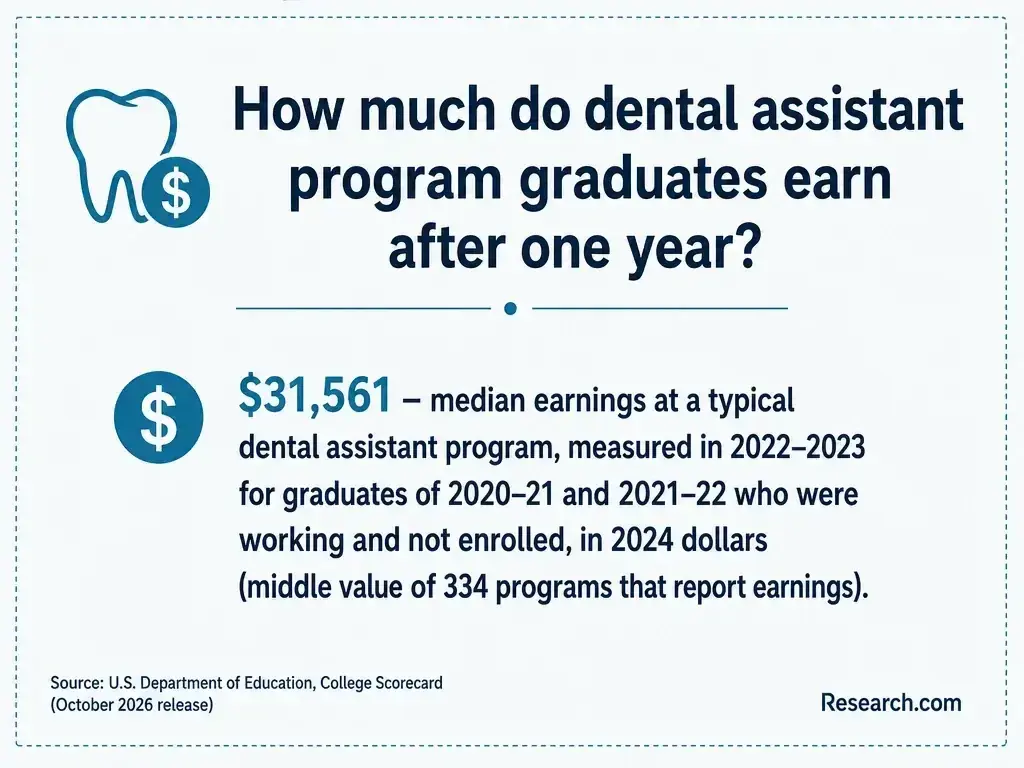
A defensible Puerto Rico-wide average for all dental assistant training routes is not available here: college datasets do not capture every career school or employer-sponsored option, and an institution-wide attendance cost is not necessarily the price of its dental assistant program. Get an itemized, current quote from each provider instead of relying on a single advertised tuition figure.
The following comparison shows costs that can change the price of becoming job-ready. Confirm which are included, which are optional, and which would be due even if you do not complete the program.
| Cost category | What to check |
| Instruction and school charges | Program tuition, mandatory fees, supplies, textbooks, and required software. |
| Clinical preparation | Uniforms, protective equipment, immunization or health documentation if required, and travel to practice sites. |
| Career entry | Applicable examination, certification, or regulatory application charges; confirm which actually apply to your goal. |
| Time and financing | Lost work hours, borrowing costs, grants, and whether employer training is paid. |
Federal aid depends on the student's and program's eligibility, not simply on a school's willingness to discuss FAFSA (Federal Student Aid, U.S. Department of Education). If you are comparing inexpensive online universities that accept fafsa, verify aid for the specific dental assistant program and include its in-person costs. Compare net cost after confirmed aid, not the advertised price alone.
That depends on the offering: a school may award a certificate, diploma, or, for an associate-level program, an associate degree. An employer may provide training without awarding an academic credential. Ask to see the exact credential name on the completion document and whether the program prepares students for a named examination.
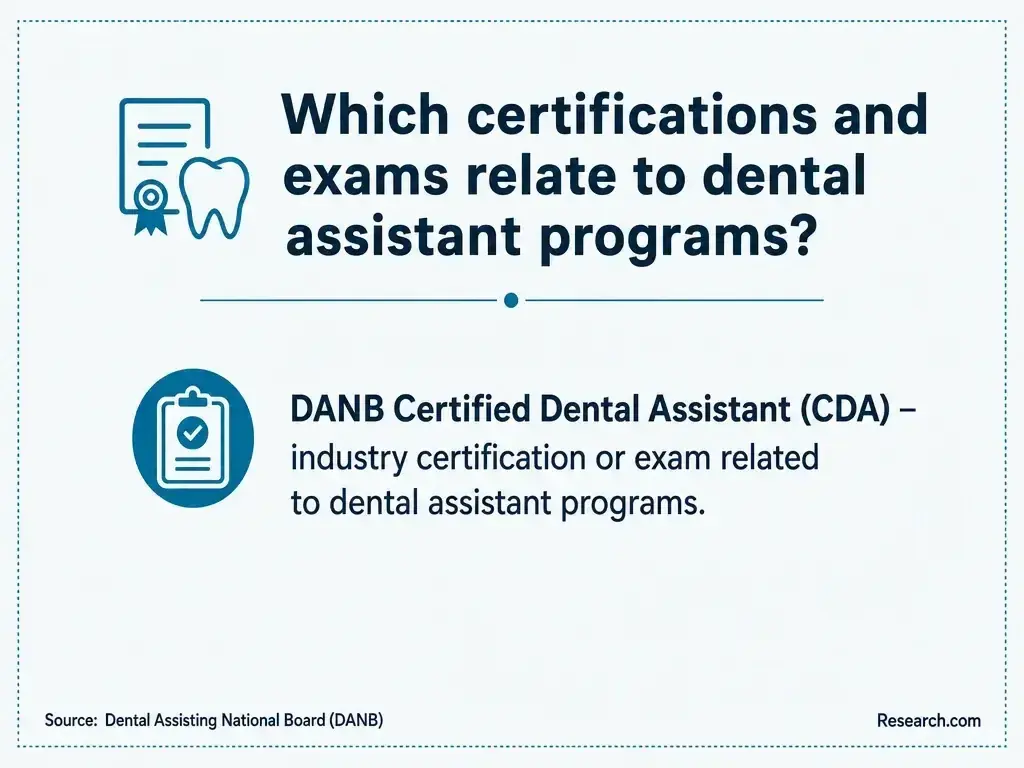
Keep four checks separate. Institutional accreditation concerns the school; programmatic accreditation, such as Commission on Dental Accreditation recognition where applicable, concerns a specific program; professional certification is awarded by a certifying body under its rules; and permission to perform regulated duties depends on Puerto Rico's requirements. One does not automatically confer the others (Commission on Dental Accreditation; Dental Assisting National Board; Puerto Rico Department of Health).
Schools set their own admissions criteria, so request the current catalog rather than assuming every provider has the same entry standard. Confirm the required prior schooling, application materials, language of instruction, start dates, and whether clinical sites impose additional health or documentation conditions. Ask about transfer or prior-learning credit only if the provider offers it, and get any reduction in required courses or fees in writing.
Entry to a program is not the same as eligibility to perform every dental-office task afterward. Before committing, ask both the school and the appropriate Puerto Rico Department of Health licensing or regulatory office what applies to your intended duties, including radiography if relevant.
A useful curriculum connects dental anatomy and terminology to chairside assistance, instrument identification, sterilization and infection prevention, patient communication, and office records. Programs may also teach radiography concepts or specialty-office procedures; confirm where students practice them and which activities local rules permit. The U.S. Bureau of Labor Statistics describes infection control, patient preparation, and assistance during treatment as core occupational work.
Ask who supervises labs, how skills are assessed, and whether students receive documented practice with equipment used in dental offices. A syllabus that names procedures without explaining supervised practice is weaker evidence of readiness than a clear lab and clinical plan.
Verify the current Puerto Rico rules for the exact duties you intend to perform before choosing a program. Requirements for chairside assistance, radiography, and other expanded tasks should not be assumed to be identical. Ask the Puerto Rico Department of Health's health-professions regulatory office which authorization, training, supervised experience, or examination applies to your intended role, and request the governing requirements in writing.
Dental Assisting National Board certification has its own eligibility and examination rules; it should not be confused with Puerto Rico occupational authorization (Dental Assisting National Board; Puerto Rico Department of Health). Likewise, graduating from an accredited institution does not automatically permit every clinical duty. If a school promises licensure or unrestricted practice upon graduation, ask it to identify the applicable rule and each remaining step.
The best option is the one that provides the credential, practical preparation, and regulatory pathway your target job requires at a cost you can reasonably recover - not necessarily the fastest or highest-ranked one. Use the ranking to shortlist programs, then put these questions to each admissions office:
Check answers against the school catalog, the named accreditor, and the relevant Puerto Rico regulator. Treat vague clinical-placement promises or a tuition quote that omits mandatory costs as reasons to pause. An employer-training route may make more sense if it offers suitable supervised practice and lower cost; a structured school program may be preferable if you need documented instruction or broader preparation. Compare other trade school careers only if their training demands and local job prospects better fit your goal.
The direct path is an entry-level dental-office support role. With experience and training appropriate to the duties, an assistant may pursue greater responsibility in a specialty practice, patient coordination, or office operations. These are possible directions, not promotions a certificate guarantees; employers may require additional experience or a distinct credential (U.S. Bureau of Labor Statistics).
If your goal is a particular clinical function, work backward from that role's Puerto Rico requirements before paying for extra coursework. If your goal is primarily office administration, compare the program's clinical cost and time with what an employer is willing to teach on the job.
The U.S. Bureau of Labor Statistics projects 7.4% growth nationally from 2025 to 2035 for dental assistants. That signals an expanding national occupation, but it is not a Puerto Rico-specific forecast or a promise of an opening near your home.
For a local decision, check current Puerto Rico labor-market projections and dental-office postings in the municipalities where you could work. Note whether openings ask for experience, radiography-related qualifications, particular schedules, or bilingual communication. That evidence is more useful for choosing a clinical placement and estimating a job search than applying the national growth rate directly to the island.
Education is a consequential investment, so Research.com compares dental assistant programs with other programs serving the same occupation and location, rather than with unrelated schools. The team checks outcomes, costs, recognition, and student support to help readers build a shortlist. Only programs with completions reported to IPEDS are eligible for this ranking; absence from the ranking does not establish that another training option is unavailable or unapproved.
The best-programs ranking considers completion and full-time and part-time retention; median earnings one year after completion and earnings relative to annual attendance cost; tuition, attendance cost, median debt including that of students who withdrew, and federal loan default rates; plus accreditation, relevant recognition, and support services. Programmatic accreditation or occupation-relevant industry recognition accounts for 20% of the score, institutional accreditation for 10%, and student support for 10%. An entropy-based method distributes the remaining 60% across outcomes, earnings, and costs, giving more weight to indicators that vary more among programs. The separate most-affordable-programs ranking scores only tuition, attendance cost, debt, and default rates using entropy-based weights; accreditation and other quality measures are not part of that score.
The team used the following sources to assemble and check the ranking. Some cover the wider trade-school landscape rather than dental assisting specifically, so a listing in one source should not be mistaken for Puerto Rico approval or eligibility to perform a dental procedure.
Readers can use the ranking to compare measured options, then confirm current program details and regulatory eligibility directly before enrolling. Research.com explains its broader approach on its methodology page.
# 1 position
# 2 position
# 3 position
# 4 position

# 5 position
# 6 position
Dental Assisting/Assistant
Delivery mode: On Campus (May Include Online Courses)
14.37
/ 100
Final score
Accreditation
Institutional accreditation from Middle States Commission on Higher Education.
Universidad Ana G. Mendez-Gurabo Campus received a Research.com Trade Program Score of 14.37/100.
# 7 position
# 8 position
It can be if it supplies supervised skills your target employers value at a manageable net cost. Compare it with available employer training, accounting for aid, lost earnings, completion likelihood, and realistic local pay.
Online classes can cover some theory, but chairside and infection-control skills need in-person practice. Check the provider's lab and clinical requirements and Puerto Rico's rules for your intended duties.
Do not assume one credential fits every role. Ask prospective employers what they require and confirm any regulated-duty requirements with the Puerto Rico Department of Health before enrolling.
Not automatically. A school certificate records program completion; professional certification has separate eligibility and examination requirements set by its certifying body, such as the Dental Assisting National Board.
Start with the clinical-training arrangement, the exact credential, and alignment with your intended duties. Then compare itemized net costs, travel, schedule, and documented outcomes.