# 1 position
Lindsey Hopkins Technical College - Dental Assisting/Assistant.
certificate or diploma

Audited and Verified:
Our Editorial and Data Verification Process
Research.com uses government datasets, official education statistics and primary institutional information to support its career and degree guides. Our review process checks factual accuracy, occupational definitions, source dates and the requirements associated with the credentials discussed.
How This Article Was Fact-Checked
Our editorial team verifies salary estimates, employment projections, education requirements and program information against original data providers and official organizations. Salary figures are checked against the relevant occupational definitions and reporting periods. Information about licensure, accreditation and required in-person training is reviewed separately.
Fact-checked and verified on:

Co-Founder and Chief Data Scientist

Reviewed by Karolina Broda
Fact-Checker and Data Verification
Choosing dental assistant training in Miami means looking beyond a school's name: the credential, clinical practice, total cost, and Florida's rules for expanded duties all affect your next step. The U.S. Bureau of Labor Statistics projects 7.4% national employment growth for dental assistants from 2025 to 2035, making program quality worth examining. This guide accompanies the Best Dental Assistant Trade Schools in Miami for 2027 ranking, created by the Research.com team of data scientists to help students identify programs worth considering and choose a practical route into the field.
Expect a mix of classroom instruction, simulated practice, and supervised patient-care experience. Dental assistants prepare treatment areas, support dentists during procedures, handle instruments, follow infection-control procedures, and may manage records or scheduling. What you can do independently or under supervision depends on the duty and Florida rules, not simply the title printed on a certificate (U.S. Bureau of Labor Statistics; Florida Board of Dentistry).
The main choice is between a structured certificate or diploma program and employer-led training. A structured program suits someone who wants guided lab practice and a documented route toward permitted expanded duties. Direct entry into a dental office may reduce upfront school costs and provide paid experience, but you must establish which tasks the employer will teach and whether that training meets any separate Florida requirements. A college associate-degree option, where available, takes a broader course load; compare its added time and cost against the specific duties and jobs you want.
Prioritize evidence over labels. Ask how many hours are spent in skills labs and supervised clinical settings, who arranges placements, and whether students practice with current dental imaging and sterilization equipment. A search for a master's program online 1 year addresses a different goal; dental assisting decisions turn on clinical competencies and work eligibility.
Dental offices are the primary workplace for dental assistants nationally, with additional roles in specialty practices such as orthodontics and oral surgery (U.S. Bureau of Labor Statistics). In Miami, a placement that exposes you to the type of practice you hope to join can be more valuable than a generic promise of "clinical experience." Ask whether the school arranges placements across Miami-Dade County and how travel time affects your schedule.
Front-desk work and chairside assisting require different preparation. If you want patient-facing clinical work, verify that the program includes supervised chairside practice rather than primarily administrative coursework. If you are considering an employer-training route, ask which procedures you may observe, practice, and eventually perform under Florida rules.
The U.S. Bureau of Labor Statistics reports a $48,070 national median annual wage for dental assistants in May 2025. This is a midpoint for employed workers across experience levels - not a Miami starting-pay offer. Before using wages to justify tuition, compare current Miami-area openings for the duties you would qualify to perform, and note whether advertised pay depends on radiography credentials, expanded-functions training, specialty experience, or bilingual patient communication.
For a more relevant benchmark, check the latest available Miami metropolitan-area dental assistant estimates in the BLS Occupational Employment and Wage Statistics series. Keep its reference period separate from current job postings: neither an occupational median nor an advertised range establishes what one graduate will earn.
Certificate and diploma timelines vary because programs differ in scheduled hours, attendance intensity, clinical placements, and whether radiography or expanded-functions training is included. A short course may get you into an office sooner, but it is not equivalent to a longer program if it omits the practical instruction or documentation needed for your intended duties. Request the current catalog's total clock hours, weekly schedule, lab hours, clinical hours, and expected completion date before comparing programs.
Part-time attendance can preserve income while extending the time before you qualify for the jobs you want. Employer-led training may allow you to earn while learning, although access to specific duties still depends on training and supervision. Readers comparing accelerated online master's degree programs should not apply "fastest completion" as the deciding measure here: hands-on dental skills cannot be evaluated by online course speed.
Online study can cover terminology, anatomy, scheduling, and some infection-control concepts. It cannot replace supervised chairside assisting, instrument handling, or practical imaging instruction. A hybrid program may be convenient if it clearly schedules those components in person; an entirely online certificate should not be assumed to meet Florida requirements for expanded duties or radiography (Florida Board of Dentistry; Florida Department of Health).
Before enrolling, get the physical training location and clinical placement terms in writing. A directory of leading online colleges may help you explore remote coursework, but it does not verify that a dental assisting program provides the required in-person practice. If travel across Miami-Dade County is difficult, compare the full commute to labs and placements - not just trips to the main campus.
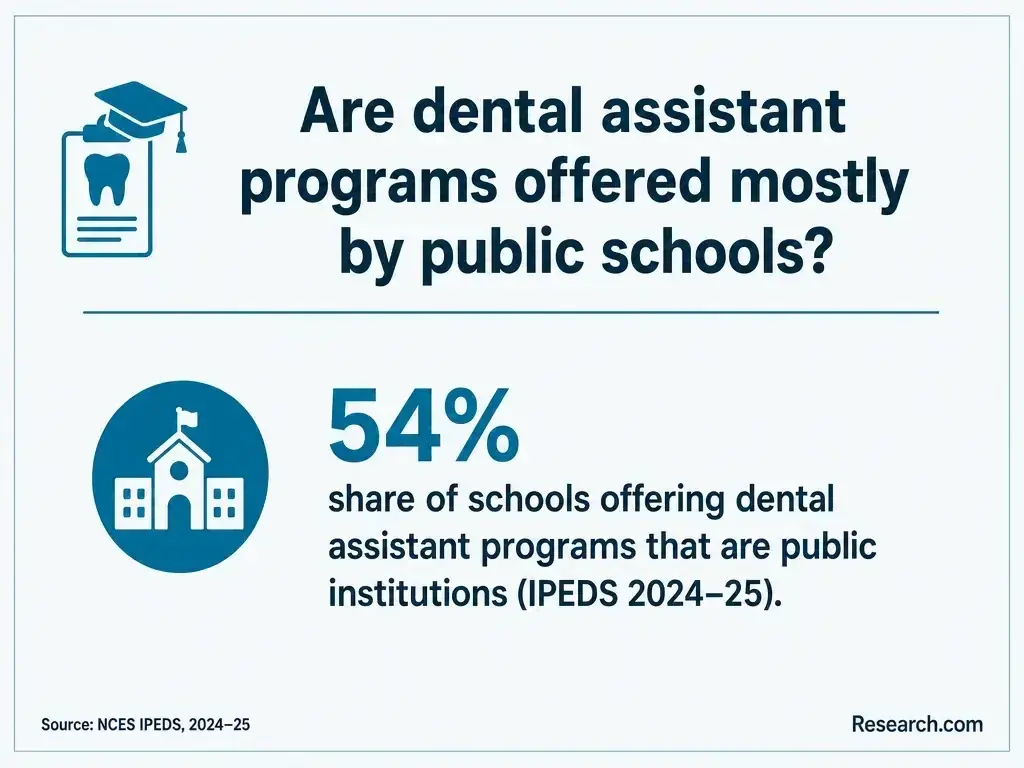
There is no single reliable Miami price that applies to every dental assistant training route: public-program charges, private-school packages, and paid employer training use different cost structures. Request an itemized, current cost sheet from each provider rather than treating a tuition quote as the cost of becoming job-ready.
The following cost categories make unlike programs easier to compare. A lower upfront price may be less attractive if it excludes training or travel you will need to pay for separately.
| Cost category | What to confirm |
| School charges | Tuition, mandatory fees, textbooks, supplies, and any additional clinical-placement charge. |
| Clinical readiness | Uniforms, protective equipment, required health documentation, and screening, if applicable. |
| Career-entry costs | Any separately charged radiography training, certification examination, or application fee relevant to your goal. |
| Time and travel | Transportation to labs and placements, childcare needs, and earnings forgone while attending. |
Ask the aid office which grants, scholarships, workforce funds, or federal aid apply to the specific program; institutional eligibility does not mean every course qualifies (Federal Student Aid). Paid office training can offset lost earnings, but compare the skills and eligibility it provides before choosing it solely on price.
The award may be a certificate, diploma, or, for a qualifying college pathway, an associate degree. An employer-training route may provide documented work experience without a school credential. Ask for the exact credential name and whether the program is accredited by the Commission on Dental Accreditation (CODA), separately from any institutional accreditation or state school authorization. These are different forms of recognition; none alone grants permission to perform every dental assisting duty (CODA; Florida Board of Dentistry).
National certification from the Dental Assisting National Board (DANB) is also distinct from a school award and from Florida's requirements for particular functions. Verify the certification eligibility route directly with DANB before assuming a program prepares you to apply. A question such as what is the easiest phd to get points to an unrelated credential decision; here, the useful question is what your training documents and permits you to do.
Admissions requirements vary by provider. Ask whether the program requires a high school diploma or equivalent, an application or placement assessment, and health or background documentation before clinical participation. Check those requirements early: being admitted to classes does not necessarily mean you can start a placement on your preferred date.
For employer-led entry, ask whether the practice hires and trains beginners, what supervision it provides, and who pays for any additional instruction. If you already have related coursework or dental-office experience, request a written prior-learning or transfer-credit evaluation; do not assume it waives required practical training or Florida-specific eligibility checks.
Core training typically covers dental terminology and anatomy, chairside procedures, instrument preparation, infection prevention, patient records, and communication. Programs may also teach dental materials, imaging, and specialty-office workflows (U.S. Bureau of Labor Statistics). The important distinction is between learning about a procedure and performing it competently under supervision.
Request a skills checklist and ask which competencies are assessed in a lab versus with patients. Because offices increasingly rely on digital records and imaging workflows, practice with the equipment and software used in clinical settings is worth checking - but equipment exposure does not replace any Florida training or certification requirement for radiography.
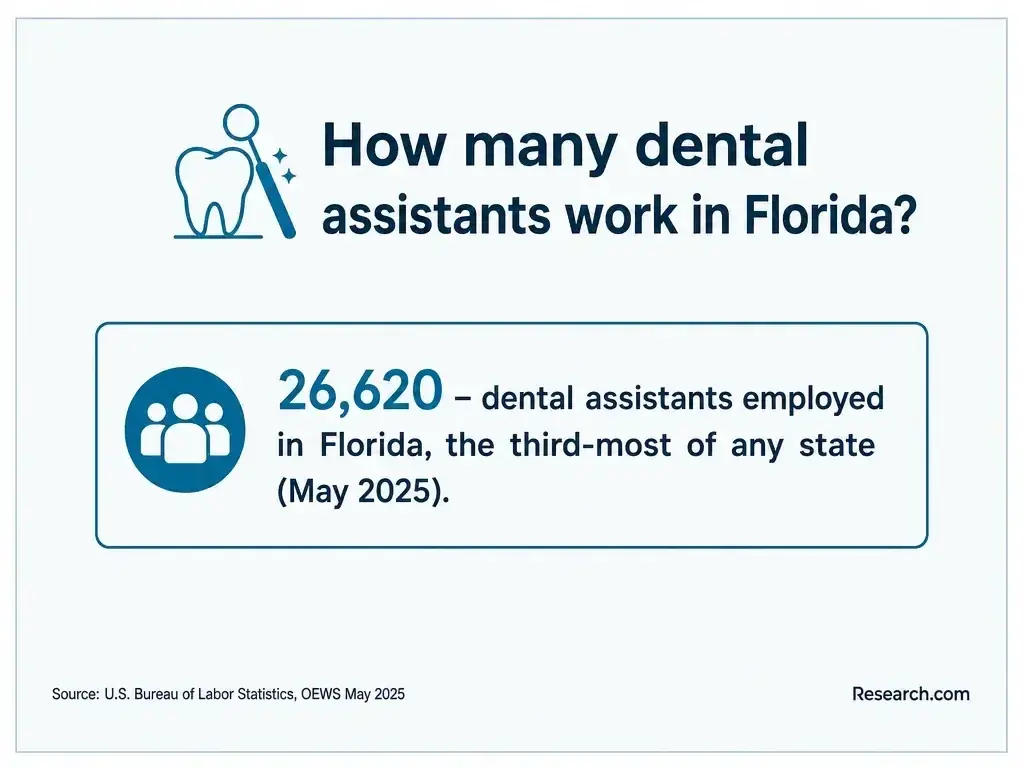
Florida does not generally license dental assistants. That does not mean every assistant may perform every task. Florida has separate rules for expanded duties and dental radiography, including applicable training, supervision, or certification conditions. Review the duties attached to jobs you want and confirm the current requirements with the Florida Board of Dentistry and Florida Department of Health before enrolling (Florida Board of Dentistry; Florida Department of Health).
DANB's national credentials are professional certifications, not Florida occupational licenses. CODA program accreditation, institutional accreditation, Florida school authorization, a course completion certificate, and permission to perform a regulated duty answer different questions. Ask the provider to identify the specific Florida rule or approval its training is intended to satisfy - and what additional step, if any, remains after graduation.
Start with the duties you want to perform, then compare programs against that goal. The ranking can help identify options, but a good personal choice depends on practical training, schedule, eligibility, and what you must spend or give up to finish.
Use these questions when speaking with each provider; request written answers where possible.
A red flag is an assurance that "accredited" or "online" automatically means ready for every dental-office task. Also avoid treating an occupational median wage as your likely first offer. For a return-on-investment comparison, weigh completion probability, aid and debt, earnings you would otherwise receive, possible post-training pay, and the time needed to recover your costs - not institution type or tuition alone.
Training can lead to entry-level chairside work, with later opportunities in specialty practices, patient coordination, or office administration as experience and employer needs allow. Additional training or certification may expand the duties for which you qualify; it should not be confused with a guaranteed promotion. Explore trade school jobs if you are still comparing occupational paths, but judge dental assisting programs by the specific office role you want.
If your long-term goal is primarily administrative, compare the clinical hours and expense of a dental assisting program with the possibility of direct office entry. If you want chairside work and broader permitted functions, a program with substantial supervised practice may be the better fit.
The U.S. Bureau of Labor Statistics projects 7.4% growth in dental assistant employment nationally from 2025 to 2035. That signals opportunities across the occupation, not a forecast of Miami vacancies or a promise of placement. For a local decision, compare recent Miami-Dade job postings by required duties and credentials, then ask programs which employers host clinical students and how they document placement outcomes.
Pay attention to the match between training and openings. If roles of interest call for imaging or expanded-functions preparation, a quick entry-level course that omits those elements may leave you needing additional training even in a growing labor market.
Education is a significant investment, so the Research.com team designed this ranking to compare dental assistant programs with other programs in the same occupation and location. The team reviewed outcomes, costs, recognition, and student support to make the comparison useful and credible. Only programs with completions reported to the Integrated Postsecondary Education Data System (IPEDS) are eligible; an unlisted employer-training route or other provider should not be assumed to be low quality.
Best-program scores consider completion and full- and part-time retention; earnings one year after completion and earnings relative to annual attendance cost; tuition, attendance cost, debt - including debt held by students who withdrew - and federal loan default rates; and relevant recognition and support. Programmatic accreditation or occupation-relevant industry recognition receives 20% of the score, institutional accreditation 10%, and student support 10%. The remaining 60% covers outcomes, earnings, and costs, with weights distributed through an entropy-based method that gives more weight to indicators that vary more across programs. Most-affordable rankings instead score only tuition, attendance cost, debt, and default rates, using entropy-based weights; accreditation and other quality measures do not enter that score.
The team used the following sources to develop and check the rankings. Some provide dental-assisting-specific evidence; others supply broader institutional, occupational, or pathway context and should not be mistaken for dental assisting accreditors.
Use the ranking to narrow your shortlist, then confirm each program's current schedule, written total cost, hands-on training, and Florida-specific eligibility directly with the provider. More detail on the scoring approach appears in Research.com's methodology.
# 1 position
# 2 position
Dental Assisting/Assistant
Delivery mode: On Campus (May Include Online Courses)
30.82
/ 100
Final score
Accreditation
Industry recognition: DANB-accepted for NELDA certification. Institutional accreditation from Southern Association of Colleges and Schools Commission on Colleges.
Miami Dade College received a Research.com Trade Program Score of 30.82/100. The program is DANB-accepted for NELDA certification.
# 3 position
Yes. Some dental offices train beginners on the job. Confirm what supervision and instruction they provide, because Florida's rules for particular expanded duties and dental radiography still apply (Florida Board of Dentistry; Florida Department of Health).
Do not assume so. Chairside skills require in-person practice, and online coursework alone should not be treated as proof of eligibility for Florida-regulated functions. Ask where practical training occurs and which requirements it addresses.
No general Florida dental assistant license applies, and DANB certification is distinct from Florida's rules for specific duties. Check the duties in the job description and the relevant state requirements (Florida Board of Dentistry; DANB).
Choose based on the work you want to do. Compare verified clinical hours, covered skills, Florida eligibility, total cost, and the time before you can seek your target job - not duration by itself.
No. Ranking eligibility requires program completions reported to IPEDS. Employer-led training and other routes may not appear, so compare them separately if they fit your goals.