# 1 position
Hillsborough Community College - Dental Assisting/Assistant.
certificate or diploma

Audited and Verified:
Our Editorial and Data Verification Process
Research.com uses government datasets, official education statistics and primary institutional information to support its career and degree guides. Our review process checks factual accuracy, occupational definitions, source dates and the requirements associated with the credentials discussed.
How This Article Was Fact-Checked
Our editorial team verifies salary estimates, employment projections, education requirements and program information against original data providers and official organizations. Salary figures are checked against the relevant occupational definitions and reporting periods. Information about licensure, accreditation and required in-person training is reviewed separately.
Fact-checked and verified on:

Co-Founder and Chief Data Scientist

Reviewed by Karolina Broda
Fact-Checker and Data Verification
Choosing dental assistant training in Tampa means comparing more than tuition: a short program may get you into a practice sooner, but it must teach the hands-on skills your intended duties require. The U.S. Bureau of Labor Statistics projects 7.4% national employment growth for dental assistants from 2025 to 2035. For prospective students and career changers, this guide explains Florida's rules, training routes, costs, and career prospects. It also accompanies the Best Dental Assistant Trade Schools in Tampa for 2027 ranking, created by the Research.com team of data scientists to help students make informed choices about programs worth considering.
Expect instruction in chairside assistance, infection control, instrument handling, patient communication, and dental-office workflows, followed by supervised practice. A useful program shows where students perform procedures on equipment or in a clinical setting - not merely where they watch demonstrations. The U.S. Bureau of Labor Statistics describes clinical and administrative tasks as part of dental assistants' work.
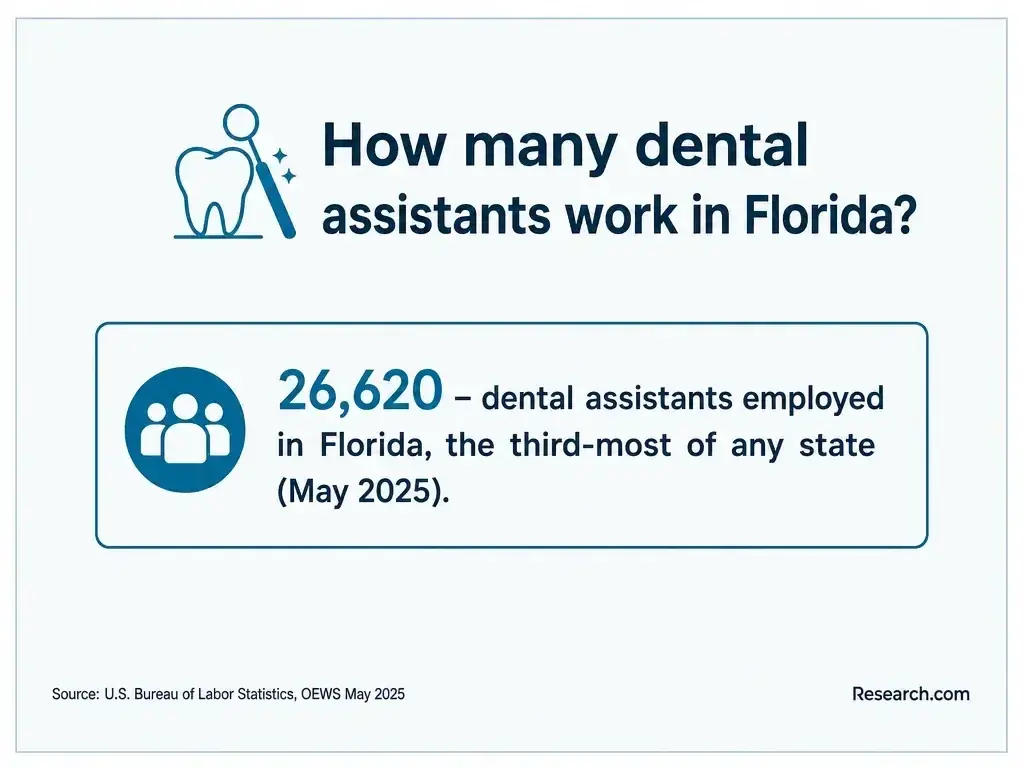
Tampa-area options may include a public technical or community-college program, a private career-school program, and training provided by a dental practice. Hillsborough Community College, Erwin Technical College, and Concorde Career Institute-Tampa are examples to investigate; confirm their current dental-assisting offerings directly rather than assuming each awards the same credential or teaches the same Florida-approved functions. Practice-based training may suit someone who can secure a supportive employer, but ask who supervises instruction and how any required expanded-function or radiography training will be completed.
Dental assistants chiefly work in dental offices, including general and specialty practices, according to the U.S. Bureau of Labor Statistics. In the Tampa area, the practical choice is between settings whose duties and schedules match your training: a general practice may offer broad chairside experience, while a specialty practice may require additional familiarity with its procedures. Ask prospective employers which duties new assistants perform and which require further Florida-compliant training.
Patient-facing chairside work is a poor fit if you want minimal daily interaction. If that is your priority, compare other jobs best for introverts before paying for a clinical program; even dental-office administrative roles involve communication.
A verified, current Tampa-specific median is needed to quote a local wage reliably. As a benchmark - not a local offer or a new graduate's likely pay - the U.S. Bureau of Labor Statistics reports a $48,070 national median annual wage for dental assistants in May 2025. The median covers workers with different experience levels, duties, and employers. When evaluating Tampa programs, compare actual local job postings by required functions, hours, and benefits; then ask schools for documented graduate outcomes rather than treating the national figure as a return-on-investment promise.
Duration depends on the credential, weekly schedule, and clinical component. A focused certificate or diploma can be a quicker route into chairside work than an associate-degree program, while employer training may let someone begin paid work before completing every additional duty-specific course. There is no single Tampa-wide number of required program hours for entry-level dental assisting; ask each provider for its current clock hours, lab hours, clinical placement requirements, and projected finish date. Florida's rules for particular functions must be checked separately with the Florida Board of Dentistry.
If speed is your priority, compare an accelerated certificate with a quickest associate's degree online carefully: a shorter calendar is useful only if the dental program still provides the supervised practical training and Florida-relevant preparation you need.
Online study can cover terminology, recordkeeping, and some theory. It cannot replace supervised practice with instruments, infection-control procedures, patients, or dental imaging equipment. A hybrid program can work when it specifies where those in-person requirements happen and who arranges them. An entirely online course should not be presumed to satisfy Florida's expanded-function or radiography requirements; confirm the particular course and intended duties with the Florida Board of Dentistry.
The comparison below separates scheduling convenience from the clinical access needed to become job-ready.
| Format | Main advantage | Point to verify |
| On campus | Scheduled access to labs and instructors | Clinical placement and required travel |
| Hybrid | Remote theory with some in-person sessions | Frequency, location, and supervision of practical work |
| Online-only coursework | Flexible academic study | Whether separate approved, in-person training is still needed |
Searching for what's the easiest online degree to get answers a different question. For dental assisting, the decisive issue is whether you can complete and document the practical preparation for your intended job.
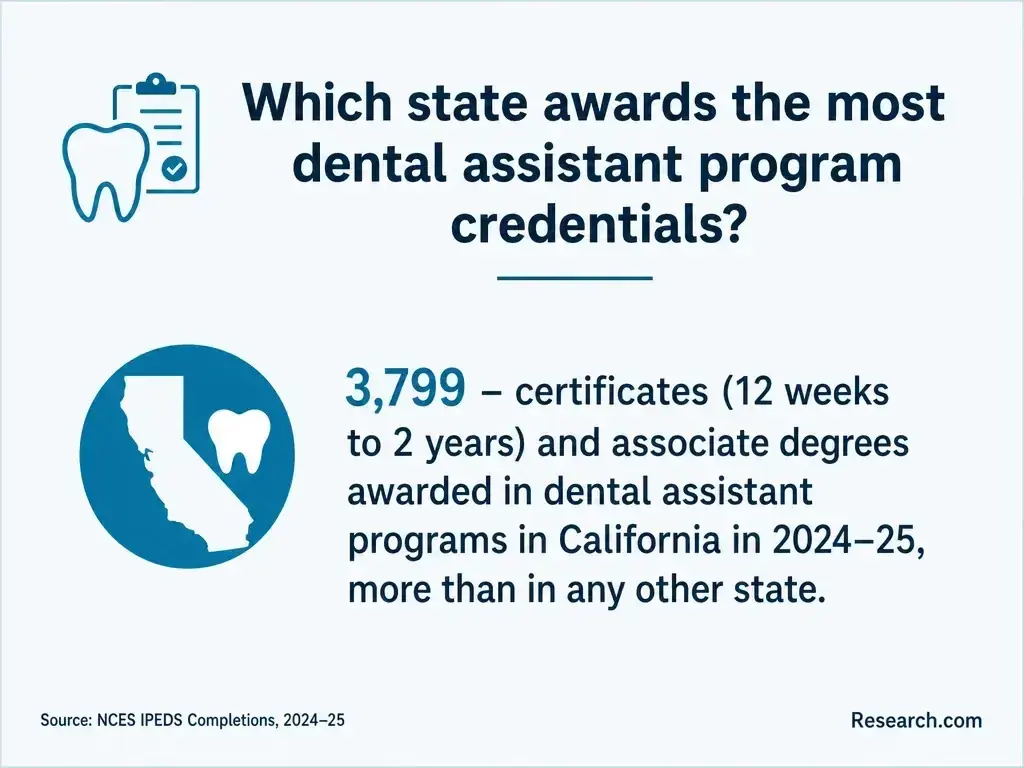
No defensible Tampa-wide average applies to every certificate, diploma, associate-degree program, and employer-training arrangement. Published tuition also may not equal the cost of becoming job-ready. Request an itemized, current estimate from each provider that includes mandatory fees, books, uniforms and protective equipment, supplies, any required health screening or background check, examination or course fees, and travel to labs or clinical sites. Add earnings you may forgo while attending, then subtract aid or wages you can reasonably expect.
For a meaningful comparison, use the same time horizon for each route and account for completion probability, borrowing costs, and your earnings before and after training. Ask the school whether its specific program qualifies for federal aid; eligibility is not automatic. The U.S. Department of Education's Federal Student Aid program advises students to check school and program eligibility. A lower-priced route can be poor value if it leaves you paying separately for essential clinical training.
Depending on the provider, completion may lead to a certificate, diploma, or associate degree. Those are educational credentials, not interchangeable proof of permission to perform every dental-assisting task. A practice-based route may instead document employer training and separate duty-specific coursework. Ask for the exact credential name and a written list of the functions, supervised experiences, and certification preparation included.
Keep the distinctions clear: institutional accreditation concerns the school; CODA programmatic accreditation concerns an eligible dental program; Florida rules govern particular duties; and DANB awards voluntary professional certifications under its own eligibility and examination rules. One status does not automatically confer another. Sources: Commission on Dental Accreditation, Dental Assisting National Board, and Florida Board of Dentistry.
Requirements vary by provider and clinical site. Ask whether admission requires a secondary-school credential, placement assessment, immunization or health documentation, background screening, or proof of eligibility to participate at a clinical site. Confirm deadlines and whether a placement is guaranteed or must be found independently. A school's admission offer is not the same as clearance for clinical participation or eligibility for a particular Florida-approved function.
If you already work in a dental office, ask whether documented prior training can reduce coursework or whether required Florida instruction must still be completed through an accepted route. Get any advanced-standing decision in writing before budgeting on a shorter schedule.
Core instruction generally combines dental anatomy and terminology with chairside workflow, instrument transfer, infection prevention, patient preparation, records, and communication. Programs may also teach dental materials and imaging, but the presence of a topic in a syllabus does not establish authority to perform the associated task in Florida. The U.S. Bureau of Labor Statistics identifies clinical support, sterilization, records, and scheduling among dental assistants' duties.
Look closely at the skills checkoffs: how often will you practice with equipment, receive feedback, and work under supervision? For a prospective Tampa commuter, a clinical assignment's location and hours can matter as much as the classroom schedule. Request the lab and clinical-hour breakdown rather than relying on a credential title.
Florida does not issue one general occupational license for dental assistants. That does not mean every duty is open to an untrained assistant. Florida Board of Dentistry rules address training and supervision for expanded duties, and dental radiography has its own certification requirements. Verify the current rules for the specific tasks in the job you want, then ask whether the program supplies the required instruction and documentation. Source: Florida Board of Dentistry.
DANB certification is a separate professional credential, not a blanket substitute for Florida requirements. CODA accreditation may matter to a particular certification pathway, but accreditation alone does not authorize a graduate to perform an expanded function. Before enrolling, ask the provider to identify the precise Florida rule or certification route its coursework is designed to meet. Sources: Dental Assisting National Board, Commission on Dental Accreditation, and Florida Board of Dentistry.
Start with the duties you want to perform, then compare programs on the evidence that gets you there. A ranking is a useful shortlist, not a substitute for checking the current program. Use these questions with admissions and program staff, and request written answers where costs or eligibility are concerned:
A common mistake is buying the fastest or least expensive option before checking clinical access and task-specific eligibility. Another is assuming that a broad earnings figure applies immediately after graduation. If your real goal is to compare four year degrees that pay well, use a different education and earnings comparison; for dental assisting, judge the investment against the time, cost, and duties of the dental job you intend to enter.
A common progression is from supervised, entry-level chairside work to a role with a wider set of documented duties, then toward specialty-practice experience, patient coordination, or office supervision. Advancement depends on employer needs, demonstrated skill, and any additional training applicable to the tasks - not simply time spent in an initial program. The U.S. Bureau of Labor Statistics notes that dental assistants perform both clinical and office responsibilities, giving workers more than one direction in which to build experience.
Dental-assisting training is an occupational entry route, not a shortcut to unrelated credentials such as 1 year doctoral programs. If your goal is specifically hands-on work in a dental practice, compare entry-level roles and their Florida duty requirements first.
The U.S. Bureau of Labor Statistics projects 7.4% growth nationally from 2025 to 2035 for dental assistants. That projection supports considering the occupation, but it is not a Tampa hiring forecast or a guarantee of placement. For a local decision, check current openings across general and specialty practices, note which Florida-approved duties employers request, and compare those requirements with each program's clinical preparation. Demand is most useful to you when the training matches the jobs you can realistically reach and accept.
Investing in training is an important decision. Research.com created the ranking to help readers compare dental assistant programs against relevant local options, rather than against unrelated trades or schools elsewhere. The team reviews outcomes, costs, recognition, and student support, while checking multiple sources to improve the ranking's quality, credibility, and accuracy.
Only programs with completions reported to the Integrated Postsecondary Education Data System (IPEDS) are eligible. That boundary matters: a legitimate employer-training route or provider absent from IPEDS may not appear in the ranking. Best-program scores assess student completion and full- and part-time retention; earnings one year after completion and earnings relative to annual attendance cost; tuition, attendance cost, debt - including debt held by students who withdrew - and federal loan default rates; and institutional accreditation, occupation-relevant programmatic accreditation or industry recognition, and student support. Occupation-relevant recognition accounts for 20% of the score, institutional accreditation for 10%, and support for 10%. Outcomes, earnings, and costs share the remaining 60% through an entropy-based method that gives more weight to indicators that differ more across programs. Most-affordable-program rankings instead score only tuition, attendance cost, median debt, and default rates, with entropy-based weights; accreditation and other quality measures do not enter that score.
The ranking draws on the following databases and organizations. Some cover broader trade education rather than dental assisting specifically; their inclusion as sources does not make their credentials interchangeable with dental-assisting approval or certification.
Use the ranking to narrow your search, then confirm each program's current schedule, total price, practical training, and eligibility for the Florida duties you want to perform. More detail on the scoring approach is available in Research.com's methodology.
# 1 position
# 2 position
# 3 position

Employer training can be a route into some duties. Ask the practice how it supervises beginners and how you would obtain any separate training or certification needed for expanded functions or radiography under Florida rules. Source: Florida Board of Dentistry.
No. A school certificate documents completion of training; professional certification is awarded separately by a certifying organization under its eligibility and examination rules. Source: Dental Assisting National Board.
Online coursework may cover theory, but chairside skills and other practical competencies require in-person preparation. Verify where a hybrid program provides that training and whether its courses address the Florida duties you intend to perform.
It can be if it covers the necessary skills, supervised practice, and duty-specific requirements at a manageable total cost. Compare documented hours and clinical placements before choosing by finish date alone.
It depends on the school, specific program, and your eligibility. Ask the provider for its program-level aid information and a complete cost estimate before deciding how much you may need to borrow. Source: U.S. Department of Education Federal Student Aid.