# 1 position

Audited and Verified:
Our Editorial and Data Verification Process
Research.com uses government datasets, official education statistics and primary institutional information to support its career and degree guides. Our review process checks factual accuracy, occupational definitions, source dates and the requirements associated with the credentials discussed.
How This Article Was Fact-Checked
Our editorial team verifies salary estimates, employment projections, education requirements and program information against original data providers and official organizations. Salary figures are checked against the relevant occupational definitions and reporting periods. Information about licensure, accreditation and required in-person training is reviewed separately.
Fact-checked and verified on:

Co-Founder and Chief Data Scientist

Reviewed by Karolina Broda
Fact-Checker and Data Verification
Choosing the cheapest dental assistant program in Tacoma could cost more if it leaves you without the clinical practice or Washington registration you need to work. The Research.com team of data scientists created the Most Affordable Dental Assistant Trade Schools in Tacoma for 2027 ranking to help students identify training worth considering. Nationally, dental assistant employment is projected to grow 7.4% from 2025 to 2035, according to the U.S. Bureau of Labor Statistics. This guide helps you compare costs, credentials, hands-on training, and routes into the job.
Expect instruction in chairside procedures, infection control, dental materials, imaging, patient communication, and office workflow, followed by practice in a lab, clinic, or dental office. The decisive question is not whether two programs both advertise "dental assisting," but whether each provides supervised practice in the tasks its graduates expect to perform.
In Tacoma, Bates Technical College and UEI College-Tacoma are school options to investigate. Compare their current credential, schedule, clinical placement, and published charges directly; do not assume their programs have identical hours or outcomes. Washington also permits a route into registered dental assisting without completing a formal school program, making employer training a meaningful alternative for someone who can secure a supervised position (Washington State Department of Health).
A short course may be appealing, but quick courses that pay well are not automatically substitutes for hands-on dental training. Ask what you will actually practice on site and who supervises you.
Dental offices are the main employment setting for dental assistants nationally (U.S. Bureau of Labor Statistics). In and around Tacoma, that can mean general practices or specialty offices such as orthodontics and oral surgery. The setting affects the work: a general office may emphasize varied chairside and front-desk tasks, while a specialty practice may train you on a narrower set of procedures.
Ask prospective training providers where students complete their clinical experience and whether placements require travel beyond Tacoma. A placement you cannot reliably reach can make an otherwise affordable program impractical. A school's employer contacts may help with introductions, but placement and employment are separate outcomes; request each school's definitions and evidence.
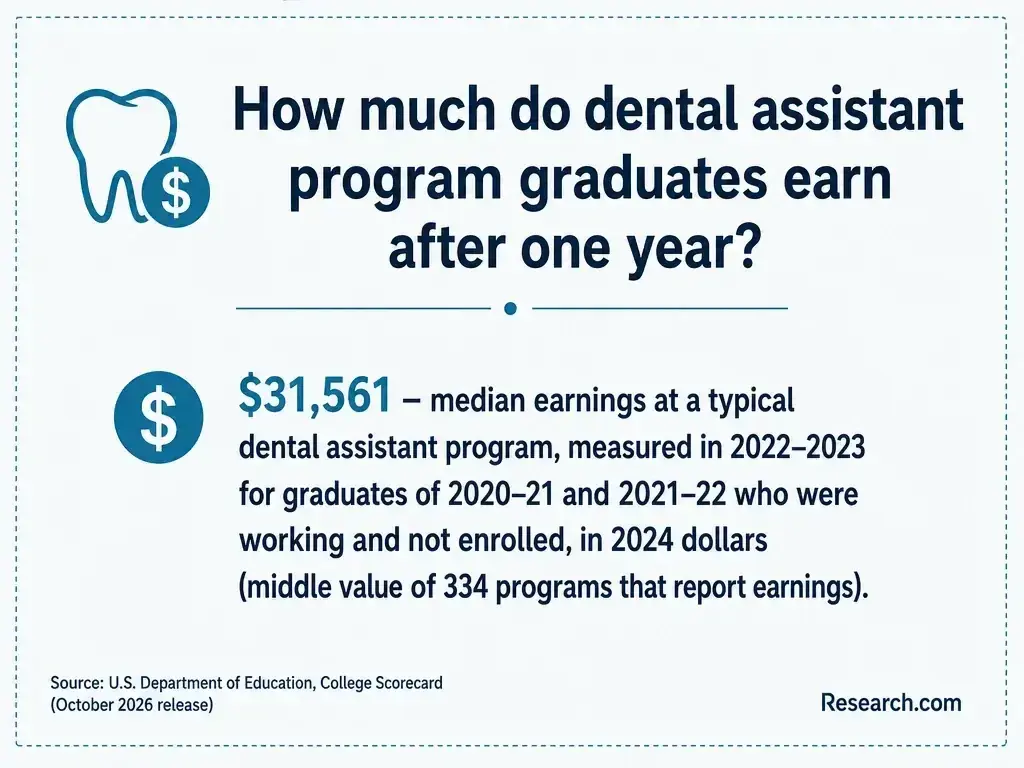
A verified Tacoma-specific wage figure is not provided here, so the most defensible benchmark is the $48,070 national median annual wage for dental assistants in May 2025 (U.S. Bureau of Labor Statistics, Occupational Outlook Handbook). A median describes workers across experience levels and locations; it is neither entry-level pay nor a prediction of what a Tacoma graduate will earn.
For a local decision, compare current Tacoma-area job postings by hourly pay, required experience, benefits, and duties. Then ask each program for documented graduate earnings, the period measured, and the share of graduates represented. Higher advertised pay for an experienced or specially qualified assistant should not be used to justify the cost of entry-level training.
There is no single Washington-mandated school duration for entry into registered dental assisting; the state's registration route does not require completion of a dental assistant program (Washington State Department of Health). School schedules vary with the credential, weekly attendance, and clinical requirements. Obtain each provider's current calendar, total instructional hours, lab hours, and externship or other workplace hours in writing.
An accelerated schedule can get you to the job market sooner but may leave little time for paid work. Part-time study may lower weekly strain while extending commuting costs and delaying full-time earnings. Searches for a top associate's degree in 6 months should not set expectations for dental training: compare actual hands-on hours and the credential awarded, not a generic completion-time claim.
Online instruction can cover terminology, anatomy, records, and other theory. It cannot replace supervised practice in infection control, chairside assisting, dental materials, or imaging. A hybrid program is useful only if its in-person labs and workplace training are accessible on the required schedule; a fully online advertisement should prompt questions about how practical competencies are taught and assessed.
Provider labels are not evidence of occupational fit. A list of non profit accredited colleges, for example, does not establish that a particular online dental course includes Tacoma-area clinical training or supports a specific certification pathway. Check the dental program's actual curriculum, placement arrangements, and recognition separately from institutional accreditation.
A trustworthy Tacoma-wide average cannot be stated without comparable, current prices for the programs and training routes a student can actually choose. Published tuition may also exclude costs needed to finish training and start work. Request an itemized estimate from Bates Technical College and UEI College-Tacoma, and compare it with the costs and potential wages of employer-provided training.
The categories below show what to include in a like-for-like comparison. Amounts vary by provider and student circumstances; no single category should be assumed to be included in advertised tuition.
| Cost or offset | What to verify |
| School charges | Tuition, mandatory fees, books, supplies, and any clinical-placement charge |
| Job-ready expenses | Uniforms, protective gear, required screening, certification exams, and Washington registration fees where applicable |
| Time and travel | Transportation to labs or worksites and earnings forgone during training |
| Possible offsets | Eligible grants, scholarships, workforce assistance, or wages from employer training |
Washington College Grant and other assistance depend on student and program eligibility; verify eligibility rather than assuming every short course qualifies (Washington Student Achievement Council; Federal Student Aid). For return on investment, weigh net cost and debt against completion likelihood, earnings before and after training, time to employment, and how long you expect to work in the field. A low tuition figure alone cannot settle that calculation.
A school may award a certificate, diploma, or an associate degree if its specific program offers one. That school credential is distinct from Washington dental assistant registration and from voluntary professional certification. Confirm the exact award on the current program page before enrolling; similarly named programs need not offer the same clinical preparation.
The Dental Assisting National Board's Certified Dental Assistant (CDA) credential has its own eligibility and examination rules. CODA program accreditation may matter to a particular DANB eligibility pathway, but institutional accreditation, CODA accreditation, state school authorization, certification, and Washington registration serve different purposes (DANB; Commission on Dental Accreditation; Washington State Department of Health). Ask which pathway the program supports and have the provider show you the applicable current requirements.
Admissions rules belong to each provider, not to the occupation as a whole. Request the current checklist from Bates Technical College or UEI College-Tacoma, including educational prerequisites, application steps, immunization or screening policies for clinical sites, and whether you must arrange your own transportation to a placement. Do not pay a nonrefundable charge before confirming you can meet any site-specific requirements.
For direct workplace entry, an employer's hiring criteria and ability to provide supervision matter more than a school admission decision. Washington registration is a separate state process; ask the Washington State Department of Health what documentation and fees apply to the role you intend to perform. Neither admission nor graduation automatically completes that process.
Core training generally covers preparing patients and treatment areas, assisting during procedures, sterilizing instruments, handling dental materials, maintaining records, and communicating with patients (U.S. Bureau of Labor Statistics, Occupational Outlook Handbook). Programs may also teach dental imaging and administrative tasks. The useful comparison is how often students perform these skills under observation - not simply whether they appear in a course description.
Ask to see the skills checklist and how instructors assess infection control and chairside work. Clarify which tasks are practiced in school labs, which occur with actual patients at a clinical site, and which require additional employer training. Scope-of-practice rules govern what an assistant may do in Washington, regardless of what a course advertises (Washington State Department of Health).
For the basic dental assistant role, Washington uses state registration; it does not require graduation from a dental assistant school or a national certification as a universal prerequisite to that registration (Washington State Department of Health). Registration is not the same as school graduation. Apply through the state and verify your status before performing work that requires registration.
Expanded Functions Dental Auxiliary (EFDA) is a different Washington credential with additional requirements and a different scope of practice. If expanded functions are your goal, check the Department of Health's current EFDA education, examination, and licensing requirements before choosing a program. DANB certification is another distinct credential: it can demonstrate professional preparation, but it does not replace Washington authorization or permit duties beyond the state-defined scope (Washington State Department of Health; Dental Assisting National Board).
Start with the work you want to do, then compare the least costly realistic routes to becoming job-ready. A school program may suit someone who wants structured labs and arranged clinical practice. Paid employer training may suit someone who can secure a supervised position and prefers to avoid tuition. Neither route is automatically better; the answer depends on training quality, access, cost, and the tasks you hope to perform.
Use the ranking as a shortlist, then ask each provider the following questions before signing an enrollment agreement:
Verify institutional accreditation, any claimed CODA accreditation, and applicable state authorization with the relevant bodies rather than treating one as proof of another. Beware of a program that promises certification or employment without explaining eligibility and clinical practice. Search results for affordable online master degree programs address a different goal; they are not evidence that a dental assistant course offers the practical training this occupation requires.
An entry-level assistant can develop experience in general dentistry and pursue roles in specialty practices, patient coordination, or office operations. Someone interested in Washington's EFDA scope must meet that credential's separate state requirements; time spent as an assistant or possession of a school certificate does not itself authorize expanded functions (Washington State Department of Health).
For someone asking what is trade school jobs, dental assisting illustrates an important distinction: initial training can open a route to supervised work, while later duties and credentials depend on state rules, employer needs, and further preparation. Compare advancement options by the work they authorize, not by whether a school markets them as a promotion.
National employment for dental assistants is projected to grow 7.4% from 2025 to 2035 (U.S. Bureau of Labor Statistics, Employment Projections). This signals continued national demand, but it is not a Tacoma hiring forecast or a guarantee of a local opening. Competition for a particular job can still depend on office location, schedule, experience, and the procedures an applicant is prepared to assist with.
Before enrolling, review recent Tacoma-area vacancies for recurring requirements and ask clinical-placement staff which skills local offices request. If nearby openings consistently require experience you will not obtain in the program, a lower-priced course may be poor value despite its affordability ranking.
Investing in training is a consequential decision, so Research.com evaluates dental assistant programs against other programs in the same occupation and location. Its team checks multiple education, financial, and occupation-specific sources to make the ranking useful and credible. Only programs with completions reported to the Integrated Postsecondary Education Data System (IPEDS) are eligible; an unlisted employer-training option or school is not necessarily unapproved or low quality.
The most affordable ranking scores tuition, cost of attendance, median student debt, and federal loan default rate. It uses an entropy-based method that gives more weight to measures that vary more across eligible programs. Accreditation and other quality measures do not enter this affordability score. That makes the ranking a starting point for comparing price, not a determination that a program meets your clinical-training or career goals.
Research.com also produces best programs rankings, which use a different model: 20% for occupation-relevant programmatic accreditation or industry recognition, 10% for institutional accreditation, 10% for student support, and 60% for student outcomes, earnings, and costs, with that last portion distributed using the entropy-based method. Outcomes include completion and full-time and part-time retention; earnings measures include median earnings one year after completion and earnings relative to annual attendance cost. Cost measures include resident and nonresident tuition, attendance cost, median debt - including for students who withdrew - and federal loan default rate.
The ranking draws on the following sources. Some cover broad education or apprenticeship information rather than dental assisting specifically; their inclusion does not mean every source supplies a score for every program.
Use the ranking to narrow your choices, then confirm current program prices, clinical arrangements, and Washington requirements directly. Research.com explains its broader approach on its methodology page.
# 1 position
# 2 position
# 3 position

Paid, supervised employer training may avoid school tuition, and Washington does not require school graduation for basic dental assistant registration. Compare actual openings and training support with each school's full price; a free route is only useful if it provides adequate preparation (Washington State Department of Health).
Not for Washington's basic dental assistant registration. CODA accreditation may matter for a particular certification or advanced-credential pathway, so check the requirements for your intended credential before enrolling (Washington State Department of Health; Commission on Dental Accreditation; Dental Assisting National Board).
Theory can be taught online, but chairside and infection-control skills need in-person practice. Ask where supervised labs and workplace training take place and whether the program supports your intended credential.
It may be if it supplies accessible, well-supervised practice and a credible route to employment that you cannot obtain more economically through an employer. Compare net cost, debt, completion prospects, and the credential's actual value for your target role.
No. School completion and Washington registration are separate. Check the Department of Health's current requirements for the work you plan to perform; expanded functions have a distinct credential (Washington State Department of Health).