# 1 position

Audited and Verified:
Our Editorial and Data Verification Process
Research.com uses government datasets, official education statistics and primary institutional information to support its career and degree guides. Our review process checks factual accuracy, occupational definitions, source dates and the requirements associated with the credentials discussed.
How This Article Was Fact-Checked
Our editorial team verifies salary estimates, employment projections, education requirements and program information against original data providers and official organizations. Salary figures are checked against the relevant occupational definitions and reporting periods. Information about licensure, accreditation and required in-person training is reviewed separately.
Fact-checked and verified on:

Co-Founder and Chief Data Scientist

Reviewed by Karolina Broda
Fact-Checker and Data Verification
The cheapest dental assistant program is not necessarily the least expensive route into a job: fees, clinical travel, and time away from work can change the calculation. This guide helps prospective students compare Lakewood, Washington, training options, credentials, and state requirements. The U.S. Bureau of Labor Statistics projects 7.4% national growth in dental assistant employment from 2025 to 2035. The Research.com team of data scientists created the Most Affordable Dental Assistant Trade Schools in Lakewood for 2027 ranking to help students make an informed choice about which programs are worth considering.
Expect instruction in chairside assisting, infection prevention, dental materials, patient communication, and office procedures, followed by supervised practice. Hands-on work matters: observing a procedure online is not the same as preparing an operatory, assisting during treatment, or working safely around patients. Ask each provider how much time students spend in labs and clinical settings, who arranges placements, and whether the schedule accommodates paid work.
Lakewood students can compare Clover Park Technical College with other eligible training routes in the wider Tacoma-area job market. A public technical-college program may offer structured practice and a school credential; employer-sponsored training may allow someone to earn while learning but can depend heavily on the supervising practice. An accelerated online associate degree is not a substitute for verified dental assisting clinical training or Washington registration.
Most dental assistants work in dentists' offices, while some work in specialty practices, clinics, or other dental-care settings (U.S. Bureau of Labor Statistics, Occupational Outlook Handbook). In the Lakewood area, searching across Tacoma and nearby communities can widen the pool of practices and clinical placements. That also makes commute time a real training cost: ask whether a program's externship site is assigned or whether students must secure their own.
A school credential can demonstrate preparation, but a practice may also assess chairside readiness, patient communication, and the tasks it needs covered. Confirm Washington registration requirements before accepting duties that require it (Washington State Department of Health).
The U.S. Bureau of Labor Statistics reports a $48,070 national median annual wage for dental assistants in May 2025. The median describes workers at different experience levels across the country, not entry-level pay in Lakewood. Use current Lakewood- and Tacoma-area job postings to check offered hourly rates, required experience, benefits, and whether employers pay for training or certification.
For a return-on-investment comparison, weigh likely starting pay against your present earnings, total training cost, debt, the probability of completing the program, and time spent out of paid work. A higher-priced program is not automatically a worse investment if its schedule lets you keep working or its clinical experience better fits local openings; neither advantage should be assumed without evidence.
Length depends on the credential, course schedule, lab requirements, and clinical placement. A short certificate and a longer technical-college pathway should not be compared by calendar length alone: request each program's published clock or credit hours, supervised-practice hours, and expected completion date. Also ask whether prerequisites or a delayed clinical placement extend the time until you can seek work.
Employer training can offer an alternative for applicants who need income sooner, although the timing and scope of instruction vary by practice. If speed is the deciding factor, distinguish a genuinely accelerated hands-on schedule from a program that simply moves coursework online. Guidance on what is the easiest associates degree to get online does not establish how quickly someone can acquire dental assisting skills.
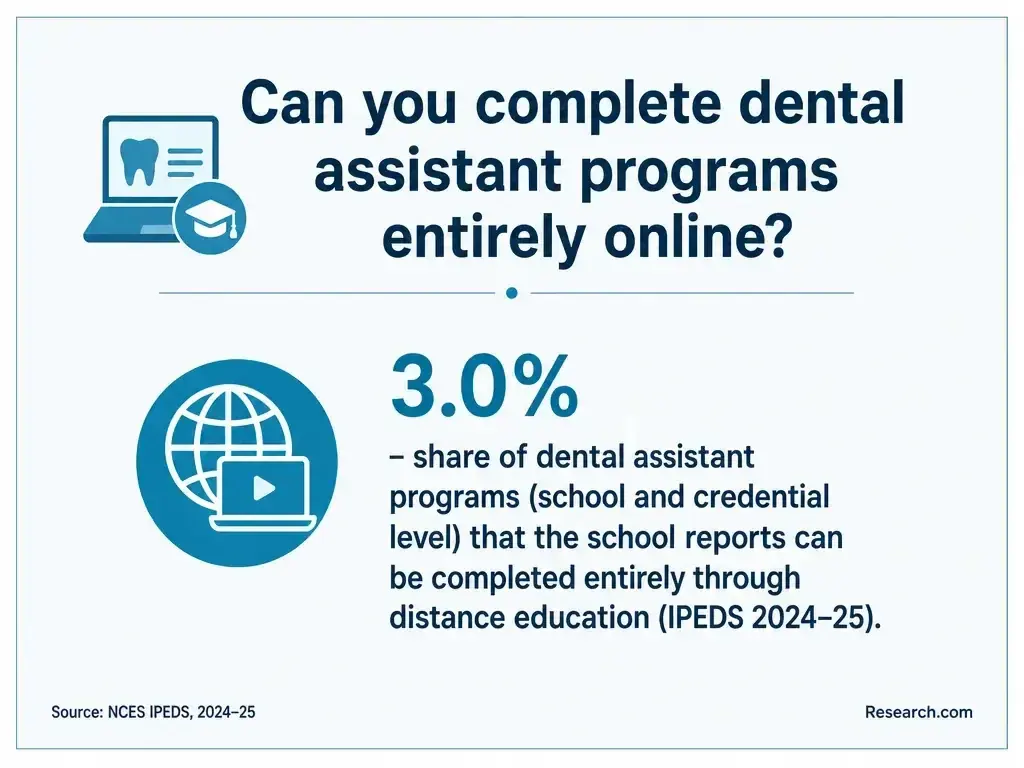
Online coursework can cover terminology, dental anatomy, records, and some infection-control concepts. Chairside procedures, equipment handling, and supervised patient-facing practice require in-person opportunities. A hybrid program may suit a working student if its lab and clinical dates are predictable; an on-campus program may be easier to evaluate if frequent supervised practice is a priority.
Before paying for an online option, get written answers about where practical training occurs, who supervises it, and whether the credential aligns with your intended certification route. A list of best colleges online may help assess an institution, but it does not establish that a dental assisting program supplies clinical experience.
There is no reliable Lakewood-wide average here that covers technical-college programs, career schools, and employer training on the same basis. Rather than treating an advertised tuition figure as the price of entry, request an itemized, program-specific estimate. This comparison shows which costs can change the apparent bargain:
Compare these cost categories across options, including anything you must pay before a clinical placement or first day of work.
| Cost category | What to verify |
| School charges | Tuition, mandatory fees, textbooks, materials, and any resident-rate conditions. |
| Practical training | Uniforms, protective equipment, supplies, screening requirements, and travel to labs or clinical sites. |
| Career entry | Washington registration fees and any optional certification examination fees. |
| Time and financing | Lost wages, borrowing costs, grants, and any wages or tuition support from an employer. |
Ask the school's aid office whether the specific program qualifies for federal aid and whether you qualify for Washington workforce or state aid; eligibility is not automatic (Federal Student Aid; Washington Student Achievement Council). A paid employer-training opportunity may lower upfront cost, but compare the instruction and supervised experience it actually provides.
A provider may award a certificate, diploma, or, for an eligible academic program, an associate degree. These are school credentials. Washington dental assistant registration is a separate state credential, and the Dental Assisting National Board's Certified Dental Assistant designation is a separate professional certification (Washington State Department of Health; Dental Assisting National Board). Ask which credential is awarded and which DANB examination-eligibility route, if any, its curriculum supports. Confirm a program's current CODA accreditation directly with CODA rather than assuming that institutional accreditation covers dental assisting.
The useful distinction is what the credential enables you to do, not how its name compares with unrelated options such as a doctoral degree no dissertation. For this occupation, prioritize supervised skills, state registration, and any certification an employer requests.
Admissions rules vary by provider. Check the current application for education prerequisites, placement steps, immunization or screening policies, and requirements that apply before clinical work. Ask whether a clinical site can impose additional conditions and what happens if you cannot meet them. Employer-trained applicants should likewise ask what documentation the practice requires before starting.
Do not confuse admission with occupational eligibility: acceptance into training does not itself grant Washington dental assistant registration (Washington State Department of Health). A list of colleges that allow double majors is unrelated to this entry decision; the relevant documents are the dental assisting program's admissions policy and the state's registration instructions.
Training typically combines dental terminology and anatomy with infection control, instrument preparation, chairside assistance, dental materials, radiography instruction, records, and patient communication (U.S. Bureau of Labor Statistics, Occupational Outlook Handbook). Compare how students demonstrate those skills, not just whether topics appear in a course catalog. For radiography and other delegated tasks, ask how the program teaches Washington-specific rules and documents practical competence (Washington State Department of Health).
Clinical work also tests whether you can maintain an organized operatory and communicate with patients while following the dentist's directions. That supervised experience is especially valuable to compare when two programs advertise similar credentials but provide different amounts of hands-on instruction.
In Lakewood, Washington requires dental assistants to register with the state; registration is distinct from both a school credential and voluntary DANB certification (Washington State Department of Health). The state permits dentists to delegate tasks within Washington's rules, so finishing a course does not authorize every procedure. Check the Department of Health's current registration instructions and scope-of-practice rules before enrolling or accepting a position.
DANB certification may matter to a particular employer or advancement goal, but it is not interchangeable with Washington registration. CODA programmatic accreditation, institutional accreditation, and state school authorization answer different questions; none alone grants permission to practice (Commission on Dental Accreditation; Washington State Department of Health). If you might work across a state line later, check that state's rules separately.
Start with the work you want: an entry-level chairside role, a certification pathway, or a longer credential with room for further training. Then compare the same facts for each option, including Clover Park Technical College if its current offering fits your schedule. An affordability rank helps identify lower-cost options, but it does not score accreditation or prove that a student will finish or find work.
These checks expose the most consequential gaps before you commit:
A red flag is a provider that advertises "certification" without naming the issuer, cannot identify its hands-on placement arrangements, or treats tuition as the complete cost. Choose the route whose documented training and cost fit your goal - not one selected from a ranking alone.
Entry-level chairside assisting can lead to greater responsibility in patient coordination, practice administration, or a dental specialty office as experience develops (U.S. Bureau of Labor Statistics, Occupational Outlook Handbook). Additional certification may strengthen an application, but its value depends on the role and employer. Washington has separate requirements for expanded-function dental auxiliary practice; ordinary dental assistant registration and a school certificate should not be presented as that credential (Washington State Department of Health).
If your goal is a specialized scope of practice rather than entry-level assisting, verify the state-approved route before choosing an introductory program. Ask local employers which skills and credentials they recognize for the position you want next.
The U.S. Bureau of Labor Statistics projects 7.4% growth nationally for dental assistants from 2025 to 2035. This indicates a growing occupation nationally, not a forecast of Lakewood vacancies or a guarantee that a new trainee will be hired. For a local decision, review current openings across the Lakewood-Tacoma commuting area and note how often they request experience, radiography skills, registration, or certification.
Use those postings to test a program's claims about job readiness. A shorter course can be worthwhile when it supplies the practical skills local practices request; a longer program may make more sense when its additional supervised training and credential match your intended path.
Investing in training is an important decision, especially when a low advertised tuition may not reflect the full cost of becoming job-ready. Research.com evaluates programs against others in the same occupation and location so readers can compare realistic local options. Only programs with completions reported to IPEDS are eligible; this means the ranking does not cover every employer-training route or provider.
The most affordable ranking scores tuition, cost of attendance, median student debt, and federal loan default rate. An entropy-based method assigns more weight to cost and debt indicators that vary more across eligible programs. Accreditation, recognition, support services, earnings, and completion outcomes are not included in this affordability score. Readers should check those factors separately before enrolling.
For comparison, Research.com's best programs rankings consider student outcomes; earnings and return on investment; costs and debt; and quality and recognition. Their weights are 20% for relevant programmatic accreditation or industry recognition, 10% for institutional accreditation, 10% for student support, and 60% for outcomes, earnings, and costs, with the last group weighted by the entropy-based method. The research team uses multiple sources to check the credibility and accuracy of its comparisons. The following sources informed the ranking:
The ranking is a cost-comparison starting point, not a finding that every listed program meets a particular employer's or certifier's requirements. Readers can review Research.com's methodology for more detail on how rankings are created.
# 1 position
# 2 position
Not every entry route requires a trade-school credential. Compare school training with a genuine employer-training opportunity, and confirm Washington registration and permitted duties with the Washington State Department of Health.
No. Add mandatory fees, supplies, clinical travel, registration costs, and lost wages; subtract aid or paid-training support you actually qualify for.
Online lessons can cover theory, but chairside skills need in-person practice. Ask where supervised practical training takes place before enrolling.
No. A school certificate, Washington registration, and DANB's Certified Dental Assistant certification are distinct credentials. Check DANB's current examination-eligibility rules for the route you plan to use.
Confirm its location, schedule, supervision, required screening, and whether you must find the site yourself. An inconvenient placement can increase both cost and time to completion.