# 1 position

Audited and Verified:
Our Editorial and Data Verification Process
Research.com uses government datasets, official education statistics and primary institutional information to support its career and degree guides. Our review process checks factual accuracy, occupational definitions, source dates and the requirements associated with the credentials discussed.
How This Article Was Fact-Checked
Our editorial team verifies salary estimates, employment projections, education requirements and program information against original data providers and official organizations. Salary figures are checked against the relevant occupational definitions and reporting periods. Information about licensure, accreditation and required in-person training is reviewed separately.
Fact-checked and verified on:

Co-Founder and Chief Data Scientist

Reviewed by Karolina Broda
Fact-Checker and Data Verification
Choosing dental assistant training in Denison means checking more than how quickly you can finish: hands-on practice and Texas registration rules can change which program is worth paying for. The Research.com team of data scientists created the Best Dental Assistant Trade Schools in Denison for 2027 ranking to help students identify programs worth considering. Nationally, dental assistants earned a median $48,070 in May 2025, according to the U.S. Bureau of Labor Statistics (BLS). This guide helps prospective students compare training, costs, credentials, and local career options before enrolling.
Expect training in patient preparation, instrument transfer, sterilization, recordkeeping, and dental office workflow, followed by practice that connects classroom instruction to chairside work. Radiography requires particular attention because Texas regulates who may take dental X-rays. A program's completion certificate, permission to perform regulated duties, and national certification are separate things (Texas State Board of Dental Examiners; DANB).
Programs can differ substantially even when both are called "dental assisting." A short career-school course may suit someone who can arrange substantial supervised practice; a longer community-college certificate may offer more structured labs and clinical experience. Direct entry into an office with employer training may suit someone seeking basic duties first, provided the employer explains supervision and how the worker can meet any later registration requirements. If speed is your priority, compare 6 month certificate programs high paying jobs cautiously: duration alone does not establish dental-office readiness.
General and specialty dental practices are the principal settings to investigate, including offices in the broader Sherman-Denison area. Some assistants also work in larger group practices or community dental settings. The BLS describes dental assistants' work as a combination of patient care, sterilization, records, and scheduling; the balance varies by office. Ask prospective clinical sites whether trainees rotate through actual chairside procedures rather than observing only.
Denison's location matters because a workable clinical placement or first job may require travel beyond the city. Before paying a deposit, ask where placements occur, whether transportation is your responsibility, and whether the school arranges sites or expects you to find one.
A verified Denison-specific median is not established here. The national median annual wage for dental assistants was $48,070 in May 2025 (BLS, Occupational Outlook Handbook). A national midpoint includes experienced workers and different labor markets; it is not an entry-level offer in Denison. Compare actual Sherman-Denison postings by duties, hours, benefits, and experience requirements, and ask local employers what they pay newly trained assistants.
For an investment decision, compare likely starting take-home pay with your current earnings, training debt, and time away from paid work. A higher quoted hourly rate may be less attractive if a position offers fewer hours or requires a longer commute.
Completion time depends on the provider's schedule, clinical requirements, and whether you attend full time or part time. There is no single Denison-wide clock-hour requirement that makes every dental assisting program equivalent. Request the current catalog's total instructional hours and a separate breakdown of laboratory, supervised clinical, and online hours; also ask how long students typically wait for a clinical placement.
Texas registered dental assistant requirements should be checked independently of a school's advertised course length. Employer-based training can begin with basic permitted duties, but it is not a shortcut around requirements for regulated duties (Texas State Board of Dental Examiners). An accelerated course makes sense only if its practice schedule and credential preparation fit the work you intend to do.
Online study can cover terminology, anatomy, infection-control principles, and office procedures. Instrument handling, patient positioning, chairside coordination, and other practical competencies need in-person practice and assessment. A hybrid program can be a useful commuting compromise; an entirely online course should not be assumed to provide equivalent clinical preparation or satisfy Texas requirements for regulated duties (Texas State Board of Dental Examiners).
When comparing most popular accredited online trade schools, check the dental assisting program itself: where are labs held, who arranges supervised experience, and which costs require travel? An on-campus option may be preferable if you need structured practice or access to equipment, while hybrid study may suit a working student who has reliable access to required in-person sessions.
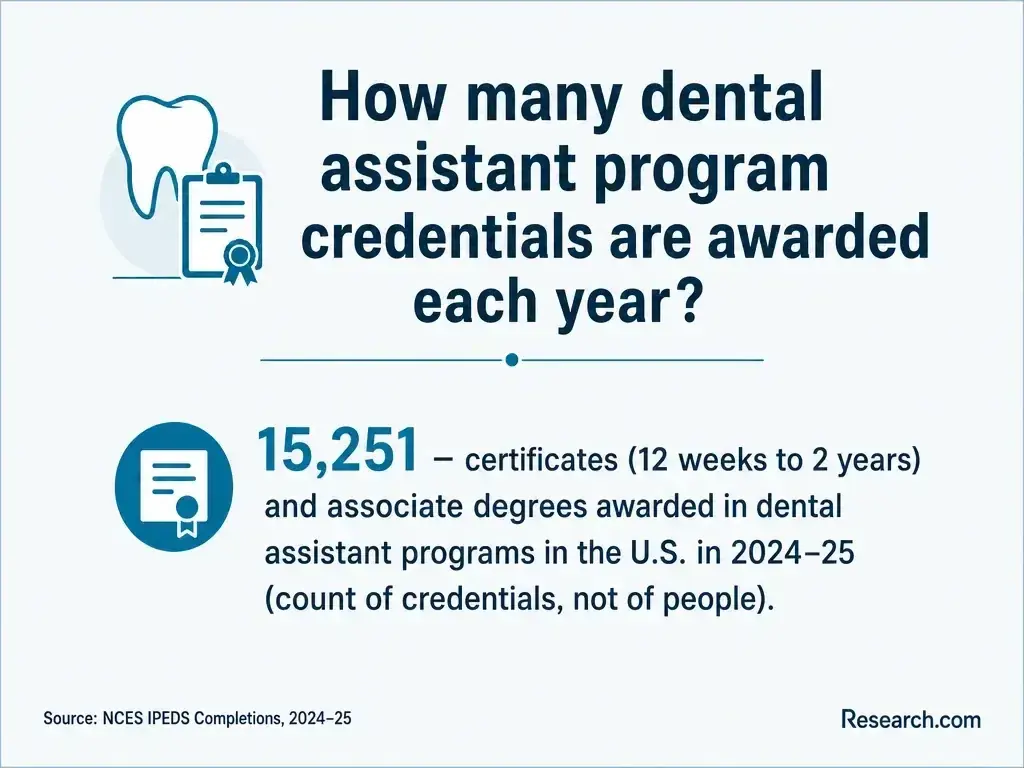
A defensible Denison-wide average is not available here; tuition varies by provider and does not capture the full price of becoming job-ready. Request an itemized, current quote before comparing a college course with a career-school program or employer training. The following cost categories show what can change the real investment.
| Cost category | Why it matters |
| Tuition and mandatory fees | Ask whether labs, clinical placement, and supplies are included. |
| Uniforms, materials, and equipment | Required purchases can make a lower advertised tuition less competitive. |
| Exams and applications | Check which Texas registration or optional certification expenses are separate. |
| Travel and foregone earnings | Clinical-site commuting and missed work may outweigh a modest tuition difference. |
Federal aid depends on the institution and eligible program, not merely on calling a course a certificate (Federal Student Aid). Ask about scholarships and whether Workforce Solutions Texoma can assess eligibility for workforce funding; employer-paid training may reduce direct costs but can provide less structured instruction. Compare net cost after aid and expected debt alongside completion prospects and the earnings you would give up while studying.
A training provider may award a completion certificate or another school credential. That award is not the same as Texas registered dental assistant status or the optional Certified Dental Assistant (CDA) credential issued by DANB. CODA programmatic accreditation, institutional accreditation, state school authorization, professional certification, and occupational registration each answer a different question (CODA; DANB; Texas State Board of Dental Examiners).
Ask a school to name the exact credential on the transcript or certificate and identify which Texas requirements its coursework addresses. If national CDA certification matters to a future employer, check DANB's current eligibility pathways directly; do not assume a similarly named school certificate confers eligibility. Likewise, ask whether credits transfer, but obtain written confirmation from the receiving provider rather than relying on a promise of "stackable" training.
Schools set their own entry rules, which may include an application, prior-school documentation, and requirements connected to clinical placement. An office hiring a trainee instead sets employment and supervision expectations. Ask about background checks, immunization or health documentation, CPR training, and clinical-site rules before committing; a school's admission offer does not guarantee placement or Texas registration.
Application fees are only one small part of the decision. A search for accredited online colleges with no application fee will not tell you whether a particular dental assisting course includes local hands-on training or meets your intended Texas pathway. Confirm both directly with admissions and the Texas State Board of Dental Examiners.
Useful curricula connect dental anatomy and terminology with infection control, instrument identification, chairside assisting, patient communication, records, and radiography rules. Students should practice workflows - not just memorize them - so they can prepare a treatment area, support a dentist efficiently, and follow safety procedures. The BLS identifies both clinical and administrative duties in dental assisting; the tasks assigned to a Texas assistant depend on applicable state rules and employer supervision (BLS; Texas State Board of Dental Examiners).
Request a skills checklist and ask how instructors assess each hands-on competency. A program with a clinical placement should explain the site's supervision, activities, and evaluation process. Treat "clinical experience included" as incomplete information until the provider explains what students actually do.
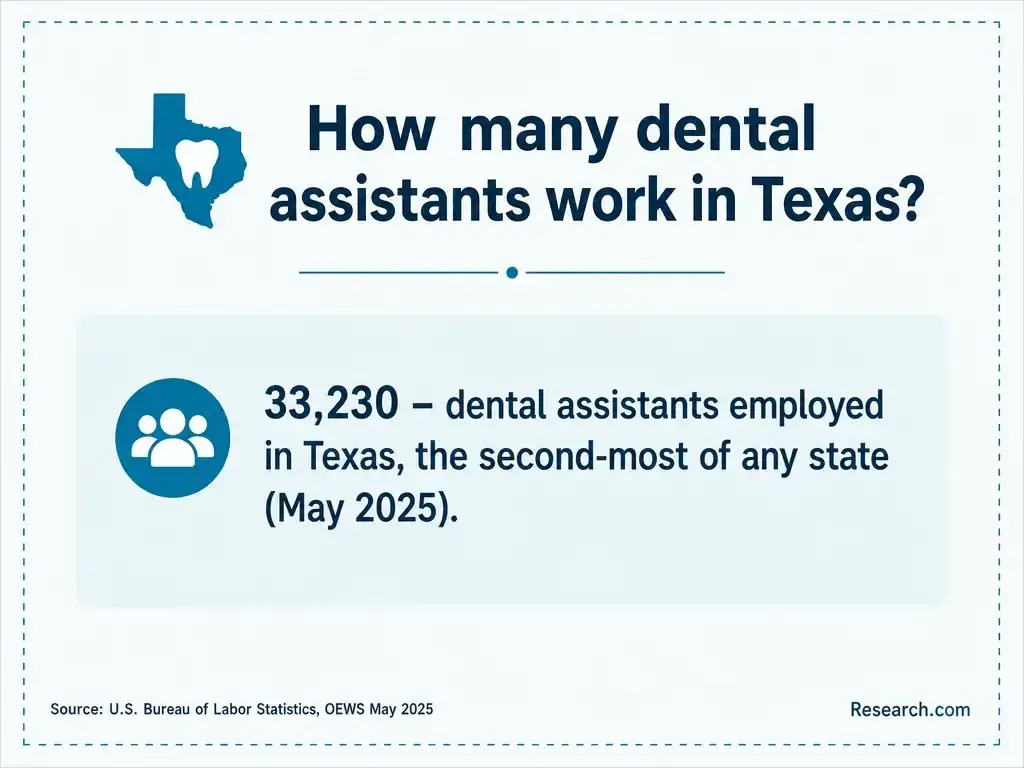
Texas does not treat every dental assisting task as requiring the same credential. Basic supportive duties may be performed without registered dental assistant status, while taking dental radiographs requires meeting Texas State Board of Dental Examiners requirements for registration. The board sets application and qualification rules, including its approved education or examination pathway and CPR requirements; check its current instructions before enrolling. A school certificate alone does not grant permission to perform regulated duties (Texas State Board of Dental Examiners).
DANB's CDA is a separate national professional certification, not a substitute for Texas registration (DANB; Texas State Board of Dental Examiners). Ask which duties your target employers expect on day one, then verify the corresponding board requirements. That sequence prevents paying for an impressive-sounding credential that does not address the work you want to perform.
Start with the job duties you want, then compare programs against the training and regulatory pathway those duties require. Grayson College is one provider to contact about current dental assisting offerings, schedules, and clinical arrangements; verify availability rather than assuming a particular course is open. A ranking helps create a shortlist, but your schedule, placement access, and net cost determine whether an option fits.
Use these questions when speaking with a program representative, employer, or Texas regulator:
Red flags include guaranteed-job language, an "online-only" promise of clinical readiness, unclear placement responsibility, or tuition quotes that omit required purchases. If your aim is chairside employment, searches such as what 4 year degree pays the most address a different investment question and should not replace checking dental assisting outcomes and Texas rules.
An entry-level assistant can build experience in general dentistry, then pursue responsibilities in a specialty office, radiography where authorized, patient coordination, or office operations. Advancement depends on employer needs, demonstrated skills, and any applicable Texas requirements; a short course does not automatically qualify someone for every dental-office role (BLS; Texas State Board of Dental Examiners).
Someone who prefers administration over chairside work should ask whether the training includes scheduling, records, and insurance workflows. Conversely, if your long-term interest is outside dental assisting, comparing unrelated searches such as easy masters degrees that pay well is less useful than first deciding whether you want daily patient-facing dental work. Avoid taking on training debt for an occupation whose routine tasks do not appeal to you.
BLS projects 7.4% U.S. employment growth for dental assistants from 2025 to 2035. That is a national occupation projection, not a forecast of openings in Denison (BLS, Employment Projections). Use it as evidence that the occupation has a broader labor market, then test local demand through current Sherman-Denison vacancies, clinical-site relationships, and conversations with practices.
Digital records and imaging also make technology skills relevant, but they do not remove the need for chairside judgment and infection-control practice (BLS, Occupational Outlook Handbook). If nearby openings consistently require experience or Texas registration, choose a program that explains how students gain supervised practice and prepare for those requirements rather than relying on the national growth figure alone.
Investing in training is an important decision, so Research.com compares dental assisting programs with other programs serving the same occupation and geography - not with unrelated trades. The ranking includes only programs with completions reported to the Integrated Postsecondary Education Data System (IPEDS). That makes the comparison more consistent, but it also means employer training and programs outside IPEDS may be absent; an omission is not a judgment of quality.
Best-program rankings assess student outcomes; earnings and return on investment; costs and debt; and quality and recognition. Measures include completion and full- and part-time retention, median earnings one year after completion, earnings relative to annual attendance cost, tuition, attendance cost, median debt including for students who withdrew, federal loan default rates, accreditation, occupation-relevant recognition, and student support. Programmatic accreditation or relevant industry recognition receives 20% of the score, institutional accreditation 10%, and student support 10%. The remaining 60% covers outcomes, earnings, and costs, with entropy-based weights giving more influence to indicators that vary more across programs. Most-affordable rankings instead score only tuition, attendance cost, median debt, and default rates, using entropy-based weights; accreditation and other quality indicators do not enter that score.
The Research.com team draws on the following databases and organizations to check coverage, outcomes, recognition, and occupational context. Not every source establishes dental assisting approval, and a ranking cannot replace checking current Texas requirements with the relevant regulator.
Use the ranking to build a shortlist, then verify each program's current curriculum, clinical arrangements, price, and Texas registration alignment. More detail on the approach is available in Research.com's methodology.
# 1 position
# 2 position
Some basic duties can be learned through supervised employer training in Texas. First confirm which duties the job includes; regulated activities such as taking dental radiographs have separate Texas requirements (Texas State Board of Dental Examiners).
No. A school issues its completion credential; the Texas State Board of Dental Examiners administers registered dental assistant requirements. Verify the board's current pathway independently.
Some theory can be studied remotely, but chairside skills require in-person practice. Ask where labs and supervised clinical activities occur and whether the course addresses your intended Texas duties.
Compare total out-of-pocket cost, paid work during training, supervised practice, the credential earned, and preparation for regulated duties. Neither route is automatically better.
No. Ask providers for clearly defined completion and placement results, then compare them with current local postings and the duties employers require.