# 1 position
Best Dental Assistant Training Programs & Trade Schools in Dallas for 2027
Audited and Verified:
Our Editorial and Data Verification Process
Research.com uses government datasets, official education statistics and primary institutional information to support its career and degree guides. Our review process checks factual accuracy, occupational definitions, source dates and the requirements associated with the credentials discussed.
How This Article Was Fact-Checked
Our editorial team verifies salary estimates, employment projections, education requirements and program information against original data providers and official organizations. Salary figures are checked against the relevant occupational definitions and reporting periods. Information about licensure, accreditation and required in-person training is reviewed separately.
Fact-checked and verified on:

Co-Founder and Chief Data Scientist

Reviewed by Karolina Broda
Fact-Checker and Data Verification
Choosing dental assistant training in Dallas means comparing more than program length: you need a route to chairside skills, the right Texas credential, and a manageable total cost. The U.S. Bureau of Labor Statistics (BLS) reports a May 2025 national median wage of $48,070 for dental assistants, but that is not a starting-pay estimate. This guide explains the trade-offs behind the Best Dental Assistant Trade Schools in Dallas for 2027 ranking, created by the Research.com team of data scientists to help students identify programs worth considering and make an informed choice.
Key findings about dental assistant degrees in Dallas
- For a Dallas student who wants to take dental X-rays, Texas Registered Dental Assistant (RDA) requirements matter more than a program's certificate title; verify the current route with the Texas State Board of Dental Examiners before enrolling.
- The BLS projects 7.4% national growth for dental assistants from 2025 to 2035. That supports investigating the occupation, but does not establish how many entry-level openings a particular Dallas program can access.
- Compare the full cost of reaching job-ready status - not tuition alone - and ask each provider to document supervised chairside practice, clinical placement arrangements, and the credential awarded.
Table of Contents
- Best Dental Assistant Training Programs & Trade Schools in Dallas for 2027
- What can I expect from a dental assistant trade school program in Dallas?
- Where can I work with a dental assistant trade school training in Dallas?
What can I expect from a dental assistant trade school program in Dallas?
Expect instruction in patient preparation, instrument transfer, sterilization, dental materials, records, and office workflow, followed by practice in a simulated operatory or supervised dental setting. Dental assisting is a hands-on occupation: a course that teaches terminology without letting you practice infection control and chairside procedures is not equivalent to one with substantial supervised practice (BLS; O*NET).
Dallas-area options include career-school programs, community-college or continuing-education training, and dental offices willing to train new assistants. The College of Health Care Professions-Dallas, PCI Health Training Center, and Concorde Career College-Dallas are examples of providers a student might investigate, not assurances that a particular schedule, credential, or clinical site will be available in 2027. An office-based route may let you earn while learning; a structured program may offer more predictable labs and documented instruction. Ask either provider exactly which tasks you will practice and who supervises them.
Where can I work with a dental assistant trade school training in Dallas?
Dental assistants primarily work in dentists' offices, according to the BLS. In the Dallas-Fort Worth area, that can mean general practices as well as orthodontic, pediatric, or oral-surgery offices. The setting changes the work: a specialty office may value familiarity with its instruments and patient flow, while a general practice may expose a new assistant to a wider range of routine procedures.
When evaluating a program, ask where its students complete clinical experience and whether those sites are reachable from your home or job. A placement across the metro area can add meaningful travel time and cost; a placement is also an opportunity to assess an office's training and hiring practices, not a job guarantee.
The BLS reports a $48,070 national median annual wage for dental assistants in May 2025. Half of employed assistants nationally earned less and half earned more; the figure covers experienced workers as well as newer entrants. It should not be presented as a Dallas starting salary or a promised return on a certificate.
For a local pay comparison, consult the BLS Occupational Employment and Wage Statistics release for the Dallas-Fort Worth-Arlington metropolitan area and check its reference year. Then compare actual entry-level postings for the duties and hours you want. Benefits, paid time off, and whether a position requires Texas RDA registration can change the value of offers that advertise similar hourly pay.
Length depends on the provider's calendar, weekly schedule, lab requirements, and any clinical placement. An accelerated course can shorten the time before applying for work, but its pace may be difficult to combine with a full-time job. Part-time study spreads attendance and payments over a longer period. Texas does not impose one universal dental-assisting trade-school clock-hour requirement for every route into basic assisting; requirements for particular duties and credentials must be checked separately with the Texas State Board of Dental Examiners.
Request each school's published total clock or contact hours, separating classroom, lab, and supervised clinical hours. Also ask how long students actually wait for a clinical assignment and whether missed sessions delay completion. Searches for fastest online programs for working adults may help frame a scheduling question, but speed does not replace chairside practice.
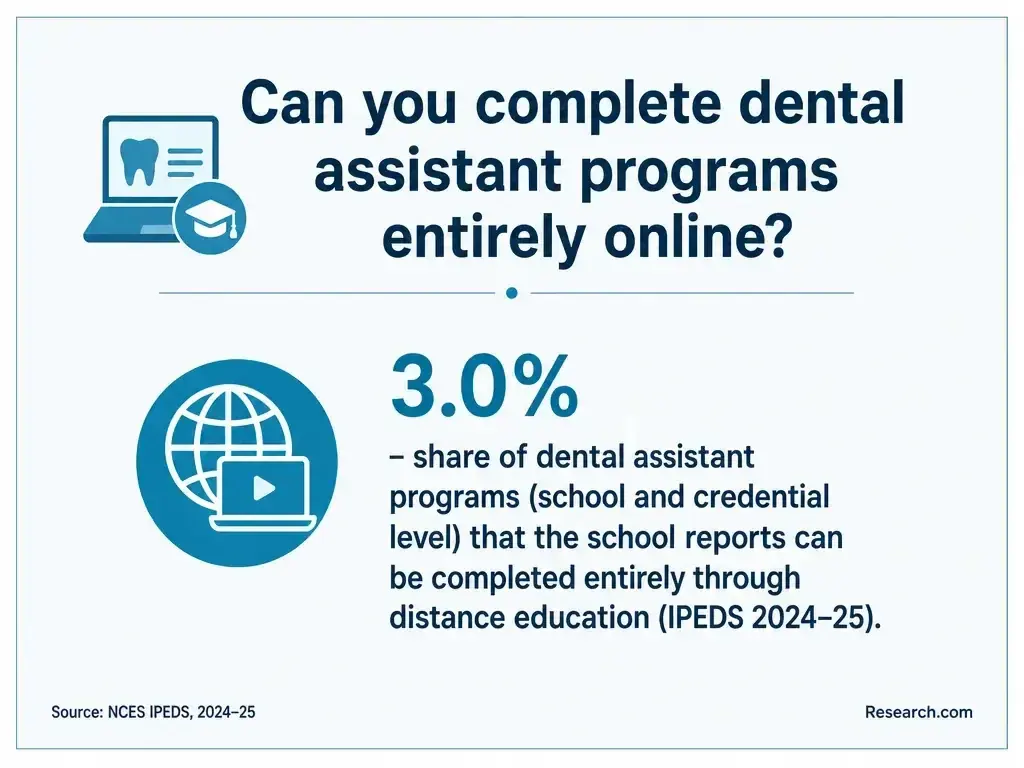
Online delivery can work for terminology, anatomy, records, and some regulatory coursework. Instrument handling, operatory setup, infection-control technique, and patient-facing chairside skills need in-person demonstration and supervised practice. A hybrid program can be convenient if it provides accessible Dallas-area labs and a clear clinical plan; an entirely remote course should not be assumed to meet an employer's expectations or Texas requirements for particular duties.
Before paying, get the lab address, required attendance dates, clinical-site policy, and any extra travel charges in writing. A general list of best affordable online universities for working adults is not evidence that a dental-assisting course supplies local hands-on training.
There is no reliable single Dallas average that captures private career schools, public continuing-education courses, and employer training on the same basis. Published tuition can also omit costs needed to finish and seek work. Rather than treating a school's advertised price as the full investment, request an itemized quote using the same categories from every provider:
- Tuition and mandatory enrollment, lab, and clinical fees.
- Textbooks or software, supplies, uniforms, and required protective equipment.
- Any certification examination, Texas application, background-check, or other required credentialing charges.
- Travel to campus and clinical sites, plus earnings forgone while attending.
Ask whether the quoted program is eligible for federal student aid; eligibility depends on the institution and program, not simply on its being called a trade school (Federal Student Aid). Also ask about scholarships, Texas workforce assistance, payment plans, and paid office training. Compare expected out-of-pocket cost and borrowing against a realistic entry-level wage - not against unrelated listings such as cheap doctorate degree online options. A cheaper course may be poor value if it leaves you paying separately for essential clinical training.
Many short programs award a school certificate of completion; that document records training, not Texas RDA registration or national certification. A provider may instead offer a diploma or another occupational credential. Confirm the exact award on the enrollment agreement, along with whether the program has Commission on Dental Accreditation (CODA) accreditation if that matters to your intended certification route.
Keep the distinctions clear: institutional accreditation concerns the school; CODA accreditation concerns an eligible dental program; state school authorization concerns permission to operate; DANB credentials are professional certifications; and Texas RDA registration is a state-issued occupational credential. None automatically substitutes for the others (CODA; DANB; Texas State Board of Dental Examiners).
Requirements vary by provider. Ask whether admission requires a high-school diploma or equivalent, an assessment, immunization records, a background check, or CPR training, and distinguish admission conditions from requirements imposed later by a clinical site. Confirm whether a site can decline a placement because of an unmet screening requirement and what alternative the school would provide.
An office willing to train an entry-level assistant may use a different hiring process from a school. That route can suit someone ready to learn on the job, but prospective trainees should still ask who teaches infection control, which duties they may perform under Texas rules, and how progress will be documented (Texas State Board of Dental Examiners).
Useful training connects dental anatomy and terminology to real workflow: preparing a treatment room, maintaining asepsis, passing instruments, mixing materials, recording information accurately, and communicating with patients and the dental team. Radiography instruction matters especially to students who want X-ray duties, because Texas regulates those duties through its dental-assistant rules (Texas State Board of Dental Examiners).
Compare programs by demonstrated competency, not course titles alone. Ask to see the skills checklist: How many opportunities are there to practice with equipment? Who evaluates performance? Is supervised experience arranged by the provider, or must students find their own office? Digital records and imaging are also worth practicing where offered, but software familiarity cannot compensate for weak infection-control or chairside training.
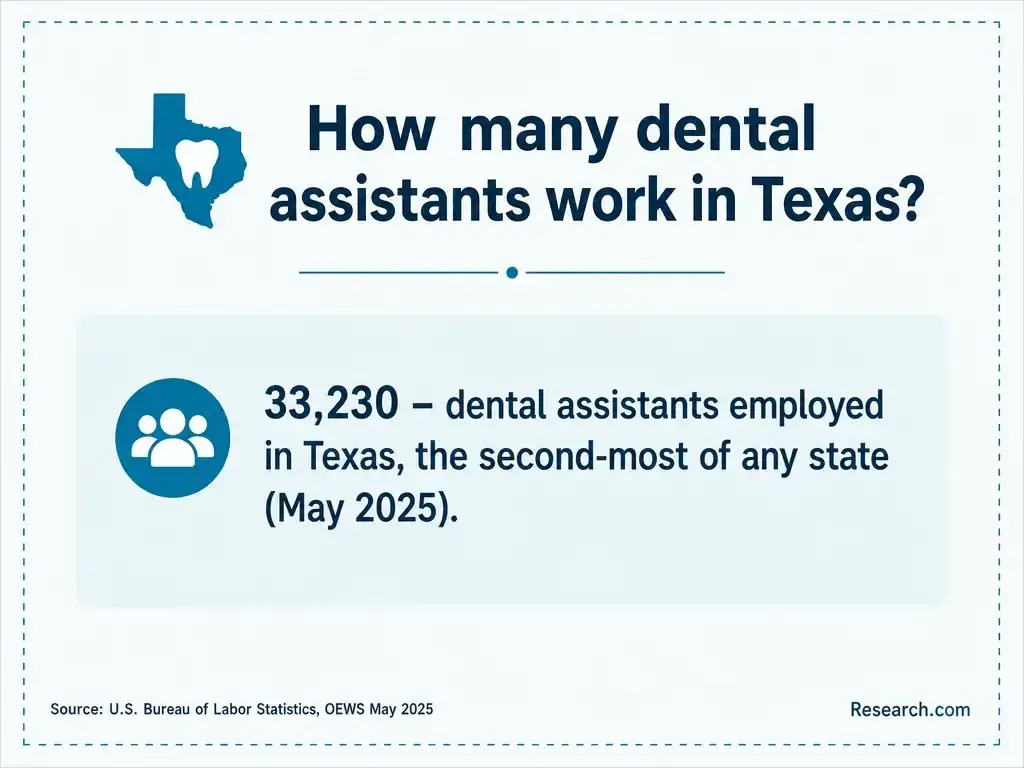
Texas distinguishes basic dental-assisting work from duties that require additional qualifications. The Texas State Board of Dental Examiners oversees Registered Dental Assistant (RDA) registration and rules affecting dental radiographs. Before choosing training, check the board's current RDA eligibility, approved-course, examination, application, and supervision requirements for the duties you intend to perform. Do not assume a school certificate alone authorizes X-ray work.
The Dental Assisting National Board's Certified Dental Assistant (CDA) credential is a separate national professional certification, with its own eligibility routes and examinations (DANB). It is not automatically required for every entry-level Texas assisting job and does not replace Texas authorization. Ask a program to identify, in writing, which Texas and DANB requirements its curriculum addresses and which steps remain your responsibility.
Start with the job you want: basic chairside work, a role involving radiographs, or a specialty practice. Then compare programs against the requirements of that job. A ranking can identify options to investigate, but your best fit depends on commute, schedule, hands-on instruction, credential eligibility, and the amount you would need to borrow.
Use the same sequence with every provider so a short course and a longer program receive a fair comparison:
- Confirm the current Dallas offering, credential awarded, total hours, lab location, and who arranges supervised clinical practice.
- Verify institutional accreditation and any claimed program accreditation with the accreditor; verify Texas RDA implications with the Texas State Board of Dental Examiners rather than relying on advertising.
- Request a complete written cost and aid estimate, including charges you would face if you withdraw or repeat a component.
- Ask for the provider's defined completion and placement outcomes, their reporting period, and whether placement means a dental-assisting job.
- Compare that cost and completion risk with paid office training and the wages you could realistically seek as a new assistant.
Be cautious of guaranteed-job claims, vague promises of being "certified," or an online course with no credible in-person skills plan. If your main goal is high pay rather than dental work, research the actual duties behind quick high paying degrees comparisons before taking on dental-training debt.
Most trainees are preparing for entry-level chairside assisting. With experience, an assistant may take on more complex permitted duties, move into orthodontic or other specialty workflows, help train colleagues, or shift toward scheduling and practice coordination. Each move depends on employer needs, demonstrated skills, and any applicable Texas requirements; a certificate does not automatically confer an expanded scope of practice (BLS; Texas State Board of Dental Examiners).
Dental assisting is a better fit for someone who wants direct patient contact and can work comfortably with close-up clinical procedures than for someone seeking a wholly remote career. Unlike an easy bachelor's degree search, this trade-school decision turns on whether supervised dental training leads to the specific work you want to do.
The BLS projects 7.4% growth nationally in dental-assistant employment from 2025 to 2035. That is an occupational projection, not a forecast of Dallas openings or a placement rate for any school. It indicates a reason to examine the career, while local hiring still depends on practice needs, applicant competition, schedule, and the duties you are qualified to perform.
For a practical local check, review recent Dallas-Fort Worth postings for required experience, RDA status, radiography duties, and working hours. If the jobs you would accept consistently require skills a program does not teach, ask how its graduates bridge that gap before enrolling. Compare openings near your likely commute as well as across the wider metro area; a job market is useful only if its positions are accessible to you.
Best Dental Assistant Training Programs & Trade Schools in Dallas for 2027
Investing in training is a consequential decision, so the Research.com team designed the ranking to help readers compare dental-assisting programs with other options in the same occupation and location. Only programs with completions reported to the Integrated Postsecondary Education Data System (IPEDS) are eligible. That makes the ranking a useful starting point, not an inventory of every Dallas training route; an employer-sponsored program, for example, may not appear.
Best-program rankings assess student outcomes; earnings and return on investment; costs and debt; and quality and recognition. Programmatic accreditation or relevant industry recognition accounts for 20% of the score, institutional accreditation for 10%, and student support for 10%. The remaining 60% covers completion, full- and part-time retention, earnings one year after completion, earnings relative to annual attendance cost, tuition, attendance cost, debt - including debt held by students who withdrew - and federal loan default rates. An entropy-based method assigns more weight to indicators that vary more across programs. Most-affordable-program rankings instead score only tuition, attendance cost, median debt, and loan default rates using that method; accreditation and other quality measures are not included in their score.
The team uses the following sources to check reported data and relevant recognition. Inclusion in this source list does not mean every organization accredits dental-assisting programs or that every source supplies a score for every school:
- IPEDS database - reported program completions and institutional measures.
- National Center for Education Statistics - federal education data and definitions.
- College Scorecard database - available cost, debt, and earnings measures.
- Peterson's database - supplementary institutional information.
- Commission on Accreditation of Allied Health Education Programs (CAAHEP) - allied-health accreditation information where relevant.
- Accrediting Bureau of Health Education Schools (ABHES) - institutional or program accreditation information where applicable.
- Commission on Dental Accreditation (CODA) - dental-assisting program accreditation information.
- Dental Assisting National Board (DANB) - certification pathways and requirements.
- National Center for Construction Education and Research (NCCER) - a broader trade-training reference, not dental-assisting accreditation.
- Apprenticeship.gov Partner Finder - a broader source for investigating work-based training, not proof of a local dental-assisting apprenticeship.
These checks improve comparability, but reported outcomes can cover different student groups and periods. Readers should use the ranking to narrow a shortlist, then verify current Dallas-campus offerings, Texas credential eligibility, hands-on training, and an individual written cost quote. Research.com explains the approach further on its methodology page.
# 2 position
PCI Health Training Center - Dental Assisting/Assistant.
certificate or diploma
# 3 position
Concorde Career College-Dallas - Dental Assisting/Assistant.
certificate or diploma
Frequently asked questions about dental assistant programs in Dallas
Is dental assistant trade school necessary in Texas?
Not for every basic entry-level assisting role; some offices provide on-the-job training. Structured training may be worthwhile if you need supervised practice, a documented credential, or preparation for duties with additional Texas requirements. Check those requirements with the Texas State Board of Dental Examiners.
Can I become a dental assistant entirely online?
Online coursework can cover theory, but chairside and infection-control skills require in-person practice. Ask where and how a program evaluates those skills before treating an online certificate as job preparation.
Does a school certificate make me a Texas RDA?
No. A school certificate, Texas RDA registration, and DANB certification are distinct. Verify the board's current RDA process and ask the school which parts, if any, its training satisfies.
What should I ask about clinical training?
Ask whether it is required, how many hours it includes, who secures the site, what tasks you may practice, and what happens if a placement is delayed or unavailable.
How can I tell whether a Dallas program is worth its cost?
Compare the complete cost and time away from paid work with its supervised training, credential eligibility, completion evidence, and realistic entry-level job options. Get the answers in writing and compare a paid office-training route as well.
- U.S. Bureau of Labor Statistics - Dental Assistants
Used to verify salary, employment outlook, and typical education requirements.
https://www.bls.gov/ooh/healthcare/dental-assistants.htm - CODA - Find a Dental Program
Used to verify programmatic accreditation or industry recognition of programs.
https://coda.ada.org/find-a-program - DANB - Certified Dental Assistant (CDA) exam
Professional certification reference for graduates of this occupation.
https://www.danb.org/exams/exam/cda-exam - The College of Health Care Professions-Dallas - official website
Official school website (programs, tuition, admissions).
https://www.chcp.edu/ - PCI Health Training Center - official website
Official school website (programs, tuition, admissions).
https://www.pcihealth.edu/ - Concorde Career College-Dallas - official website
Official school website (programs, tuition, admissions).
https://www.concorde.edu/campus/dallas-texas