# 1 position
NorthWest Arkansas Community College - Dental Assisting/Assistant.
certificate or diploma

Audited and Verified:
Our Editorial and Data Verification Process
Research.com uses government datasets, official education statistics and primary institutional information to support its career and degree guides. Our review process checks factual accuracy, occupational definitions, source dates and the requirements associated with the credentials discussed.
How This Article Was Fact-Checked
Our editorial team verifies salary estimates, employment projections, education requirements and program information against original data providers and official organizations. Salary figures are checked against the relevant occupational definitions and reporting periods. Information about licensure, accreditation and required in-person training is reviewed separately.
Fact-checked and verified on:

Co-Founder and Chief Data Scientist

Reviewed by Karolina Broda
Fact-Checker and Data Verification
The cheapest dental assistant program is not necessarily the least expensive route into an Arkansas dental office. Fees, clinical travel, lost work time, and eligibility for expanded duties can change the value of a low tuition price. The Research.com team of data scientists created the Most Affordable Dental Assistant Trade Schools in Arkansas for 2027 ranking to help students identify training programs worth considering. With national dental assistant employment projected to grow 7.4% from 2025 to 2035, this guide helps you compare costs, credentials, hands-on training, and career-entry requirements before enrolling.
Expect instruction in patient preparation, infection control, chairside assistance, dental materials, records, and office workflow, followed by opportunities to practice those skills. A dental assistant prepares treatment areas and supports a dentist; the role is distinct from a dental hygienist, whose training and licensing pathway differs (U.S. Bureau of Labor Statistics).
The best route depends on whether you need structured clinical practice, a particular credential, or the ability to earn while learning. These pathways are not interchangeable simply because they lead to similarly titled jobs.
| Pathway | What it typically offers | Best fit and principal trade-off |
| Public-college certificate or diploma | Organized coursework, labs, and potentially a clinical placement | Students seeking a defined curriculum; compare actual clinical access and full attendance cost |
| Private career-school program | Occupation-focused training that may offer a different schedule | Students needing its format; verify authorization, fees, and hands-on requirements |
| Employer-sponsored training | Workplace learning that may provide pay while training | Students able to secure an entry-level office position; instruction and access to expanded duties may require additional steps |
Ask each provider how many hours are supervised in a lab and how many occur with patients; published hours and placements vary by program. Dental-office training is a realistic alternative to school for some entry-level duties, but a job offer alone does not establish eligibility to perform every regulated function (Arkansas State Board of Dental Examiners). Students exploring fast track degrees should recognize that a short occupational certificate is a different credential: assess it by the dental duties and job access it actually provides.
Dental assistants primarily work in dentists' offices, including general and specialty practices; some work in physicians' offices or government settings (U.S. Bureau of Labor Statistics). In Arkansas, a clinical placement and commute may matter as much as the campus address. If you live outside a population center, ask whether supervised patient experience and potential employers are available near home before choosing a cheaper but distant program.
Specialty practices may involve orthodontic or oral-surgery workflows, while general practices can expose a new assistant to a broader mix of appointments. Training in a specialty does not by itself authorize an expanded function: check the Arkansas State Board of Dental Examiners' rules for the particular duty.
The U.S. median annual wage for dental assistants was $48,070 in May 2025 (U.S. Bureau of Labor Statistics, Occupational Outlook Handbook). That is a national midpoint for employed assistants across experience levels, not an Arkansas wage or a likely first-job offer. For an Arkansas budget, compare current local job postings and the latest state-specific occupational wage estimates from the U.S. Bureau of Labor Statistics or Arkansas labor-market agency, keeping their reference dates and wage definitions consistent.
Before paying for training, ask nearby practices what they pay new assistants and whether added duties change pay. Compare take-home earnings with transport, childcare, and any debt payment; a higher advertised hourly rate may be less valuable if the job requires a substantially longer commute.
Dental assisting certificates and diplomas are generally shorter than associate-degree routes, while employer training follows an office's staffing and supervision needs rather than a standard school calendar (U.S. Bureau of Labor Statistics). There is no single Arkansas-wide program length or clock-hour total that describes every provider. Ask for the published calendar, required contact hours, clinical hours, and the earliest realistic date you could start working.
An accelerated schedule may reduce time away from paid work overall but demand more hours each week; a part-time schedule may preserve current earnings while extending commuting and other recurring costs. If you are considering a fast associate degree, confirm that the additional credential serves your goal rather than assuming it is necessary for dental assistant entry.
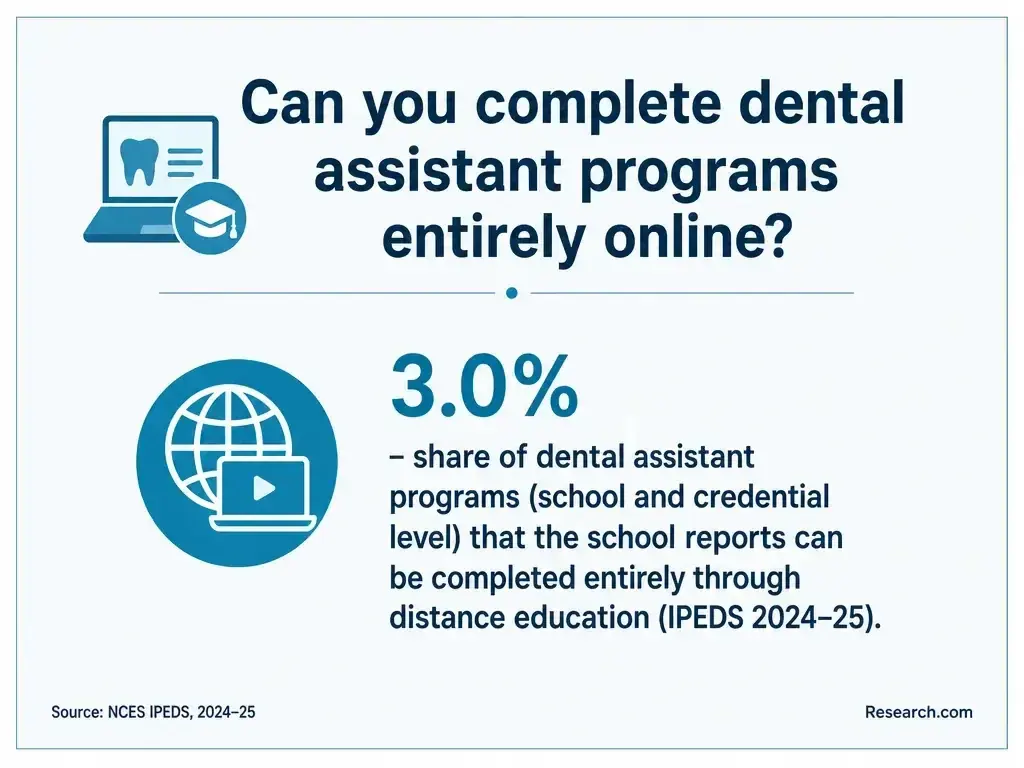
Online delivery can suit terminology, records, and other classroom topics. Chairside technique, infection-control practice, equipment use, and supervised patient care require in-person demonstration or assessment. A hybrid program is worthwhile only if its lab and clinical arrangements are practical from your Arkansas address and support the duties you intend to perform.
Ask who arranges clinical sites, whether placements are guaranteed or competitive, and whether travel or schedule restrictions apply. Do not assume an online certificate meets Arkansas requirements for registered or expanded duties; verify those requirements with the Arkansas State Board of Dental Examiners. Lists of non profit accredited online colleges may help you investigate an institution, but institutional accreditation does not replace dental-specific practical training or state eligibility checks.
There is no reliable single statewide average that captures public-college programs, private training, and employer-sponsored routes on the same basis. An IPEDS tuition figure can be useful for comparing eligible colleges, but it does not include every provider or necessarily every cost of becoming job-ready (National Center for Education Statistics, IPEDS).
Request a written, itemized total for tuition, mandatory fees, textbooks, uniforms and protective supplies, immunizations or background checks if required, certification examinations, state applications, and travel to labs or clinical sites. Then subtract grants or employer contributions for which you actually qualify. Federal aid eligibility depends on the institution and program, not merely on whether a school advertises dental assisting (Federal Student Aid). Ask Arkansas workforce-service staff whether you qualify for training assistance before borrowing.
For a meaningful return-on-investment comparison, include program duration, earnings forgone during training, expected starting pay, aid, likely debt payments, your chance of completing, and how long you expect to work in the occupation. A paid office position may have lower upfront cost but offer less structured instruction; an inexpensive campus program may cost more overall if clinical travel prevents you from working.
Depending on the provider, you may receive a certificate, diploma, or associate degree; employer training may instead document workplace competencies. The award tells you what you completed, not automatically which duties Arkansas permits you to perform. Confirm the exact credential name and whether the curriculum supports any state registration or duty-specific requirements you seek (Arkansas State Board of Dental Examiners).
Institutional accreditation concerns the school; CODA programmatic accreditation concerns an eligible dental assisting program; state school authorization concerns permission to operate; DANB certification is a professional credential; and Arkansas registration or other board requirements concern regulated duties. None substitutes automatically for another (Commission on Dental Accreditation; Dental Assisting National Board; Arkansas State Board of Dental Examiners). If a program advertises certification preparation, ask which examination it prepares you for and whether graduates meet that certifier's eligibility rules.
Admissions rules vary. Providers may require a high school diploma or equivalent and may set additional prerequisites for clinical participation, such as health documentation or a background check. Ask for the written admissions policy and the separate clinical-site requirements before paying a deposit; admission to a classroom program does not necessarily secure a patient-care placement.
If you already work in a dental office, ask whether documented experience can satisfy any course requirement or qualify for credit. Get any prior-learning or transfer-credit decision in writing, along with its effect on tuition and time to completion. Employer-sponsored entry may be faster, but ask who supervises training and how the office handles functions that require additional Arkansas qualifications.
A useful curriculum connects classroom knowledge to repeatable clinical skills: preparing instruments and treatment areas, applying infection-control procedures, assisting during procedures, communicating with patients, and maintaining accurate records (U.S. Bureau of Labor Statistics, Occupational Outlook Handbook). Depending on its scope, a program may also teach dental imaging concepts, materials, scheduling, and insurance workflow.
Look beyond a course catalog's topic list. Ask to see how instructors assess chairside performance, how students practice before seeing patients, and which tasks they complete under supervision. Imaging and other expanded functions merit special scrutiny: instruction in a topic is not proof that Arkansas permits a graduate to perform that duty (Arkansas State Board of Dental Examiners).
Do not treat "dental assistant" as a single license covering every task. Arkansas distinguishes basic assisting work from duties subject to board rules, registration, or additional qualifications. Before enrolling, identify the tasks in the jobs you want - particularly radiography and other expanded functions - and check the current requirements for each with the Arkansas State Board of Dental Examiners. Graduation alone does not establish authorization.
DANB's Certified Dental Assistant credential is a separate national professional certification with its own eligibility and examination requirements; it is not a substitute for Arkansas rules (Dental Assisting National Board; Arkansas State Board of Dental Examiners). Ask a school to identify precisely which board requirements its graduates can meet, what further application or examination steps remain, and whether an employer can train you for your intended entry-level role.
Start with your intended job, then compare only options that can realistically get you there. The following checks help separate a low advertised price from a low-cost, usable pathway:
NorthWest Arkansas Community College, University of Arkansas-Pulaski Technical College, and Arkansas Northeastern College are examples of institutions a prospective student can contact when checking current offerings; verify that a suitable dental assisting program is actually enrolling before comparing it. Red flags include a promised job or salary, unclear clinical access, or a claim that accreditation alone authorizes expanded duties. If your goal is an easy bachelor degree, dental assistant trade training is not a substitute; judge this investment against the occupation you actually want.
The direct path is an entry-level chairside or office-support role. With experience and any required Arkansas qualifications, an assistant may seek expanded responsibilities, specialize in a type of practice, or move toward scheduling, treatment coordination, or office management. These are potential paths, not automatic promotions, and additional education may be necessary for occupations such as dental hygiene (U.S. Bureau of Labor Statistics; Arkansas State Board of Dental Examiners).
When comparing trade school jobs, focus on whether the work itself suits you: dental assisting combines close patient contact, precise infection-control habits, teamwork, and often a practice's appointment-driven schedule. Ask local offices which additional skills they value before paying for an optional credential.
National employment of dental assistants is projected to increase 7.4% from 2025 to 2035 (U.S. Bureau of Labor Statistics, Employment Projections). That signals demand across the U.S.; it does not measure Arkansas openings or guarantee a position near a particular campus. Use Arkansas labor-market projections and current postings to check the communities where you can work, then ask prospective training providers which local practices host clinical students.
Pay attention to what postings require, not just how many appear. If nearby employers consistently request experience with imaging or specified expanded duties, choose training that provides the appropriate instruction and a clear route to Arkansas eligibility. If they train entry-level assistants in-house, compare that paid route with the cost and clinical advantages of school.
Investing in training is a consequential decision, so Research.com designed this ranking to help readers compare dental assistant programs with other options in the same occupation and location. The team checks multiple education and occupational sources to improve the ranking's credibility and accuracy. Only programs with completions reported to the Integrated Postsecondary Education Data System (IPEDS) are eligible; an unlisted employer-training or private-school option is not necessarily poor quality.
The most affordable ranking scores costs and debt only: tuition, cost of attendance, median student debt, and federal loan default rate. Weights are assigned through an entropy-based method, which gives more weight to measures that differ more across eligible programs. Accreditation and other quality indicators are not part of this affordability score. For comparison, Research.com's separate best programs rankings consider completion and retention, earnings and return on investment, costs and debt, accreditation or relevant industry recognition, and student support. Their current weights are 20% for programmatic accreditation or industry recognition, 10% for institutional accreditation, 10% for student support, and 60% for outcomes, earnings, and costs, distributed through the entropy-based method.
The team uses the following sources to evaluate eligible programs and check relevant education and occupational information:
These sources do not cover every dental-office training arrangement. Use the ranking to narrow your search, then confirm each program's current charges, clinical access, and Arkansas-specific eligibility directly. More detail on the ranking approach is available in Research.com's methodology.
# 1 position
# 2 position
# 3 position
An employer-sponsored entry-level position may minimize upfront tuition and allow you to earn while learning. Compare its supervision and access to required qualifications with the full net cost and clinical training of a school program; the cheapest advertised tuition is not always the cheapest route to your intended job.
Some coursework can be remote, but chairside skills and supervised clinical practice require in-person participation. Confirm a hybrid program's lab and placement arrangements before enrolling.
No. Check each intended duty and its current registration, training, or other requirements with the Arkansas State Board of Dental Examiners. A school certificate and state authorization serve different purposes.
No. CODA accredits eligible dental assisting programs; institutional accreditation evaluates the school. Neither alone establishes Arkansas eligibility for a particular duty (Commission on Dental Accreditation; Arkansas State Board of Dental Examiners).
No. Use it to shortlist options, then verify total cost, clinical hours, completion information, commute, credential, and eligibility for the work you want. Rankings based on reported college data may not include employer training or every private provider.