# 1 position
Wytheville Community College - Dental Assisting/Assistant.
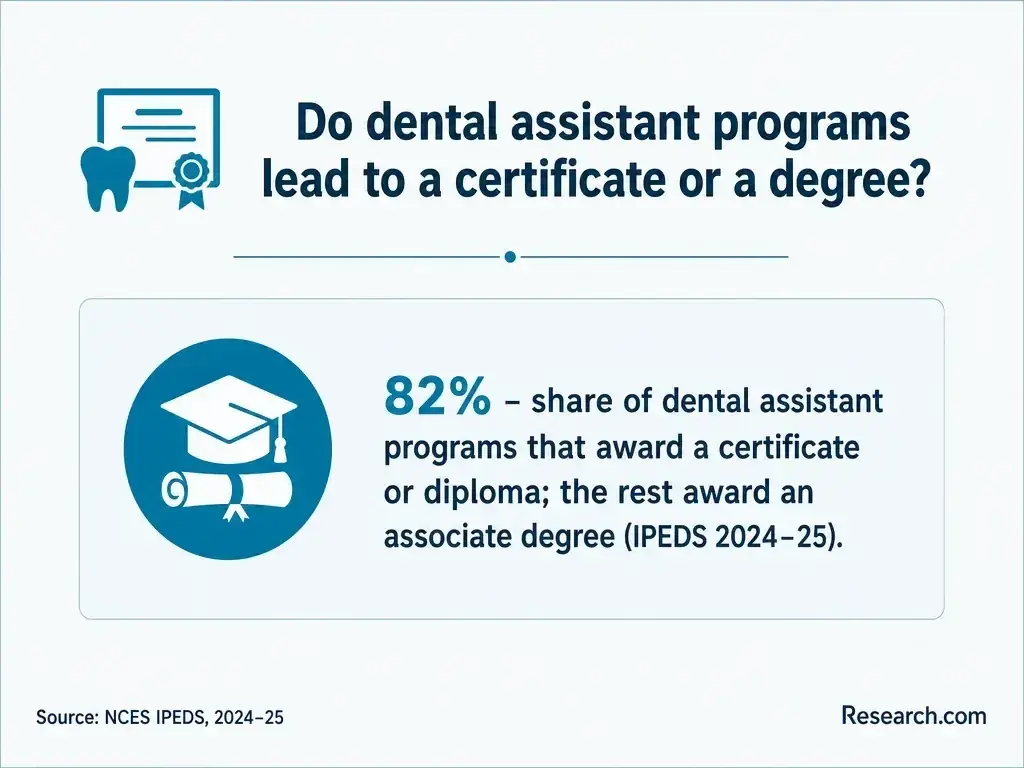
certificate or diploma

Audited and Verified:
Our Editorial and Data Verification Process
Research.com uses government datasets, official education statistics and primary institutional information to support its career and degree guides. Our review process checks factual accuracy, occupational definitions, source dates and the requirements associated with the credentials discussed.
How This Article Was Fact-Checked
Our editorial team verifies salary estimates, employment projections, education requirements and program information against original data providers and official organizations. Salary figures are checked against the relevant occupational definitions and reporting periods. Information about licensure, accreditation and required in-person training is reviewed separately.
Fact-checked and verified on:

Co-Founder and Chief Data Scientist

Reviewed by Karolina Broda
Fact-Checker and Data Verification
A low tuition price does not tell you whether dental assistant training will prepare you for the work you want to do in Virginia. The Research.com team of data scientists created the Most Affordable Dental Assistant Trade Schools in Virginia for 2027 ranking to help students identify programs worth considering. The decision matters: the U.S. Bureau of Labor Statistics projects dental assistant employment to grow 7.4% nationally from 2025 to 2035. This guide helps you compare total costs, hands-on training, credentials, and Virginia's rules before you enroll.
Expect instruction in patient preparation, infection control, instrument handling, dental materials, records, and chairside assistance, followed by supervised practice. Radiography and expanded functions need particular scrutiny because Virginia regulates who may perform specific duties; a course title alone does not grant permission to perform them (Virginia Board of Dentistry).
Training routes differ in what you receive for your time and money. This comparison helps distinguish a school credential from the workplace experience that may accompany it.
| Route | Typical credential or outcome | Best fit and key check |
| Community-college certificate | College-issued certificate | Students seeking structured labs and a documented curriculum; verify clinical placement and whether the specific program meets a certification or registration prerequisite. |
| Private career-school program | School-issued certificate or diploma | Students prioritizing a particular schedule; compare the all-in price and independently verify school authorization and any claimed program accreditation. |
| Employer-sponsored training | Workplace skills; any external credential requires separate verification | People who can obtain a supervised entry-level position; ask which duties are taught, whether training is paid, and how radiography or expanded-duty eligibility is addressed. |
| Registered apprenticeship, where available | Work-based training and the sponsor's specified completion credential | People seeking paid, structured training; confirm that an actual dental-assisting sponsor and position are available locally. |
A public college is not automatically cheaper after fees and travel, and a short private program is not automatically faster to employment. Ask each provider how much practice occurs in labs, clinics, or dental offices and who arranges the placement.
Dental offices are the primary workplace for dental assistants nationally, according to the U.S. Bureau of Labor Statistics. In Virginia, positions may involve general dentistry or specialty practices such as orthodontics and oral surgery. Compare openings near your home with openings near a school: an affordable program can become expensive if clinical rotations or a first job require a long commute.
A practice's needs also affect the training that is useful. If a posting emphasizes radiographs, ask the employer and the Virginia Board of Dentistry what preparation permits that work. If it emphasizes scheduling and records, a program with strong office-work instruction may be useful, but it should not replace hands-on chairside training when chairside work is your goal.
Pay varies by Virginia labor market, employer, experience, and permitted duties. For context - not as a Virginia pay figure - the national median annual wage for dental assistants was $48,070 in May 2025 (U.S. Bureau of Labor Statistics, Occupational Outlook Handbook). A median describes workers already in the occupation; it does not predict a new trainee's offer.
For a local decision, compare current entry-level postings in the area where you intend to work with Virginia-specific dental-assistant wage estimates from the U.S. Bureau of Labor Statistics' Occupational Employment and Wage Statistics or Virginia labor-market resources. Check the posting's hours and benefits as well as pay: a higher hourly offer may not offset a costly commute or fewer scheduled hours.
There is no single statewide program length for every entry-level dental-assisting route. A school certificate may take months, while a longer college pathway can include more coursework and clinical experience; an employer-trained assistant learns on the job. Published calendars can also omit the wait for a clinical placement. Ask for the program's actual clock or credit hours, laboratory hours, supervised practice requirements, and the expected time from enrollment to completion.
If you are comparing a longer college option with a fast-track associates degree, first establish whether the specific dental-assisting pathway awards an associate degree and whether its practical training and credential match your intended duties. Speed is a poor bargain if required in-person experience must still be arranged afterward.
Online coursework can cover terminology, anatomy, records, and infection-control concepts. It cannot, by itself, demonstrate safe chairside technique, instrument processing, or patient-care skills. A hybrid program may offer scheduling flexibility, but the location, supervision, and cost of its labs and clinical work determine whether it is workable for you.
A search for the cheapest online schools for working students can help frame a scheduling comparison, not establish that an online dental-assisting program meets Virginia duty requirements. Ask who secures the local practice placement and whether the required in-person work fits your job schedule. Do not assume an online certificate qualifies you for radiography, national certification, or Dental Assistant II registration (Virginia Board of Dentistry; Dental Assisting National Board).
There is no single reliable statewide average that covers public programs, private schools, and employer-sponsored training on the same basis. Published tuition is only one part of the amount you may need to become job-ready. Resident and nonresident tuition can differ at public colleges, and a low-cost program with a distant clinical site can cost more to attend than its tuition suggests.
Request an itemized estimate from each provider. The following costs are worth checking before comparing offers:
Ask the financial-aid office whether this specific program qualifies for federal aid or Virginia assistance; institutional eligibility does not mean every short program qualifies (Federal Student Aid). Virginia Career Works may be able to assess eligibility for workforce-training support. Compare any grants or paid employer training against the full cost, not just the tuition bill. A sound return-on-investment estimate also considers completion likelihood, your current earnings, expected post-training earnings, debt payments, and how long you expect to work in the occupation.
The credential depends on the provider: it may be a certificate, diploma, or associate degree. These are educational awards, not interchangeable with a professional certification or a state registration. The Dental Assisting National Board (DANB) administers professional certifications, while Virginia's Board of Dentistry governs state dental-assisting duties and Dental Assistant II registration (DANB; Virginia Board of Dentistry).
Ask for the exact credential name before enrolling. Then verify separately whether the program has institutional accreditation, whether its dental-assisting curriculum has Commission on Dental Accreditation (CODA) accreditation if your goal requires it, and whether its graduates can satisfy the current requirements for the credential or duties you want. State authorization to operate a school, institutional accreditation, programmatic accreditation, certification eligibility, and occupational registration answer different questions; none automatically substitutes for another.
Requirements vary by provider. A school may ask for evidence of secondary-school completion, placement assessment, or prerequisite coursework. Clinical sites may impose additional health, immunization, or background-check conditions. Employer-sponsored entry positions have their own hiring requirements. Obtain the current written admissions and placement policies rather than assuming a school's general admissions policy covers its dental-assisting program.
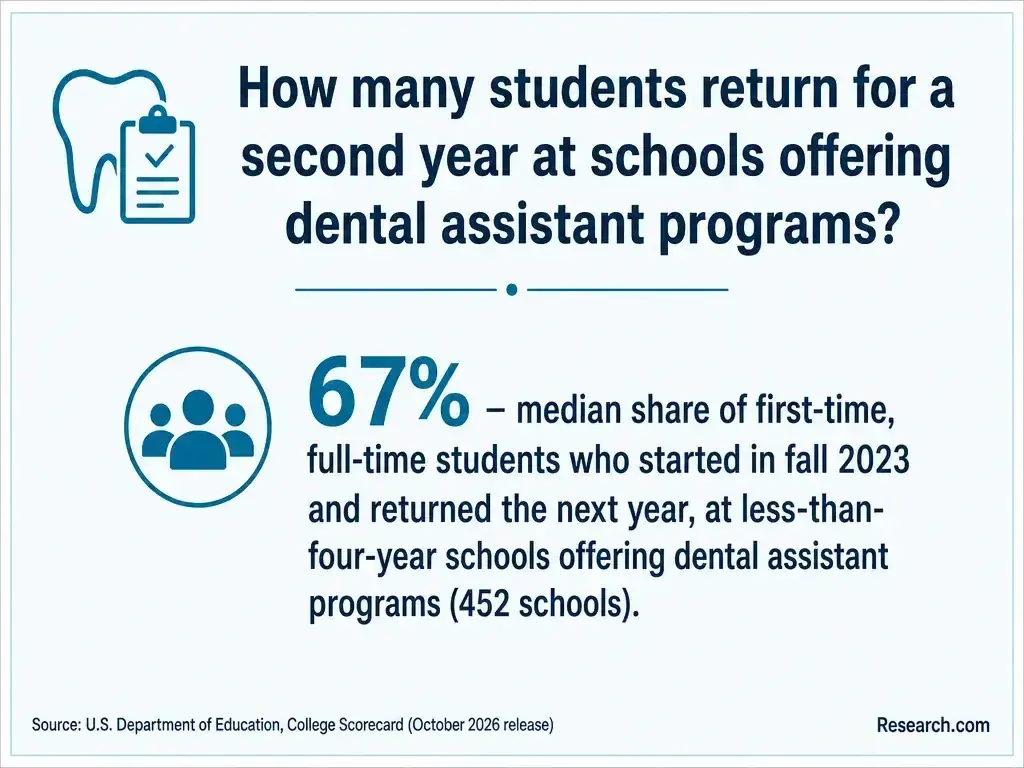
Even if you are exploring open enrollment colleges, check whether dental-assisting labs have limited seats or clinical-placement requirements. Before paying a deposit, ask when you can begin practical work, what happens if you cannot secure a placement, and whether prior coursework or documented work experience can reduce required classes without compromising credential eligibility.
A useful curriculum connects dental terminology and anatomy to practical tasks: preparing treatment rooms, maintaining infection-control procedures, assisting at chairside, handling materials and instruments, documenting care, and communicating with patients. The U.S. Bureau of Labor Statistics identifies these as central dental-assistant duties. Ask to see a skills checklist and find out which tasks you practice on equipment and which you merely study.
Digital imaging and electronic records make technology practice relevant, but a software demonstration is not a substitute for supervised clinical competence. Check how the program teaches radiography safety and identifies duties that Virginia restricts by training or registration. Supervised experience should also assess reliability, patient privacy, and communication - the workplace skills a practice will observe immediately.
Not every dental-assisting position requires the same state credential. Virginia distinguishes entry-level dental-assisting duties from expanded duties performed by a registered Dental Assistant II. It also sets requirements for dental radiography. DANB certification is a professional credential, not a general license to perform every dental-assisting task in Virginia (Virginia Board of Dentistry; DANB).
Start with the duties in the jobs you want, then check the Virginia Board of Dentistry's current regulations and application instructions for each restricted duty or registration. Ask a school to identify the precise coursework, examination, supervised experience, and documentation its graduates will have - not simply whether they receive a certificate. If you might work across a state line, check that state's rules independently; Virginia eligibility does not automatically transfer.
Choose the least costly viable route to your intended job, not necessarily the program with the lowest advertised tuition. A student seeking entry-level chairside work may find supervised employer training practical; someone targeting expanded duties should put the applicable Virginia eligibility requirements ahead of speed. To test a shortlist, ask providers these questions in order:
A ranking can narrow your search, but it cannot replace those answers. Verify accreditation claims with the named accreditor and duty requirements with the Virginia Board of Dentistry. If search results lead you to phd programs that do not require a dissertation, set them aside for this decision: they are not a dental-assisting entry route.
One path is entry-level chairside assistance, followed by experience in general or specialty practices. Depending on the duties sought, an assistant may pursue additional radiography preparation, DANB certification, or the requirements for Virginia Dental Assistant II registration. These steps serve different purposes; do not assume that experience alone authorizes expanded duties (Virginia Board of Dentistry; DANB).
Experienced assistants may also take on scheduling, treatment coordination, or practice-support responsibilities if an employer offers those roles. Ask whether a proposed credential advances the work you actually want to do. A one year doctorate, for example, is not an alternative route to dental-assistant registration.
The U.S. Bureau of Labor Statistics projects 7.4% national employment growth for dental assistants from 2025 to 2035. That is evidence of broader occupational demand, not a forecast for a particular Virginia county or a guarantee of placement. For a local decision, compare recent openings in your intended commuting area and ask programs where their clinical partners hire.
Look beyond the number of postings: check whether employers request radiography preparation, certification, or experience that your chosen route will not provide. A program is a stronger investment when its practical training matches the requirements of reachable openings - not merely when national growth looks favorable.
Investing in training is a consequential decision, so Research.com designed this ranking to make local cost comparisons more transparent. Programs are compared with others in the same occupation and location; only programs with completions reported to the Integrated Postsecondary Education Data System (IPEDS) are eligible. That coverage limit means an employer-training route or other provider absent from IPEDS is not necessarily unavailable or unsuitable.
The most affordable ranking scores tuition, cost of attendance, median student debt, and federal loan default rates. Weights are assigned using an entropy-based method, which gives more weight to measures that differ more across programs. Accreditation, student support, completion, and earnings are not part of this affordability score. They still matter to your enrollment decision, so use the ranking as a cost-focused starting point rather than a verdict on job readiness.
Research.com consulted the following data sources to assess reported program information and relevant recognition:
These sources serve different purposes: appearing in an accreditation or certification source does not itself establish that a particular school meets Virginia's dental-assisting requirements. Readers can find further detail on the Research.com methodology page.
# 1 position
# 2 position

# 3 position
# 4 position
# 5 position

# 6 position

# 7 position
# 8 position

# 9 position
# 10 position
# 11 position

No. Compare total cost, clinical placement, completion outcomes, and whether the training supports the Virginia duties you want to perform.
Employer-sponsored, supervised training may be an entry-level route. Check the Virginia Board of Dentistry's requirements before assuming it also qualifies you for radiography or expanded duties.
Do not assume so. Ask how you will complete and document hands-on competencies and whether the program supports any certification or state-registration goal.
No. A school award and Virginia Dental Assistant II registration are separate. Verify the Board of Dentistry's current requirements against the program's curriculum before enrolling.
Get an itemized cost estimate, written clinical-placement policy, exact credential name, and a clear explanation of which requirements remain before you can perform your intended duties.