# 1 position


Audited and Verified:
Our Editorial and Data Verification Process
Research.com uses government datasets, official education statistics and primary institutional information to support its career and degree guides. Our review process checks factual accuracy, occupational definitions, source dates and the requirements associated with the credentials discussed.
How This Article Was Fact-Checked
Our editorial team verifies salary estimates, employment projections, education requirements and program information against original data providers and official organizations. Salary figures are checked against the relevant occupational definitions and reporting periods. Information about licensure, accreditation and required in-person training is reviewed separately.
Fact-checked and verified on:

Co-Founder and Chief Data Scientist

Reviewed by Karolina Broda
Fact-Checker and Data Verification
Choosing affordable dental assistant training in Melbourne means looking beyond tuition: a low-cost course may leave you paying separately for the hands-on preparation needed for the work you want. The Research.com team of data scientists created its Most Affordable Dental Assistant Trade Schools in Melbourne for 2027 ranking to help students identify programs worth considering. The U.S. Bureau of Labor Statistics projects 7.4% national growth in dental assistant employment from 2025 to 2035. This guide helps new students and career changers compare costs, credentials, Florida requirements, and routes into local dental offices.
Expect instruction in chairside assistance, infection control, instrument handling, patient preparation, dental terminology, and office workflow. A useful program also shows how students practice these tasks: in a simulation lab, through a supervised placement in a dental office, or both. Ask for the actual lab schedule and placement arrangements, not just a course description.
Melbourne-area students should compare a structured certificate or diploma with employer-provided training for basic assisting. A school program may offer more predictable instruction and documented competencies; direct entry may let you earn while learning but depends on an office willing to train you. Neither route automatically authorizes Florida expanded duties or radiography. Unlike broad comparisons of college majors, this decision turns on specific clinical tasks and the preparation required to perform them.
The principal destination is a dental office, including general and specialty practices. Dental assistants prepare treatment areas, support dentists during procedures, help maintain infection-control processes, and may handle scheduling or records; permitted clinical tasks depend on training and Florida rules. The U.S. Bureau of Labor Statistics identifies dentists' offices as the main national employer of dental assistants.
For a Melbourne job search, include practices elsewhere in Brevard County if the commute is realistic. That widens the set of offices and potential supervised-training opportunities, but travel costs and schedules belong in your training budget. Ask prospective employers whether an opening is primarily chairside, administrative, or both - and whether they train new hires in the duties listed in the posting.
A verified Melbourne-specific wage should be your preferred benchmark when one is available for the same occupation and reference period. In its absence, the U.S. Bureau of Labor Statistics' May 2025 national median annual wage of $48,070 for dental assistants offers context, not a local salary prediction. The median includes experienced workers and varied workplaces, so do not use it as an expected first offer.
Before committing to tuition, compare current local job-posting pay ranges with your likely starting duties and schedule. Then estimate what you would earn while training, what you might forgo by reducing work hours, and how long any debt would take to repay. A modest tuition saving can disappear if a program's timetable delays employment or requires extensive unpaid travel.
There is no single Melbourne-wide program length or clock-hour requirement for all basic dental assisting jobs. Certificate and diploma schedules, part-time options, lab time, and placements vary by provider. Employer training follows the workplace's needs rather than a common school calendar. Ask each provider for its published start-to-finish schedule and a breakdown of classroom, lab, and supervised clinical hours.
Choose an accelerated schedule only if it leaves enough time to practice chairside skills and complete any preparation required for your intended Florida duties. A quick course is not necessarily a quick route to those duties. Lists of quickest degrees that make the most money use a different comparison; for this occupation, the useful measure is time until you can perform the work an employer needs.
Online coursework can cover terminology, anatomy, records, and infection-control principles. It cannot by itself demonstrate how a student passes instruments, prepares a treatment area, or works safely beside a patient. A hybrid program can be practical if it provides accessible in-person labs and supervised clinical experience; an on-campus program may make those sessions easier to schedule, but still warrants a check of what hands-on work is included.
Before paying for an online course, obtain written answers about where practical sessions occur, who arranges placements, and whether its training supports the Florida duties you seek. General lists of cheap online masters are not a substitute for that occupation-specific check. Avoid a course that markets itself as entirely online while leaving essential clinical practice for the student to find independently.
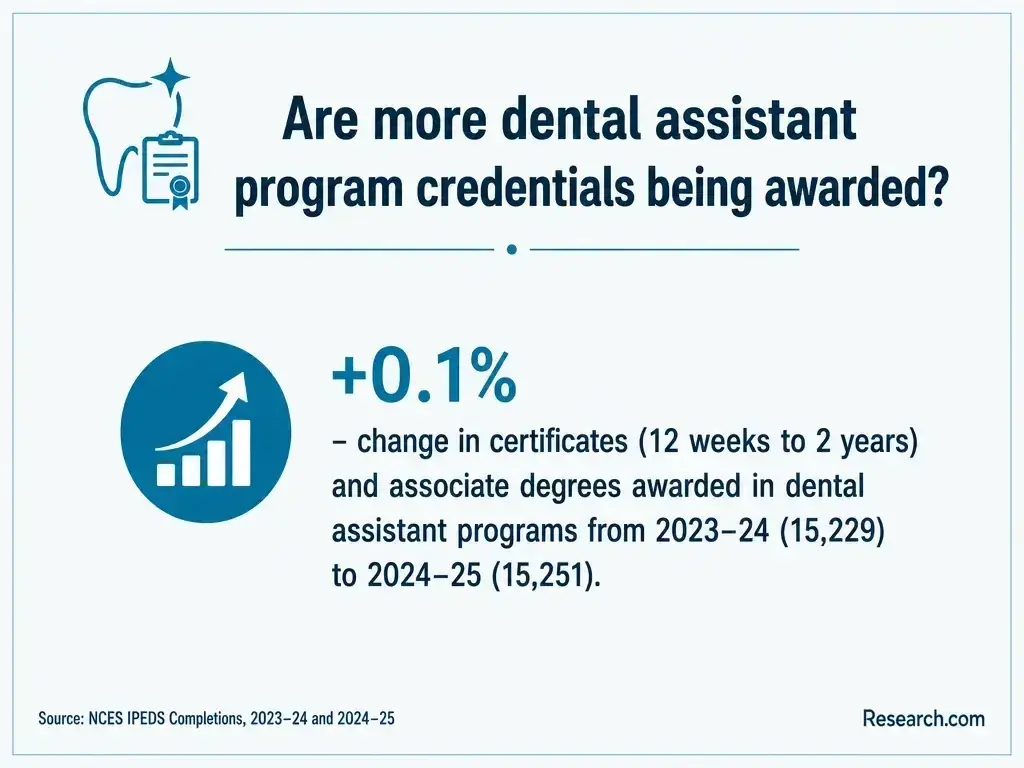
A defensible Melbourne-wide average is not available here: prices depend on the provider, residency rules, schedule, and what a quoted price includes. Rather than treating an advertised tuition figure as the total, request an itemized, current quote for the intake you would attend. The comparison below shows which costs can change the apparent bargain.
| Cost to compare | Why it matters |
| Tuition and mandatory fees | Establishes the amount owed to the school and whether lab or placement fees are separate. |
| Supplies and entry expenses | May include textbooks, uniforms, protective equipment, health checks, background screening, and applicable examination fees. |
| Travel and time away from work | Lab and clinical locations can increase commuting expenses or reduce earnings. |
| Aid and paid training | Eligible grants, scholarships, workforce assistance, or employer wages can reduce out-of-pocket cost; eligibility varies. |
Ask the school whether its specific program qualifies for federal student aid; institutional participation alone does not establish program eligibility. Compare the net cost to become job-ready, including likely debt, with an employer-training offer if one is available. The most affordable program in a ranking may still be the wrong investment if it omits the practical preparation you need.
Depending on the provider, completion may lead to a certificate, diploma, or another documented training award. An employer-trained assistant may instead have a record of workplace training. These are not interchangeable with professional certification: the Dental Assisting National Board (DANB) sets separate eligibility and examination requirements for its credentials.
Check the exact award printed on the program's current catalog page and whether its curriculum addresses your intended Florida duties. Commission on Dental Accreditation (CODA) program accreditation, institutional accreditation, Florida authorization to operate, and eligibility for particular expanded duties are distinct questions. Do not infer one from another - or from a credential's name.
Requirements are provider-specific. A school may assess educational readiness and require immunization records, a background check, or other documentation before a clinical placement; an employer may instead hire for a basic assisting role and train on the job. Request the current admissions checklist and ask which conditions apply at enrollment versus before clinical work.
If you already have relevant workplace experience, ask whether the provider evaluates prior learning or offers advanced standing, and get the decision in writing. Do not assume previous experience replaces a course or assessment required for a particular Florida expanded duty. If considering Eastern Florida State College, verify the current catalog, program availability, admissions requirements, and any placement conditions directly before planning around a proposed start date.
Core instruction generally connects infection prevention and patient communication to the sequence of a dental visit: preparing the room, supporting a procedure, processing instruments, and documenting care. Clinical practice matters because knowing the sequence is different from performing it safely and efficiently. The U.S. Bureau of Labor Statistics describes both clinical support and office tasks within the occupation.
When comparing syllabi, look for supervised practice and feedback on chairside techniques, sterilization, and workflow - not merely a list of topics. Ask which procedures students observe, simulate, and perform under supervision. Training in radiography or expanded functions deserves its own check against Florida Board of Dentistry requirements; a general dental assisting module may not meet them.
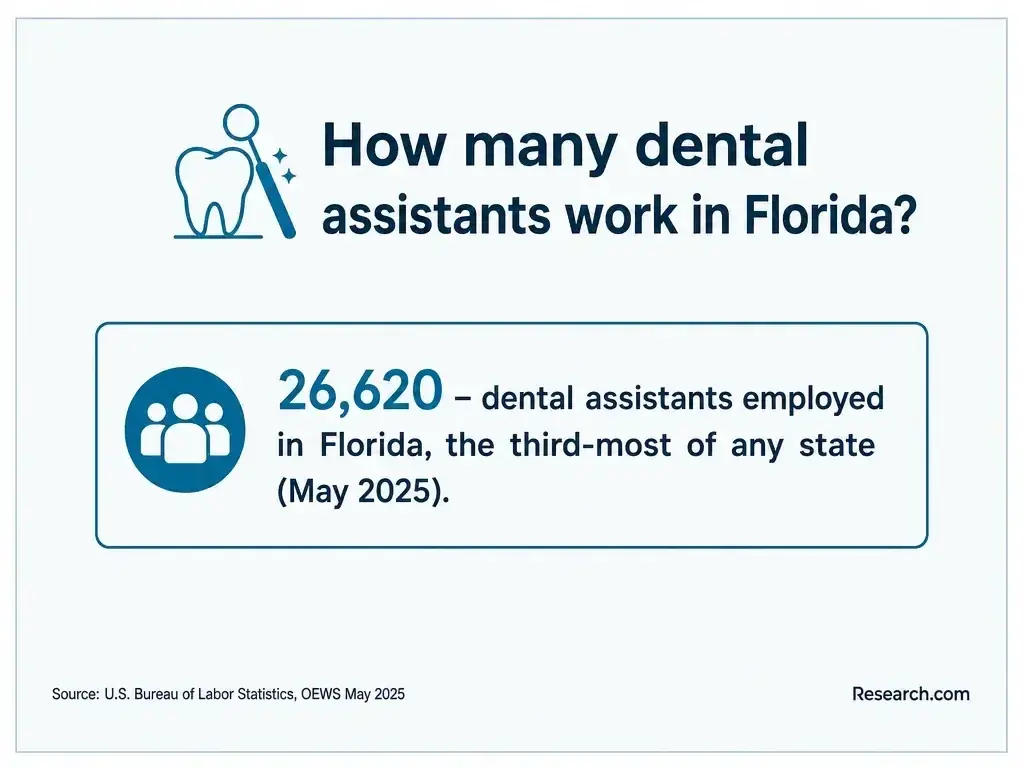
Florida does not generally issue an occupational license for basic dental assisting. That does not mean every assistant can perform every task: Florida Board of Dentistry rules govern expanded functions and dental radiography, including the qualifying training applicable to those duties. Confirm the specific duties you want with the board's current requirements before choosing a course. Requirements elsewhere may differ if you later move.
DANB certification is a separate professional credential, not a substitute for Florida's rules on permitted duties. Likewise, school accreditation does not itself grant permission to perform a procedure. Ask a provider to identify, in writing, the precise Florida duty or certification eligibility its curriculum supports and the additional steps, if any, you must complete.
Start with the job you want, then compare programs on total cost, supervised practice, schedule, and preparation for the duties employers expect. A ranking can narrow the options, but an affordability score does not measure whether a lab or clinical experience fits your goal. Broad guides to an easiest doctoral program answer a very different question; here, demonstrated chairside preparation matters more than the ease of completing coursework.
Use the following checks when speaking with admissions staff and local employers. They turn a low advertised price into a comparison you can act on.
A red flag is a provider that promises certification, permission to perform every dental task, or a particular salary merely for finishing its course. Seek written evidence and verify regulatory claims independently before paying a deposit.
A common starting point is general-practice chairside support, with experience potentially leading to specialty-practice work, more responsibility for permitted clinical duties, or office coordination. Advancement depends on employer needs, demonstrated skills, and any additional training required for the tasks - not simply time served. DANB certification may be useful for professional development or employer preferences but is distinct from Florida's duty-specific rules.
If your goal is office administration rather than patient-side work, ask whether a clinical-heavy program is worth its cost. Conversely, someone seeking hands-on clinical work should not choose a mostly administrative course because its title sounds similar. Other trade schools careers involve different training and entry rules; judge this pathway against the dental office role you actually want.
The U.S. Bureau of Labor Statistics projects 7.4% national employment growth for dental assistants from 2025 to 2035. That supports considering the occupation, but it does not measure openings in Melbourne or guarantee a job after training. Local hiring, commuting range, and whether practices need entry-level or already-trained assistants will affect your opportunities.
Before enrolling, review current Brevard County postings for required duties and experience, then ask placement staff or employers how often they hire new assistants. If nearby openings expect expanded-duty preparation, a cheaper basic course may require further training. If an office will train a new hire for the role you want, compare that paid route before taking on school debt.
Investing in training is an important decision. Research.com created the ranking to help readers compare dental assisting programs against other programs serving the same occupation and location, rather than against unrelated schools. The team uses multiple education, cost, and recognition sources to check the quality and credibility of the information. Only programs with completions reported to IPEDS are eligible; an omitted employer-training option or other provider is not necessarily unavailable or poor quality.
The Most Affordable ranking scores costs and debt only: tuition, cost of attendance, median student debt, and federal loan default rate. Indicator weights are assigned using an entropy-based method, which gives more weight to measures that vary more across eligible programs. Accreditation, practical-training quality, and other quality indicators are not part of this affordability score. Readers should check those factors separately before enrolling. More detail is available in Research.com's ranking methodology.
The ranking draws on the following sources. Some cover the broader trade-school research process rather than dental assisting specifically; for example, NCCER is not a dental assisting accreditor.
# 1 position
# 2 position
Ask local offices whether they hire and train assistants for basic duties, then compare any paid offer with the full cost of a school program. Confirm what additional preparation you would need for expanded duties or radiography under Florida Board of Dentistry rules.
An online course may teach theory, but it cannot replace in-person chairside practice. Check its lab and clinical arrangements and do not assume it meets requirements for particular Florida duties.
Florida does not generally license assistants for basic assisting, and DANB certification is separate from state rules. Expanded functions and radiography have their own qualifying-training requirements; check the duties you intend to perform with the Florida Board of Dentistry.
No. Eligibility requires program completions reported to IPEDS, so employer training and other options may not appear. Compare those routes separately, and assess hands-on preparation as well as ranked cost.
It can be if the program provides supervised skills and duty-specific preparation you need at a manageable net cost. Compare its total price, time away from work, and likely debt with employer training and the requirements in local job postings.