# 1 position


Audited and Verified:
Our Editorial and Data Verification Process
Research.com uses government datasets, official education statistics and primary institutional information to support its career and degree guides. Our review process checks factual accuracy, occupational definitions, source dates and the requirements associated with the credentials discussed.
How This Article Was Fact-Checked
Our editorial team verifies salary estimates, employment projections, education requirements and program information against original data providers and official organizations. Salary figures are checked against the relevant occupational definitions and reporting periods. Information about licensure, accreditation and required in-person training is reviewed separately.
Fact-checked and verified on:

Co-Founder and Chief Data Scientist

Reviewed by Karolina Broda
Fact-Checker and Data Verification
The cheapest dental assistant program is not necessarily the least expensive route into a job: fees, clinical travel, and training for expanded duties can change the total. This guide is for Fort Lauderdale students comparing costs, credentials, and Florida requirements for 2027. The Research.com team of data scientists created the Most Affordable Dental Assistant Trade Schools in Fort Lauderdale for 2027 ranking to help students make an informed choice about programs worth considering. Nationally, dental assistants earned a median $48,070 in May 2025 (U.S. Bureau of Labor Statistics). Here, you'll learn how to judge the investment behind a listed price.
Expect training for chairside work: preparing treatment areas, assisting during procedures, sterilizing instruments, communicating with patients, and maintaining records. A useful program pairs instruction with supervised practice on dental equipment and, where offered, experience in a clinical setting. Ask how much practice is performed with patients or at an employer site rather than only in a classroom (U.S. Bureau of Labor Statistics).
There are several routes. A career-school certificate may suit someone seeking a shorter, structured start; a public-college certificate may appeal to someone comparing aid eligibility and scheduled clinical training. An employer may train a new assistant for basic duties, potentially reducing upfront tuition, but that training does not automatically confer eligibility for Florida expanded functions or radiography. A broader associate-degree pathway takes more time and should be chosen for its specific credential and career purpose, not because chairside work inherently requires a degree. Broward College is one local institution readers can check for current dental-related offerings and entry requirements; verify the specific program before making plans.
Do not select a program by a general list of college majors with best job prospects. For this occupation, the decisive question is whether the training and supervised practice match the duties you want a Florida dentist to assign you.
Dental offices are the principal workplace for dental assistants nationally (U.S. Bureau of Labor Statistics). In Fort Lauderdale, a sensible search extends across Broward County because a workable clinical placement or first job may be outside the city. General dentistry, specialty practices, and multi-location dental groups can differ in scheduling, patient volume, and the functions they expect an assistant to perform.
Ask prospective clinical sites and employers which duties they assign to new hires, whether they provide paid training, and whether radiography or expanded-function eligibility is expected on day one. That information can prevent paying for a credential that does not match the positions within your commuting range.
A verified Fort Lauderdale-specific wage figure is not presented here. As a benchmark, the U.S. median annual wage was $48,070 in May 2025 for dental assistants (U.S. Bureau of Labor Statistics). This is the midpoint for workers nationwide, including experienced assistants - not a starting-pay estimate for a local graduate.
Before using wages to justify tuition, review current Broward-area job postings for entry-level pay, required duties, and benefits. Compare the likely increase over what you earn now with the complete training cost and time away from paid work. Expanded duties may improve your fit for some openings, but they do not guarantee a particular wage.
There is no single Florida-wide program length for entry into basic dental assisting. Short courses, longer certificate programs, and workplace training differ substantially in scheduled hours and practical experience. A faster finish is useful only if its timetable leaves room to develop the chairside skills and meet the Florida requirements relevant to your intended duties (Florida Board of Dentistry; Florida Department of Health).
Request a written calendar showing classroom hours, lab hours, clinical hours, and any separate expanded-function or radiography course. Ask whether clinical placement is arranged by the school, how missed sessions are made up, and when you would actually be available to seek work. For someone already employed, evening availability and travel to a clinical site may matter more than the advertised number of weeks.
Online study can cover terminology, infection-control principles, records, and other theory. It cannot replace supervised practice in instrument handling, chairside procedures, or radiographic positioning. A hybrid program can work for a Fort Lauderdale commuter if its in-person labs and clinical site are accessible; an entirely remote certificate should not be assumed to prepare someone for every duty a local employer expects.
Flexible scheduling is a legitimate reason to compare the cheapest online colleges for working students, but confirm where this particular dental assistant program's practical work takes place. Obtain written confirmation of who arranges the site, whether travel is required, and whether the training meets the Florida pathway you intend to pursue (Florida Board of Dentistry; Florida Department of Health).
A defensible Fort Lauderdale average cannot be calculated from the prices available here: providers may quote different program lengths and include different supplies or clinical requirements. Treat any advertised tuition as a partial figure until the provider supplies an itemized, current quote. The comparison below shows what belongs in a job-ready budget.
| Cost component | What to confirm | Why it changes the comparison |
| Tuition and mandatory fees | Full-program price and payment schedule | A lower sticker price may exclude required charges. |
| Supplies and compliance | Books, uniforms, protective gear, background checks, or health requirements | These can be due before clinical work begins. |
| Additional credentials | Required courses, applications, and examination fees, if applicable | Expanded-duty or radiography preparation may be priced separately. |
| Time and travel | Clinical-site commute and unpaid hours away from work | Both affect affordability even when tuition is low. |
Ask the financial-aid office which charges are covered and which are not. Federal aid depends on the eligibility of the institution, program, and student; a payment plan is not a grant (Federal Student Aid). Employer-paid training, scholarships, and eligible workforce assistance can reduce out-of-pocket cost, while loans increase the amount ultimately repaid. If considering a longer credential, compare its complete price - not just an advertised associates degree online cost - with the additional training and opportunities it actually provides.
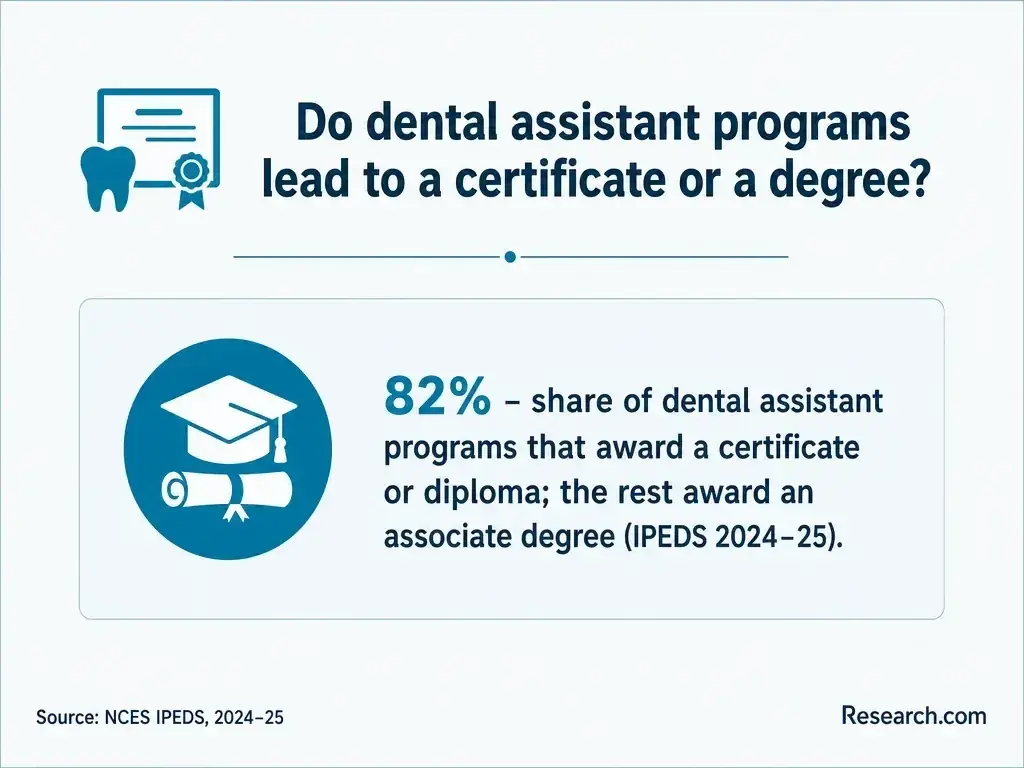
The award depends on the provider: it may be a certificate, diploma, or academic credential from a longer program. Employer training may produce documented work experience without a school award. None of these labels, by itself, establishes that the holder may perform every expanded duty or take dental radiographs in Florida (Florida Board of Dentistry; Florida Department of Health).
Keep four distinctions clear. A school's institutional accreditation concerns the institution; Commission on Dental Accreditation accreditation concerns a specific dental program. State authorization concerns permission to operate, while Florida's rules determine eligibility for regulated dental-assisting functions. Dental Assisting National Board certification is a separate professional credential, not a Florida general dental assistant license (Commission on Dental Accreditation; Dental Assisting National Board; Florida Board of Dentistry). Ask the provider to identify its exact award and document which requirements its training satisfies.
Requirements vary by provider. Ask whether admission requires a high school diploma or equivalent, an assessment, an interview, or prerequisite coursework. Clinical participation may bring separate health, immunization, or background-screening requirements set by the school or placement site. Check these before paying a nonrefundable enrollment charge.
Also ask when aid eligibility is determined. A list of low tuition universities online that accept financial aid cannot establish that a specific dental assistant trade program qualifies for federal aid. Confirm the program and your eligibility with its aid office and Federal Student Aid, and request a net-cost estimate in writing.
Core instruction commonly includes dental anatomy and terminology, infection control, instrument preparation, chairside assistance, patient communication, and records. Effective hands-on training lets students practice setup, passing instruments, maintaining a clean treatment area, and working safely around patients and the dental team (U.S. Bureau of Labor Statistics).
Examine the syllabus for any promised expanded-function and radiography content. Learning a procedure in class is not the same as qualifying to perform it under Florida rules. Have the provider identify the applicable approval or training route, the supervised practice involved, and the document you receive when it is completed (Florida Board of Dentistry; Florida Department of Health).
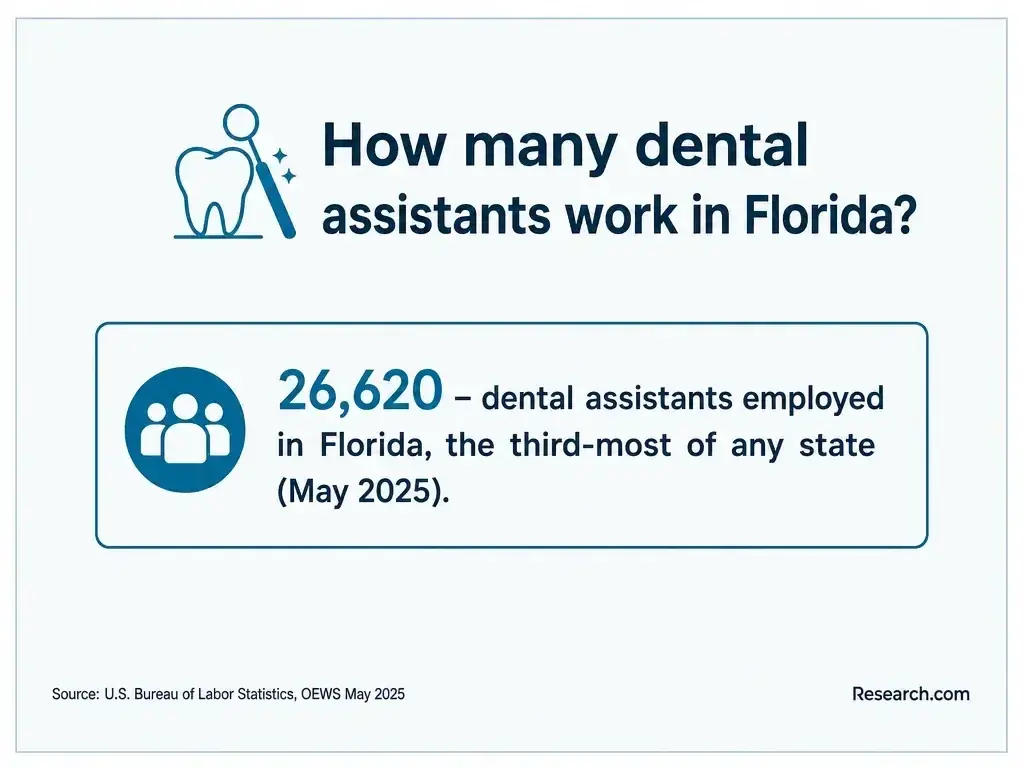
Florida does not issue a general occupational license for dental assistants. That does not mean every assistant may perform every task. Florida regulates expanded functions and dental radiography separately; the qualifying training, supervision, and documentation depend on the function. Dental radiography has a state certification process, while a national professional certification is a distinct credential (Florida Board of Dentistry; Florida Department of Health; Dental Assisting National Board).
Before enrolling, name the duties you want to perform and ask the school how its graduates meet the current Florida requirements for each one. Verify the answer with the Florida Board of Dentistry or Department of Health rather than relying on "certification included" in an advertisement. Institutional accreditation, a course-completion certificate, and permission to perform a regulated function are not interchangeable.
Start with the duties and employers you are targeting, then compare programs on job readiness and total cost. An inexpensive short course may be a good fit if an employer will provide substantial supervised training. A program with more lab and clinical time may be worth a higher price when you need structured practice or a defined route toward additional functions.
Use these checks when speaking with admissions staff; request documents rather than accepting a verbal assurance:
A ranking helps narrow the search, but it cannot resolve these individual questions. Unrelated comparisons such as easy masters do not measure chairside readiness or Florida eligibility. The strongest investment is the option you can complete, afford, and use for your intended duties - not automatically the lowest tuition or fastest schedule.
A common starting point is general-practice chairside assistance. With appropriate training and experience, an assistant may pursue expanded functions, dental radiography eligibility, specialty-practice work, or lead-assistant responsibilities. Some move toward scheduling, treatment coordination, or office operations. These are possible paths, not automatic promotions; employers set role expectations, and Florida rules still govern regulated functions (Florida Board of Dentistry; U.S. Bureau of Labor Statistics).
For someone weighing college majors with best job prospects against a quicker occupational route, dental assisting offers a more specific question: do you want daily patient-facing, hands-on work in a dental practice? If not, paying for chairside training solely because it appears affordable is unlikely to be a sound choice.
National employment of dental assistants is projected to grow 7.4% from 2025 to 2035 (U.S. Bureau of Labor Statistics). That signals continued demand across the occupation, but it is not a Fort Lauderdale hiring forecast and does not show how many openings will suit a new applicant.
For a local decision, compare current Broward-area postings with each program's training: note requested chairside experience, radiography status, expanded functions, schedules, and commute. A program is more compelling when its practical components prepare you for openings you could realistically accept. Do not treat national growth - or a school's placement claim without a defined measurement period - as a job guarantee.
Investing in training is a consequential decision. Research.com developed this ranking to help readers compare affordable dental assistant programs against other programs in the same occupation and location, rather than against unrelated trades. The team reviews reported cost and debt measures for consistency and credibility; readers should still confirm current prices and Florida-specific training eligibility directly with each provider.
Only programs with completions reported to IPEDS are eligible. The most affordable ranking scores tuition, cost of attendance, median student debt, and federal loan default rate, with weights assigned through an entropy-based method. Accreditation, clinical training, and other quality indicators are not part of that affordability score. By contrast, Research.com's separate best-program rankings assess outcomes, earnings, costs, and quality. An IPEDS-based ranking cannot capture every career school or employer-training route, so absence from the ranking is not evidence that a provider lacks authorization or quality.
The following data sources were used in developing the ranking and reviewing occupation-specific context. A source's inclusion does not mean it accredits dental assisting or determines Florida eligibility:
The ranking is a starting point for a shortlist, not a verdict on job readiness. Readers can use it to identify lower-cost options, then check clinical access, Florida expanded-duty and radiography pathways, and the full amount payable. More detail on Research.com's approach appears on its methodology page.
# 1 position
# 2 position
Compare employer-paid training with the complete, itemized cost of school programs. The lowest tuition is not necessarily cheapest if essential practical training or Florida-specific coursework costs extra.
Florida does not require a general dental assistant license, and an employer may train someone for basic duties. Expanded functions and dental radiography have separate requirements; confirm the route for the tasks you want to perform (Florida Board of Dentistry; Florida Department of Health).
Online coursework can cover theory, but chairside skills require in-person practice. Verify a program's lab and clinical arrangements and do not assume a remote certificate establishes eligibility for regulated functions.
No. Commission on Dental Accreditation accreditation describes a program. Florida's dental-radiography rules determine the training and certification needed to take radiographs; ask how a specific program fits that route (Commission on Dental Accreditation; Florida Department of Health).
It may be if you want hands-on dental work, can complete the practical training, and the full price is reasonable relative to your current earnings and realistic local job options. Include debt, lost work time, and any additional training in that calculation.