# 1 position


Audited and Verified:
Our Editorial and Data Verification Process
Research.com uses government datasets, official education statistics and primary institutional information to support its career and degree guides. Our review process checks factual accuracy, occupational definitions, source dates and the requirements associated with the credentials discussed.
How This Article Was Fact-Checked
Our editorial team verifies salary estimates, employment projections, education requirements and program information against original data providers and official organizations. Salary figures are checked against the relevant occupational definitions and reporting periods. Information about licensure, accreditation and required in-person training is reviewed separately.
Fact-checked and verified on:

Co-Founder and Chief Data Scientist

Reviewed by Karolina Broda
Fact-Checker and Data Verification
Choosing the cheapest dental assistant program is only a good deal if it teaches the clinical skills and Florida-approved duties you need for work. The U.S. Bureau of Labor Statistics projects 7.4% growth in dental assistant employment nationally from 2025 to 2035, making training choices worth examining now. This guide compares costs, credentials, hands-on training, and career prospects. It also accompanies the Most Affordable Dental Assistant Trade Schools in Fort Pierce for 2027 ranking, created by the Research.com team of data scientists to help students identify programs worth considering.
Expect a certificate or diploma program centered on chairside care, infection control, dental materials, patient communication, and supervised practice. Classroom instruction alone cannot establish competence in tasks such as instrument transfer, sterilization, or assisting during procedures. Ask how many hours take place in a lab or dental office and whether the school arranges placements near Fort Pierce rather than leaving students to find their own.
Indian River State College is one local institution to investigate when comparing current dental assisting options; confirm its present program, campus, schedule, credential, and clinical arrangements directly before applying. A shorter employer-training route may fit someone who can secure a dental-office position quickly, while structured school training may better suit a beginner who needs scheduled practice and a documented route toward additional duties. For readers comparing short occupational credentials more broadly, best 6 month certifications that pay well online is a starting point, not evidence that dental assisting clinical work can be completed remotely.
Most dental assistants work in dentists' offices, according to the U.S. Bureau of Labor Statistics. In and around Fort Pierce, that points primarily to general dentistry and specialty practices rather than a hospital-based career. A smaller local job market can make commute distance meaningful: ask where a program places students and consider practices elsewhere on the Treasure Coast if nearby openings are limited.
Settings also change the skills employers value. An orthodontic office may emphasize patient instruction and appliance-related workflow; an oral surgery practice may place greater weight on preparation, infection control, and procedure support. Ask prospective employers which duties they expect a new hire to perform and which Florida-approved training those duties require.
The latest national median annual wage for dental assistants was $48,070 in May 2025 (U.S. Bureau of Labor Statistics). That figure covers experienced and new workers across the country; it is neither a Fort Pierce wage estimate nor a likely starting offer. Do not use it as a guaranteed return on tuition.
For a local decision, compare current entry-level postings in the Fort Pierce commuting area by pay, hours, benefits, and required skills. An offer that includes paid training may compare favorably with a higher hourly rate that requires you to finance additional instruction first. Ask programs for occupation-specific placement information, but check how they define "placed" and whether they report wages for completers.
Duration depends on the credential, weekly schedule, and clinical requirements; there is no single Fort Pierce-wide program length or clock-hour requirement that describes every route into basic dental assisting. Request each program's published total clock hours and a breakdown of classroom, laboratory, and supervised office time. Then ask whether clinical hours are included in the advertised completion date.
An accelerated schedule can reduce time away from work but may make weekday clinical attendance harder to manage. A part-time route can preserve income while extending the time before completion. Employer-based training may start with paid work sooner, but the time needed to learn particular tasks - and to meet Florida requirements for additional duties - must be checked separately.
Online study can cover dental terminology, records, and some infection-control theory. Chairside techniques, radiography practice where applicable, and supervised patient-facing work require appropriate in-person training. A course marketed as "online dental assisting" should not be treated as equivalent to a program with clinical experience or as proof of eligibility for Florida-authorized duties.
For a Fort Pierce student, the useful question is not simply whether a program is online; it is where and when the required in-person work happens. Hybrid delivery may save travel for theory classes but still require recurring trips to a lab or assigned practice. Compare the clinical schedule before using a list of top affordable online courses & degree programs to evaluate remote coursework costs.
A defensible Fort Pierce-wide average is not available from a single comparable set of current program prices. Schools may quote tuition, total attendance costs, or a bundled program price, while employer training may exchange lower upfront costs for a different schedule or starting wage. Request a written, itemized estimate for your intended enrollment term rather than relying on an unsupported "average."
Use the same cost categories for each option so the cheaper quote does not hide a required expense:
Federal aid eligibility depends on both the institution and the specific program (Federal Student Aid). A low tuition quote does not establish eligibility. An online associate program may look inexpensive in a broad search such as cheapest online associates degree, but price alone does not show that it supplies dental assisting clinical training or Florida duty eligibility.
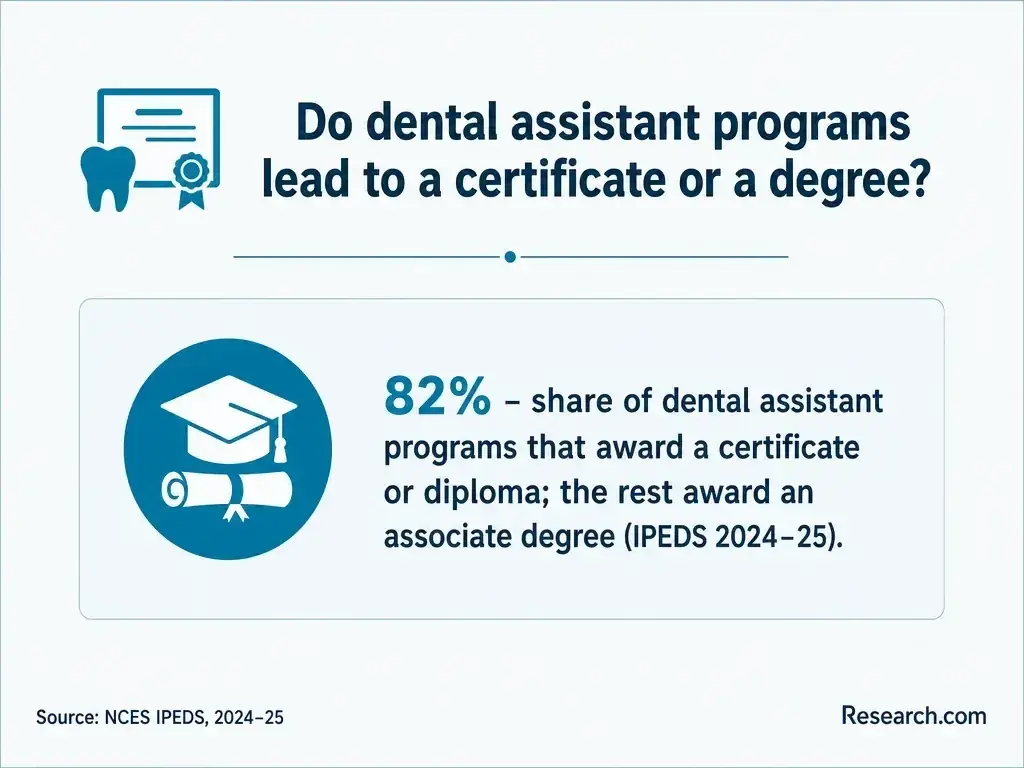
Depending on the route, you might earn a school-issued certificate or diploma, a documented completion of employer training, or - if you separately meet its requirements - a professional certification. These are not interchangeable. CODA programmatic accreditation concerns a dental program; institutional accreditation concerns a school; and Florida authorization for particular duties concerns what an assistant may do in practice. Check each independently (Commission on Dental Accreditation; Florida Board of Dentistry).
The Dental Assisting National Board's Certified Dental Assistant credential has its own eligibility routes and examination requirements; a similarly named school certificate is not the same credential (Dental Assisting National Board). If you are comparing good paying certifications, ask whether the specific dental assisting program prepares you for the certification you want and whether that certification affects the duties sought by local employers.
Admissions rules vary by provider. Before paying an application fee, confirm the school's education prerequisite, required records, start dates, and whether a background check, health documentation, or immunization records are needed for a clinical placement. A clinical site may impose requirements beyond ordinary classroom admission.
For employer training, the entry requirement is usually an employer willing to hire and supervise a beginner, not admission to a school. Ask whether the practice provides paid instruction, how progress is documented, and which tasks a new hire can perform before completing any duty-specific Florida training. Prior healthcare experience may help with hiring, but do not assume it replaces a program requirement or automatically grants advanced standing.
A useful curriculum connects foundational knowledge to work in a dental operatory: infection prevention and instrument processing; dental anatomy and terminology; patient preparation; chairside instrument handling; dental materials; records and scheduling; and radiography instruction where offered. The U.S. Bureau of Labor Statistics identifies patient care, equipment preparation, and administrative tasks among dental assistants' work.
Look beyond the course titles. Ask students to demonstrate competencies in a lab before treating an externship as their first chance to practice, and confirm who supervises them in a dental office. Because Florida regulates certain expanded functions and dental radiography, a program should identify the specific tasks its training supports rather than promise vaguely that graduates can perform "all dental assistant duties" (Florida Board of Dentistry).
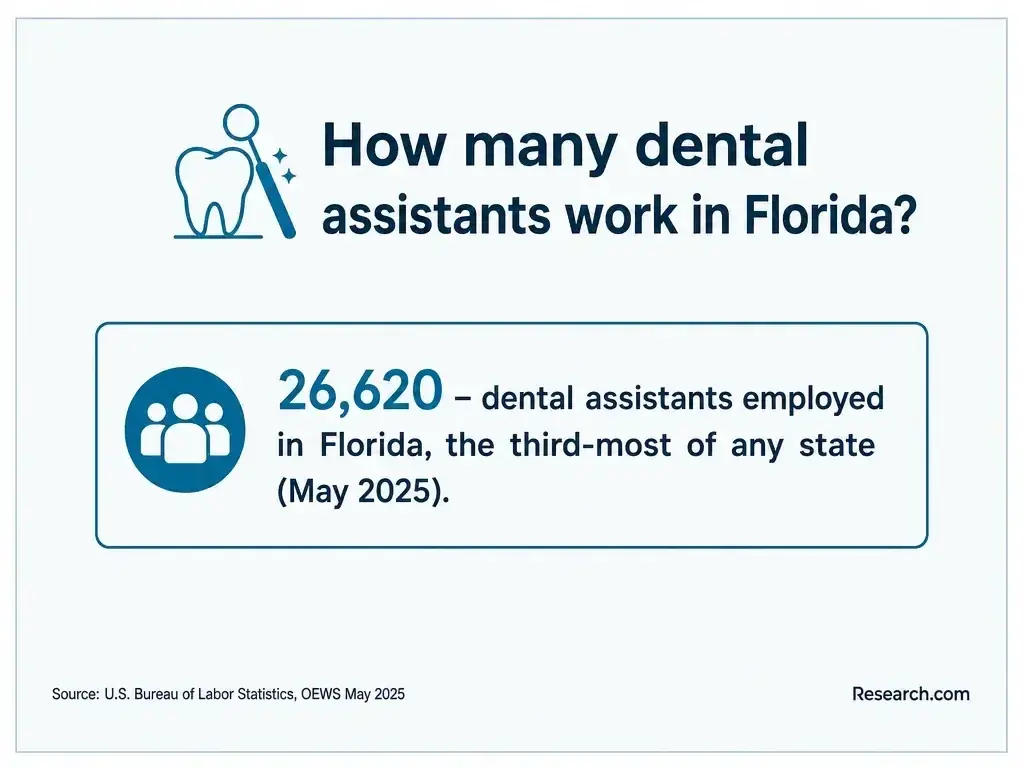
Florida does not require a general occupational license simply to work as a dental assistant performing basic duties. It does regulate training and authorization for certain expanded functions and dental radiography; the applicable requirements depend on the task, not merely on the job title (Florida Board of Dentistry). National certification through the Dental Assisting National Board is a separate credential, not a substitute for checking Florida's duty-specific rules.
Before enrolling, give the provider examples of the tasks you want to perform and request written confirmation of the training route for each. Verify the answer against current Florida Board of Dentistry rules. This matters especially when comparing a brief online course, employer training, and a formal clinical program: all three may use "dental assistant" in their descriptions while preparing students for different scopes of work.
Start with the job you want, then compare eligible training routes on what they actually deliver. An affordable program is worth considering when its total cost, completion schedule, clinical access, and Florida duty preparation fit that goal. A low advertised price cannot compensate for an unavailable placement or training that stops short of the tasks an employer expects.
Ask each provider the same questions, and keep its answers with the written cost estimate:
Check institutional accreditation, any claimed CODA programmatic accreditation, school authorization, and duty-specific training status with their respective authorities; none automatically proves the others. Also ask Indian River State College or another provider whether prior coursework can be assessed for credit, but get any advanced-standing decision in writing before budgeting for a shorter program.
The direct path is an entry-level dental assistant role, followed by greater responsibility as experience and task-specific training permit. Some assistants move toward specialty practices, patient coordination, or office administration. Optional national certification may support advancement, but employers' preferences and Florida's rules for particular clinical duties remain separate questions (Dental Assisting National Board; Florida Board of Dentistry).
Dental hygienist is a different occupation with different educational and Florida licensing requirements; dental assistant training alone does not qualify someone for it. Likewise, choosing a route because it appears in a search for what is the easiest bachelor's degree to get does not answer the practical question here: whether a credential prepares you to work in a dental office under Florida's rules.
The U.S. Bureau of Labor Statistics projects 7.4% national employment growth from 2025 to 2035 for dental assistants. That supports investigating the occupation, but it is not a forecast of openings within Fort Pierce or a promise of employment after training. Local hiring can depend on practice staffing, turnover, and how far a new assistant can commute.
Use the projection alongside current Treasure Coast job postings. Note whether employers seek basic chairside help, radiography capability, expanded functions, or experience. If most appealing openings specify skills a program does not teach, the faster or cheaper route may require additional training before it serves your goal.
Investing in training is a consequential decision, so Research.com uses multiple sources and checks the relevance of each measure to the occupation and location. This ranking compares dental assisting programs against other eligible local options, rather than against unrelated trades. Only programs with completions reported to the Integrated Postsecondary Education Data System (IPEDS) are included; that limit does not mean an unlisted employer-training route or provider is unapproved or unsuitable.
The most affordable ranking scores costs and debt: tuition, cost of attendance, median student debt, and federal loan default rate. Weights are assigned through an entropy-based method, which gives more weight to measures that differ more across eligible programs. Accreditation and other quality measures are not included in this affordability score. Readers should therefore check clinical training and Florida duty eligibility separately before choosing a low-ranked-cost option. More detail appears on the Research.com methodology page.
The following databases and organizations inform ranking research and occupation-specific verification. Some cover broader trade fields and do not establish dental assisting approval on their own:
# 1 position
# 2 position
For basic duties, an employer-training route may be possible. Florida has separate requirements for certain expanded functions and radiography, so confirm what training the intended job requires with the Florida Board of Dentistry.
No. Compare total costs, clinical placement, completion time, and preparation for the duties you want. An inexpensive course without needed hands-on training could cost more once additional instruction is included.
You may be able to study some theory online, but clinical skills require appropriate in-person practice. Check where any required labs and supervised office experience take place.
No. A school-issued certificate and the Dental Assisting National Board's Certified Dental Assistant credential are distinct. Check the board's current eligibility and examination requirements.
No. The May 2025 national median of $48,070 covers workers at different experience levels and locations (U.S. Bureau of Labor Statistics). Compare current entry-level offers within your commuting area instead.