# 1 position

Audited and Verified:
Our Editorial and Data Verification Process
Research.com uses government datasets, official education statistics and primary institutional information to support its career and degree guides. Our review process checks factual accuracy, occupational definitions, source dates and the requirements associated with the credentials discussed.
How This Article Was Fact-Checked
Our editorial team verifies salary estimates, employment projections, education requirements and program information against original data providers and official organizations. Salary figures are checked against the relevant occupational definitions and reporting periods. Information about licensure, accreditation and required in-person training is reviewed separately.
Fact-checked and verified on:

Co-Founder and Chief Data Scientist

Reviewed by Karolina Broda
Fact-Checker and Data Verification
Choosing an affordable dental assistant program in Rockville means comparing more than tuition: hands-on training, Maryland radiography rules, and time away from work can change the value of an offer. The Research.com team of data scientists created the Most Affordable Dental Assistant Trade Schools in Rockville for 2027 ranking to help students identify programs worth considering. With U.S. dental assistant employment projected to grow 7.4% from 2025 to 2035, this guide helps career changers and first-time students compare costs, credentials, and routes into local dental offices (U.S. Bureau of Labor Statistics).
Expect instruction in chairside procedures, infection control, instrument processing, dental terminology, patient communication, and office workflow. A worthwhile program also gives students supervised practice with the equipment and tasks they intend to use at work. Classroom coverage alone is not evidence that a graduate can perform clinical duties safely (U.S. Bureau of Labor Statistics; O*NET).
Rockville applicants can compare a community-college option, such as an available Montgomery College offering, with career-school training and dental-office hiring that includes on-the-job instruction. Confirm the current catalog before treating any offering as available for 2027. A structured program can suit someone who wants practice before applying; employer training may suit someone who can secure a position and learn while earning. Neither route automatically qualifies a person for every duty regulated by Maryland (Maryland State Board of Dental Examiners).
Dental offices are the principal workplace for dental assistants; duties can include preparing treatment rooms, assisting dentists, sterilizing instruments, and scheduling patients (U.S. Bureau of Labor Statistics). In the Rockville area, applicants may also consider specialty practices and offices elsewhere in Montgomery County. A wider commute expands the offices you can approach, but its cost belongs in your training and job-search budget.
Do not assume a Maryland-trained assistant can perform the same regulated duties across the District of Columbia or Virginia. Check the destination jurisdiction before paying for training intended to support a cross-border job. Dental assisting is one of several high paying trade school jobs readers may compare, but occupation-wide wages do not establish what a particular office will offer a new assistant.
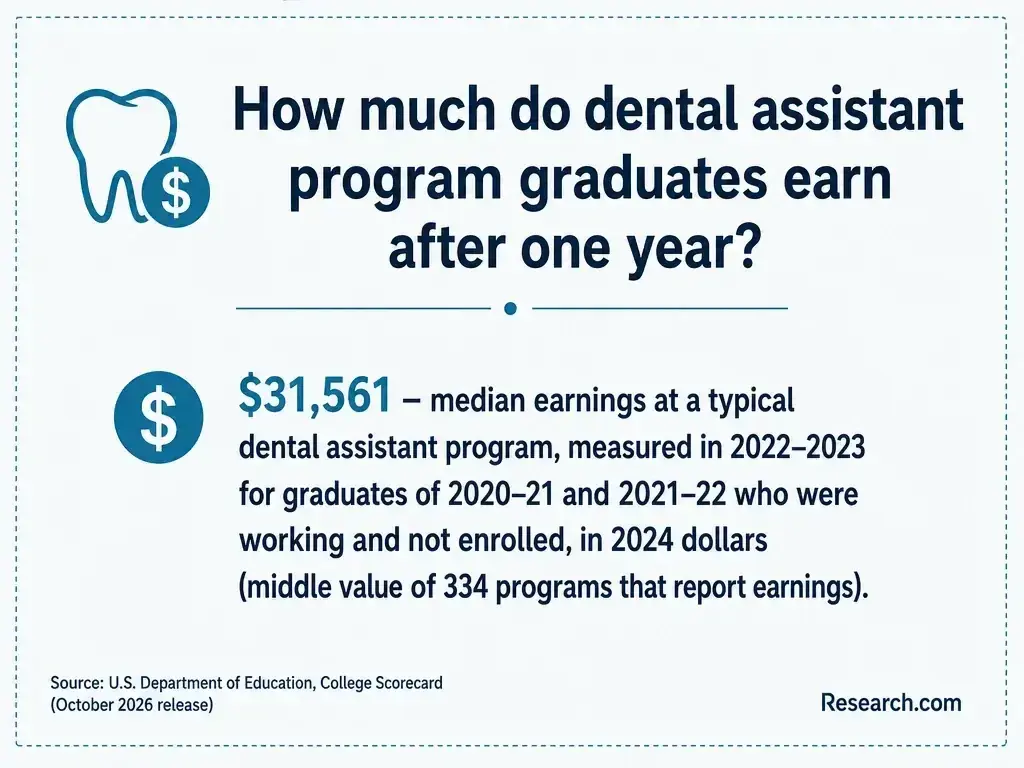
The latest national median supplied for dental assistants is $48,070 in May 2025 (U.S. Bureau of Labor Statistics, Occupational Outlook Handbook). Half of employed dental assistants nationally earned more and half earned less. It is not a Rockville wage estimate or a likely first-job offer.
For a local decision, compare current Rockville-area postings by required experience, radiography duties, schedule, and benefits, then consult the latest metropolitan occupational-wage release from the U.S. Bureau of Labor Statistics. Keep its reference year distinct from the publication date. An apparent pay increase may not justify a longer or costlier program if the jobs you want do not require its additional credential.
Duration depends on the route: a focused certificate or noncredit training program, a longer credit-bearing program, and office-based training do not follow one standard schedule. Ask each provider for total calendar time and required classroom, lab, and supervised clinical or worksite hours. Published weeks alone can conceal a delayed clinical placement or a part-time schedule.
Choose an accelerated option only if its practical training and Maryland-relevant preparation still fit your goal. An online accelerated associate's degree comparison may help you assess scheduling trade-offs, but it does not establish that remote study can replace dental assisting labs or supervised practice. If you already work in an office, ask whether documented experience can affect placement or course requirements; never assume prior-learning credit waives a regulated requirement.
Online delivery can make terminology, scheduling, and some theory coursework easier to fit around work. Instrument handling, infection-control practice, chairside skills, and any required clinical experience need an appropriate in-person setting. A hybrid program is useful only if its lab location, placement arrangements, and schedule are workable for a Rockville student; a fully online course should not be assumed to establish Maryland radiography eligibility (Maryland State Board of Dental Examiners).
Low advertised online tuition is therefore an incomplete comparison. Even when browsing low tuition online colleges that accept fafsa, verify the dental assistant program's aid eligibility and where its hands-on training occurs. Institutional participation in federal aid does not mean every short or noncredit offering qualifies (Federal Student Aid).
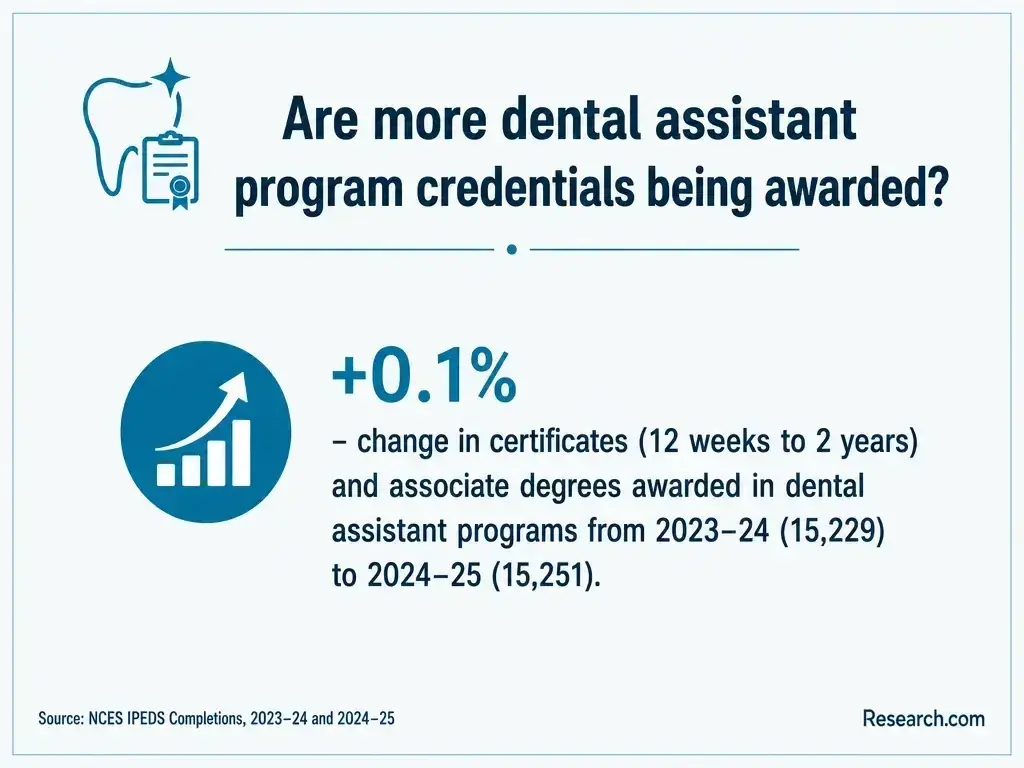
A reliable Rockville-wide average cannot be stated without a defined set of current, comparable program prices. A quoted tuition figure may exclude mandatory fees, textbooks, scrubs, protective supplies, background checks or health requirements for placements, examination and application charges, and travel to labs or clinical sites. Request an itemized 2027 total cost to become job-ready from every provider rather than comparing tuition alone.
Also calculate earnings forgone while studying and likely borrowing costs. Ask whether the specific program qualifies for federal aid, Maryland aid, workforce funding, or employer payment; eligibility varies by program and student (Federal Student Aid; Maryland Higher Education Commission). Paid office training can reduce upfront spending, although it may offer a different structure and pace of supervised instruction. A useful return-on-investment comparison considers completion likelihood, debt, time away from work, current earnings, plausible post-training earnings, and how long you expect to work in the role - not a single salary figure.
The award may be a certificate, diploma, or academic credential, depending on the program; employer instruction may instead produce a record of training and work experience. Ask for the exact award title and whether the curriculum supports the duties you want. A school completion certificate is not the same thing as a state-issued authorization or a professional certification.
The Dental Assisting National Board administers voluntary national credentials with their own eligibility and examination rules. CODA accredits qualifying dental education programs; institutional accreditation, state school authorization, and CODA programmatic accreditation answer different questions. None, by itself, grants permission to perform every Maryland-regulated task (Dental Assisting National Board; Commission on Dental Accreditation; Maryland State Board of Dental Examiners).
Entry rules depend on the provider and whether instruction is credit-bearing, noncredit, or employer-based. Ask about prior schooling, placement assessments, application deadlines, and any health, immunization, or background documentation needed for clinical assignments. A dental office hiring trainees may emphasize availability and patient-facing ability instead of a school application; admission to a program, however, does not guarantee a clinical placement or a job.
Before paying a deposit, obtain written confirmation of any placement prerequisites and their costs. If a provider advertises transfer credit or advanced standing, ask which courses it applies to and whether reducing classroom time changes access to labs, clinical practice, or certification preparation.
A job-focused curriculum should connect dental anatomy and terminology to actual chairside work: preparing materials, passing instruments, maintaining infection-control procedures, documenting care, and communicating with patients. Compare how students demonstrate those skills under supervision, not just the course titles (U.S. Bureau of Labor Statistics; O*NET).
Radiography deserves a separate check because Maryland regulates who may take dental radiographs. Ask whether the course includes appropriate equipment practice and preparation for the board's current certification route; do not infer this from a general "dental assistant" label. Training in digital records and practice-management workflow may also help with office roles, but software familiarity is not a substitute for clinical competency (Maryland State Board of Dental Examiners).
Maryland does not impose one general occupational license for every basic dental assistant task. Dental radiography is a separate decision: the Maryland State Board of Dental Examiners regulates dental radiation technologist certification and specifies applicable education and examination requirements. Confirm the current board route before enrolling if taking radiographs is part of your intended job (Maryland State Board of Dental Examiners).
National certification through the Dental Assisting National Board can demonstrate additional qualifications, but its credential is distinct from Maryland authorization. Ask a prospective employer which duties the opening includes and verify each regulated duty with the board. School approval, accreditation, examination eligibility, and state certification are separate checks; graduation alone should not be treated as permission to perform radiography.
Start with the job you want, then compare programs on the training and eligibility needed for that job. The questions below expose differences an affordability rank cannot show:
Watch for a provider that calls coursework "certification" without naming the certifying body, promises Maryland radiography eligibility without explaining the route, or cannot describe how clinical skills are assessed. Rankings can narrow choices, but they cannot resolve those red flags. Comparing a short dental assistant credential with easy doctorate degrees would not answer the relevant investment question: whether this particular training gets you into the dental duties you want at a manageable total cost.
The direct path is an entry-level chairside or office-support position, with responsibilities shaped by employer training and Maryland's rules for particular duties. With experience, an assistant may seek specialty-office work, lead-assistant responsibilities, training duties, or a stronger administrative role. These are possible progressions, not automatic promotions or guaranteed pay increases (U.S. Bureau of Labor Statistics; Maryland State Board of Dental Examiners).
If your goal is to begin patient-facing dental work relatively soon, compare a structured program with paid office training. If your main goal is a different occupation, reconsider the credential before enrolling; lists of 4 year degrees that make the most money answer a different career-planning question, not whether dental assistant training meets Maryland's requirements.
U.S. dental assistant employment is projected to grow 7.4% from 2025 to 2035 (U.S. Bureau of Labor Statistics, Employment Projections). That national projection suggests continuing opportunities, but it is neither a Rockville vacancy count nor a promise of employment after training.
To judge the local market, review current Montgomery County-area openings for the duties, schedules, and experience they require. Note how often employers request radiography qualifications before choosing a program. A credential that aligns with recurring local requirements may be more useful than a faster, cheaper course that leaves those requirements unmet.
Education is a consequential investment, so Research.com designed its affordability ranking to help readers compare dental assistant programs against other programs in the same occupation and location. Only programs with completions reported to IPEDS are eligible. The most affordable ranking scores tuition, cost of attendance, median student debt, and federal loan default rate; an entropy-based method gives more weight to measures that vary more across programs. Accreditation and other quality indicators are not part of this affordability score.
Research.com's broader best-program rankings use a different model: 20% for relevant programmatic accreditation or industry recognition, 10% for institutional accreditation, 10% for student support, and 60% for outcomes, earnings, and costs, with entropy-based weights within that last group. The team consulted the following sources to support the ranking's data quality and occupation-specific review:
The ranking is a starting point, not a list of every training option: employer training and providers without IPEDS-reported completions may be absent. Readers should use it to narrow cost comparisons, then verify current program availability, practical training, and Maryland eligibility directly. More detail is available in the Research.com methodology.
# 1 position
# 2 position
Compare itemized program costs with dental offices willing to train new hires. Paid training may reduce upfront expense, but confirm the supervision offered and whether it prepares you for the duties you want.
Not for every basic assisting position in Maryland. Employers set hiring preferences, while the Maryland State Board of Dental Examiners sets separate requirements for regulated duties such as dental radiography.
Some theory may be taught online, but chairside and equipment skills need suitable in-person practice. Verify clinical arrangements and Maryland eligibility before enrolling.
No. This ranking includes only programs with completions reported to IPEDS; employer-sponsored training and other providers may not appear.
Not automatically. Check the Maryland State Board of Dental Examiners' current dental radiation technologist requirements and ask the program exactly how its training supports them.