# 1 position
Most Affordable Dental Assistant Schools & Training in Blackwood for 2027
Audited and Verified:
Our Editorial and Data Verification Process
Research.com uses government datasets, official education statistics and primary institutional information to support its career and degree guides. Our review process checks factual accuracy, occupational definitions, source dates and the requirements associated with the credentials discussed.
How This Article Was Fact-Checked
Our editorial team verifies salary estimates, employment projections, education requirements and program information against original data providers and official organizations. Salary figures are checked against the relevant occupational definitions and reporting periods. Information about licensure, accreditation and required in-person training is reviewed separately.
Fact-checked and verified on:

Co-Founder and Chief Data Scientist

Reviewed by Karolina Broda
Fact-Checker and Data Verification
Choosing an affordable dental assistant program in Blackwood means comparing more than tuition: hands-on training, commuting costs, and New Jersey's rules for radiography and expanded duties can change the value of a credential. The Research.com team of data scientists created the Most Affordable Dental Assistant Trade Schools in Blackwood for 2027 ranking to help students identify programs worth considering. With dental assistant employment projected to grow 7.4% nationally from 2025 to 2035, this guide helps you compare training routes, costs, and career-entry requirements before enrolling (U.S. Bureau of Labor Statistics).
Key findings about dental assistant degrees in Blackwood
- The lowest-cost route is not necessarily the lowest advertised tuition: compare required fees, clinical travel, supplies, examination costs, and lost wages before choosing a Blackwood-area program.
- New Jersey treats entry-level assisting, dental radiography, and registered dental assistant duties differently. Confirm which duties your intended training prepares you to perform with the New Jersey State Board of Dentistry and the state's radiologic technology program.
- The U.S. median annual wage for dental assistants was $48,070 in May 2025, and employment is projected to grow 7.4% from 2025 to 2035; neither figure predicts a new graduate's pay or hiring prospects in Blackwood (U.S. Bureau of Labor Statistics).
Table of Contents
- Most Affordable Dental Assistant Schools & Training in Blackwood for 2027
- What can I expect from a dental assistant trade school program in Blackwood?
- Where can I work with a dental assistant trade school training in Blackwood?
What can I expect from a dental assistant trade school program in Blackwood?
Expect instruction in chairside procedures, infection control, patient communication, instruments, and dental-office workflow, followed by supervised practice where the program provides it. For a Blackwood resident, the key distinction is whether that practice includes an accessible lab or clinical placement - not merely whether the coursework is advertised as convenient.
Training routes serve different goals. A short certificate or diploma can suit someone seeking entry-level chairside work; a longer community-college pathway may offer broader coursework or an academic credential. Employer-sponsored training can reduce upfront school costs but depends on a practice willing to train and supervise you. These routes are not interchangeable for New Jersey duties that require separate qualifications (New Jersey State Board of Dentistry).
Camden County College is a local provider to investigate, but verify the specific dental assisting offering, its credential, campus or clinical requirements, and current approval status directly with the college. Do not assume every course carrying the same subject name includes the same hands-on preparation.
Where can I work with a dental assistant trade school training in Blackwood?
Dental assistants primarily work in dentists' offices; duties can include preparing treatment rooms, supporting procedures, and handling records or scheduling (U.S. Bureau of Labor Statistics). A Blackwood resident can also consider practices across Camden County and the wider Philadelphia-Camden-Wilmington commuting area. That broader search may improve access to openings, but travel time and any cross-state differences in permitted duties belong in the job comparison.
General practices may offer broad chairside experience, while specialty practices can provide more focused work after training. Ask prospective employers which tasks new assistants actually perform and whether they support training for radiography or other authorized duties.
There is no single reliable Blackwood-specific wage in the national figures used here. The U.S. Bureau of Labor Statistics reports a $48,070 median annual wage in May 2025 for dental assistants nationwide. That is a midpoint for employed workers at varied experience levels - not an entry-level offer or a local earnings estimate.
For a pay comparison that informs a Blackwood decision, check the latest BLS metropolitan-area occupational wages for Philadelphia-Camden-Wilmington or New Jersey labor-market wage data, then compare actual job postings by duties, hours, benefits, and commute. A higher offer across the state line may be less attractive after travel costs or if its duties require credentials you do not hold.
Duration depends on the credential, schedule, and amount of supervised practice. Short certificate training may get a student ready to seek entry-level work sooner than a diploma or associate-degree pathway, but a shorter calendar does not establish eligibility for New Jersey radiography or registered-assistant duties (New Jersey State Board of Dentistry). No universal Blackwood program length or clock-hour requirement applies to every assisting route.
Ask for the program's published calendar and its breakdown of classroom, laboratory, and clinical hours. Part-time study may preserve earnings during training but extend the time before completion. If speed is your priority, an article on what is the fastest associates degree to get can help frame the time trade-off; verify the dental assisting pathway itself rather than assuming a generally accelerated credential includes required practice.
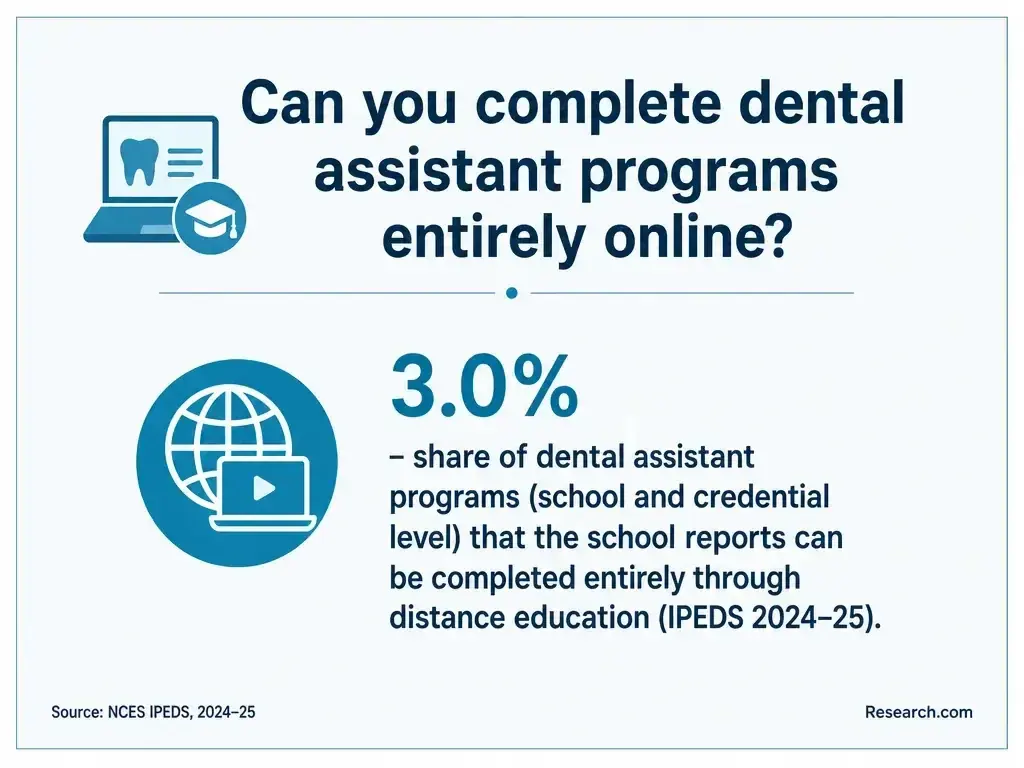
Online study can cover terminology, records, and some infection-control theory. Instrument handling, chairside positioning, and supervised patient-facing skills require in-person practice. A hybrid program can be workable if its lab schedule and clinical site are reachable from Blackwood; an entirely online course should not be assumed to provide practical preparation or meet New Jersey requirements for a particular duty (New Jersey State Board of Dentistry).
The format comparison below focuses on what a prospective assistant would actually need to arrange, rather than treating delivery mode as a measure of quality.
| Format | Potential advantage | Question to resolve before enrolling |
| On-campus | Scheduled access to equipment and supervised practice | Where and when do clinical experiences occur? |
| Hybrid | Less travel for coursework that can be taught remotely | How frequent are required labs, and who arranges the clinical site? |
| Online coursework only | Flexible study of foundational topics | What separate in-person training is needed for the intended duties? |
Flexible study can matter to career changers and older students. Resources on top degree programs for seniors online discuss online-study considerations, but they do not replace a dental assisting program's lab and clinical requirements.
A defensible Blackwood-wide average is not available from the information here. Provider prices, credential lengths, and what tuition includes differ too much for an unsupported average to help with enrollment. Request a current, itemized cost of attendance from each program instead of relying on a quoted tuition figure.
For an apples-to-apples comparison, include the costs most likely to change what you pay to become job-ready:
- Tuition, mandatory fees, textbooks, software, instruments or supplies, and required uniforms or protective equipment.
- Any separate examination, application, background-check, or health-screening charges applicable to your chosen route.
- Travel to campus and clinical sites, plus earnings forgone while attending required daytime sessions.
Subtract grants, scholarships, and confirmed employer contributions; compare the remainder with what you can pay without borrowing. Federal aid depends on both the student's eligibility and the specific program's eligibility, so confirm it with the provider and Federal Student Aid. An employer-training route may lower tuition while offering wages, but it can provide a different scope of instruction.
A provider may award a certificate, diploma, or associate degree. Those are educational credentials, not automatically a professional certification, New Jersey registration, or permission to take dental radiographs. The Dental Assisting National Board (DANB) administers national certification examinations; the New Jersey State Board of Dentistry and the state radiologic technology program govern relevant state credentials and duties.
If you are weighing a quick associate's degree online against a shorter dental assisting credential, ask what the additional study buys you: supervised competencies, applicable certification preparation, or broader coursework. A fast academic award is not a substitute for a required clinical component.
Requirements vary by provider and by whether a student enters a clinical placement. Check the specific program for its prior-education requirement, application materials, placement process, and any health, immunization, or background-check rules for clinical participation. Do not assume admission means a clinical site has been secured or that a graduate will qualify for every dental assisting duty.
Ask admissions staff whether relevant prior coursework or documented work experience can reduce training time, and obtain any credit or advanced-standing decision in writing. Comparing application costs can also be worthwhile: a guide to accredited colleges online offering free applications illustrates one possible cost consideration, though an online college's application policy says nothing about a dental assisting program's clinical fit.
A useful curriculum connects dental anatomy and terminology with instrument identification, infection prevention, chairside workflow, patient preparation, and office documentation. These are practical competencies: ask how instructors observe and assess them, not just whether the topics appear in a course description (U.S. Bureau of Labor Statistics; Dental Assisting National Board).
Radiography deserves a separate question. Learning its concepts does not itself authorize a student to expose dental radiographs in New Jersey; determine whether the program's training aligns with the state pathway for the duties you want (New Jersey radiologic technology program). Ask whether supervised practice includes actual patient-care settings and who arranges those placements.
Not every entry-level dental assisting duty requires the same credential in New Jersey. What matters is the task. The New Jersey State Board of Dentistry governs dental assisting duties and registered dental assistant status; dental radiography has a separate state radiologic technology credentialing pathway. DANB certification is a professional credential and must not be confused with either state authorization (New Jersey State Board of Dentistry; New Jersey radiologic technology program; Dental Assisting National Board).
Before paying a deposit, name the duties you hope to perform and check the current eligibility, training, examination, and application requirements with the responsible New Jersey authority. If you plan to work across the Delaware River, check that state's rules separately: authorization to perform a duty in New Jersey does not establish permission elsewhere.
Start with the job you want, then test each program against its actual cost and preparation for that job. An affordability ranking helps identify options to investigate, but its score does not establish practical-training quality, certification eligibility, or a personal return on investment.
Use these checks when speaking with a program representative; request written answers when a claim affects your decision:
- Identify the awarded credential and confirm which entry-level duties - and which additional New Jersey credential pathways - the curriculum addresses.
- Ask for classroom, lab, and clinical hours, the clinical-site location, and the process if a placement is unavailable.
- Verify institutional accreditation, any relevant programmatic accreditation, and state authorization separately; ask the New Jersey authority whether the training meets the requirement for your intended duty.
- Obtain an itemized price, aid estimate, refund policy, and recent program-level completion and employment information where available.
- Compare that net cost and time away from work with an employer-training option, accounting for likely starting pay rather than the national occupational median.
A red flag is a provider that calls a course "certification-ready" without identifying the certifying organization, examination eligibility, hands-on requirements, or New Jersey rules. Institutional accreditation, CODA programmatic accreditation where applicable, state school authorization, DANB certification, and occupational authorization answer different questions; none should be presented as a substitute for the others (Commission on Dental Accreditation; Dental Assisting National Board; New Jersey State Board of Dentistry).
Entry-level chairside assisting can lead to broader responsibilities as an assistant gains experience and meets requirements for particular duties. Some assistants move into specialty practices or dental-office coordination; others pursue state-authorized radiography or registered dental assistant duties. Those steps depend on the applicable requirements and an employer's role, not simply time spent on the job (New Jersey State Board of Dentistry; U.S. Bureau of Labor Statistics).
If your chief goal is rapid paid entry into a dental office, compare a short program with supervised employer training. If you want a more structured clinical experience or a particular credential pathway, the added cost and time of a longer program may be worthwhile. Readers exploring the occupation alongside other skilled roles can use best careers in trade school as a broader comparison, then return to the New Jersey-specific requirements for this job.
The U.S. Bureau of Labor Statistics projects 7.4% national employment growth for dental assistants from 2025 to 2035. That supports investigating the field, but it is not a forecast for Blackwood or a guarantee of a nearby opening. Practices may differ in the duties and credentials they expect.
Before selecting a training schedule, review current Camden County and nearby metropolitan-area postings for recurring requirements, work hours, and travel distance. This check is especially valuable if clinical placement or a first job would require commuting: a program's low tuition matters less if its schedule or location prevents you from completing it or taking an available role.
Most Affordable Dental Assistant Schools & Training in Blackwood for 2027
Investing in training is an important decision, especially when a low advertised price may not cover everything needed to start work. Research.com evaluates programs against others in the same occupation and location so readers can compare realistic local options. Its most-affordable ranking considers tuition, cost of attendance, median student debt, and federal loan default rates; weights are distributed using an entropy-based method. Accreditation and other quality indicators do not contribute to this affordability score, so readers should check them separately.
Only programs with completions reported to the Integrated Postsecondary Education Data System (IPEDS) are eligible. That limit means the ranking may omit employer training and other providers that do not report completions to IPEDS; an omission is not a judgment of quality. To support the ranking's accuracy and credibility, the Research.com team draws on the following sources, while readers can find more detail on how the ranking was created:
- IPEDS database - program completions and institutional reporting.
- National Center for Education Statistics - education data and institutional context.
- College Scorecard database - available cost, debt, and outcome measures.
- Peterson's database - supplementary institutional information.
- Commission on Accreditation of Allied Health Education Programs (CAAHEP) - accreditation reference information.
- Accrediting Bureau of Health Education Schools (ABHES) - accreditation reference information.
- Commission on Dental Accreditation (CODA) - dental assisting program-accreditation information.
- Dental Assisting National Board (DANB) - certification and examination information.
- National Center for Construction Education and Research (NCCER) - occupational-training reference information.
- Apprenticeship.gov Partner Finder - registered-apprenticeship reference information.
Use the ranking to narrow a shortlist, not as a substitute for confirming a program's current price, practical training, and fit with New Jersey requirements.
# 2 position
Camden County College - Dental Assisting/Assistant.
certificate or diplomaFrequently asked questions about dental assistant programs in Blackwood
Is dental assistant trade school worth it if an office will train me?
It can be if it provides supervised skills, a useful credential, or preparation for duties your employer will not teach. Compare its full net cost and time away from work with the employer's training plan and the tasks you would be allowed to perform.
Can I become a dental assistant through an online-only program?
Online coursework can teach theory, but it does not replace in-person chairside practice. Check how practical training is arranged and whether the complete pathway meets requirements for your intended New Jersey duties.
Does a dental assisting certificate let me take dental X-rays in New Jersey?
Not automatically. Dental radiography has a separate New Jersey credentialing pathway; verify current requirements with the state radiologic technology program before enrolling.
Is the cheapest program the best value?
Not necessarily. Add fees, supplies, clinical travel, examination costs, and lost earnings, then check completion support and hands-on preparation. A lower tuition price can conceal a higher cost to become job-ready.
Should I choose a certificate or an associate-degree pathway?
Choose based on the duties and credential you need, the supervised experience included, and the extra time and cost. An associate degree can offer broader coursework, but its name alone does not confer certification or state authorization.
- U.S. Bureau of Labor Statistics - Dental Assistants
Used to verify salary, employment outlook, and typical education requirements.
https://www.bls.gov/ooh/healthcare/dental-assistants.htm - CODA - Find a Dental Program
Used to verify programmatic accreditation or industry recognition of programs.
https://coda.ada.org/find-a-program - DANB - Certified Dental Assistant (CDA) exam
Professional certification reference for graduates of this occupation.
https://www.danb.org/exams/exam/cda-exam - Camden County College - official website
Official school website (programs, tuition, admissions).
https://www.camdencc.edu/