# 1 position


Audited and Verified:
Our Editorial and Data Verification Process
Research.com uses government datasets, official education statistics and primary institutional information to support its career and degree guides. Our review process checks factual accuracy, occupational definitions, source dates and the requirements associated with the credentials discussed.
How This Article Was Fact-Checked
Our editorial team verifies salary estimates, employment projections, education requirements and program information against original data providers and official organizations. Salary figures are checked against the relevant occupational definitions and reporting periods. Information about licensure, accreditation and required in-person training is reviewed separately.
Fact-checked and verified on:

Co-Founder and Chief Data Scientist

Reviewed by Karolina Broda
Fact-Checker and Data Verification
Choosing dental assistant training near Benton Harbor means deciding whether a program's cost and hands-on experience justify the time away from work. The U.S. Bureau of Labor Statistics projects 7.4% national growth in dental assistant employment from 2025 to 2035, but that does not guarantee a local opening. This guide compares training routes, Michigan credential rules, costs, and career prospects. It also features a Best Dental Assistant Trade Schools in Benton Harbor for 2027 ranking, created by the Research.com team of data scientists to help students identify programs worth considering.
Dental assistant training prepares students for chairside support, instrument processing, patient preparation, and dental-office workflow. A program's value depends less on the credential's name than on whether students practice those tasks under supervision and can pursue their intended duties in Michigan. Availability can change, so ask Lake Michigan College whether it currently offers a relevant program and where its practical training takes place; do not assume a nearby college has an active dental assisting cohort.
The comparison below separates school-based and work-based entry routes. Neither route automatically confers a Michigan registration or a national certification.
| Training route | Typical outcome | Best fit and trade-off |
| Certificate or diploma with labs and clinical practice | School-issued credential | Fits students seeking structured practice; compare placement access, schedule, and full cost. |
| Associate degree with dental assisting coursework | Academic degree, if offered | Fits students who value broader coursework; may require more time and expense than entry-level work demands. |
| Employer-sponsored chairside training | Work experience; credential varies | May allow paid entry, but the dentist must provide adequate instruction and any additional training required for intended duties. |
These are not interchangeable pathways. A short course without supervised patient-care experience may be a poor fit for someone who needs confidence at chairside or plans to pursue an advanced credential. An online fastest associates degree online listing does not establish that a dental assisting program includes local clinical practice.
Most dental assistants work in dentists' offices, supporting general or specialty care; duties depend on the employer and Michigan's scope-of-practice rules (U.S. Bureau of Labor Statistics; Michigan Board of Dentistry). For a Benton Harbor resident, the practical job search should include nearby communities as well as the city itself. Ask a prospective program which dental practices host its clinical students and whether graduates must arrange their own transportation to those sites.
Training is occupation-specific. If you are comparing dental assisting with other trade school professions, weigh how much of each program's practical experience happens at an actual worksite, not just how quickly it awards a credential.
The U.S. Bureau of Labor Statistics reports a May 2025 national median annual wage of $48,070 for dental assistants. That figure describes workers across experience levels and locations, not a new graduate's offer in Benton Harbor. A comparable, current local wage figure is not established here; request pay ranges from nearby employers and check Michigan labor-market data before estimating a return on training.
Compare an offer's hourly pay, scheduled hours, benefits, and commuting costs. Experience and permitted responsibilities may affect pay, but completing a program or earning certification does not guarantee an increase.
There is no single Benton Harbor training length or universal clock-hour requirement for every dental assistant entry route. A school certificate, a diploma, and dentist-directed workplace training can have different schedules and amounts of supervised practice. Ask each provider for its published calendar, total contact hours, lab hours, required clinical hours, and whether placement delays can extend completion.
An accelerated schedule saves time only if it preserves the practice needed for your intended duties. If your broader goal is to compare routes into other occupations, an accelerated bachelor degree online is a different kind of education and is not a substitute for dental chairside training.
Online instruction can cover terminology, infection-control principles, records, and office procedures. Instrument handling, chairside techniques, radiography practice, and patient-facing clinical experience require appropriate in-person instruction and supervision. A hybrid program can be useful for someone working shifts, provided its lab and clinical locations are reachable from Benton Harbor.
Ask for the location and schedule of every required in-person component before enrolling. Do not assume that a course advertised among easy online degrees provides the practical experience or eligibility needed for dental assisting.
A defensible Benton Harbor average cannot be stated without current, comparable prices for active local programs. Published tuition alone is not the cost of becoming job-ready. Request an itemized estimate covering mandatory fees, books, uniforms, protective equipment, supplies, any health or background requirements, certification examinations, and travel to labs or clinical sites. Ask whether fees are refundable if a placement is unavailable.
Compare the net cost after grants or eligible federal aid with income you might forgo while training. Federal aid depends on the institution and program's eligibility, not simply on a school being accredited (Federal Student Aid). Ask about Michigan workforce-training assistance and employer-paid instruction, but confirm eligibility and funding before treating either as a discount. A paid chairside position may lower upfront cost; compare the structure of its training as carefully as its wages.
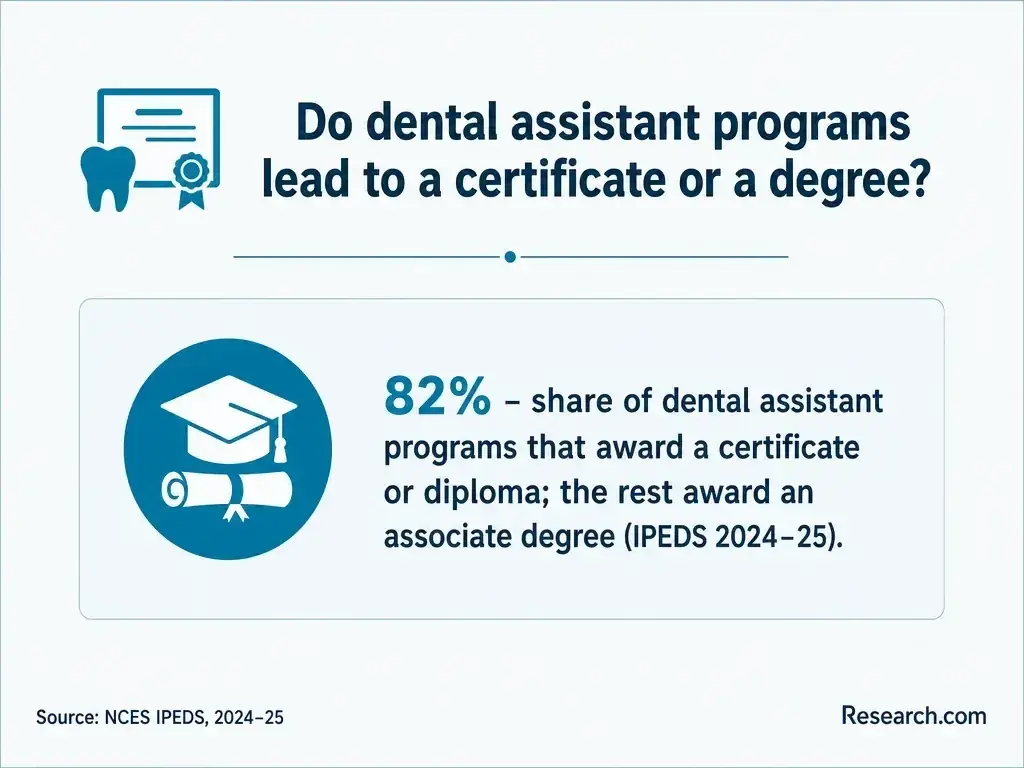
A program may award a certificate, diploma, or - in a longer academic pathway - an associate degree. The school credential records completion; it is not the same as Certified Dental Assistant (CDA) certification from the Dental Assisting National Board or Registered Dental Assistant (RDA) status under Michigan rules. Ask the provider to name its exact award and document which certification or registration pathways its curriculum supports (Dental Assisting National Board; Michigan Board of Dentistry).
Institutional accreditation evaluates a school, while programmatic accreditation evaluates a specific program. The Commission on Dental Accreditation is the relevant programmatic accreditor to check for dental assisting. State authorization, accreditation, professional certification, and Michigan registration answer different questions; none should be presented as a substitute for the others.
Requirements depend on the provider and clinical site. Ask whether admission requires a high school credential, prerequisite coursework, an interview, immunization documentation, a background check, or proof of CPR training, and whether any of those items must be renewed before clinical placement. Get the requirements and deadlines in writing rather than assuming that acceptance into the school secures a clinical seat.
For employer-sponsored entry, ask who teaches new assistants, which duties they can perform while learning, and whether the employer will pay for later training. A direct-entry job can make sense for someone who needs income now; a structured school program may suit someone who wants scheduled labs and a documented curriculum.
Relevant instruction includes dental anatomy and terminology, infection prevention, instrument identification and sterilization, chairside procedures, patient communication, records, and office workflow. Programs may also teach dental imaging and impressions, subject to Michigan rules governing who may perform particular functions (U.S. Bureau of Labor Statistics; Michigan Board of Dentistry).
Request a skills checklist showing which procedures are demonstrated in a lab and which students perform in a supervised clinical setting. That distinction matters more than a catalog description that merely lists topics: an employer needs an assistant who can work safely with patients and the dental team.
Michigan distinguishes dental assistants' permitted duties from functions associated with RDA registration; a school completion certificate does not itself grant RDA status. The Michigan Board of Dentistry sets the applicable registration and scope-of-practice rules, including requirements relevant to particular expanded duties. Before choosing a program, check the board's current rules for the tasks you hope to perform, especially dental radiography, and ask the program to explain its graduates' eligibility in writing.
National CDA certification is a separate credential administered by the Dental Assisting National Board. Its eligibility routes and examinations should be checked directly with DANB; CDA certification and Michigan RDA registration are not interchangeable. A dentist may train someone for permitted entry-level duties, but that does not waive requirements for duties that need additional qualifications (Michigan Board of Dentistry; Dental Assisting National Board).
Use the ranking to narrow options, then verify what each option will actually let you do. For a local student, a distant clinical site, an unsuitable schedule, or unclear Michigan credential eligibility can outweigh a favorable headline price.
Before signing an enrollment agreement, work through these checks with admissions and the dental assisting program director:
Beware of guaranteed-job or guaranteed-salary claims, a fully online clinical curriculum, and promises of certification without a stated eligibility route. Return on investment depends on completion probability, aid, debt, earnings before and after training, lost work time, and how long you expect to work in the field - not institution type or tuition alone.
An entry-level assistant may build experience in general dentistry, then seek work in a specialty practice or take on permitted office and patient-care responsibilities. Further training and the applicable Michigan registration can matter for expanded functions; supervisory or practice-coordination work generally depends on experience and employer needs. Neither advancement nor a pay increase follows automatically from a short program (Michigan Board of Dentistry; U.S. Bureau of Labor Statistics).
If chairside patient care is not appealing, compare the actual duties and entry requirements of other quick college degrees that pay well before paying for dental-specific training. Dental assisting is most compelling when its hands-on work - not just its potential earnings - matches your goal.
The U.S. Bureau of Labor Statistics projects 7.4% national employment growth for dental assistants from 2025 to 2035. This signals demand across the occupation, not a forecast of Benton Harbor vacancies. Local openings depend on dental practices' hiring and turnover, so check current postings and ask clinical-site coordinators whether nearby offices hire trainees.
Use the national projection as context, not proof that borrowing for any program will pay off. A program with accessible clinical partners and clear employer connections may be more useful locally than a faster course that leaves you to find practical experience on your own.
Education is a consequential investment. Research.com created this ranking to help readers compare dental assistant programs against other programs in the same occupation and location, using measures of outcomes, cost, and quality rather than reputation alone. The team checks multiple education and occupation-specific sources for credibility and accuracy. Only programs with completions reported to IPEDS are eligible; an unlisted employer-training route or other provider should not be assumed to be unapproved or ineffective.
Best-program rankings assess student outcomes, earnings and return on investment, costs and debt, and quality and recognition. Programmatic accreditation or relevant industry recognition accounts for 20% of the score, institutional accreditation for 10%, and student support services for 10%. The remaining 60% covers completion and full-time and part-time retention; earnings one year after completion and relative to annual attendance cost; and tuition, attendance cost, median debt - including for students who withdrew - and federal loan default rates. Weights within that 60% are assigned through an entropy-based method, giving more weight to indicators that distinguish programs more strongly.
Most-affordable-program rankings are different: they score tuition, cost of attendance, median debt, and federal loan default rates using entropy-based weights. Accreditation and other quality measures are not part of that affordability score. The following sources inform the ranking; occupation-specific sources are considered for their relevance to dental assisting rather than treated as interchangeable endorsements.
The ranking is a starting point, not a substitute for confirming a current dental assisting offering, clinical access, Michigan eligibility, and a written total-cost estimate. More detail on the approach appears in Research.com's methodology.
# 1 position
# 2 position
Not necessarily. Employer-directed training can be an entry route for permitted duties. A structured program may be preferable if you want supervised practice and a documented path toward specific credentials; verify Michigan requirements for your intended duties (Michigan Board of Dentistry).
Check its current program catalog and admissions office. Offerings and clinical arrangements can change; do not assume a program is active based solely on its proximity.
Online coursework can cover theory, but chairside and other practical competencies require in-person training. Confirm where and when a hybrid program provides that practice.
No. A school credential and Michigan RDA registration are distinct. Check the Michigan Board of Dentistry's current eligibility requirements before enrolling.
Ask for the complete cost, clinical hours and location, credential awarded, accreditation status, Michigan credential alignment, aid eligibility, and refund policy - in writing.