# 1 position


Audited and Verified:
Our Editorial and Data Verification Process
Research.com uses government datasets, official education statistics and primary institutional information to support its career and degree guides. Our review process checks factual accuracy, occupational definitions, source dates and the requirements associated with the credentials discussed.
How This Article Was Fact-Checked
Our editorial team verifies salary estimates, employment projections, education requirements and program information against original data providers and official organizations. Salary figures are checked against the relevant occupational definitions and reporting periods. Information about licensure, accreditation and required in-person training is reviewed separately.
Fact-checked and verified on:

Co-Founder and Chief Data Scientist

Reviewed by Karolina Broda
Fact-Checker and Data Verification
Choosing dental assistant training in Oglesby means weighing hands-on experience, cost, and Illinois practice rules - not just finding the shortest program. The U.S. Bureau of Labor Statistics projects 7.4% national growth in dental assistant employment from 2025 to 2035, making training choices timely but not guaranteeing local openings. This guide helps first-time students and career changers compare routes into the field. It also accompanies the Best Dental Assistant Trade Schools in Oglesby for 2027 ranking, created by the Research.com team of data scientists to help students identify programs worth considering.
Dental assistants prepare treatment areas, support dentists during procedures, handle instruments, follow infection-control procedures, and may help with records and scheduling. The exact duties they can perform depend on Illinois rules, training, and supervision (U.S. Bureau of Labor Statistics; Illinois Department of Financial and Professional Regulation). Expect a combination of classroom instruction, simulated practice, and, where the program provides it, supervised work with patients.
The practical choice is between a structured certificate or diploma, a longer associate-degree route if one is available, and employer-based entry with training on the job. A structured program may suit someone who wants practice before applying; employer training may suit someone who has an offer and wants to avoid upfront school costs. Ask Illinois Valley Community College whether it currently offers a dental assisting credential or relevant coursework; do not assume that a nearby college offers a particular program every year. Resources about easiest associate degrees address a different comparison: for dental assisting, hands-on preparation and intended duties matter more than perceived ease.
Dental offices are the principal setting for dental assistants nationally; some also work in specialty practices and other dental-care settings (U.S. Bureau of Labor Statistics). For an Oglesby resident, the feasible job market extends beyond town boundaries. Before enrolling, check openings across the commute you would actually accept, including nearby communities in the Illinois Valley, and note whether employers request radiography preparation, chairside experience, or certification.
A school placement is useful only if its location and schedule are workable. Ask where recent students completed supervised practice and whether the school arranges placements or expects students to find their own. Do not confuse access to a training site with a promised job.
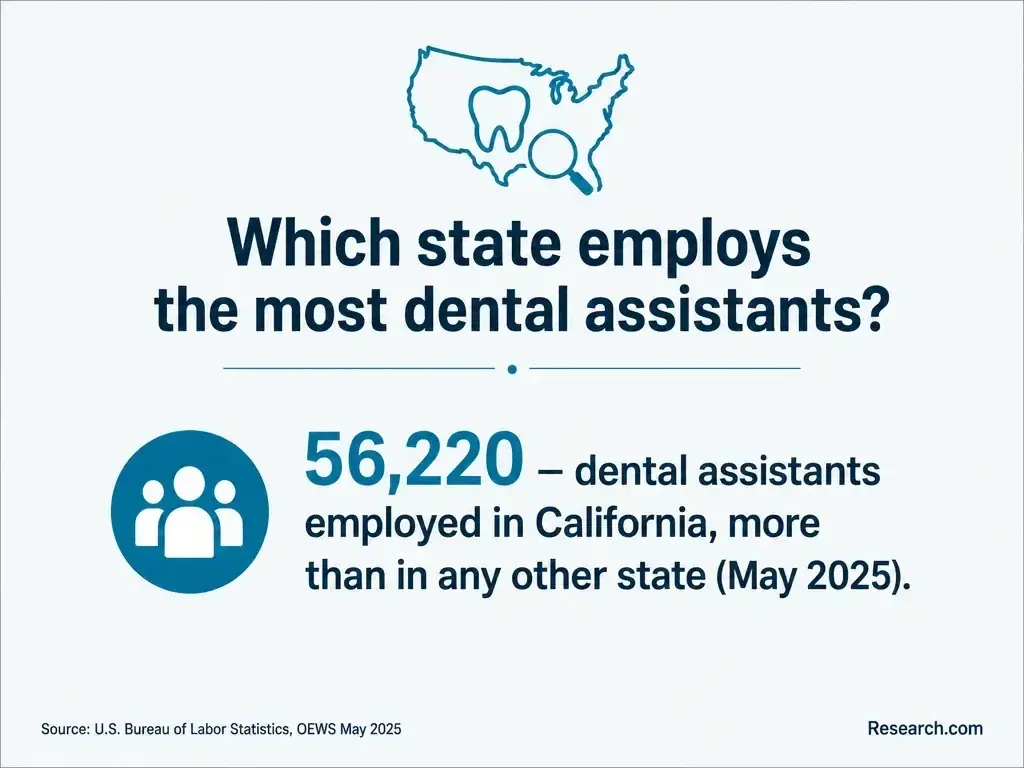
The national median annual wage for dental assistants was $48,070 in May 2025 (U.S. Bureau of Labor Statistics). That is the midpoint for employed dental assistants nationwide - not a verified Oglesby wage or an expected first-year salary. Experience, employer, hours, and permitted duties can change an offer.
Use current vacancies within your commuting area to build a realistic entry-pay range, and ask employers whether posted pay assumes prior experience or specific training. Compare that range with the earnings you would give up while studying; a higher national median alone cannot establish that a program will pay for itself.
There is no single Illinois-wide program length for every dental assisting entry route. Certificate and diploma schedules, associate-degree programs, and employer training differ in classroom time, clinical practice, and calendar length. Illinois requirements for particular expanded duties must be checked separately from the time needed to finish a school credential (Illinois Department of Financial and Professional Regulation).
Request the current calendar and a breakdown of classroom, lab, and supervised clinical hours. Then ask when you could begin working, not merely when classes end: placement availability or an unfinished practical component can delay that date. A comparison with cheap accelerated bachelor's degree online options is not a shortcut into chairside work; the relevant timeline is the time needed to gain dental assisting competence.
Online study can cover terminology, anatomy, records, and some infection-control theory. Instrument handling, chairside communication, and other practical competencies need supervised in-person assessment; an online certificate should not be assumed to satisfy Illinois requirements for a particular duty (Illinois Department of Financial and Professional Regulation).
For someone commuting from Oglesby, hybrid study may reduce classroom trips but not trips to labs or clinical sites. Ask for the exact site, required attendance dates, and who secures patient-care experience before choosing a format. Listings of accredited online universities with free admission process should not be used as evidence that remote dental assisting training provides hands-on preparation.
There is no reliable Oglesby-wide average that captures college programs, career-school training, and employer-based routes on the same basis. Obtain a current itemized quote rather than treating advertised tuition as the cost of becoming job-ready. Include mandatory fees, books, scrubs and protective supplies, immunizations or background checks if required by a placement, travel, and any applicable certification examination fees.
Financial aid depends on the student and program, not simply the school's name; confirm federal-aid eligibility with the school and Federal Student Aid. Ask about scholarships and Illinois workforce assistance, and compare any employer-paid training against wages forgone while attending school. A list of best affordable associate programs online cannot replace a dental assisting quote that includes local practical training.
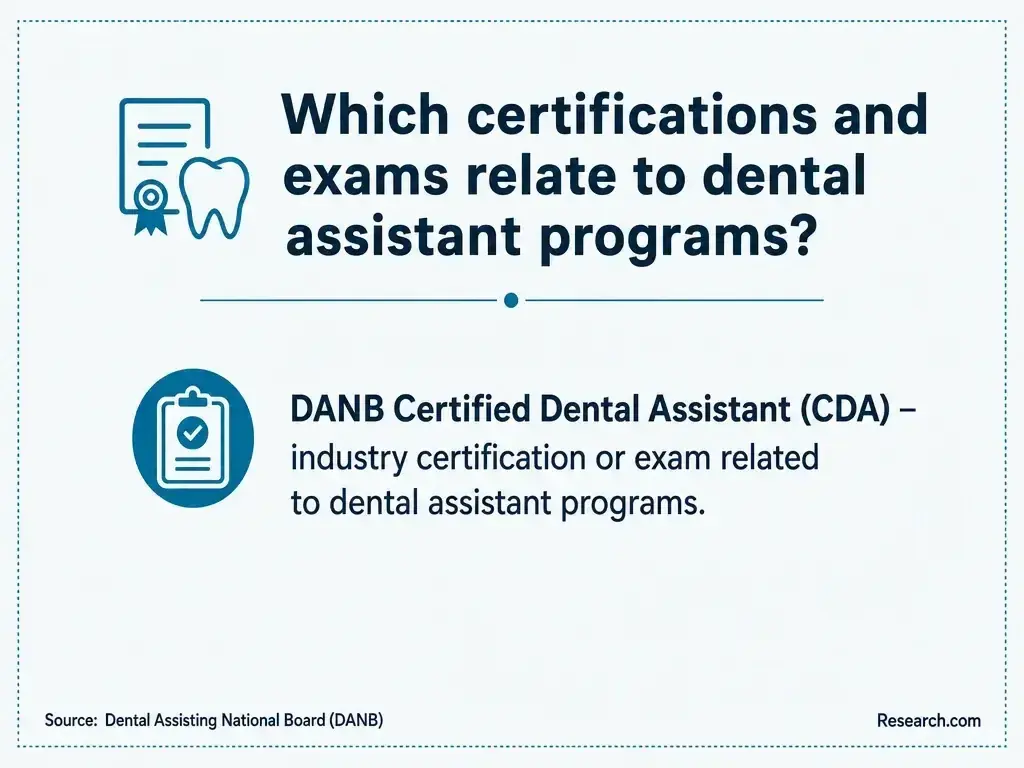
A school may award a certificate, diploma, or, for an applicable associate-degree program, an academic degree. These are educational credentials. The Certified Dental Assistant (CDA) credential is a separate professional certification issued by the Dental Assisting National Board; eligibility has its own pathways and examination requirements (Dental Assisting National Board). Neither a school credential nor national certification automatically authorizes every expanded duty under Illinois rules (Illinois Department of Financial and Professional Regulation).
Before enrolling, ask for the exact credential name, whether the dental assisting program has Commission on Dental Accreditation accreditation, and which Dental Assisting National Board eligibility route its graduates may use. Verify those claims with the accreditor and certifying organization rather than relying on a general statement that the school is "accredited."
Requirements vary by provider and clinical site. Ask about prior schooling, placement testing, immunizations, background screening, and the ability to attend scheduled clinical practice before applying. An employer-training position has a different entry process: the practice decides whom to hire and what training it will provide.
Confirm each requirement in writing and its deadline. In particular, find out whether a clinical-site requirement could prevent you from completing the credential after you have paid tuition. Illinois Valley Community College's current admissions information, if you consider one of its offerings, should be checked alongside the requirements of the specific program.
Relevant instruction includes dental anatomy and terminology, chairside assisting, instrument processing, infection prevention, patient communication, recordkeeping, and office workflow (U.S. Bureau of Labor Statistics). Programs may also teach radiography and other functions, but whether a student can later perform a particular task in Illinois depends on applicable training and supervision rules (Illinois Department of Financial and Professional Regulation).
Compare curricula by observable practice, not course titles alone. Ask how students demonstrate instrument transfer, operatory preparation, and infection-control procedures; whether they work with patients under supervision; and how instructors correct mistakes. Those details distinguish substantial practical training from coursework that is mostly theoretical.
Illinois does not treat every dental assisting task as requiring the same credential. Entry-level assisting, radiography, and expanded functions must be evaluated by the specific duties involved, applicable training, and dentist supervision under Illinois rules (Illinois Department of Financial and Professional Regulation). National CDA certification is distinct from state permission to perform a duty and should not be described as an Illinois license (Dental Assisting National Board).
Identify the tasks in the jobs you want, then check the Illinois Department of Financial and Professional Regulation's current dental practice rules and ask a prospective program to show how its instruction addresses them. Do this before paying for a course advertised broadly as "certification preparation."
Start with the duties and workplaces you want, then compare programs on practical access, verified credentials, and total cost. A faster or cheaper course is not better if it lacks the experience an employer expects or leaves you unable to complete a required clinical component. Institutional accreditation, programmatic accreditation, state school authorization, and professional certification are different checks; none should be assumed to substitute for another.
Use the following questions with each provider, including Illinois Valley Community College if it has a relevant current offering:
A red flag is a promise of certification, expanded duties, or a job without identifying the responsible authority and required steps. For return on investment, consider completion probability, aid and debt, earnings before and after training, time out of work, and how long you expect to use the credential - not institution type or ranking alone.
Chairside assisting is the direct entry path. With experience and any required additional training, an assistant may seek broader permitted duties, specialty-practice work, or dental office coordination; advancement depends on the position and Illinois rules, not the entry certificate alone (Illinois Department of Financial and Professional Regulation; U.S. Bureau of Labor Statistics).
If your goal is primarily office administration rather than patient-side work, compare dental office roles before paying for extensive clinical training. Conversely, someone seeking chairside work should not substitute a general program - such as low cost online bachelor degree programs - for supervised dental assisting practice.
The U.S. Bureau of Labor Statistics projects 7.4% growth in dental assistant employment nationally from 2025 to 2035. That supports considering the occupation, but it is not a projection for Oglesby or a guarantee of openings after graduation. In a smaller local market, the number of practices within a manageable commute matters more to an individual applicant than national growth alone.
Check current postings repeatedly before enrolling and near graduation. Record which duties, experience, hours, and credentials employers actually request; use that evidence to decide whether a structured program, employer training, or additional skills training is the better next step.
Education is a significant investment. Research.com created its ranking to help readers compare dental assistant programs against others serving the same occupation and location, rather than against unrelated schools. The team evaluates reported outcomes, costs, and relevant quality measures; readers should still confirm each program's current offerings and Illinois training requirements before enrolling.
Only programs with completions reported to IPEDS are eligible. Best-program scores consider student completion and full- and part-time retention; earnings one year after completion and earnings relative to annual attendance cost; tuition, attendance cost, debt - including debt held by students who withdrew - and federal loan default rates; plus accreditation, occupation-relevant recognition, and student support. Programmatic accreditation or relevant industry recognition carries 20% of the score, institutional accreditation 10%, and student support 10%. Outcomes, earnings, and costs share the remaining 60%, with entropy-based weights assigning more weight to indicators that vary more across programs. Most-affordable-program rankings instead score only costs and debt using entropy-based weights; they do not score accreditation or other quality indicators.
The team used the following sources to assess reported information and relevant recognition. Their coverage differs: a provider's absence from a college-oriented database does not establish that its training is unavailable or low quality.
The ranking offers a starting point for comparing documented options, not a substitute for checking clinical practice, total cost, and eligibility for the duties you want to perform. Read more about Research.com's methodology.
# 1 position
# 2 position
Not necessarily for every entry-level role. Some employers train assistants on the job, while particular duties have separate Illinois requirements. Compare actual job postings with the preparation each route provides (Illinois Department of Financial and Professional Regulation).
No. A school certificate and the Dental Assisting National Board's CDA certification are separate credentials with separate requirements (Dental Assisting National Board).
You may be able to study some theory online, but chairside skills require in-person practice and assessment. Check a program's lab and clinical arrangements before enrolling.
Ask where you will practice with supervision, what credential you will earn, how the training relates to your intended Illinois duties, and what you will pay in total - including travel to clinical sites.
Not necessarily. The $48,070 median describes employed dental assistants nationwide in May 2025, across experience levels and locations (U.S. Bureau of Labor Statistics). Use local entry-level offers to plan your budget.