# 1 position

Audited and Verified:
Our Editorial and Data Verification Process
Research.com uses government datasets, official education statistics and primary institutional information to support its career and degree guides. Our review process checks factual accuracy, occupational definitions, source dates and the requirements associated with the credentials discussed.
How This Article Was Fact-Checked
Our editorial team verifies salary estimates, employment projections, education requirements and program information against original data providers and official organizations. Salary figures are checked against the relevant occupational definitions and reporting periods. Information about licensure, accreditation and required in-person training is reviewed separately.
Fact-checked and verified on:

Co-Founder and Chief Data Scientist

Reviewed by Karolina Broda
Fact-Checker and Data Verification
The cheapest dental assistant program is not necessarily the cheapest route to a job: required clinical practice, supplies, travel, and Texas registration steps can change the total. Dental assistants earned a national median of $48,070 in May 2025, according to the U.S. Bureau of Labor Statistics (BLS), making training cost worth examining carefully. This guide explains how to compare programs and entry routes. It will also feature the Most Affordable Dental Assistant Trade Schools in Texas for 2027 ranking, created by the Research.com team of data scientists to help students make an informed choice.
Expect a mix of classroom instruction, simulated chairside practice, and, in programs that offer it, supervised experience in a dental setting. Dental assistants prepare treatment rooms, support dentists during procedures, sterilize instruments, document care, and communicate with patients. Their permitted duties depend on Texas rules and the supervision provided (BLS Occupational Outlook Handbook; TSBDE).
The right program depends on the work you intend to do. A short certificate may suit someone seeking a structured introduction to chairside assisting; a longer college program may provide more clinical exposure or a broader credential. Neither program length nor a certificate title proves eligibility for Texas RDA registration. Ask the provider to identify the exact hands-on activities, clinical placement arrangements, and TSBDE requirements its curriculum addresses.
Dental offices are the main employment setting for dental assistants nationally; some positions are in specialty practices or other healthcare settings (BLS Occupational Outlook Handbook). In Texas, a prospective student should compare nearby general dentistry, orthodontic, oral surgery, and pediatric offices because their schedules, patient mix, and preferred skills can differ. A placement across a large metro area may also add meaningful travel costs.
Ask schools where recent students completed clinical experience and whether those sites are reachable from home. In a smaller community, an employer willing to train a new assistant may be a practical alternative to commuting to a distant campus; confirm which duties you can perform before obtaining any required state registration.
Pay varies by local market, experience, duties, and employer. The BLS reports a $48,070 national median annual wage for dental assistants in May 2025. That is the midpoint for employed assistants nationwide - not a Texas entry-level wage or a forecast for someone finishing training.
For a local decision, compare current offers in the Texas area where you plan to work, including hours and benefits, with the complete cost of each training option. If a program advertises graduate earnings, ask which graduates were counted, when earnings were measured, and whether the figure comes from verified records rather than selected testimonials.
Dental assistant certificates can differ substantially in calendar length and scheduled hours; there is no single trade-school duration that applies to every Texas program. Full-time, accelerated, evening, and college-calendar formats also produce different completion dates. A school's advertised weeks may exclude the time needed for a clinical placement, examination, or state application.
Ask for the published clock or credit hours, lab hours, clinical hours, weekly schedule, and earliest realistic completion date. A faster program can reduce time away from paid work, but it may be a poor bargain if it provides too little practice or leaves you to arrange hands-on experience yourself. General guides to fast track degrees online are not substitutes for checking a dental assistant program's actual in-person schedule.
Online delivery can work for subjects such as terminology, anatomy, records, and infection-control theory. It cannot, by itself, demonstrate chairside instrument transfer, sterilization technique, radiographic positioning, or patient interaction. A hybrid program is useful only if its required labs and any clinical experience are accessible and adequately supervised.
Before paying an online provider, get its in-person requirements and clinical-site policy in writing. Confirm whether it arranges a Texas placement, what happens if no placement is available near you, and how its instruction relates to the RDA duties you intend to pursue. A list of best universities online does not establish that a particular dental assisting program provides practical training or meets TSBDE requirements.
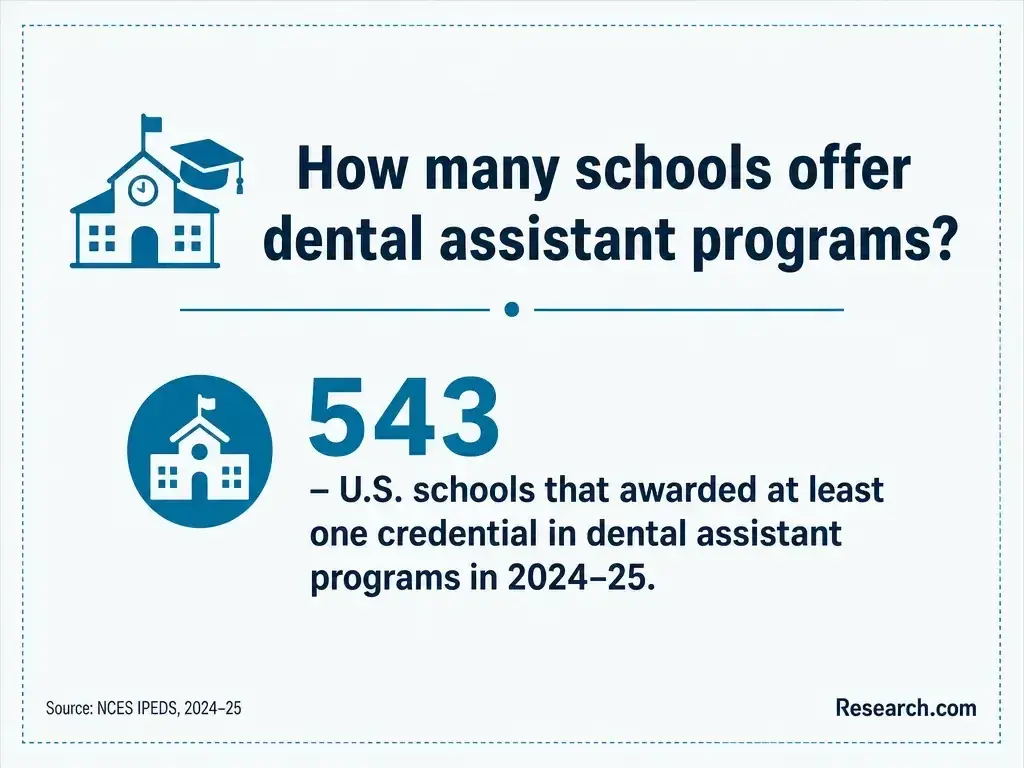
A reliable statewide average cannot be stated from the information available here: programs differ in length, provider type, included supplies, and whether published charges cover clinical training. Request a current, itemized estimate from each school rather than treating one advertised tuition figure as a Texas benchmark.
The table separates charges that are easy to overlook. Ask whether each item is included, required, refundable, or paid to an outside organization.
| Cost component | What to verify |
| School charges | Tuition, mandatory fees, books, software, lab materials, and consumable supplies |
| Career-entry expenses | Uniforms, protective equipment, examinations, registration applications, and any required screening |
| Time and travel | Transportation to campus and clinical sites, childcare, and earnings forgone while training |
| Possible offsets | Grants, eligible aid, scholarships, workforce funding, or wages from employer-sponsored training |
Federal aid depends on both the student's eligibility and the school and program's eligibility; do not assume every short course qualifies (Federal Student Aid). Ask a Texas Workforce Solutions office about applicable workforce-training assistance, and compare the net cost with a paid employer-training offer. Borrowing less is helpful, but a low-priced course that does not support your intended duties may be the more expensive mistake.
Depending on the provider, completion may lead to a school certificate, diploma, or college credential. These document training; they are not themselves Texas RDA registration. The Dental Assisting National Board's Certified Dental Assistant (CDA) credential is a separate national certification with its own eligibility and examination rules. CODA program accreditation, institutional accreditation, and state authorization likewise answer different questions (DANB; CODA; TSBDE).
Request the exact credential name and a written explanation of any certification eligibility the program claims. If you may continue training later, ask a college whether credits transfer or whether prior learning receives credit; do not assume a private course will transfer. A double degree program comparison does not answer whether a dental assisting credential meets a specific employer's or Texas regulator's requirements.
Schools set their own admission rules, which may include an educational prerequisite, assessment, immunization documentation, background screening, or requirements imposed by a clinical site. A direct-hire employer may set different entry conditions. Ask which checks are needed before enrollment and which are needed before placement, since a delayed placement can extend training and increase costs.
Do not confuse admission with permission to perform regulated duties. Confirm with the TSBDE what registration or other conditions apply to the work you want to do, then ask the school how its curriculum prepares students for those conditions. Guides about what is an easy bachelor's degree to get do not address dental assistant admission, clinical placement, or occupational entry.
Relevant instruction typically covers dental anatomy and terminology, infection prevention, instrument processing, chairside procedures, patient communication, charting, and dental materials. Radiography instruction matters particularly if your goal includes taking dental images: verify both the supervised practice offered and the Texas requirements for that duty (BLS Occupational Outlook Handbook; TSBDE).
Compare programs by demonstrated competencies, not course names alone. Ask how often students practice with equipment, who evaluates their work, and whether they assist with real patients under appropriate supervision. Training in digital imaging and electronic records may help with modern office workflows, but software exposure cannot replace safe, observed clinical performance.
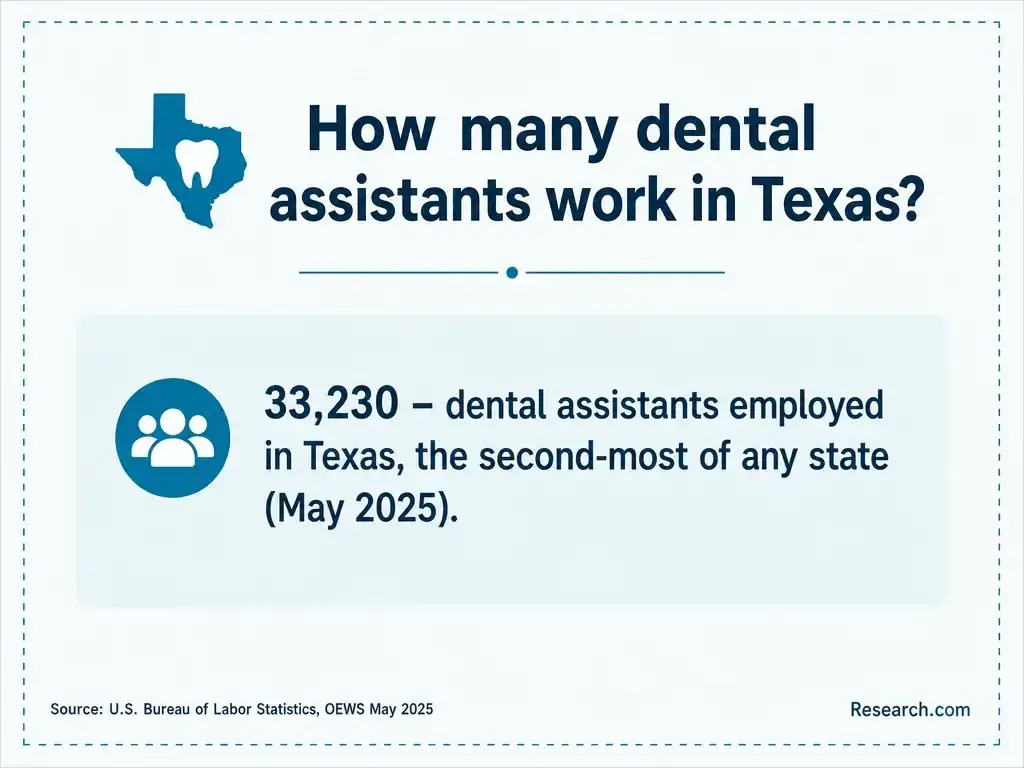
Not every assisting task requires the same credential. Texas regulates the scope of dental assisting duties and has an RDA registration process; requirements depend on the duties an assistant will perform (TSBDE). Do not assume that graduating from a school, passing a national certification exam, or being hired by a dentist automatically authorizes you to take radiographs or perform every expanded duty.
Before choosing a program, check the TSBDE's current RDA application, approved education or examination routes, and duty rules. Ask the school to identify which requirements it satisfies and which steps remain your responsibility. DANB certification is separate from Texas registration, while CODA accreditation concerns a program rather than an individual's permission to practice (DANB; CODA; TSBDE).
Start with the duties and work location you want, then compare programs on eligibility, supervised practice, completion time, and net job-entry cost. An affordability ranking narrows the search, but it does not score program quality or verify that every ranked option fits your goals. A college option such as Del Mar College, El Paso Community College, Houston City College, or Tarrant County College District should be evaluated against its current published program details - not assumptions based on its name or provider type.
Use these questions with admissions staff, a prospective employer, and, for regulatory issues, the TSBDE:
Compare likely additional earnings with tuition, debt, time out of work, aid, and your chance of completing the program over a realistic time horizon. Even a low-cost program can have weak value if its schedule prevents completion. Conversely, employer-paid training may cost less upfront but offer narrower instruction. Broad guides to cheapest phd programs in usa use a different education and cost framework; they should not guide this occupational investment.
A common starting point is supervised chairside assisting in general dentistry. Experience may lead to work in a specialty practice, patient coordination, inventory or scheduling responsibilities, or a lead-assistant position. The path depends on demonstrated skills, employer needs, and any Texas requirements for particular duties - not simply on the title printed on a school certificate (BLS Occupational Outlook Handbook; TSBDE).
Employer-sponsored training is a realistic alternative for someone who can secure a practice willing to teach and supervise them while they earn wages. A formal program can make more sense when the employer expects applicants to arrive with practiced skills, when structured clinical exposure is important, or when the program clearly supports a desired credential. A dental assistant course alone is not training for a different licensed dental occupation.
The BLS projects 7.4% growth in U.S. dental assistant employment from 2025 to 2035. This national projection points to continuing demand, but it does not measure openings near a particular Texas campus or guarantee placement after training.
To test the local market, review current postings within a commute you can sustain. Note how often employers request experience, radiography-related duties, registration, or particular schedules, then compare those requirements with each program's curriculum and placement support. This check is especially important if attending a distant school would make clinical travel or eventual employment impractical.
Education is a consequential investment, so the Research.com team designed this ranking to help readers compare reported costs and debt among relevant local options - not to suggest that the lowest-priced program is automatically the best fit. Programs are compared with others in the same occupation and location. Only programs with completions reported to the Integrated Postsecondary Education Data System (IPEDS) are eligible; an unlisted employer training program or career school should not be assumed nonexistent or inferior.
The most affordable ranking scores tuition, cost of attendance, median student debt, and federal loan default rate. Weights are assigned using an entropy-based method, which gives more weight to measures that vary more across programs. Accreditation and other quality measures are not part of this affordability score. Research.com's separate best-program rankings also consider outcomes, earnings, student support, and relevant recognition; readers should not confuse those scores with this cost-focused ranking.
The team used the following sources to assemble and check the ranking data. Some provide broader institutional or occupational context rather than an affordability-score measure:
Use the ranking to identify programs worth investigating, then confirm current charges, practical-training arrangements, and Texas State Board of Dental Examiners (TSBDE) requirements directly before enrolling. More detail about Research.com's approach appears on its methodology page.
# 1 position
# 2 position
# 3 position

# 4 position
# 5 position
Dental Assisting/Assistant
Delivery mode: On Campus (May Include Online Courses)
91.83
/ 100
Final score
Accreditation
Institutional accreditation from Council on Occupational Education.
CTK Healthcare & Career Institute earned a Research.com Affordability Score of 91.83/100, with $1,680 annual in-state tuition among the verified supporting factors.
# 6 position

# 7 position
# 8 position
# 9 position
# 10 position

# 11 position
# 12 position
# 13 position
Dental Assisting/Assistant
Delivery mode: On Campus (May Include Online Courses)
87.67
/ 100
Final score
Accreditation
Programmatic accreditation: CODA. Institutional accreditation from Southern Association of Colleges and Schools Commission on Colleges.
Tyler Junior College earned a Research.com Affordability Score of 87.67/100, supported by $2,424 annual in-state tuition and $6,500 median student debt. The program is CODA-accredited.
# 14 position

# 15 position

# 16 position
# 17 position

# 18 position

# 19 position
Dental Assisting/Assistant
Delivery mode: On Campus (May Include Online Courses)
65.07
/ 100
Final score
Accreditation
Institutional accreditation from Accrediting Council for Continuing Education & Training.
Lamson Institute earned a Research.com Affordability Score of 65.07/100, supported by $7,600 median student debt and 12% federal loan default rate.
# 20 position
Compare an itemized school estimate with available employer-sponsored training. Include supplies, travel, time away from work, and any registration costs; the lowest advertised tuition may not produce the lowest job-entry cost.
Employer training can be a route into appropriate supervised duties. Check the TSBDE's current rules before assuming employer training qualifies you for duties requiring RDA registration.
Theory may be delivered online, but chairside and other practical skills require in-person instruction or supervised practice. Confirm the provider's lab and placement arrangements before enrolling.
No. A school certificate records program completion; RDA registration is issued through the Texas regulatory process. Ask the TSBDE which current requirements apply to your intended duties.
It can be if the extra time delivers useful supervised practice, supports a credential you want, or improves access to suitable employers. Compare those benefits with net cost, lost earnings, and your likelihood of completing the program.