# 1 position
Ross Medical Education Center-Charleston - Dental Assisting/Assistant.
certificate or diploma

Audited and Verified:
Our Editorial and Data Verification Process
Research.com uses government datasets, official education statistics and primary institutional information to support its career and degree guides. Our review process checks factual accuracy, occupational definitions, source dates and the requirements associated with the credentials discussed.
How This Article Was Fact-Checked
Our editorial team verifies salary estimates, employment projections, education requirements and program information against original data providers and official organizations. Salary figures are checked against the relevant occupational definitions and reporting periods. Information about licensure, accreditation and required in-person training is reviewed separately.
Fact-checked and verified on:

Co-Founder and Chief Data Scientist

Reviewed by Karolina Broda
Fact-Checker and Data Verification
Choosing dental assistant training in West Virginia means comparing more than tuition: clinical practice, travel, and eligibility for specialized duties can change the value of a program. The U.S. Bureau of Labor Statistics projects 7.4% national employment growth for dental assistants from 2025 to 2035, making career-entry planning timely. The Research.com team of data scientists created its Best Dental Assistant Trade Schools in West Virginia for 2027 ranking to help students identify programs worth considering. This guide helps you compare pathways, costs, credentials, and career prospects before enrolling.
Expect instruction in chairside procedures, infection control, dental terminology, patient communication, and practice operations, followed by supervised practice where the program provides it. Training may take place in simulation labs, dental offices, or both. Ask for the scheduled lab and externship hours in writing: a course with substantial supervised patient-facing practice offers a different experience from one built chiefly around online lessons.
West Virginia students can consider public technical training, private career schools, community-college credentials where available, and dentist-sponsored on-the-job training. A structured school program may suit someone who wants guided practice and a formal credential. Direct employment with a practice may suit someone who can secure supervised entry-level work and wants to limit upfront schooling costs. An advertised apprenticeship should be treated as a registered apprenticeship only if its registration can be verified with the U.S. Department of Labor or the appropriate state partner.
Before enrolling, identify the tasks you want to perform. Dental assisting is not dental hygiene: completing an assisting program does not qualify a person to practice as a dental hygienist. The West Virginia Board of Dentistry, rather than a school's marketing description, is the authority on duties that require additional qualifications.
Most dental assistants work in dentists' offices, according to the U.S. Bureau of Labor Statistics. In West Virginia, that makes the availability of practices within a reasonable commute especially important. General dentistry offices offer broad chairside exposure; specialty practices, including orthodontic or oral-surgery offices, may seek procedure-specific experience. Some assistants also take on scheduling, records, sterilization, or treatment-coordination duties.
Ask a school where its students complete externships and whether those sites are accessible from your home. A placement across the state may be impractical even if tuition is attractive. Likewise, ask local employers which entry-level duties they train for in-house and which documented skills they expect applicants to bring.
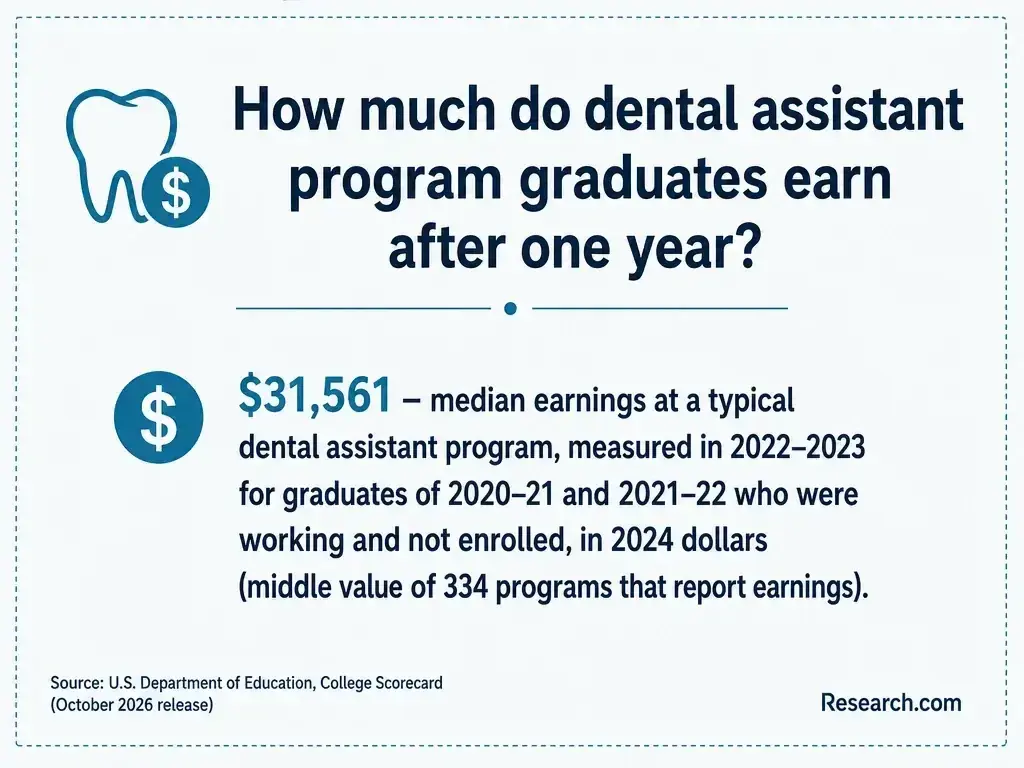
West Virginia pay depends on experience, duties, employer, and local hiring conditions. The U.S. Bureau of Labor Statistics reports a $48,070 national median annual wage in May 2025 for dental assistants. That figure describes the midpoint of employed assistants nationwide - not a promised salary for a new graduate or a West Virginia wage. For a local comparison, consult the latest West Virginia dental-assistant estimate in the BLS Occupational Employment and Wage Statistics series and compare job postings in the area where you can work.
When evaluating an offer, compare hourly pay alongside scheduled hours, benefits, commuting costs, and any employer-paid training. A higher advertised rate can have less value if hours are limited or the trip to the practice is expensive. Experience and added responsibilities may improve options, but neither a school credential nor a certification guarantees a raise.
Certificate or diploma training is generally the faster school-based route; an associate-degree program usually takes longer because it includes additional coursework. Employer training may let you begin earning sooner but can take time to build a comparable range of skills. Calendars vary by provider, attendance schedule, and externship availability, so do not rely on a generic program-length estimate.
Request the total clock or credit hours, lab hours, required clinical hours, weekly schedule, and next available externship date. West Virginia does not impose one universal school-program length for every dental assisting job; requirements for particular duties are a separate question for the West Virginia Board of Dentistry. A short course is worthwhile only if its practice and credential match the role you seek.
Online lessons can make terminology, records, and other classroom material easier to fit around work. They cannot replace supervised practice in instrument handling, infection control, chairside assisting, or patient interaction. A hybrid program can be practical if its required labs and externship are reachable; an entirely remote course should not be assumed to provide the hands-on preparation an employer expects.
Compare formats by where skills are assessed, not by the share of lectures delivered online. Ask who arranges the clinical site, whether you must find one yourself, what travel is required, and whether the program's training supports any West Virginia duty-specific requirements. A list of top colleges online can help you examine general online-study features, but it cannot verify a dental assisting program's local clinical access or regulatory fit.
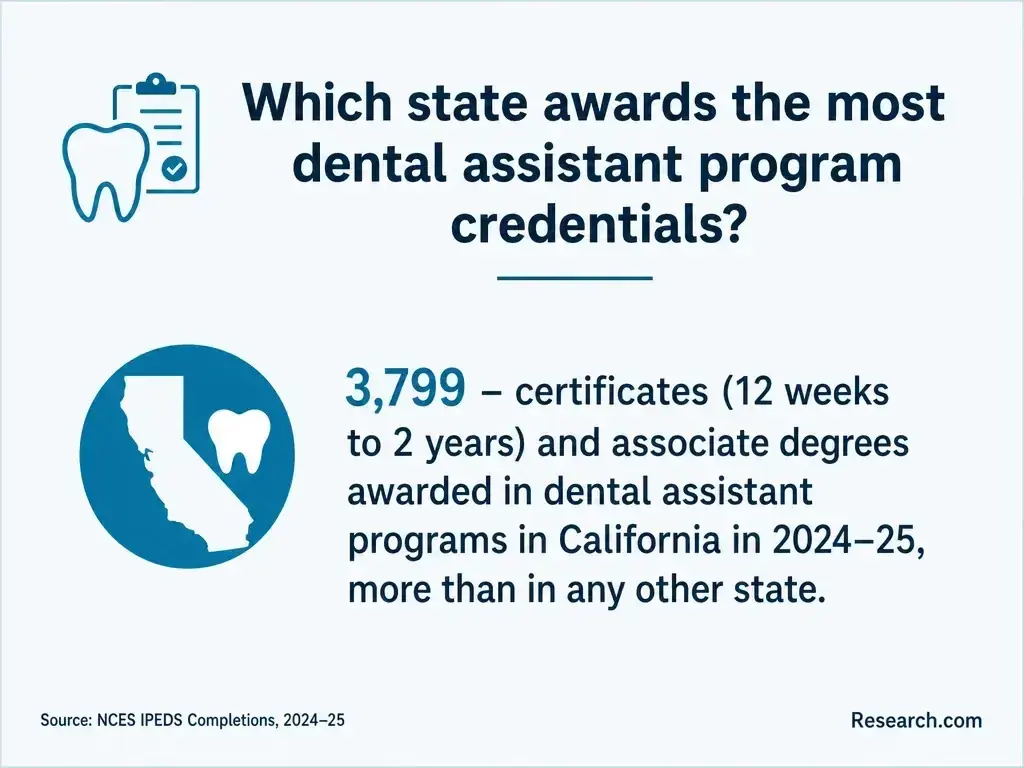
There is no single reliable statewide price to apply to every West Virginia dental assisting pathway: providers award different credentials, include different supplies, and schedule different amounts of in-person training. Request an itemized, current cost-of-attendance estimate from each school rather than treating advertised tuition as an average. Public-program resident pricing, private-school charges, and employer-sponsored training can produce substantially different personal costs.
Your comparison should include tuition, mandatory fees, books, scrubs and protective equipment, supplies, any examination charges, required screenings, and travel to labs or externships. Add wages you would forgo while attending, then subtract aid you are actually eligible to receive or pay earned during training. Federal Student Aid determines federal-aid eligibility rules; the West Virginia Higher Education Policy Commission administers state aid, including West Virginia Invests for eligible programs and applicants. Confirm that your specific program qualifies before counting either source of assistance.
Assess value over the period you expect to work, not just the first bill: weigh completion likelihood, debt and repayment, baseline earnings, plausible post-training pay, and time away from work. A cheapest online bachelor degree comparison addresses a different credential and is not evidence that a dental assisting program is affordable or job-ready.
The credential depends on the route: a school may award a certificate, diploma, or associate degree; an employer may instead document completed training. A school credential is not the same as professional certification or permission to perform a regulated duty. The Dental Assisting National Board (DANB) sets eligibility and examination rules for its certifications, while the West Virginia Board of Dentistry governs applicable state practice requirements.
The following comparison shows why credential names alone do not establish that two routes prepare you for the same job.
| Route | What you receive | Best fit | Check before committing |
| Certificate or diploma program | School-issued completion credential | Students seeking focused, structured entry training | Clinical practice, employer recognition, and certification alignment |
| Associate-degree program | Academic degree with occupational coursework | Students who want a broader college credential and can invest more time | Added cost, transferable coursework, and whether it changes job eligibility |
| Employer-sponsored training | Employer-documented skills; no school credential unless separately arranged | Applicants with an offer and access to supervision | Scope of training and eligibility for any intended advanced duties |
Ask whether previous coursework can transfer into a longer program and obtain the receiving school's answer in writing. An easiest associates degrees to get comparison cannot tell you whether a particular dental assisting credential includes the clinical training you need.
Requirements differ by provider. Schools may ask for proof of prior schooling, an application, and documents needed for clinical-site placement; a dental office hiring a trainee may instead evaluate availability, communication, and willingness to learn under supervision. Do not assume a school's admission decision also guarantees externship placement.
Request separate written requirements for admission, participation in labs, placement at an externship site, graduation, and eligibility for any certification the school advertises. Ask whether health documentation, background screening, or transportation is needed and who pays. If you already have relevant healthcare or office experience, ask whether the school awards prior-learning credit and whether that credit changes the hands-on requirements.
Core training commonly covers dental anatomy and terminology, infection prevention, instrument preparation, chairside support, patient communication, documentation, and office workflow. The U.S. Bureau of Labor Statistics describes assistants as performing both clinical and administrative tasks; a program's balance between them should match the work you want. For example, an applicant targeting chairside work should look beyond billing lessons for supervised procedure practice.
Digital records and dental imaging make technology competence relevant, but learning about imaging equipment does not by itself establish permission to use it. Check the West Virginia Board of Dentistry's current requirements for any imaging or expanded function you intend to perform. Ask the school to show how each claimed skill is taught, practiced, and assessed with real equipment or in a supervised setting.
Do not treat a general dental assisting job, a DANB certification, and authorization for particular duties as interchangeable. The West Virginia Board of Dentistry is the primary source for the current rules governing assistants' tasks and any qualifications required for radiography or expanded functions. Verify the duties attached to the jobs you want before selecting a course; completion alone does not establish eligibility for every task.
CODA accreditation concerns the dental assisting program. Institutional accreditation concerns the school. State authorization concerns whether an institution may operate or offer education under applicable rules. DANB certification involves that organization's eligibility and examination requirements. None automatically substitutes for the others or for a West Virginia Board of Dentistry requirement. Ask both the school and the board which training, supervised experience, and examinations apply to your intended duties, especially if you may later work in another state.
Start with the job you want and the area where you can realistically work, then compare programs against that goal. A ranking can narrow the field, but it cannot tell you whether an externship commute is manageable or a school's current curriculum meets your intended duty-specific needs.
Use these checks with each school and, where relevant, the West Virginia Board of Dentistry:
Watch for promises that a fully online course qualifies you for every dental office duty, vague clinical-hour descriptions, or pressure to enroll before receiving the full cost. Resources about unrelated credentials - including a cheap phd listing - are not substitutes for checking dental assisting practice requirements and local employer expectations.
An entry-level assistant may develop into a more experienced chairside assistant or take on specialty-office, patient-coordination, or office-management responsibilities. Additional duties may require training, supervision, certification, or compliance with West Virginia Board of Dentistry rules. Advancement is therefore better planned around a specific role than around collecting credentials without a job target.
If you want to compare optional credentials for their possible earning value, a guide to the highest paid certifications provides broader context. It does not establish that a dental assisting certification raises pay in West Virginia. Ask local practices which skills they reward, how they train assistants for added responsibilities, and whether they reimburse examination or continuing-training costs.
The U.S. Bureau of Labor Statistics projects 7.4% national growth from 2025 to 2035 for dental assistants. That national projection supports considering the occupation, but it is not a forecast for a particular West Virginia county or a guarantee of an opening after graduation. State labor-market projections and current local postings are more useful for judging how many reachable employers seek new assistants.
In a smaller local market, commuting flexibility and a school's relationships with nearby practices may matter as much as statewide demand. Before paying for training, review vacancies within your travel radius and note whether employers seek general chairside skills, particular experience, or qualifications for additional duties. That comparison helps distinguish a realistic first job from a longer-term career goal.
Investing in training is an important decision. To make the ranking useful and credible, the Research.com team compares dental assisting programs with others serving the same occupation and location, using reported outcomes, costs, recognition, and student-support information. Only programs with completions reported to the Integrated Postsecondary Education Data System (IPEDS) are included; an unlisted employer training route or school is not necessarily a poor option.
Best-program rankings assess completion and full-time and part-time retention; earnings one year after completion and earnings relative to annual attendance cost; tuition, attendance cost, debt - including debt held by students who withdrew - and federal loan default rates; and relevant accreditation, industry recognition, and support services. Relevant programmatic recognition receives 20% of the score, institutional accreditation 10%, and student support 10%. Outcomes, earnings, and costs share the remaining 60%, with entropy-based weighting that gives more weight to indicators that vary more across programs. Most-affordable-program rankings instead score only costs and debt using entropy-based weights; accreditation and other quality measures are not part of that score.
The team used the following sources to assemble and check ranking information. Their inclusion as sources does not mean every organization accredits dental assisting programs or that every listed provider appears in each database.
The ranking is a starting point, not a substitute for checking a program's current clinical arrangements, full price, and fit with West Virginia rules. Those checks can help readers turn a comparison of schools into a sound enrollment decision. More detail about the ranking approach appears on the Research.com methodology page.
# 1 position
# 2 position

# 3 position
# 4 position

# 5 position
# 6 position
# 7 position
# 8 position

It can be if the program provides supervised skills practice and a credential local employers value at a total cost you can manage. Compare it with a paid, supervised entry-level position before borrowing.
An employer-sponsored entry route may be possible, depending on the job and duties. Check the West Virginia Board of Dentistry's requirements before assuming on-the-job training qualifies you for radiography or other specialized work.
You may be able to study classroom subjects online, but chairside skills require in-person practice. Confirm where labs and any externship occur before enrolling.
No. A school-issued credential and a DANB certification are different. DANB sets its own eligibility and examination requirements.
Ask whether placement is guaranteed or student-arranged, where sites are located, which duties you will practice, and whether travel or screening creates extra costs.