# 1 position
Remington College-Nashville Campus - Dental Assisting/Assistant.
certificate or diploma

Audited and Verified:
Our Editorial and Data Verification Process
Research.com uses government datasets, official education statistics and primary institutional information to support its career and degree guides. Our review process checks factual accuracy, occupational definitions, source dates and the requirements associated with the credentials discussed.
How This Article Was Fact-Checked
Our editorial team verifies salary estimates, employment projections, education requirements and program information against original data providers and official organizations. Salary figures are checked against the relevant occupational definitions and reporting periods. Information about licensure, accreditation and required in-person training is reviewed separately.
Fact-checked and verified on:

Co-Founder and Chief Data Scientist

Reviewed by Karolina Broda
Fact-Checker and Data Verification
A low-priced dental assistant program is not a bargain if it leaves you without the hands-on skills or Tennessee eligibility your intended job requires. The U.S. Bureau of Labor Statistics projects 7.4% national growth in dental assistant employment from 2025 to 2035, making training choices worth examining. For prospective students and career changers, the Research.com team of data scientists created the Most Affordable Dental Assistant Trade Schools in Nashville for 2027 ranking to help identify programs worth considering. This guide explains how to compare their full costs, practical training, credentials, and career-entry requirements.
Expect instruction in chairside assistance, infection control, dental terminology, instrument handling, patient communication, and office workflow. Programs can differ substantially in how much time students spend practicing on equipment, observing procedures, and working with patients. A similarly named certificate does not establish equivalent clinical readiness.
A short career-school certificate may fit someone seeking a quick transition; a longer technical-college program may offer a broader schedule of labs and coursework. Employer-sponsored entry training can reduce upfront school costs, but its content and advancement opportunities depend on the employer. Dental assisting is generally learned through supervised practice rather than a standard registered-apprenticeship requirement; do not assume a posting labeled "apprenticeship" is a registered program or meets Tennessee rules.
If you are comparing Remington College-Nashville Campus with Tennessee College of Applied Technology Nashville, first confirm that each currently offers the specific dental assisting program you want, at the location and start date you need. Obtain the current catalog and ask for clinical-site arrangements, scheduled hours, and the credential awarded before treating either as an available option.
General dental practices are the primary setting; specialty practices and dental clinics may offer other roles. The U.S. Bureau of Labor Statistics identifies dentists' offices as the principal employer of dental assistants nationally. That makes chairside experience directly relevant when evaluating a Nashville program, while specialty offices may expect additional experience or training.
Ask a prospective training provider where recent students completed clinical work and whether those sites are reachable from your home or job. A placement that requires an impractical commute can make an otherwise affordable program difficult to finish. A certificate alone does not guarantee a position or permission to perform every task advertised in a job posting.
Do not use a national midpoint as a local entry-level offer. The U.S. Bureau of Labor Statistics reports a $48,070 national median annual wage for dental assistants in May 2025. Half of employed dental assistants nationally earned less and half earned more; the figure covers experienced workers as well as newer entrants. It does not establish what a Nashville employer will pay you.
For a local comparison, request current pay ranges from Nashville-area employers and consult Tennessee Department of Labor and Workforce Development occupational wage estimates for the Nashville metropolitan area. Compare postings that specify your intended duties: general chairside roles and positions requiring additional credentials may not pay alike. When estimating a program's return, use a plausible starting offer and your current earnings, not the national median as a guaranteed post-training salary.
Duration varies with the credential, weekly schedule, and required in-person practice. An accelerated certificate can mean a faster move toward employment, but also less room to work while enrolled. Part-time study may preserve income while extending the time before you can apply for roles requiring the training.
There is no single clock-hour figure that establishes the quality or Tennessee eligibility of every dental assisting program. Request the exact total clock or credit hours, lab hours, and supervised clinical hours for each option, plus its attendance and make-up policies. Ask whether clinic hours occur during business hours: that detail can determine whether a working student can actually complete the program.
Online coursework can cover terminology, anatomy, infection-control principles, and administrative topics. It cannot by itself demonstrate chairside instrument transfer, equipment use, or work with patients. A hybrid program is useful only if its required labs and supervised practice are accessible and fit your schedule.
This distinction matters when reviewing short certificate programs that pay well online: an online learning format is not evidence of dental assisting clinical competence or Tennessee regulatory eligibility. Ask exactly where hands-on work occurs, who supervises it, and whether the school arranges the site. If you must find your own site, include the possible delay and travel expense in your comparison.
There is no defensible single Nashville average to quote without comparable, current prices for the same type of program and a clear definition of included expenses. Request an itemized, current cost sheet from each provider instead of comparing tuition alone. The table separates costs that are easily overlooked; amounts depend on the program and your circumstances.
| Cost component | Why it changes the comparison |
| Tuition and mandatory fees | Check whether lab, enrollment, and clinical charges are included. |
| Books, supplies, uniforms, and protective equipment | Confirm what the school provides and what must be purchased separately. |
| Exams, applications, and screening | Ask whether relevant certification or Tennessee application costs, background checks, or health requirements are included. |
| Travel and forgone pay | Clinic-site commutes and time away from work can outweigh a small tuition difference. |
| Grants, aid, and employer support | Compare what you would actually pay or borrow after confirmed assistance. |
Federal aid depends on the school and program's eligibility and on the student's circumstances, according to Federal Student Aid; never assume a certificate qualifies. Ask about eligible aid, Tennessee workforce assistance, payment terms, and employer-paid training before borrowing. If you also browse lists of the cheapest college online, keep this occupational cost comparison separate: dental assisting requires practical training that an online tuition figure may omit.
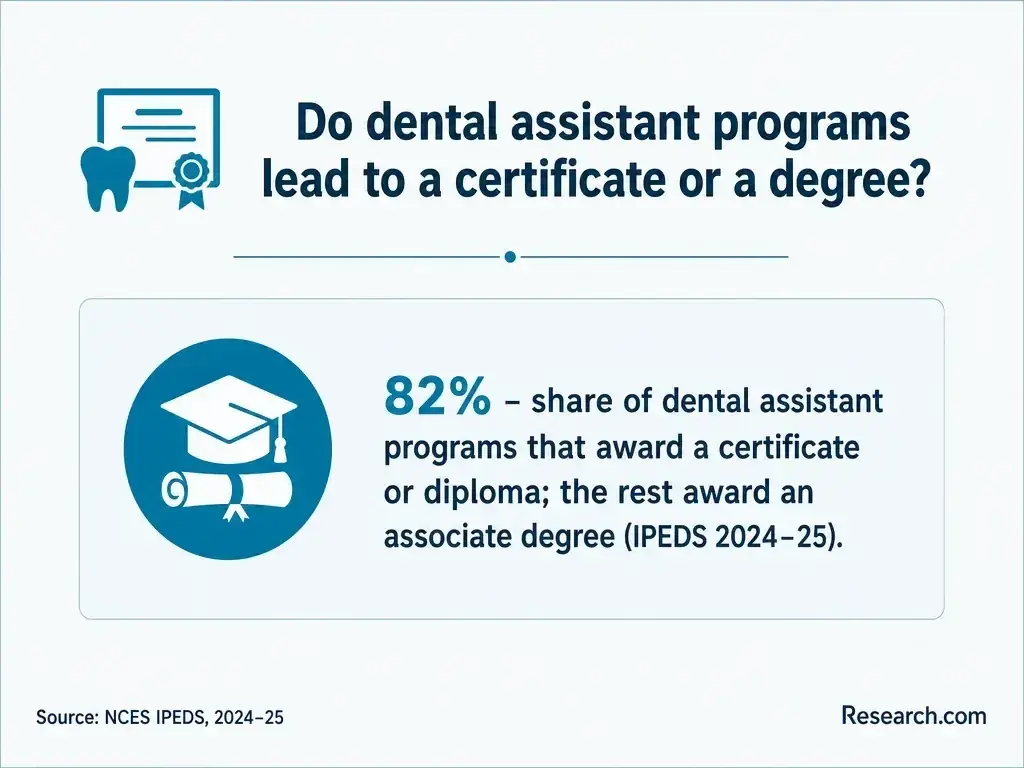
Depending on the provider, you may receive a certificate or diploma documenting completion of its curriculum. That school-issued credential is different from a professional certification issued by the Dental Assisting National Board (DANB), and neither should be confused with Tennessee registration or authorization for additional functions.
Before enrolling, get the credential's exact name in writing. Ask whether the program has Commission on Dental Accreditation (CODA) accreditation, if relevant to your certification plans, and check your intended DANB eligibility route directly with DANB. Institutional accreditation, CODA program accreditation, state school authorization, professional certification, and permission to perform regulated duties answer different questions; none should be inferred from a school's marketing language.
Schools set their own admissions criteria, which may include a secondary-school credential, an application, and health or background documentation before clinical placement. Employer-sponsored entry roles instead depend on an employer's hiring requirements. Neither route should be assumed open to every applicant or automatically sufficient for expanded duties.
Ask admissions staff to distinguish requirements for enrollment from requirements for clinical participation. A student able to start classes but unable to attend assigned clinic hours risks paying for training they cannot finish. If you already have relevant work experience, ask whether prior learning changes required coursework; get any credit or advanced standing confirmed in writing rather than assuming it will shorten the program.
A useful curriculum connects safety knowledge to repeatable practice: preparing treatment areas, processing instruments, assisting during procedures, documenting care, and communicating with patients and the dental team. The U.S. Bureau of Labor Statistics identifies infection control, patient care, and recordkeeping among dental assistant duties. Training in digital records and imaging workflows is useful, but performing particular radiography or expanded functions may require separate Tennessee authorization.
Judge the practical component by what you will actually do, not by the presence of a "hands-on" label. Request a lab schedule and a description of supervised clinical tasks. Simulation is valuable preparation, but it is not identical to treating patients in a working dental office.
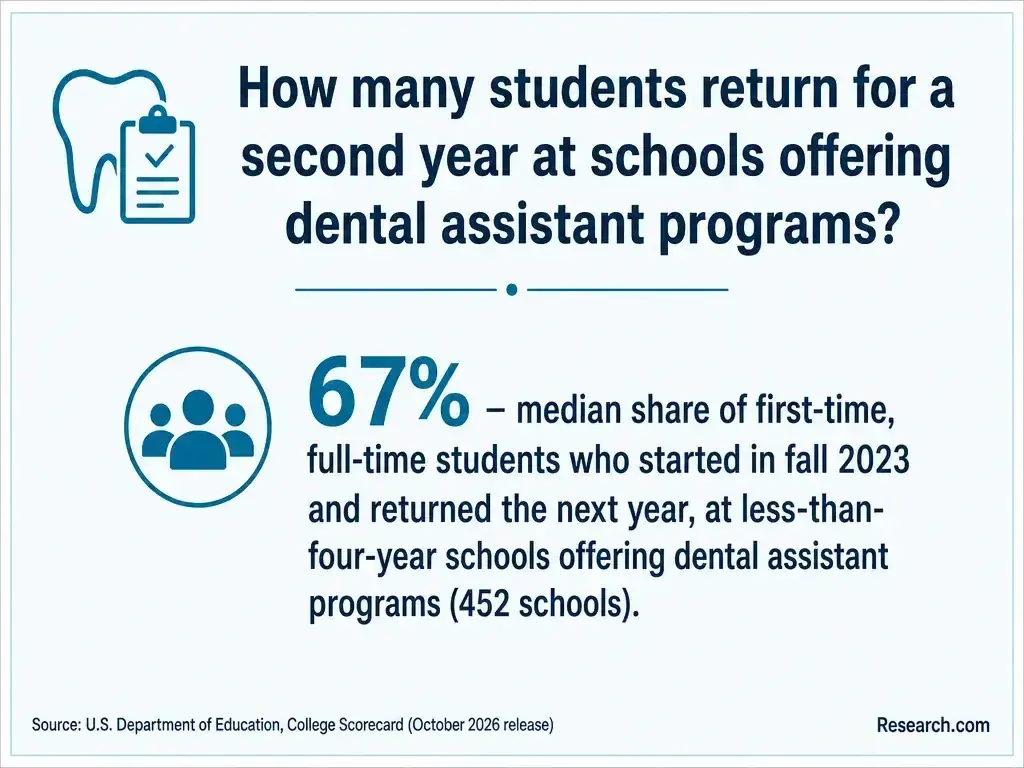
Tennessee requirements depend on the duties you intend to perform. The Tennessee Board of Dentistry regulates dental assistant registration and permissions for functions beyond basic assisting, including applicable radiography and expanded-function pathways. Do not assume that completing any dental assistant certificate grants a state credential or authorizes every chairside task.
Before committing to a program, identify the duties in the jobs you want, then check the Board's current requirements for those duties. Ask the school which requirements its curriculum satisfies and which courses, examinations, applications, or supervised experience remain. DANB certification is a separate professional credential with its own eligibility rules; verify those with DANB. A school's institutional accreditation or state authorization to operate does not replace either set of requirements.
Start with your intended job, then compare programs on the complete route to that job. The affordability ranking can narrow your shortlist, but its score does not evaluate hands-on quality, completion likelihood, earnings, or regulatory fit. A higher-priced program may be worth considering if its schedule and supervised training make completion more realistic; a lower-cost employer route may be better if it offers adequate instruction for your goals.
Use these checks before you sign an enrollment agreement:
Common mistakes are treating accreditation as a permit to perform expanded functions, overlooking clinic travel, or choosing on advertised tuition alone. To test whether training is worth the investment, consider completion probability, your current pay, a realistic starting offer, debt, time out of work, and how long you expect to use the credential. A comparison with broad guides to the best college majors for future jobs should not replace this occupation-specific calculation.
Basic chairside work can lead to positions with greater responsibility in patient coordination, practice administration, or permitted expanded functions. Which clinical tasks you can add depends on Tennessee Board of Dentistry requirements and employer needs, not simply time on the job. A specialty practice may also train an experienced assistant in its workflow.
Choose initial training for the role you want first, then ask what additional education, examination, or authorization advancement would require. It is easy to confuse occupational progression with unrelated offerings such as colleges with double major programs; the relevant question here is whether a dental assisting credential and subsequent training qualify you for the next duties you want to perform.
The U.S. Bureau of Labor Statistics projects 7.4% national employment growth for dental assistants from 2025 to 2035. That indicates growth in the occupation nationally, not a guaranteed Nashville vacancy or a forecast for a particular graduate. Local hiring depends on practices' staffing needs, turnover, and the duties applicants are qualified to perform.
Before paying for training, review current Nashville-area openings for their stated experience and Tennessee credential requirements. That check helps distinguish accessible entry roles from postings seeking expanded functions. It also shows whether a program's clinical experience and schedule align with the jobs available when you expect to finish. Broader search results for a quickest masters program do not answer that dental-assisting job-market question.
Investing in training is a consequential decision. Research.com created this ranking to help readers compare dental assistant programs against relevant local alternatives, rather than treating a low advertised tuition as the whole story. The team evaluates available data for consistency and credibility; the ranking includes only programs with completions reported to the Integrated Postsecondary Education Data System (IPEDS). Consequently, an employer training route or a school absent from IPEDS may still be worth considering.
For the most affordable ranking, scores use tuition, cost of attendance, median student debt, and federal loan default rate. Indicator weights are assigned through an entropy-based method, which gives more weight to measures that differ more across included programs. Accreditation, student support, completion, and earnings are not part of this affordability score. Readers should assess those factors separately before enrolling. Research.com's broader best-program rankings use a different model and should not be mistaken for this one.
The following sources inform Research.com's ranking data and verification work. Some are cross-occupation resources; their inclusion does not imply that a construction credential or a general allied-health accreditation applies to dental assisting.
Use the ranking to narrow a cost-focused shortlist, then confirm the current price, clinical experience, program status, and Tennessee requirements directly. More detail on the approach is available in Research.com's methodology.
# 1 position
# 2 position

Compare current, itemized program prices with employer-sponsored training, if available. Include required supplies, clinical travel, lost wages, and likely borrowing; advertised tuition alone cannot identify your cheapest job-ready route.
Online coursework can teach theory, but chairside competence requires in-person practice. Confirm where labs and supervised clinical training occur and whether the resulting pathway fits Tennessee rules for your intended duties.
No. CODA accredits dental education programs; the Tennessee Board of Dentistry determines requirements for regulated duties. Check each separately, along with the school's institutional status.
No. A school certificate records program completion. DANB certification has separate eligibility and examination requirements, which applicants should verify with DANB.
Compare supervised practice, total cost, work you must forgo, schedule feasibility, and the credential's fit with your target job. Finishing quickly helps only if the training prepares you for the duties you seek.